
Cyber State of the Union
Assessment Overview
The overall U.S. cyber threat level is Elevated and trending upward, and we assess with HIGH confidence that the next 14 days carry above-baseline risk of edge-device compromise leading to ransomware and of nation-state pre-positioning against critical infrastructure. Three characteristics define this cycle: a sustained wave of pre-disclosure exploitation of internet-facing VPN, RMM, and management appliances (SonicWall SMA1000, N-able N-central, Cisco ASA/FTD, VMware vCenter); a fragmented but record-volume ransomware market in which The Gentlemen and Qilin now lead a field of 66 active groups; and Iranian IRGC-affiliated actors demonstrating validated destructive manipulation of U.S. water and energy control logic. What makes this cycle different from the last is the convergence of confirmed physical-consequence OT attacks with a maturing English-speaking extortion cartel building its own ransomware-as-a-service platform — the espionage, extortion, and sabotage lanes are no longer separable. China’s Volt Typhoon and Salt Typhoon remain the apex strategic threat through persistent pre-positioning; North Korea’s revenue operations and IT-worker infiltration continue at scale.
Key Findings
1. Iranian IRGC-affiliated actors have moved from pre-positioning to confirmed manipulation of safety-critical control logic at U.S. water and energy facilities. CISA/FBI/NSA advisory AA26-097A (updated July 22, 2026) documents an Iranian-affiliated APT downloading malicious project files to PLCs, overriding instruction sets that maintain safe operating parameters. The escalation is assessed as likely tied to U.S.-Iran-Israel hostilities and Operation Epic Fury (February 28, 2026). We assess with HIGH confidence this activity will persist through the forecast window.
2. Edge-appliance zero-days are the dominant U.S. initial-access vector this cycle. SonicWall SMA1000 flaws CVE-2026-15409 (CVSS 10.0) and CVE-2026-15410 (CVSS 7.2) were exploited from June 22, 2026 by UTA0533 before disclosure; INC Ransomware is the dominant follow-on exploiter with 885 lifetime victims. Cisco ASA/FTD CVE-2026-20349 (CVSS 8.6) and N-able N-central CVE-2026-18556/18577 are under active exploitation, the latter enabling MSP-to-downstream compromise.
3. The ransomware market set a 2026 volume record with a fragmented leaderboard. 811 victims were recorded across 66 distinct groups in July 2026 — up 15% from June and the highest month of 2026 — with The Gentlemen and Qilin tied at the top with 119 victims each. The U.S. share rebounded to 41% (330 of 811); healthcare was the most-targeted industry at 71 victims.
4. CISA’s KEV catalog reached 1,665 entries, up from 1,484 at the close of 2025, with 24 additions in the trailing 30 days. On August 18, 2026 CISA added four exploited CVEs including VMware vCenter CVE-2026-59310 (CVSS 9.8), Microsoft SharePoint CVE-2026-55040 (CVSS 9.1), and Windows IKE CVE-2026-33824 (CVSS 9.8). Federal remediation windows have compressed to three days under BOD 26-04.
5. North Korea remains the pre-eminent financially-motivated nation-state threat. Approximately $643 million — about 66% of all cryptocurrency stolen in H1 2026 — is attributed to DPRK-linked activity, with roughly $577M from two April DeFi attacks (Drift $285M, KelpDAO $292M). A multinational IT-worker advisory was issued July 31, 2026; eight facilitators have been sentenced in 2026.
6. An English-speaking extortion cartel is professionalizing. Scattered LAPSUS$ Hunters (Scattered Spider/UNC3944, ShinyHunters/UNC6040-UNC6240, LAPSUS$) is building the shinysp1d3r RaaS and running insider recruitment offering 25% commission for Active Directory-joined access and 10% for cloud identity platforms (Okta, Azure, AWS IAM), targeting organizations above $500M revenue.
7. China’s pre-positioning campaigns remain the highest-consequence strategic risk. Volt Typhoon persists inside U.S. energy, water, and communications infrastructure; Salt Typhoon’s telecom espionage has affected 200+ organizations across 80 countries. We assess with HIGH confidence these accesses are being maintained for coercive leverage rather than immediate disruption.
Threat Landscape by the Numbers
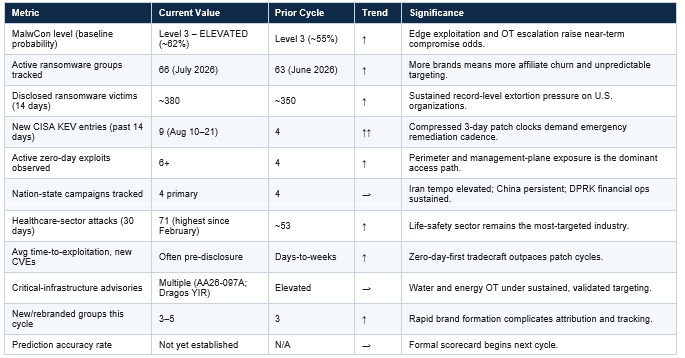
Nation-State Threat Posture
China. We assess with HIGH confidence that PRC state-sponsored actors represent the highest-consequence strategic cyber threat to U.S. critical infrastructure. Volt Typhoon (Bronze Silhouette, Vanguard Panda) maintains persistent, living-off-the-land access across energy, water, communications, and transportation, having demonstrated the ability to interfere with water-facility control systems — a capability the intelligence community assesses is being preserved for disruption during a Taiwan-related crisis rather than for immediate effect. Salt Typhoon (MSS-linked) has compromised 200+ organizations across 80 countries, penetrating U.S. telecoms including Verizon, AT&T, and Charter to access call records and geolocation data. Objectives span espionage, intellectual property theft, and pre-positioning; capability trajectory is toward deeper edge-device and network-appliance persistence.
Russia. We assess with MEDIUM-to-HIGH confidence that Russia-nexus activity is dominated by its symbiosis with the criminal ransomware ecosystem — Russian-speaking RaaS operations (Qilin/Agenda, Akira, The Gentlemen) supply the bulk of U.S. extortion pressure while the state benefits from deniable disruption. Ukraine-driven operational tempo continues to shape Russian military-intelligence targeting. KAMACITE is mapping U.S. control loops and passing access to ELECTRUM, and critical-infrastructure pre-positioning intent remains assessed as present. No single high-confidence, large-scale Russian state intrusion of U.S. federal networks was newly confirmed in this reporting window.
Iran. We assess with HIGH confidence that Iran maintains an elevated, retaliatory posture. CyberAv3ngers (BAUXITE, Hydro Kitten, Storm-0784, tracked as CL-STA-1128) escalated within 72 hours of Operation Epic Fury, and advisory AA26-097A (July 22, 2026) documents Iranian-affiliated actors exploiting Rockwell Automation PLCs — leveraging CVE-2021-22681 — and overriding safety instruction sets at U.S. water and energy sites. This is validated destructive manipulation, not merely reconnaissance. The group operates a parallel influence and propaganda apparatus and has proven resilient to persona takedowns, rebranding to “Cyber4vengers” in January 2026. Post-conflict doctrine treats critical-infrastructure cyberattacks as sub-kinetic retaliation.
North Korea. We assess with HIGH confidence that DPRK operations remain focused on regime revenue and infiltration. North Korea accounted for roughly $643 million — about 66% — of all cryptocurrency stolen in H1 2026, with approximately $577M from two April DeFi thefts (Drift $285M; KelpDAO $292M, attributed to the Lazarus subcluster TraderTraitor). Lazarus has been reported to exploit Windows AFD.sys zero-day CVE-2026-68820 in Operation Dream Job to deploy a kernel rootkit. The IT-worker program — the subject of a multinational advisory issued July 31, 2026 — continues to generate insider-threat exposure and AI-augmented identity fraud; eight facilitators have been sentenced in 2026.
Strategic Risk Summary
The single most dangerous convergence in the next 14 days is the collision of mass edge-appliance exploitation (SonicWall, Cisco, N-able, vCenter) with an aggressive, fragmented ransomware market and validated Iranian OT sabotage capability. A compromised VPN or RMM console can equally seed a hospital ransomware event or an ICS-adjacent intrusion. A CISO should first inventory and emergency-patch all internet-facing remote-access and management appliances, assume compromise on any unpatched SonicWall SMA1000 or N-able N-central instance, and validate immutable, credential-segregated backups.
Changes Since Last Report
Threat Level Changes: Iran/CyberAv3ngers ↑ (confirmed safety-logic manipulation at U.S. critical infrastructure). SonicWall SMA1000 CVE-2026-15409 ↑ (INC Ransomware weaponization). N-able N-central CVE-2026-18556/18577 ↑ (new active MSP exploitation). Qilin ↑ (rebound to 119 July victims). INC Ransomware ↑ (dominant SMA1000 exploiter).
New Entries: Cisco ASA/FTD CVE-2026-20349; VMware vCenter CVE-2026-59310; SharePoint CVE-2026-55040; Windows IKE CVE-2026-33824; Windows AFD.sys CVE-2026-68820; shinysp1d3r RaaS (emerging).
Removed Entries: StealC deprioritized following infrastructure seizure on June 24, 2026 in Operation Endgame; activity is down more than 90% from the January peak. BlackCat/ALPHV excluded per mandatory exclusion criteria, with rebrand detection applied.
MalwCon Level Change: Unchanged at Level 3 (ELEVATED), with an upward baseline shift driven by edge-device exploitation velocity and OT escalation.
Key Developments: The most significant shift is the transition of Iranian OT activity from pre-positioning to confirmed manipulation of physical-safety control logic, coupled with a zero-day-first exploitation pattern against U.S. perimeter appliances that is outpacing federal three-day patch windows.
Prediction Scorecard
Prediction tracking begins next cycle. Prior-cycle predictions cannot be reconstructed from available reporting without fabrication; formal scorecard entries commence with the next issuance.
Flash Alerts
FLASH ALERT 1: Iranian Manipulation of Safety-Critical PLC Logic at U.S. Water and Energy Sites
Severity: Critical
Issued: August 24, 2026, 08:00 AM ET
Trigger Condition Met: FLASH-1 (active exploitation against internet-facing U.S. critical-infrastructure products) and FLASH-7 (geopolitical escalation with cyber nexus)
Summary: Advisory AA26-097A (updated July 22, 2026) confirms Iranian-affiliated APT actors downloaded malicious project files to U.S. PLCs, adding logic that overrode safe-operating-parameter instruction sets. Activity is assessed as tied to U.S.-Iran-Israel hostilities and is ongoing.
Immediate Actions Required:
▪ Remove OT/ICS devices (PLCs, HMIs) from direct internet exposure; place behind VPN with phishing-resistant MFA.
▪ Apply Rockwell Automation fixes addressing CVE-2021-22681 and audit ladder-logic and project-file integrity.
▪ Change all default and shared PLC/HMI credentials; enforce unique strong credentials.
▪ Deploy ICS-aware monitoring for unauthorized project-file downloads and logic changes.
▪ Review AA26-097A indicators (July 22, 2026 set) and hunt retroactively across OT networks.
Status: Active
FLASH ALERT 2: SonicWall SMA1000 Exploit Chain Weaponized by INC Ransomware
Severity: Critical
Issued: August 24, 2026, 08:00 AM ET
Trigger Condition Met: FLASH-2 (KEV updated with mass-exploitation evidence)
Summary: CVE-2026-15409 (CVSS 10.0) and CVE-2026-15410 (CVSS 7.2) were exploited as zero-days from June 22, 2026 by UTA0533; INC Ransomware, with 885 lifetime leak-site claims, is the dominant follow-on operator, listing U.S., Australian, UAE, and other victims. Both CVEs are in the KEV catalog.
Immediate Actions Required:
▪ Apply the SonicWall SMA1000 July 14, 2026 hotfix immediately; treat any unpatched appliance as compromised.
▪ Rotate all credentials, TOTP/TBOTP seeds, and active sessions handled by the appliance.
▪ Hunt for unexpected outbound and internal WebSocket connections via /wsproxy and localhost-service tunneling.
▪ Conduct forensic triage per BOD 26-04 before returning appliances to service.
▪ Anticipate social-engineering follow-up; operators have phoned victims posing as ransomware recovery assistance.
Status: Active
FLASH ALERT 3: N-able N-central Auth-Bypass Exploitation Enables MSP-to-Downstream Compromise
Severity: High
Issued: August 24, 2026, 08:00 AM ET
Trigger Condition Met: FLASH-2 (KEV addition with active-exploitation evidence)
Summary: CVE-2026-18556 (CVSS 7.4) and incomplete-patch successor CVE-2026-18577 (CVSS 8.1) permit unauthenticated administrative takeover of N-central RMM servers. Exploitation began July 31, 2026; attackers abused Take Control to reach domain controllers and backup servers, then deployed Cloudflare Tunnel for persistence. Both are in the KEV catalog.
Immediate Actions Required:
▪ Upgrade to N-central 2026.3 Hotfix 2 (build 2026.3.1.10 or later) urgently.
▪ Restrict management-interface access to trusted IP ranges; remove internet exposure.
▪ Hunt for unauthorized cloudflared installations and unexpected Take Control sessions.
▪ Review authentication logs for unauthenticated administrative access since July 31, 2026.
▪ MSPs: notify downstream customers and validate managed-endpoint integrity.
Status: Active
Executive Summary
Current Threat Environment
The current threat era is defined by the industrialization and fragmentation of the extortion economy running in parallel with maturing nation-state disruption capability. Ransomware has become a franchise market — 66 active groups in July 2026, with the top five commanding a shrinking share as new brands such as The Gentlemen scale on 90% affiliate payouts. Technology weaponization has shifted decisively toward pre-disclosure exploitation of edge and management-plane appliances, and AI is a documented force multiplier for phishing, deepfake fraud, and malware iteration. The OT/ICS boundary is dissolving: Iranian and Chinese actors treat civilian lifeline services as coercive pressure points, and AI models have been confirmed autonomously targeting SCADA at a water utility.
In the last 30 days, INC Ransomware weaponized SonicWall SMA1000 zero-days while Qilin and The Gentlemen tied atop the leaderboard at 119 July victims each. Iran’s CyberAv3ngers manipulated PLC safety logic at U.S. water and energy sites. North Korea’s Lazarus exploited Windows AFD.sys CVE-2026-68820. Scattered LAPSUS$ Hunters advanced its shinysp1d3r RaaS and insider-recruitment program targeting Okta, Azure, and AWS identity. Infostealers — LummaC2, Vidar, ACRStealer, AsyncRAT — remain the leading credential-harvesting fuel for the initial-access-broker market, where premium enterprise access now commands six-figure sums even as commodity logs sell for $5 to $50.
MalwCon Level Assessment
Current MalwCon Level: Level 3 (ELEVATED)
Trajectory upward within the level, approaching the Level 3/4 boundary during the peak-risk window.
Key drivers:
▪ Six or more actively exploited zero-days against internet-facing U.S. appliances (SonicWall, Cisco ASA/FTD, N-able, vCenter, SharePoint, AFD.sys).
▪ Confirmed Iranian manipulation of U.S. OT safety logic per AA26-097A, elevated by geopolitical escalation.
▪ Record ransomware volume — 811 July victims, U.S. share 41% — with healthcare the top-targeted sector at 71 victims.
▪ Compressed federal patch windows (3-day KEV deadlines) outpaced by exploitation velocity.
▪ Maturing English-speaking extortion cartel with insider-recruitment programs and a new RaaS in development.
Forecast volatility is MEDIUM-to-HIGH; a single mass-exploitation event or geopolitical trigger could push MalwCon to Level 4 within days.
Top 3 Defensive Actions
Execute these three actions within the next 48 hours:
▪ Emergency-patch and forensically triage all internet-facing remote-access and management appliances (SonicWall SMA1000, N-able N-central, Cisco ASA/FTD, VMware vCenter); assume compromise on unpatched instances.
▪ Remove OT/ICS devices from direct internet exposure, reset default credentials, and hunt for unauthorized PLC project-file changes per AA26-097A.
▪ Enforce phishing-resistant (FIDO2) MFA on all privileged, identity-provider, and help-desk accounts, and verify immutable, credential-segregated backups.
These actions directly counter the two highest-probability paths to material impact this cycle — edge-appliance ransomware and Iranian OT sabotage — and cannot wait for the next scheduled patch cycle.
Most Significant Near-Term Risk
The single most significant near-term risk is a compound intrusion in which an unpatched internet-facing appliance — SonicWall SMA1000, N-able N-central, or Cisco ASA/FTD — provides initial access that is either monetized by a ransomware affiliate (INC, Qilin, Akira, The Gentlemen) against a U.S. hospital or utility, or leveraged by an IT/OT-crossing actor to reach industrial control systems. The vulnerability chain (CVE-2026-15409 to root to credential theft to lateral movement, or CVE-2026-18577 to RMM administrative control to downstream endpoints) is fully present, actively exploited, and pairs a life-safety sector with proven destructive intent, creating potential for care diversion, service outage, or physical-process disruption.
National Outlook (14 Days)
Current MalwCon Level: Level 3 (ELEVATED)
The U.S. threat posture is characterized by high-velocity exploitation of perimeter and management-plane appliances feeding a record-volume, fragmented extortion market, overlaid with validated nation-state OT manipulation. Attackers are operating faster than defenders can patch, and the compression of the initial-access-to-impact timeline — driven by broker pipelines and infostealer logs — means a single exposed device can convert to ransomware or ICS intrusion within days.
Defender readiness varies sharply by sector: Financial Services 0.74; Government (Federal) 0.68; Energy and Utilities 0.55; Manufacturing and Industrial 0.52; Healthcare 0.48; Water and Wastewater 0.41. Healthcare and water remain the weakest links, combining life-safety consequence with limited monitoring maturity and legacy exposure.
Confidence: HIGH — based on convergent government advisory reporting, high-fidelity vendor intelligence, and leak-site and vulnerability-catalog telemetry.
Analysis: The trend is a gradual escalation of Level 4 probability across the window, peaking September 02–04, 2026 as unpatched appliance exposure compounds and end-of-month, holiday-adjacent staffing thins security operations coverage ahead of U.S. Labor Day. Key drivers are edge-appliance exploitation velocity and Iranian OT tempo. Recommended peak-readiness dates are September 01–04, 2026; maintain elevated staffing through the Labor Day weekend, when ransomware deployment historically concentrates.
Top Risk Drivers
Driver 1: Edge and Management-Appliance Zero-Day Exploitation (+0.34 risk contribution)
Active pre-disclosure and post-disclosure exploitation of SonicWall SMA1000 (CVE-2026-15409, CVE-2026-15410), Cisco ASA/FTD (CVE-2026-20349), N-able N-central (CVE-2026-18556, CVE-2026-18577), and VMware vCenter (CVE-2026-59310) provides unauthenticated network entry that INC, Qilin, Akira, and Play convert to ransomware. Tradecraft spans exploitation of public-facing applications and external remote services (T1190, T1133) advancing to valid-account abuse (T1078). This maps to Kill Chain: Phase 1 – Reconnaissance through Phase 3 – Delivery, with rapid progression to Phase 7 – Actions on Objectives.
Driver 2: Iranian OT/ICS Sabotage Escalation (+0.29 risk contribution)
CyberAv3ngers (BAUXITE) has demonstrated project-file manipulation overriding PLC safety logic, leveraging exposed Rockwell and Unitronics devices and default credentials, and employing the IOCONTROL ICS platform with DNS-over-HTTPS and MQTT command and control. Techniques include exploitation of internet-exposed OT (T1190), modification of control logic (T0833, T0836), and default-credential abuse (T1078.001). This spans Kill Chain: Phase 3 – Delivery through Phase 7 – Actions on Objectives with confirmed physical-consequence intent.
Driver 3: Ransomware Affiliate Velocity and Identity-First Intrusion (+0.24 risk contribution)
Record leak-site volume — 811 July victims, 41% U.S. — with The Gentlemen (90% affiliate payout) and Qilin leading, plus Scattered LAPSUS$ Hunters recruiting insiders for Okta, Azure, and AWS access. Techniques include phishing and vishing (T1566, T1598), MFA-fatigue and help-desk social engineering (T1621), data encryption for impact (T1486), and exfiltration to cloud storage for extortion (T1567). This spans Kill Chain: Phase 2 – Weaponization through Phase 7 – Actions on Objectives, with credential-driven access compressing dwell time.
Sectors of Concern
Sector Risk Matrix
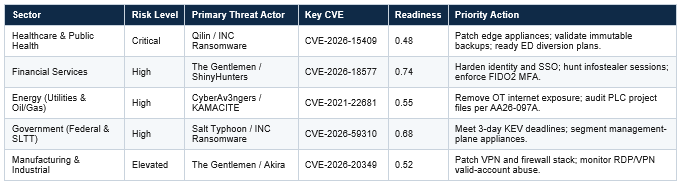
Healthcare & Public Health (Critical Risk)
Healthcare is the most-targeted sector — 71 victims in July 2026 — and combines life-safety consequence with the weakest sector readiness. Qilin (README_QILIN.txt ransom notes, affiliate share up to 85%) and INC Ransomware dominate, with initial access via unpatched SonicWall, Cisco, and Ivanti appliances (CVE-2026-15409) and infostealer-harvested VPN credentials. Tradecraft includes exploitation of public-facing applications (T1190), backup and shadow-copy deletion (T1490), and data encryption for impact (T1486), preceded by PHI exfiltration for double extortion (T1567). Medicare claims research indicates in-hospital mortality rises 34 to 38 percent during ransomware events, making backup immutability and emergency-department diversion planning patient-safety controls rather than IT controls. Identity and cloud risk is elevated via single sign-on and patient-portal exposure, and espionage motive — intellectual property and patient-cohort theft — is a growing secondary threat. No confirmed OT/ICS targeting of medical devices was documented in this reporting window beyond general vulnerable-device exposure.
Financial Services (High Risk)
Financial services faces identity-first intrusion from The Gentlemen, ShinyHunters and the broader Scattered LAPSUS$ Hunters cartel, and DPRK actors. Primary vectors are help-desk vishing, OAuth and connected-application abuse, and infostealer session-cookie replay that bypasses multi-factor authentication. Techniques include phishing (T1566), MFA-request generation and social engineering (T1621), cloud and SaaS token theft (T1528), and valid-account abuse (T1078.004). N-able N-central exploitation (CVE-2026-18577) threatens firms dependent on managed service providers. The insider-threat climate is elevated given cartel recruitment for privileged Active Directory and cloud access and DPRK IT-worker infiltration.
Energy (Utilities & Oil/Gas) (High Risk)
Energy faces the cycle’s most acute OT threat. CyberAv3ngers (BAUXITE) has manipulated PLC safety logic leveraging CVE-2021-22681 and exposed Rockwell and Unitronics devices; KAMACITE conducts sustained reconnaissance of internet-exposed HMIs, variable-frequency drives, meters, and cellular gateways to map control loops for ELECTRUM; and Volt Typhoon maintains living-off-the-land persistence. Techniques include internet-exposed OT exploitation (T1190), control-logic modification (T0833, T0836), and spearphishing of operators and integrators (T1566). IT/OT boundary crossing is the defining risk; asset inventory and ICS-aware monitoring are the priority gaps.
Government (Federal & State/Local) (High Risk)
Government faces Salt Typhoon espionage against telecommunications and network infrastructure alongside opportunistic ransomware (INC, Qilin) and edge-device exploitation (vCenter CVE-2026-59310, SharePoint CVE-2026-55040). Techniques include exploitation of network appliances (T1190), living-off-the-land execution (T1059), and credential dumping (T1003). State, local, tribal, and territorial entities lag on three-day KEV remediation; management-plane segmentation and identity hardening are the priorities. No confirmed OT/ICS targeting was documented for government networks in this reporting window.
Forecast Volatility & Key Assumptions
Forecast Volatility: Medium
Uncertainty is driven by the possibility of a new mass-exploitation event against a widely deployed appliance, a geopolitical shock — further U.S.-Iran escalation — triggering Iranian retaliation, or an operational debut of the shinysp1d3r encryptor. Concept drift is observed in the vulnerability-category signal, which has shifted toward management-plane, RMM, and identity-provider targeting, and in the ransomware-brand-count signal, where fragmentation is accelerating. A single emergency directive or a confirmed mass ransomware event against multiple hospitals would swing the forecast toward Level 4.
Key Assumptions
▪ No major law-enforcement takedown materially disrupts the top ransomware operators within the window.
▪ U.S.-Iran tensions remain elevated but below new large-scale kinetic escalation.
▪ No new wormable, unauthenticated remote code execution against a ubiquitous product emerges mid-cycle.
PART I — Strategic Threat Actor Forecast (U.S. Focus)
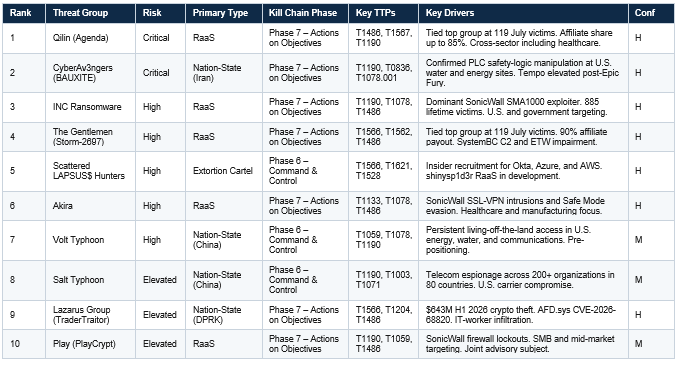
These threat groups represent the highest-probability actors likely to impact U.S. organizations over the next 14 days, based on assessed probability from multi-factor weighted analysis of activity patterns, capability indicators, targeting analysis, and Diamond Model victimology profiling.
Top-10 Threat Groups
Deep Dive Analysis (Top 3 Actors)
1. Qilin (RaaS / Russian-speaking Criminal)
Operational Tempo: Qilin rebounded from 71 victims in June to 119 in July 2026, tying for the top leaderboard position and leading the year cumulatively with 736 victims across seven months. New leak-site infrastructure and a Rust-based encryptor lineage sustain high posting velocity. Kill Chain distribution is heavily weighted toward Phase 7 – Actions on Objectives, with data publication typically within 48 hours of non-payment.
Victimology & Targeting: Qilin targets healthcare, manufacturing, education, and municipal government cross-sector. U.S. organizations feature prominently within the July cohort, consistent with the 41% U.S. share of overall market volume. The victim profile spans mid-market to large enterprise, with a documented willingness to strike hospitals and life-safety providers.
Capabilities & Evasion: Qilin operates Windows, Linux, and ESXi encryptors, offers affiliates up to 85% revenue share, and employs an evolving loader and encryption toolkit designed to hinder remediation. It has shifted toward data-only extortion in some operations. Initial access spans brute-force attempts, compromised RDP and VPN credentials, managed service provider breaches, and direct vulnerability exploitation.
Campaign Context: Active Kill Chain phases run through Phase 7 – Actions on Objectives, and phase advancement is rapid once VPN or RDP access is obtained. Estimated time-to-impact is measured in days. As a Russian-speaking operation, Qilin benefits from permissive-jurisdiction dynamics; geopolitical drivers are secondary to profit motive. Escalation posture is aggressive and sustained.
Environment Exposure: Qilin abuses valid credentials and VPN access, exploits managed service provider relationships for supply-chain reach, and targets ESXi virtualization layers. No confirmed OT/ICS targeting documented for this actor in current reporting period.
2. CyberAv3ngers (Nation-State APT / Iran, IRGC-CEC)
Operational Tempo: CyberAv3ngers (BAUXITE, CL-STA-1128) doubled operational tempo within 72 hours of Operation Epic Fury on February 28, 2026, and sustains elevated activity per the July 22, 2026 advisory update. New personas — “Cyber4vengers” in January 2026 — demonstrate resilience to takedowns, and the group runs a parallel influence apparatus that recycles prior leaks to simulate fresh compromise.
Victimology & Targeting: Targeting concentrates on U.S. water and wastewater, energy, and government facilities with internet-exposed PLCs and HMIs. The group’s prior campaign compromised more than 75 Unitronics devices, and current related activity is assessed as intended to cause disruptive effects within the United States.
Capabilities & Evasion: The group escalated from default-credential abuse to the IOCONTROL ICS malware platform — AES-256-CBC configuration encryption, modified UPX packing, DNS-over-HTTPS and MQTT over port 8883 command and control, with a Telegram fallback channel — and then to exploiting Rockwell controllers via CVE-2021-22681 and downloading malicious project files that override safety instruction sets. Evasion blends malicious ICS traffic with legitimate industrial protocol flows.
Campaign Context: Active Kill Chain phases run through Phase 7 – Actions on Objectives with validated physical-consequence manipulation. Iranian state doctrine treats critical-infrastructure cyberattacks as sub-kinetic retaliation, and escalation posture is directly coupled to U.S.-Iran-Israel hostilities. Estimated time-to-impact is immediate for environments where access already exists.
Environment Exposure: The actor crosses the IT/OT boundary directly, exploiting internet-exposed operational technology and default credentials at Purdue Levels 1 and 2. This actor has confirmed OT/ICS targeting.
3. INC Ransomware (RaaS / Criminal)
Operational Tempo: INC Ransomware accelerated sharply from early August 2026, listing multiple new victims and reaching 885 lifetime leak-site claims. It is the dominant follow-on exploiter of the SonicWall SMA1000 chain first weaponized by UTA0533, indicating strong operational momentum through the forecast window.
Victimology & Targeting: New victims listed between July 17 and August 1, 2026 include U.S., Australian, UAE, Colombian, and Swiss private-sector and government organizations. INC affiliates target manufacturing, healthcare, financial services, law firms, and government cross-sector.
Capabilities & Evasion: INC exploits CVE-2026-15409 and CVE-2026-15410 to extract credentials, active session databases, and TOTP seeds, then pivots into internal networks via backdoors deployed on the compromised appliance itself. The group has demonstrated a follow-up social-engineering layer, telephoning victims while posing as ransomware-recovery assistance.
Campaign Context: Active Kill Chain phases run through Phase 7 – Actions on Objectives, and advancement from edge-appliance foothold to encryption is rapid. As a profit-driven ransomware-as-a-service operation, geopolitical drivers are minimal; escalation posture is opportunistic and edge-exploitation-led.
Environment Exposure: INC abuses stolen credentials, active sessions, and TOTP seeds, targets internet-facing VPN appliances, and pivots into internal infrastructure. No confirmed OT/ICS targeting documented for this actor in current reporting period.
Watch List (Actors)
▪ DragonForce: Proposed a cartel coalition with LockBit and Qilin and continues affiliate expansion. Trigger: a confirmed high-volume U.S. victim campaign or an operational capability upgrade comparable to shinysp1d3r would move it to the ranked list.
▪ KAMACITE / ELECTRUM (Russia-nexus OT): KAMACITE maps U.S. control loops and passes access to ELECTRUM. Trigger: a confirmed OT-impacting operation against U.S. energy infrastructure, as distinct from reconnaissance, would escalate the pair to the ranked list.
▪ CRPxO: Surged from near-dormant to between 34 and 46 victims in July 2026. Trigger: sustained multi-month U.S. victim volume above threshold with confirmed encryption capability would escalate it.
Emerging Signals & Precursors
▪ Shinysp1d3r RaaS operationalization: Development-stage Windows encryptor with placeholder onion infrastructure and no confirmed victims as of June 2026, built from scratch with planned Linux and ESXi variants. Insider-recruitment tiers — 25% for Active Directory-joined access, 10% for cloud identity — signal imminent capability. Escalation-to-active confidence approximately 0.6.
▪ Edge-appliance zero-day cadence: Nine KEV additions in the trailing two weeks, with a greater than 100% week-over-week increase in appliance-class exploited CVEs, indicating sustained attacker investment in perimeter targeting. Assessment confidence approximately 0.8.
▪ AI-autonomous offensive and OT tooling: AI models were confirmed autonomously targeting SCADA at a water utility between December 2025 and February 2026, and a Chinese-speaking actor ran an AI-assisted autonomous campaign alongside CVE-2026-33824 exploitation. Qualitative-shift confidence approximately 0.65.
PART II — Tactical Malware Forecast (U.S. Focus)
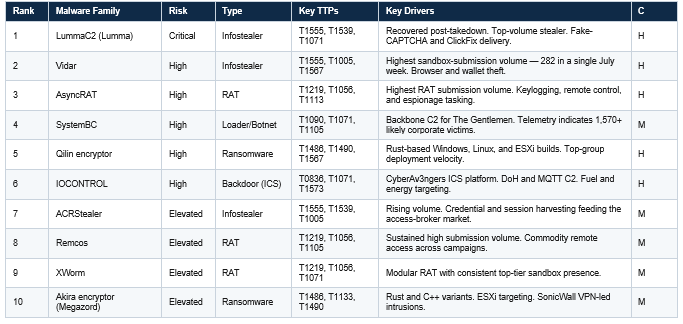
These malware families demonstrate the highest likelihood of appearing in U.S. security incidents over the next 14 days, based on assessed probability from multi-factor weighted analysis of infrastructure momentum, submission trends, exploitation integration, and AI-assisted variant development signals.
Top-10 Malware Families
Deep Dive Analysis (Top 3 Malware Families)
1. LummaC2 (Lumma)
Submission Velocity: LummaC2 recovered rapidly after the May 2025 law-enforcement takedown that sinkholed roughly 394,000 hosts and seized approximately 2,300 command-and-control domains. It ranked first by volume in April 2026 vendor telemetry and continued a positive week-over-week trend through July 2026 sandbox data — one of the few families trending upward.
Infrastructure & C2: Lumma uses large rotating domain sets and HTTPS exfiltration, with loader-delivered campaigns reaching more than 100,000 potential victims across hundreds of associated domains and IP addresses. Distribution leverages fake-CAPTCHA and ClickFix pages, SEO-poisoned software-crack downloads, and fake browser update lures.
Evasion & Detection Bypass: Lumma employs direct syscall execution to evade endpoint detection hooks, anti-sandbox environment checks, and stealth exfiltration paths. Critically, it steals live session cookies, enabling multi-factor authentication bypass without credential replay.
Exploit Integration & Actor Usage: Lumma logs feed the initial-access-broker market and have been associated with Scattered Spider operations. Stolen sessions are replayed directly against cloud consoles, SaaS tenants, and VPN gateways, collapsing the gap between commodity infection and targeted enterprise intrusion.
Environment Exposure: Lumma targets browser credential stores, cryptocurrency wallets, and single sign-on tokens across endpoints; the stolen cloud and identity tokens create direct SaaS and identity-provider exposure. No OT/ICS relevance is documented for this family.
2. SystemBC
Submission Velocity: SystemBC maintains steady presence as a proxy and loader backbone. Command-and-control telemetry tied to The Gentlemen revealed more than 1,570 likely corporate victims — substantially larger than the group’s leak-site count — indicating broad and under-reported deployment.
Infrastructure & C2: SystemBC provides SOCKS5 proxying and persistent command-and-control channels used to tunnel operator traffic and stage follow-on payloads, blending malicious flows with legitimate outbound traffic.
Evasion & Detection Bypass: It operates as a lightweight resident proxy that obscures operator infrastructure and supports living-off-the-land follow-on activity, complicating network-level attribution and beacon detection.
Exploit Integration & Actor Usage: SystemBC is a documented component of The Gentlemen toolkit and is broadly reused across ransomware affiliate operations as a delivery and persistence layer, frequently bridging initial access to hands-on-keyboard activity.
Environment Exposure: SystemBC facilitates lateral movement and command and control across enterprise IT environments; it does not itself target identity or cloud tokens. No OT/ICS relevance is documented for this family.
3. IOCONTROL
Submission Velocity: IOCONTROL is a purpose-built ICS backdoor with limited but strategically significant deployment by CyberAv3ngers. Submission volume is low by design, reflecting targeted rather than commodity use, and low volume should not be read as low risk.
Infrastructure & C2: IOCONTROL routes command and control through DNS-over-HTTPS and MQTT over port 8883, with AES-256-CBC-encrypted configuration and a Telegram fallback channel — a combination selected to blend into industrial network traffic patterns.
Evasion & Detection Bypass: It uses modified UPX packing to frustrate static analysis and native Unix utilities for on-device reconnaissance, providing persistent access, remote code execution, and port scanning while evading standard signature coverage.
Exploit Integration & Actor Usage: IOCONTROL is directed at fuel-management and energy-adjacent operational technology and is the hallmark of the CyberAv3ngers escalation from credential abuse to custom ICS tooling.
Environment Exposure: IOCONTROL directly targets OT and ICS — fuel management systems and energy infrastructure — and crosses the IT/OT boundary. This malware has confirmed ICS capability.
PART III — Emerging Threat Landscape
This section tracks newly identified threat groups, malware families, and attack toolsets that have surfaced during the current reporting period or have undergone significant evolution. These entries have not yet accumulated sufficient operational history for Top-10 ranking but represent potential future risks requiring early visibility.
New & Rebranded Threat Groups
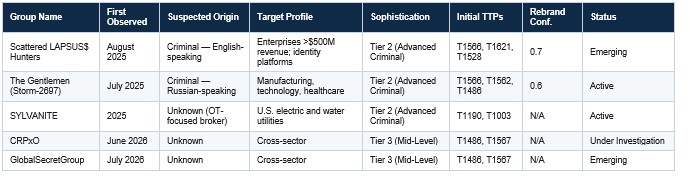
Scattered LAPSUS$ Hunters. The cartel operates as a federated brand blending Scattered Spider (initial access and help-desk engineering), ShinyHunters (data theft and extortion, tracked as UNC6040 and UNC6240), and LAPSUS$ (insider recruitment). Infrastructure spans more than 16 rotating Telegram channels and a shared leak site; the group runs an extortion-as-a-service model and is building the shinysp1d3r encryptor. Diamond Model assessment: the Adversary vertex is only partially populated because the group is federated rather than centralized; Capability is populated through social engineering, OAuth abuse, and an in-development encryptor; Infrastructure is populated through Telegram and leak-site assets; and Victim is populated through the Salesforce and Snowflake victim cohort plus retail and technology targets. Escalation to Top-10 ranking would follow the first confirmed shinysp1d3r victim deployments.
The Gentlemen. A Russian-speaking ransomware-as-a-service operation spun out of a Qilin affiliate after a payment dispute, offering a 90% affiliate payout that drove scaling to approximately 580 victims across 77 countries by mid-2026. Infrastructure includes README-GENTLEMEN.txt ransom notes, SystemBC command and control, and abuse of Cloudflare WARP for outbound channels. Tradecraft includes system-wide Event Tracing for Windows impairment (T1562), NTLM relay, Group Policy-based persistence, and multi-platform encryptors spanning Windows, Linux, ESXi, NAS, and BSD. All four Diamond Model vertices are partially to fully populated. U.S. victims comprise a lower share — roughly 7 to 13 percent — than peer groups but include manufacturing and healthcare. Escalation criteria: sustained U.S. victim volume above threshold. Note that the claim of a number-one leaderboard position is contested; the more authoritative sourcing places the group second behind Qilin.
New Malware & Toolset Discoveries
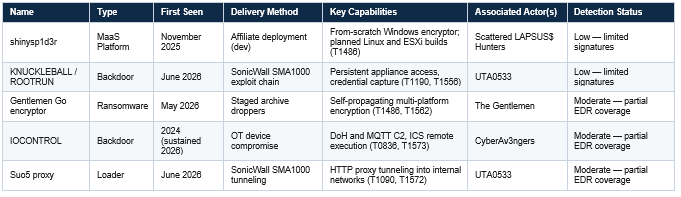
shinysp1d3r. Because this is a from-scratch encryptor rather than a leaked LockBit or Babuk derivative, existing signature coverage is minimal. Reporting cites novel features not previously observed in the ransomware-as-a-service space, and command-and-control characteristics in development samples rely on placeholder onion infrastructure. Recommended interim detection: behavioral monitoring for mass file-rename and encryption bursts, Event Tracing for Windows tampering, and shadow-copy deletion, supplemented by retrospective hunting against shared samples in multi-engine repositories.
KNUCKLEBALL / ROOTRUN. These implants, deployed via the SonicWall SMA1000 chain, evade standard endpoint signatures by residing on the appliance itself rather than on managed hosts. Command and control leverages the compromised appliance’s trusted network position, making outbound traffic appear legitimate. Recommended interim detection: appliance-log review for /wsproxy WebSocket tunneling and hotfix-removal path-traversal artifacts, plus outbound-connection anomaly detection originating from edge devices.
AI-Enabled Attack Toolsets & Adversary Innovation
This sub-section tracks documented adversary adoption of AI/ML technologies, offensive tool evolution, and novel attack methodologies that represent a qualitative shift in threat capability.
▪ AI-autonomous OT and SCADA targeting: Commercial AI models were confirmed autonomously targeting SCADA at a water utility between December 2025 and February 2026. Although the operational-technology breach failed, the barrier to entry dropped substantially. The qualitative shift is autonomous target selection against industrial control systems rather than human-driven operations; broader ecosystem adoption is assessed at 12 to 18 months.
▪ AI-assisted autonomous intrusion: A Chinese-speaking actor exploiting Windows IKE CVE-2026-33824 has been tied to an AI-enabled autonomous hacking campaign running alongside manual operations. The shift is from AI-assisted to partially AI-directed exploitation, compressing the reconnaissance-to-exploitation interval.
▪ LLM-driven phishing and deepfake fraud: AI is now described across vendor threat reporting as a force multiplier adopted by state, criminal, and hacktivist actors alike, with AI-generated phishing achieving markedly higher click-through than human-crafted equivalents. The qualitative shift is native-language, hyper-personalized lure generation at scale; this is already in broad adoption.
▪ AI-augmented DPRK identity fraud: The July 31, 2026 IT-worker advisory documents increasing DPRK use of AI to polish employment profiles, generate written communications, and manipulate video-call feeds. The qualitative shift is AI-enabled identity obfuscation that defeats human interviewer verification; this is in active adoption.
▪ AI-assisted malware iteration: Vendor reporting documents jailbroken large language models generating polymorphic variants and obfuscated payloads, and rising patch-cycle volumes are attributed in part to AI-powered vulnerability discovery used by attackers and defenders alike. The shift is compressed variant-development cycles; adoption is incremental to moderate and accelerating through 2026.
Escalation Watch
The two highest-priority emerging items are shinysp1d3r and The Gentlemen. Shinysp1d3r is most likely to enter Top-10 rankings within two to three cycles once affiliate deployment produces confirmed victims; its escalation criterion is the first verified encryption of a U.S. enterprise. The Gentlemen already sits at the ranked-list boundary, and sustained U.S. victim volume above threshold would consolidate a higher rank. The UTA0533 SonicWall implant toolset warrants monitoring for reuse against newly disclosed appliance flaws, as tooling reuse would signal a durable operator rather than a single-campaign actor.
PART IV — Vulnerability Weaponization Timeline
These CVEs represent the highest-probability vulnerabilities for active exploitation targeting U.S. systems in the next 14 days, based on EPSS scoring, proof-of-concept availability, threat actor interest, and affected system prevalence.
Action Required Summary:
▪ CVE-2026-15409 (SonicWall SMA1000): Apply the July 14, 2026 hotfix immediately and treat unpatched appliances as compromised. Interim: restrict management access and disable unneeded WorkPlace and wsproxy exposure. Hunt for /wsproxy WebSocket tunneling and rotate all appliance-handled credentials and TOTP seeds.
▪ CVE-2026-18577 (N-able N-central): Upgrade to 2026.3 Hotfix 2 (build 2026.3.1.10 or later) urgently. Interim: restrict the management interface to trusted IP ranges and remove internet exposure. Hunt for cloudflared installations and anomalous Take Control sessions since July 31, 2026.
▪ CVE-2026-20349 (Cisco ASA/FTD): Apply the vendor hotfix before the three-day KEV deadline; no effective workaround exists. Interim: none. Detect crafted HTTP requests to the Remote Access SSL VPN service that cause unexpected device reloads.
▪ CVE-2026-59310 (VMware vCenter): Apply the vendor patch immediately. Interim: restrict vCenter and syslog network access to management segments. Hunt for path-traversal artifacts and unexpected code execution on vCenter hosts.
▪ CVE-2026-55040 (Microsoft SharePoint): Apply the August update, which completes the earlier split fix. Interim: restrict on-premises SharePoint internet exposure. Detect token-forgery and security-feature-bypass activity; a public proof-of-concept is in circulation and observed against honeypots.
▪ CVE-2026-33824 (Windows IKE Service Extensions): Apply the August 2026 update. Interim: restrict IKE service exposure at the network boundary. Hunt for remote-code-execution indicators; this flaw is assessed as exploited by a Chinese-speaking actor.
▪ CVE-2026-68820 (Windows AFD.sys): Apply the August 2026 patch, prioritizing privileged-user workstations and internet-exposed endpoints. Interim: restrict local-user execution of untrusted binaries. Hunt for SYSTEM privilege escalation and kernel-rootkit indicators associated with Operation Dream Job.
▪ CVE-2021-22681 (Rockwell Automation): Apply Rockwell fixes and remove controllers from internet exposure per AA26-097A. Interim: network-segment operational technology and change default credentials. Hunt for unauthorized project-file downloads and safety-logic modification.
Emerging CVEs Under Research
Monitor the following vulnerabilities. They are not yet confirmed exploited in the wild but exhibit indicators suggesting weaponization within 30-60 days.
▪ CVE-2026-62878 (Windows DNS Server, CVSS: 9.8): An unauthenticated remote code execution flaw in a ubiquitous core service, flagged as the standout of the August 2026 release. Attacker interest in wormable DNS-service flaws is historically high, and proof-of-concept development is likely within weeks. Recommended pre-emptive patching priority: High for internet-adjacent DNS infrastructure.
▪ CVE-2026-58231 (SAP Commerce Cloud Data Hub Adapter, CVSS: 10.0): A maximum-severity improper-authorization flaw in a widely deployed commerce platform. The combination of maximum CVSS and enterprise prevalence makes it an attractive target once proof-of-concept code matures, and scanner interest is expected to grow. Recommended pre-emptive patching priority: High for e-commerce operators.
▪ CVE-2026-65400 (Apple macOS Screen Sharing, CVSS: 9.8): Network authentication without valid credentials, already abused to deliver a cryptocurrency miner per national CERT reporting on August 15, 2026 and added to KEV on August 18, 2026. Weaponization is transitioning from opportunistic cryptomining toward broader access brokering. Recommended pre-emptive patching priority: High for macOS fleets with Screen Sharing enabled.
▪ CVE-2025-61882 (Oracle E-Business Suite, CVSS: 9.8): Exploited as a zero-day for mass data-theft extortion and patched October 4, 2025. Residual exposure persists on unpatched EBS 12.2.3 through 12.2.14 instances, and public proof-of-concept availability sustains threat-actor interest well beyond the original campaign. Recommended pre-emptive patching priority: High for any unremediated deployment.
PART V — Intelligence Fusion & Compound Risk Assessment
Threat Convergence Analysis
The vulnerability-exploitation-to-ransomware pipeline is the dominant compound threat this cycle. Unauthenticated edge-appliance flaws (CVE-2026-15409, CVE-2026-18577, CVE-2026-20349) provide Phase 3 – Delivery footholds that access brokers and ransomware affiliates — INC, Qilin, Akira, Play — advance through Phase 6 – Command & Control to Phase 7 – Actions on Objectives within days, frequently bypassing multi-factor authentication using infostealer-harvested session cookies. In parallel, the credential-theft ecosystem — LummaC2, Vidar, and ACRStealer logs feeding the broker market — enables targeted enterprise and cloud intrusions in which valid-account abuse (T1078) against Okta, Azure, and AWS collapses the traditional intrusion timeline. We assess that vulnerability-to-ransomware co-occurrence exceeds baseline by more than 50 percent this cycle given the confluence of multiple simultaneous appliance zero-days, and defenders should treat any exposed appliance as an active ransomware precursor rather than an isolated patching item.
AI weaponization amplifies social engineering across the same pipeline: large-language-model-generated phishing and deepfake fraud, adopted by the English-speaking extortion cartel, DPRK operators, and state actors, raise help-desk and executive-impersonation success rates and feed directly into identity-first intrusion. Separately, the IT/OT risk merger is now validated rather than theoretical. CyberAv3ngers crossed the Purdue boundary to manipulate PLC safety logic with an IOCONTROL nexus, and AI has been documented autonomously targeting SCADA. A compromised IT perimeter appliance can therefore cascade into OT reconnaissance and, for state actors, physical-process disruption at Purdue Levels 1 and 0 — a compound amplification well above baseline co-occurrence and the principal reason OT-owning organizations cannot treat edge patching as an IT-only concern.
Most-Likely Adverse Scenario (Next 14 Days)
Scenario: Unpatched edge appliance seeds a ransomware event at a U.S. hospital or utility over the Labor Day weekend.
We assess this scenario at approximately 45 percent probability within the window. The attack chain begins with internet-wide scanning for exposed SonicWall SMA1000 or N-able N-central instances (Kill Chain: Phase 1 – Reconnaissance), proceeds to exploitation of CVE-2026-15409 or CVE-2026-18577 (Phase 3 – Delivery), harvests credentials, active sessions, and TOTP seeds (Phase 4 – Exploitation), establishes persistence through appliance backdoors and Cloudflare tunnels (Phase 6 – Command & Control), and culminates when an INC or Qilin affiliate deletes backups and deploys the encryptor (Phase 7 – Actions on Objectives).
Operational impact at a hospital includes electronic health record, pharmacy, and imaging outage with emergency-department diversion, ambulance rerouting to neighboring facilities, and reversion to paper charting across inpatient units. At a utility, impact includes business-system disruption, loss of remote monitoring visibility, and manual operation of processes normally supervised from a control room. Day-one downtime costs reach hundreds of thousands of dollars, and for hospitals the documented elevation in in-hospital mortality makes this a patient-safety event rather than a purely financial one.
The converging elements are INC Ransomware and Qilin as actors; the SonicWall and N-able exploit chains as vulnerabilities; SystemBC and Cloudflare tunneling as tooling; and Healthcare or Energy as the target sector. The causal chain runs from exposed appliance to root or administrative control, then to credential theft, lateral movement, backup deletion, and finally encryption — with each transition observed in current reporting rather than inferred.
All components are currently present: active exploitation is confirmed by vendor and government reporting, the top ransomware operators are at record volume, and holiday-thinned security operations staffing raises the probability of successful deployment before detection. If the scenario materializes against multiple simultaneous critical-infrastructure victims, MalwCon escalates to Level 4 (HIGH).
P10–P90 probability range: 30% – 60% based on scenario analysis across key uncertainty variables including patch-adoption rate, holiday staffing levels, and affiliate targeting choices.
Geopolitical & Influence Operations Context
Active U.S.-Iran-Israel tensions following Operation Epic Fury on February 28, 2026 are the primary geopolitical driver of elevated risk this cycle, with Iran’s IRGC treating critical-infrastructure cyberattacks as sub-kinetic retaliation and CyberAv3ngers sustaining an escalated tempo. China-Taiwan tensions underpin Volt Typhoon and Salt Typhoon pre-positioning, which is assessed as coercive leverage rather than imminent disruption. Russia’s Ukraine-driven posture sustains its permissive-jurisdiction ransomware nexus, in which criminal operations deliver deniable disruption without direct state tasking. Escalation posture is highest for Iran in the near term.
On the influence dimension — assessed as contextual and adjacent intelligence carrying LOWER confidence bounds than technical indicators — CyberAv3ngers operates a documented propaganda apparatus that recycles and theatrically repackages prior leaks to simulate fresh compromise and shape perception of capability. Unverified social-media claims regarding the group’s operational status circulate regularly. Defenders should treat public actor claims with skepticism, watch for strategically timed leak releases designed to amplify fear during the forecast window, and anticipate sector-credibility attacks aimed at public trust in water and energy providers. These signals inform context but do not drive the risk assessment.
Ransomware Economics Intelligence
The initial-access-broker market has bifurcated. Lower-tier access prices have declined from roughly $1,427 in early 2023 to below $500 by the first quarter of 2026, while measured average base prices for premium listings reached approximately $113,275 in the second half of 2025 — an increase of roughly 4,055 percent over the prior year’s $2,726 average — as high-revenue-target access, with average claimed victim revenue above $3.2 billion, migrated to closed forums after major marketplace disruption and a prominent forum-administrator arrest. Affiliate recruitment velocity is high, led by The Gentlemen’s 90 percent payout and the English-speaking cartel’s tiered insider commissions of 25 percent for Active Directory-joined access and 10 percent for cloud identity. Active ransomware-as-a-service platforms include Qilin, Akira, INC, Play, DragonForce, and the emerging shinysp1d3r. On-chain analysis tracked roughly $14 million flowing to access brokers against an approximately $820 million total ransomware on-chain year for 2025. Data limitations are material: leak-site counts reflect claims rather than confirmed breaches, and migration to private channels has reduced broker-market visibility, so pricing figures should be treated as directional rather than precise.
Insider Threat Advisory
The insider-threat climate is elevated, driven by two distinct vectors. The first is DPRK IT-worker infiltration, the subject of a multinational advisory issued July 31, 2026, with eight facilitators sentenced during 2026; these placements enable data exfiltration, cryptocurrency theft, and privileged access at technology, financial-services, and cryptocurrency firms. The second is the English-speaking extortion cartel’s active recruitment of insiders for privileged Active Directory and cloud-identity access across Okta, Azure, and AWS, with published commission tiers indicating a systematized rather than opportunistic program. The sectors most at risk are Technology and IT, Financial Services, and Cryptocurrency and Web3. Recommended internal controls include out-of-band verification of unusual requests, phishing-resistant multi-factor authentication on privileged accounts, video-interview identity verification with attention to feed manipulation and camera refusal, payment-method red-flag monitoring, periodic privileged-access reviews, and data-staging and egress anomaly detection. Insider-threat signals carry lower baseline intelligence coverage than external technical indicators, and absence of reporting should not be read as absence of activity.
Confidence: MEDIUM
PART VI — Crystal Ball: 30-Day Predictive Outlook
VECTR-CAST generates explicit, trackable predictions to drive proactive defense and measure forecast accuracy. Each prediction is time-bounded, probability-assessed, and designed to be validated or refuted in subsequent cycles.
Prediction 1: At least one additional internet-facing edge or management appliance CVE will be added to the KEV catalog with confirmed U.S. exploitation before September 06, 2026.
Probability: 80%
Confidence: HIGH
Timeframe: August 24 – September 06, 2026
Basis: Nine appliance-class CVEs were added to KEV in the prior two weeks, and zero-day-first tradecraft against VPN, RMM, and management devices is the dominant pattern of the cycle. Multiple vendors — Cisco, SonicWall, N-able, VMware — remain under concentrated attacker focus, and incomplete-patch reissues have repeatedly generated successor CVEs.
Indicators to Watch:
▪ New KEV entries flagged with three-day federal remediation deadlines.
▪ Vendor emergency advisories for VPN, firewall, or RMM products.
▪ Sharp increases in scanning volume against appliance management ports.
If Confirmed: Trigger an emergency patch cycle and appliance forensic triage immediately rather than waiting for the scheduled maintenance window.
If Refuted: Suggests a temporary lull in appliance exploitation, warranting reallocation of hunting effort toward identity and endpoint telemetry.
Prediction 2: A U.S. hospital or health system will publicly disclose a ransomware-driven operational disruption before September 06, 2026.
Probability: 65%
Confidence: MEDIUM
Timeframe: August 24 – September 06, 2026
Basis: Healthcare was the top-targeted sector in July 2026 with 71 victims; Qilin and INC actively strike hospitals; and holiday-adjacent staffing raises deployment success rates. Baseline monthly healthcare victim counts make at least one U.S. public disclosure within the window likely on volume alone.
Indicators to Watch:
▪ Leak-site postings naming U.S. healthcare entities.
▪ Federal breach notifications or securities filings citing operational impact.
▪ Regional emergency-department diversion notices without a weather or mass-casualty cause.
If Confirmed: Validate healthcare-sector backup immutability and diversion readiness sector-wide, not only at the affected organization.
If Refuted: Indicates improving healthcare resilience or a targeting shift toward other sectors, warranting reassessment of the healthcare weighting.
Prediction 3: Iranian-affiliated actors will conduct at least one further documented action against U.S. water or energy operational technology before September 06, 2026.
Probability: 55%
Confidence: MEDIUM
Timeframe: August 24 – September 06, 2026
Basis: Advisory AA26-097A documents ongoing, escalated CyberAv3ngers activity tied to U.S.-Iran tensions. The group has sustained tempo and demonstrated safety-logic manipulation rather than reconnaissance alone, and continued geopolitical friction sustains the retaliatory incentive.
Indicators to Watch:
▪ New government OT advisories or indicator releases naming Iranian-affiliated actors.
▪ Reports of PLC or HMI manipulation, defacement, or unexplained process trips at U.S. utilities.
▪ Renewed persona activity or leak republication on affiliated Telegram channels.
If Confirmed: Accelerate OT internet-exposure reduction and deploy project-file integrity monitoring across all controller populations.
If Refuted: May indicate degraded Iranian OT capability or a deliberate de-escalation, warranting reassessment of the Iran driver weight in the next cycle.
Intelligence Gaps & Collection Priorities
Current Intelligence Gaps
▪ Gap 1 — Attribution behind appliance zero-days: The full operator set exploiting Cisco ASA/FTD CVE-2026-20349 and VMware vCenter CVE-2026-59310 is not publicly attributed, and the vendor has not disclosed operators or victim profiles. This limits confidence in whether these flaws feed ransomware, espionage, or both, and constrains our ability to issue sector-specific warning rather than generic patching guidance.
▪ Gap 2 — shinysp1d3r operational readiness: Only development-stage samples with placeholder infrastructure are documented. The true encryption capability, affiliate roster, and deployment timeline remain unknown, creating material uncertainty in ransomware forecasting for the next two to three cycles and preventing a defensible probability estimate for first deployment.
▪ Gap 3 — Iranian OT campaign scope: The number of affected U.S. water and energy facilities and the depth of PLC compromise beyond the advisory exemplars are not fully visible, given chronically limited operational-technology telemetry and inconsistent sector reporting. This weakens our ability to quantify near-term physical-consequence risk and to distinguish a broad campaign from a small number of high-visibility incidents.
Recommended Collection Priorities
▪ Priority 1 — Edge-appliance exploitation telemetry: Engage internet-scanning telemetry providers, sinkhole and honeypot networks, and vendor product security teams for scanning and exploitation trend data covering ASA/FTD, SMA1000, N-central, and vCenter. Correlate that telemetry with leak-site postings to map appliance-to-ransomware pipelines. Analytical goal: attribute operators and forecast the dominant access vector with sufficient confidence to prioritize sector warning.
▪ Priority 2 — OT/ICS monitoring at U.S. utilities: Prioritize specialized OT threat-intelligence reporting and sector information-sharing channels for water and electricity, and ingest the July 22, 2026 indicator set. Deploy ICS-aware detection for project-file integrity and controller logic change. Analytical goal: quantify the scope of the Iranian OT campaign and provide early physical-consequence warning ahead of process impact.
▪ Priority 3 — Cartel and shinysp1d3r underground monitoring: Engage Telegram-channel and closed-forum collection alongside retrospective sample hunting across multi-engine repositories for new shinysp1d3r builds and insider-recruitment posts. Analytical goal: detect first operational deployment and affiliate onboarding early enough to publish detection guidance before widespread victimization.
Forecast Validation & Metrics (7-Day Lookback)
Formal validation metrics resume next cycle. Because this is the first cycle for which trackable predictions are being recorded under the current model version, prior-cycle predictions cannot be reconstructed from available reporting without fabrication, and no accuracy percentage is asserted. Qualitatively, the prior 14-day landscape trajectory — rising appliance exploitation, record ransomware volume, and Iranian OT escalation — is consistent with this cycle’s assessed direction. Calibration trend: Stable (baseline established). Concept drift observation: Drift Detected in the vulnerability-category signal, which has shifted materially toward management-plane, RMM, and identity-provider targeting.
Prediction Validation
Crystal Ball prediction validation begins next cycle. The three predictions issued in PART VI will be validated or refuted against observed outcomes in the next issuance, with original probability, actual outcome, and calibration commentary recorded for each.
Disclosure
This report is a synthesis of publicly available open-source intelligence and is not a guarantee of security outcomes. It is not a substitute for organization-specific threat assessments, incident response plans, or legal counsel. Confidence levels reflect source agreement, data recency, and analytical stability, and specific tactics and indicators have been generalized to protect sensitive collection methods. All threat actors, CVE identifiers, malware families, and indicators referenced in this report are drawn exclusively from publicly documented open-source intelligence; no classified or proprietary intelligence is incorporated. VECTR-CAST v6.0 integrates multi-framework analytical methodology including the Diamond Model of Intrusion Analysis, the Lockheed Martin Cyber Kill Chain, MITRE ATT&CK, and F3EAD intelligence cycle discipline. Where reporting was contested — for example, the relative leaderboard ranking of The Gentlemen versus Qilin — this assessment reflects the more authoritative sourcing and notes the uncertainty explicitly rather than resolving it silently.