
EXECUTIVE SUMMARY
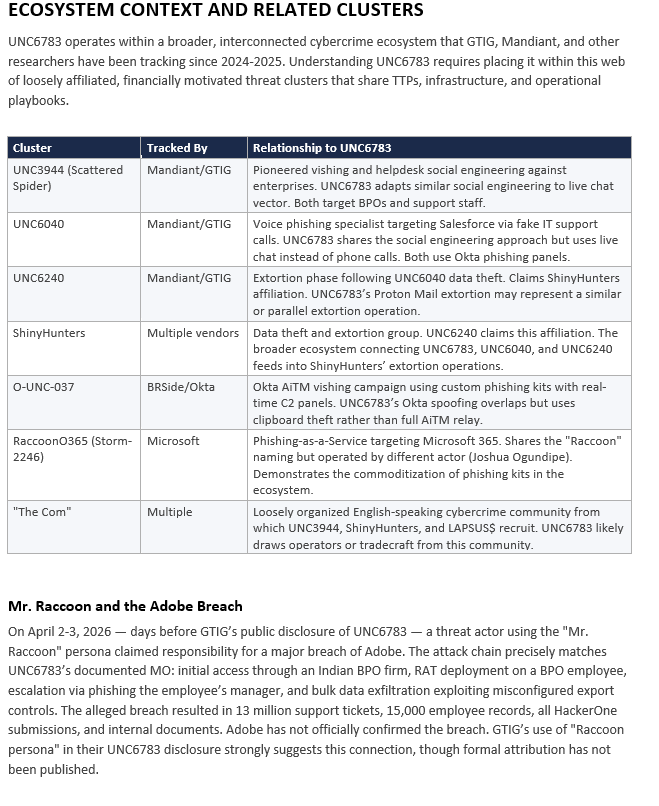
UNC6783 is a financially motivated threat cluster tracked by Google Threat Intelligence Group (GTIG), potentially tied to the online persona “Mr. Raccoon.” First publicly disclosed on April 7, 2026, UNC6783 targets dozens of high-value corporate entities across multiple sectors by compromising Business Process Outsourcers (BPOs) and helpdesk staff to gain trusted access for data theft and extortion. The group represents an evolution in the “The Com” cybercrime ecosystem — blending the social engineering tradecraft of Scattered Spider (UNC3944) with the data extortion playbook of ShinyHunters (UNC6240), but introducing novel live chat-based attack vectors and Okta-spoofing phishing infrastructure that distinguishes it from predecessors.
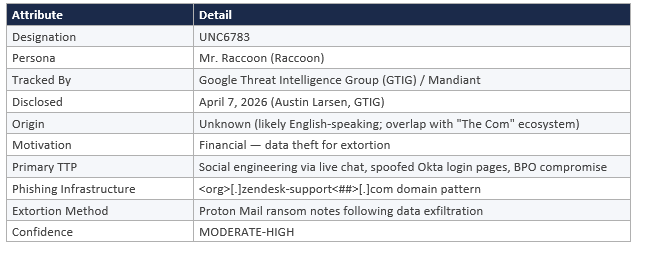
The UNC designation indicates this is an “uncategorized” cluster — meaning Mandiant has observed sufficient activity to track it as a distinct cluster but has not yet merged it into a named threat group. The “Raccoon” persona link opens the possibility of connection to the Mr. Raccoon actor who claimed the Adobe BPO breach in early April 2026, though formal attribution remains pending.
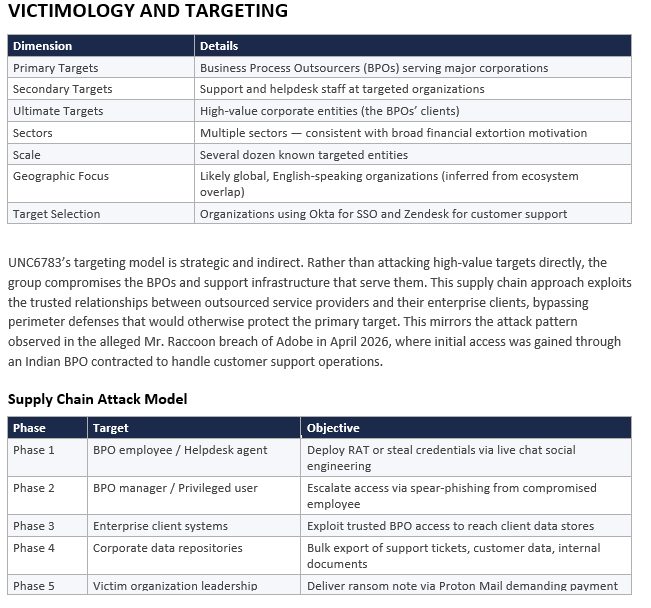
INITIAL ACCESS TECHNIQUES
1. Social Engineering via Live Chat
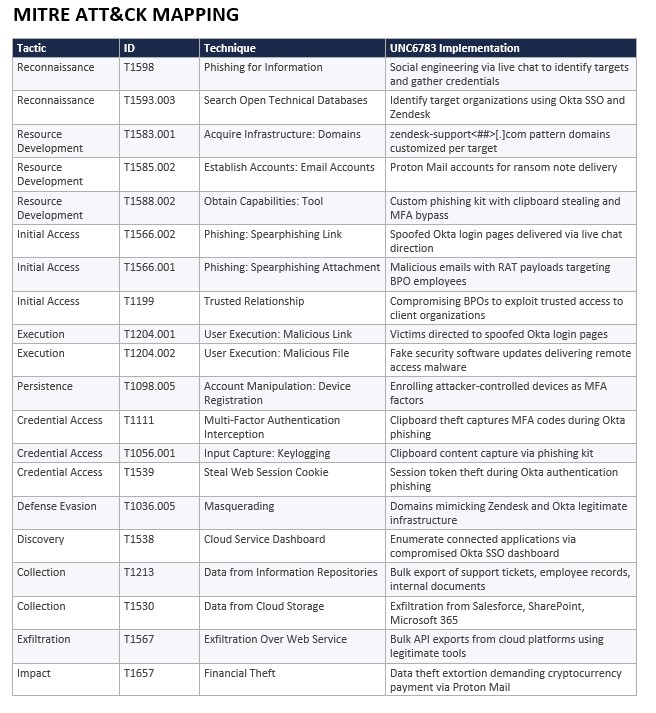
The primary and distinguishing initial access vector for UNC6783 is social engineering conducted through live chat interfaces. Rather than relying on traditional email phishing or voice phishing (vishing) that characterize related clusters like UNC6040 and UNC3944, UNC6783 leverages live chat platforms — likely including Zendesk chat, help desk portals, and internal support channels — to engage employees in real-time conversation. During these interactions, the attacker directs the victim to visit a malicious, spoofed Okta login page. The live chat medium allows the attacker to build rapport and respond dynamically to victim hesitation, making it more effective than static phishing emails.
2. Spoofed Okta Login Pages
UNC6783 deploys convincing replicas of Okta Single Sign-On (SSO) login pages to harvest credentials and MFA tokens. The phishing pages are designed to match the targeted organization’s Okta tenant branding. The phishing kit includes clipboard-stealing functionality that captures MFA codes and session data from the victim’s clipboard. This capability enables the attacker to bypass standard MFA verification without needing real-time adversary-in-the-middle relay, as the clipboard contents often include copied authentication codes or tokens. Once credentials and MFA tokens are captured, the attacker enrolls their own devices for persistent access to the victim’s SSO environment.
3. Fake Security Software Updates
As a secondary initial access vector, UNC6783 distributes fake security software updates to trick victims into downloading remote access malware. This technique likely involves either injecting fake update prompts during live chat support sessions or distributing malicious links disguised as legitimate security tool installers. The remote access malware provides persistent access to the victim’s machine, enabling credential harvesting, lateral movement, and data collection without requiring ongoing social engineering.
4. BPO Employee Compromise via Malicious Email (Mr. Raccoon Attribution)
If the GTIG-tracked UNC6783 cluster aligns with the Mr. Raccoon persona as indicated, the Adobe breach provides additional insight into initial access methods. In that incident, Mr. Raccoon deployed a Remote Access Tool (RAT) on a BPO employee’s machine via a malicious email. The RAT provided comprehensive access including webcam surveillance and WhatsApp message interception. The attacker then escalated by phishing the compromised employee’s manager, broadening network access. This multi-stage BPO compromise chain represents a patient, targeted approach consistent with the broader UNC6783 operational model.
ATTACK LIFECYCLE
Phase 1: Reconnaissance and Infrastructure Setup
• Identify target organizations using Okta SSO and BPO relationships
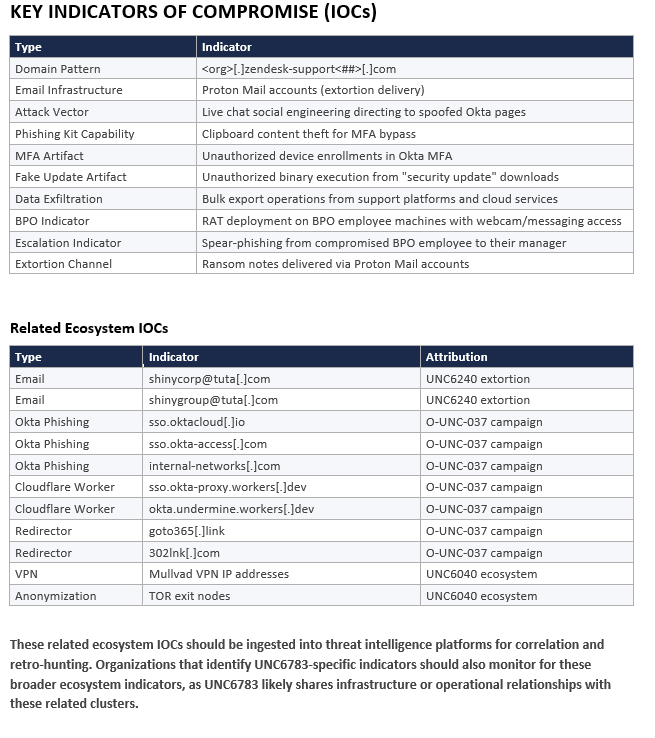
• Register spoofed domains following <org>[.]zendesk-support<##>[.]com pattern
• Provision Okta-branded phishing pages matching target organization’s branding
• Establish Proton Mail accounts for extortion communications
• Prepare remote access malware disguised as security software updates
Phase 2: Initial Access via Live Chat
• Initiate contact with BPO employees or helpdesk staff via live chat
• Use social engineering pretext (security issue, account verification, software update)
• Direct victim to spoofed Okta login page on zendesk-support domain
• Harvest credentials, MFA codes, and clipboard contents via phishing kit
• Alternatively, deliver fake security software update containing remote access malware
Phase 3: MFA Bypass and Persistence
• Use stolen clipboard contents containing MFA tokens to bypass authentication
• Authenticate to victim’s real Okta SSO tenant with stolen credentials
• Enroll attacker-controlled device as new MFA device for persistent access
• Access SSO dashboard to enumerate all connected enterprise applications
• Establish persistent foothold independent of initial compromised credentials
Phase 4: Lateral Movement and Data Collection
• Leverage SSO access to pivot across connected applications (Salesforce, Microsoft 365, SharePoint, Zendesk, etc.)
• In BPO scenarios, exploit trusted access pathways to reach client organization data
• Identify and target high-value data repositories (support tickets, customer databases, internal documents)
• Exploit misconfigurations allowing bulk data export (as observed in Adobe breach: “They allowed you to export all tickets in one request from an agent”)
• Collect support tickets, employee records, internal documents, and potentially vulnerability disclosures
Phase 5: Exfiltration and Extortion
• Execute bulk data export from compromised platforms
• Exfiltrate data to attacker-controlled infrastructure
• Following exfiltration (potentially weeks to months later), deliver ransom note via Proton Mail
• Demand cryptocurrency payment under threat of public data release
• May post sample data on leak sites or contact media to increase pressure
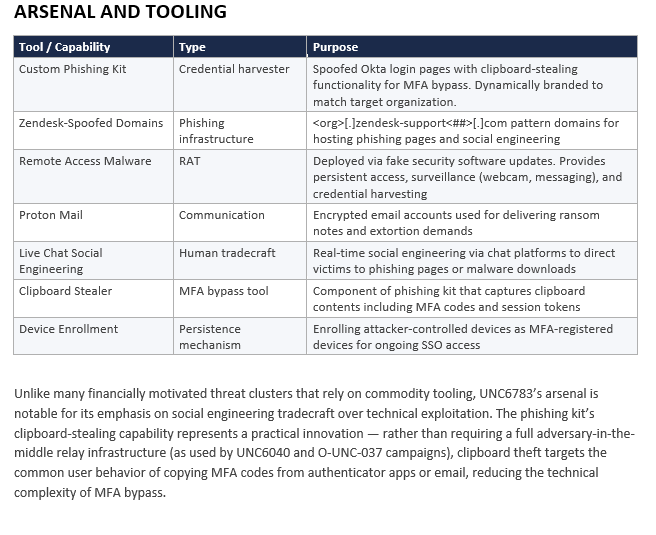
DEFENSE EVASION AND PERSISTENCE
• Trusted Relationship Abuse — By compromising BPOs first, UNC6783 enters target environments through pre-established trust channels that bypass standard perimeter controls. BPO credentials and access paths are expected by the target’s security infrastructure.
• Legitimate Platform Mimicry — Zendesk-spoofed domains and Okta-branded phishing pages exploit users’ trust in familiar platforms. The domain pattern <org>[.]zendesk-support<##>[.]com closely resembles legitimate support infrastructure.
• Live Chat Vector — Unlike email phishing (heavily filtered) or voice phishing (increasingly recognized), live chat is a less-monitored attack surface. Most organizations lack security controls for detecting social engineering conducted through chat platforms.
• MFA Device Enrollment — By enrolling their own devices as legitimate MFA factors, attackers establish persistence that survives password resets and credential rotation. The enrolled device appears as a normal user authentication method.
• Clipboard-Based MFA Bypass — Capturing clipboard contents is stealthier than real-time credential relay, as it requires no persistent connection between the attacker and the victim’s authentication session. The clipboard capture happens passively on the phishing page.
• Encrypted Communications — Use of Proton Mail for extortion communications provides operational security, making it difficult for law enforcement to trace ransom demands back to the operators.
• Fake Security Updates — Disguising RATs as security software updates leverages users’ trust in IT security processes, particularly during or after a social engineering interaction that has already established an IT support pretext.
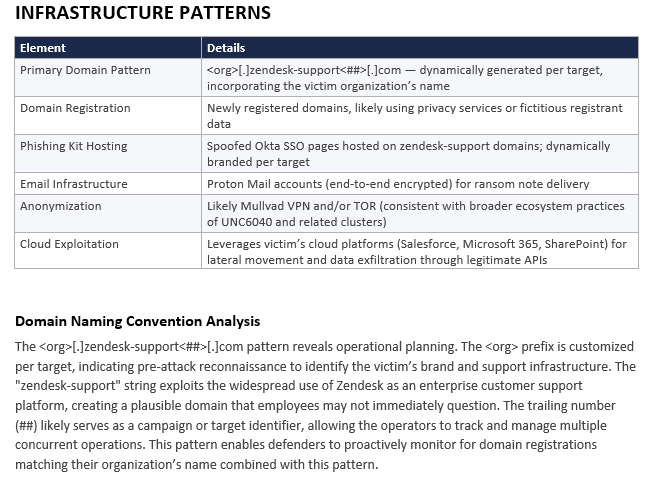
DETECTION AND HUNTING GUIDANCE
Actionable recommendations for SOC teams to detect and hunt UNC6783 activity:
• [CRITICAL] Implement Phishing-Resistant MFA — Deploy FIDO2 hardware security keys or Okta FastPass for all users, especially support and helpdesk staff. Standard MFA (SMS, push, TOTP) is insufficient against UNC6783’s clipboard-stealing phishing kit.
• [HIGH] Monitor for Zendesk-Support Domain Pattern — Proactively monitor Certificate Transparency logs and domain registrations for any domains matching <your-org>[.]zendesk-support[0-9]+[.]com. Block these preemptively.
• [HIGH] Audit MFA Device Enrollments — Regularly audit newly enrolled MFA devices in Okta for unauthorized additions. Alert on any device enrollment that occurs outside of normal provisioning workflows.
• [HIGH] Monitor Live Chat for Social Engineering — Educate employees about social engineering via live chat. Monitor for anomalous or suspicious chat interactions that direct users to external links, particularly links containing “zendesk-support” or “okta” patterns.
• [HIGH] Alert on Unauthorized Binary Execution — Monitor for unauthorized binary execution, particularly installers or “updates” downloaded during or immediately after support sessions.
• [HIGH] Monitor Bulk Data Exports — Implement alerts for unusual spikes in data export volume from support ticketing platforms (Zendesk, ServiceNow, Salesforce), especially bulk exports executed by individual agent accounts.
• [MED] BPO Access Monitoring — Apply enhanced monitoring and access controls to BPO partner connections. Implement just-in-time access, session recording, and anomaly detection for outsourced support activities.
• [MED] Proton Mail Alerting — Monitor for inbound emails from Proton Mail domains containing ransom-related keywords. While Proton Mail has legitimate uses, ransom notes from unknown Proton Mail addresses are a UNC6783 indicator.
• [MED] Detect Clipboard Interaction on Login Pages — If possible, implement browser-based controls or EDR rules to detect web pages attempting to access clipboard contents during authentication flows.
• [MED] Monitor SSO Dashboard Access Patterns — Alert on SSO dashboard enumeration activity from unusual locations, devices, or IP ranges, particularly after new MFA device enrollment events.
Detection Engineering Notes
• Sigma: Create rules for Okta Event Log detecting new device enrollment (system.mfa.factor.activate) followed by rapid application access across multiple connected apps.
• Network: Monitor DNS queries and web traffic for domains matching the regex pattern [a-z0-9]+\.zendesk-support[0-9]+\.com.
• Email: Flag Proton Mail-origin messages to executive leadership containing terms like “ransom,” “exfiltrated,” “deadline,” “bitcoin,” or “data leak.”
• Endpoint: Monitor for unsigned binary execution from user temp directories, especially during active chat or support sessions.
• Cloud: Alert on Salesforce/Zendesk/SharePoint bulk export operations exceeding baseline thresholds, particularly when executed by BPO-linked accounts.
INTELLIGENCE GAPS
• Formal Attribution — The connection between UNC6783 and the Mr. Raccoon persona remains at GTIG “potentially tied” confidence. No formal merge or confirmation has been published.
• Full Malware Analysis — The remote access malware delivered via fake security updates has not been publicly analyzed. Malware family, capabilities, C2 protocol, and persistence mechanisms are unknown.
• Complete IOC Set — GTIG has not released a full IOC annex for UNC6783. Specific phishing domains, C2 infrastructure, and file hashes are not publicly available.
• Geographic Attribution — UNC6783 operator locations, nationalities, and language capabilities are undisclosed. Ecosystem overlap with “The Com” suggests English-speaking operators, but this is inferred.
• Victim Enumeration — “Several dozen high-value corporate entities” are referenced but not named. Sector distribution beyond “multiple sectors” is unknown.
• Extortion Specifics — Ransom demand amounts, payment success rates, and data leak follow-through are not publicly documented.
• Relationship to Other Clusters — Whether UNC6783 is a new entrant, a splinter of an existing group, or an evolution of a prior cluster (UNC6040, UNC3944) has not been determined.
• Adobe Breach Confirmation — Adobe has not officially confirmed the Mr. Raccoon breach claim. If confirmed, it would be the strongest corroborating evidence for UNC6783’s BPO targeting methodology.
SOURCES
1. Google Threat Intelligence Group (GTIG) / Austin Larsen — UNC6783 Disclosure (LinkedIn/X Thread) — April 7, 2026
2. International Cyber Digest — “Adobe Breached by Mr. Raccoon” — April 2, 2026
3. Cybersecurity News — “Adobe Breach: Threat Actor Claims Leak of 13 Million Support Tickets” — April 2, 2026
4. Cyber Press — “Adobe Breach Threat Actor Claims Leak of 13 Million Support Tickets” — April 3, 2026
5. Google Threat Intelligence Group — “The Cost of a Call: From Voice Phishing to Data Extortion” (UNC6040/UNC6240) — June 4, 2025
6. Google Threat Intelligence Group — “Cybercrime Observations from the Frontlines: UNC6040 Proactive Hardening Recommendations” — September 30, 2025
7. Google Cloud — Cloud Threat Horizons Report H1 2026 — 2026
8. Okta Threat Intelligence — Vishing Advisory (AiTM Phishing Kits) — January 22, 2026
9. TechInformed — “Hackers Exploit Vishing to Bypass MFA at Okta” — February 2, 2026
10. BRSide — “How Vishing Attacks Bypass Okta MFA: Defense Guide for 2026” (O-UNC-037) — February 6, 2026
11. Microsoft Digital Crimes Unit — “Microsoft Seizes 338 Websites to Disrupt RaccoonO365 Phishing Service” — September 16, 2025
12. Obsidian Security — “ShinyHunters and Scattered Spider: A Merger of Chaos in the 2025 Salesforce Attacks” — August 20, 2025
13. Resecurity — “Trinity of Chaos: The LAPSUS$, ShinyHunters, and Scattered Spider Alliance” — September 25, 2025
14. EclecticIQ — “ShinyHunters Calling: Financially Motivated Data Extortion Group Targeting Enterprise Cloud Applications” — September 22, 2025
15. Flare — “Chaotic Scattered Shiny Lapsus$ Spider: Information Warfare” — October 31, 2025
16. ThreatLocker — “0ktapus Phishing Campaign: How Attackers Abuse Okta SSO to Bypass MFA” — February 13, 2026