
TL;DR
UNC5221 is the most consequential China-nexus edge-exploitation cluster of 2024–2026. Mandiant’s Charles Carmakal called it “the most prevalent adversary in the United States over the past several years” in frequency, severity and complexity; it pioneered Ivanti Connect Secure zero-day exploitation, and its BRICKSTORM backdoor enabled a 393-day average dwell time against legal, SaaS, BPO and tech targets — culminating in the F5 BIG-IP source-code breach. (HIGH confidence; multi-sourced.)
The existing draft is largely accurate and well-grounded. Every CVE characterization, the “Cutting Edge” campaign name/date, the BRICKSTORM scanner citation, the Microsoft Silk Typhoon sectors, and the Volexity “mitigations will not resolve past compromise” warning all check out against primary sources. The biggest value-adds are the December 2025 CISA/NSA/Canadian joint BRICKSTORM advisory (Rust + .NET variants, a confirmed April 2024–Sept 3 2025 victim, ADFS cryptographic-key theft), the CrowdStrike WARP PANDA distinct-cluster reporting, the Volexity VerdantBamboo MSP-compromise case, and the DOJ APT27 indictment that complicates attribution.
Premium differentiation comes from (1) a cross-vendor naming concordance the free vendor blogs never assemble in one place, (2) the supply-chain “blast-radius” framing tied to the F5 and SaaS-pivot evidence, (3) a concrete appliance/vCenter/identity hunt playbook, and (4) sector-specific guidance for MSPs, SaaS providers and legal firms — the exact verticals being hit.
Key Findings
The primary corpus is unusually clean and self-consistent across Mandiant/GTIG, Volexity, CISA/NSA, Microsoft and (newly) CrowdStrike. UNC5221’s signature is espionage-grade stealth on telemetry-poor edge and virtualization infrastructure: Ivanti VPNs, NetScaler, F5 BIG-IP, EPMM, SAP NetWeaver, and above all VMware vCenter/ESXi. The defining operational fact for a practitioner audience is that atomic IOCs are nearly useless (no C2-domain or sample reuse across victims), forcing a TTP- and artifact-based hunting posture. The defining strategic fact is the supply-chain pivot: SaaS/MSP/technology vendors are compromised to reach downstream customers and to steal source code that feeds future zero-day development.
Details (organized by the nine research objectives)
Objective 1 — Primary source pull (keystone documents)
Mandiant/GTIG — “Another BRICKSTORM: Stealthy Backdoor Enabling Espionage into Tech and Legal Sectors” (Sept 24, 2025). cloud.google.com/blog/topics/threat-intelligence/brickstorm-espionage-campaign. Authors: Sarah Yoder, John Wolfram, Ashley Pearson, Doug Bienstock, Josh Madeley, Josh Murchie, Brad Slaybaugh, Matt Lin, Geoff Carstairs, Austin Larsen. Verbatim: “Since March 2025, Mandiant Consulting has responded to intrusions across a range of industry verticals, most notably legal services, Software as a Service (SaaS) providers, Business Process Outsourcers (BPOs), and Technology.” Dwell time: “modifications to the BRICKSTORM backdoor, has enabled them to remain undetected in victim environments for 393 days, on average.” Attribution nuance: “While UNC5221 has been used synonymously with the actor publicly reported as Silk Typhoon, GTIG does not currently consider the two clusters to be the same.” Reliability: HIGH (primary IR data). Charles Carmakal (CTO, Mandiant Consulting, Google Cloud), per Cybersecurity Dive (Sept 24, 2025), called UNC5221 “the most prevalent adversary in the United States over the past several years” “in terms of the frequency, severity and complexity of their attacks.” Austin Larsen (principal analyst, GTIG): “We believe dozens of organizations in the United States have been impacted by Brickstorm, not including downstream victims.” Carmakal added the campaign’s impact will keep surfacing “six- to twelve- to eighteen- to twenty-four months from now” as new victims disclose breaches. H2S Media
Volexity — “Active Exploitation of Two Zero-Day Vulnerabilities in Ivanti Connect Secure VPN” (Jan 10, 2024). volexity.com. Origin point: first disclosure of CVE-2023-46805 + CVE-2024-21887 chained as zero-days, with exploitation “as early as December 3, 2023.” “Volexity has reason to believe that UTA0178 is a Chinese nation-state-level threat actor.” Webshell GLASSTOKEN initially; the follow-on “Goes Global” post (Jan 15, 2024) states: “On Sunday, January 14, 2024, Volexity had identified over 1,700 ICS VPN appliances that were compromised with the GIFTEDVISITOR webshell” — a figure later updated to over 2,100 backdoored appliances. The exact language to quote in the rewrite: “applying mitigations and patches will not resolve past compromise. It is important that organizations running ICS VPN appliances review their logs, network telemetry, and Integrity Checker Tool results (past and present) to look for any signs of successful compromise.” Volexity also flagged that its scan methodology “would not have worked against organizations that have already deployed the Ivanti mitigation or had otherwise been taken offline,” so the true compromise count is higher. Reliability: HIGH.
CISA / NSA / Canadian Centre for Cyber Security. (a) Emergency Directive ED 24-01 (Jan 19, 2024) ordering federal agencies to mitigate Ivanti. (b) RESURGE MAR (originally March 28, 2025; AR25-087A) for CVE-2025-0282 — a 32-bit Linux shared object libdsupgrade.so evolving from SPAWNCHIMERA, with a passive C2 model (no outbound beacon; hooks the Ivanti web process, forged va1.Ivanti.net certificate, CRC32 ClientHello fingerprint, P-521 mTLS), and an updated warning that it “can remain dormant and undetected.” (c) The BRICKSTORM keystone — joint advisory AA25-339A + MAR AR25-338A (MAR-251165), published Dec 4, 2025, updated Dec 19 2025, Jan 20 2026, and Feb 11 2026. Verbatim from AR25-338A: “PRC state-sponsored cyber actors gained long-term persistent access to the organization’s internal network in April 2024 and uploaded BRICKSTORM malware to an internal VMware vCenter server… They successfully compromised the ADFS server and exported cryptographic keys. The cyber actors used BRICKSTORM for persistent access from at least April 2024 through at least Sept. 3, 2025.” Sample count: 12 total — initially 8 Go-based (Dec 4); the Dec 19 update added 3 (”two of the three new samples… are Rust-based”); the Feb 11, 2026 update added a 12th variant. Victim sectors per CISA: “Government Services and Facilities and Information Technology Sectors.” Reliability: HIGH (government IR + multi-agency).
Microsoft Threat Intelligence — “Silk Typhoon targeting IT supply chain” (March 5, 2025). microsoft.com/en-us/security/blog. The supply-chain pivot keystone. Sectors, verbatim: “information technology (IT) services and infrastructure, remote monitoring and management (RMM) companies, managed service providers (MSPs) and affiliates, healthcare, legal services, higher education, defense, government, non-governmental organizations (NGOs), energy.” CVEs: CVE-2025-0282 (Ivanti, Jan 2025), CVE-2024-3400 (PAN-OS GlobalProtect), CVE-2023-3519 (Citrix NetScaler), ProxyLogon set (2021). Tied to the December 2024 U.S. Treasury/BeyondTrust breach. Reliability: HIGH. Note: Microsoft links Silk Typhoon to “Hafnium” and some researchers to APT27; GTIG treats UNC5221 and Silk Typhoon as distinct — flag this divergence explicitly in the rewrite. Microsoft
Other government/vendor advisories worth citing: Ivanti KB advisories (Jan 10 / Jan 31 / Feb 8, 2024; CVE-2025-0282/0283 Jan 8, 2025; CVE-2025-22457 patched in ICS 22.7R2.6 Feb 11, 2025; EPMM advisory May 13, 2025); CISA ED 26-01 (F5, Oct 15, 2025); UK NCSC F5 warning; Tenable/Wiz/Rapid7 technical FAQs (corroborating, not primary).
Objective 2 — Malware family details
BRICKSTORM (flagship). Go-based ELF backdoor (CISA Dec 2025 confirms newer Rust builds and a Feb 2026 .NET variant); cross-platform by design to run on appliances lacking EDR. Capabilities: SOCKS proxy/tunneling (wssoft/wssoft2 library, Yamux multiplexing), interactive shell, file manipulation, and a web-server handler. C2 obfuscation: WebSockets + nested TLS + DNS-over-HTTPS, blending with legitimate HTTPS; infrastructure via Cloudflare Workers, Heroku, and sslip.io/nip.io dynamic DNS. Tradecraft hallmarks: no C2-domain or sample reuse across victims, Garble obfuscation, and a “delay” timer that keeps an implant dormant until a hard-coded future date (one sample was deployed on an internal vCenter after the victim began incident response). Self-watching persistence (reinstalls/restarts if disrupted). NVISO (April 15, 2025) documented Windows variants (Go 1.13.5, no exports, scheduled-task persistence, C2 ms-azure.azdatastore.workers.dev) active against European targets since at least 2022; GTIG acknowledges the NVISO report but says it has not observed a Windows variant in its own investigations. First documented by Mandiant in spring 2024 (Cutting Edge Part 4 / MITRE NERVE breach).
Ivanti web-shell & implant family: ZIPLINE (passive backdoor with custom auth protocol), THINSPOOL (dropper), LIGHTWIRE (web shell), WARPWIRE (JavaScript credential harvester, multiple variants), WIREFIRE/GIFTEDVISITOR (web shell), BUSHWALK (Perl, embedded in querymanifest.cgi, used to bypass the Jan 10 mitigation via CVE-2024-21893), CHAINLINE & FRAMESTING (Python web shells in the CAV package — health.py and category.py), PHASEJAM (bash dropper modifying getComponent.cgi/restAuth.cgi/DSUpgrade.pm). ROOTROT (web shell in MITRE NERVE breach).
SPAWN ecosystem (originally attributed to UNC5337, since merged into UNC5221): SPAWNANT (installer), SPAWNMOLE (tunneler), SPAWNSNAIL (SSH backdoor), SPAWNSLOTH (log tampering), consolidated as SPAWNCHIMERA → evolved into RESURGE (libdsupgrade.so). TRAILBLAZE (in-memory dropper) + BRUSHFIRE (passive backdoor) deployed via CVE-2025-22457 (mid-March 2025).
BRICKSTEAL — malicious Java Servlet filter for the Apache Tomcat layer of vCenter, injected in-memory by a custom dropper (no restart needed), hooking /web/saml2/sso/* to decode HTTP Basic auth and capture Active Directory credentials. SLAYSTYLE — JSP web shell on vCenter (MITRE tracks as BEEFLUSH). KrustyLoader — Rust loader (delivers AES-128-CFB-encrypted Sliver) used on EPMM/SAP intrusions; note: not conclusively attributed to UNC5221 by all sources. Junction & GuestConduit — see Objective 4.
Objective 3 — Recent activity (2025–2026)
F5 BIG-IP breach. Disclosed via SEC 8-K Oct 15, 2025; discovered Aug 9, 2025; disclosure delayed at DOJ request. Nation-state actor (China-linked, BRICKSTORM, attributed to UNC5221 per Bloomberg/Mandiant) maintained ~12 months of access to F5’s BIG-IP product-development environment and engineering knowledge-management platform, stealing portions of BIG-IP source code and undisclosed vulnerability data. CISA issued ED 26-01 (imminent-threat framing); F5 rotated signing certs/keys Oct 13. Exposure scale: The Shadowserver Foundation counted 266,978 internet-exposed F5 BIG-IP instances (~269,000 IPs daily) on Oct 16, 2025, “nearly half of them (over 142,000) in the United States.” (Other vendors cite higher figures using different methodologies — Censys ~680,000, Cortex Xpanse 600,000+ — attribute the methodology when quoting.) F5 engaged Mandiant and CrowdStrike; IOActive/NCC Group found no evidence of build-pipeline tampering. Strongest single case study for the rewrite.
EPMM (CVE-2025-4427 auth bypass + CVE-2025-4428 RCE). Exploited from May 15, 2025 (day of disclosure) per EclecticIQ, attributed to UNC5221 with high confidence. Chain hits
/mifs/rs/api/v2/, deploys KrustyLoader (from AWS S3) → Sliver, FRP for reverse SOCKS5, and abuses hard-coded MySQL creds in/mi/files/system/.mifppto loot themifsDB (O365 refresh/access tokens, LDAP, device IMEI/SIM). Sectors: healthcare, telecom, aviation, municipal government, finance, defense across Europe/NA/APAC.SAP NetWeaver (CVE-2025-31324). EclecticIQ (high confidence) links intrusions to UNC5221 alongside UNC5174 and CL-STA-0048; open-dir leak showed 581 compromised instances and an 1,800-domain target list.
VerdantBamboo MSP case (Volexity, Sept 2025). IR on a Linux Egnyte Storage Sync VM; 18-month dwell; the victim’s MSP was the likely initial vector (MSP pfSense firewall carried web shells + a BRICKSTORM implant — root-level MSP access). The actor replayed stolen session tokens through BRICKSTORM tunnels to reach M365 while appearing to originate from the victim’s own SSL-VPN IPs, defeating Conditional Access. Two new malware families found alongside BRICKSTORM. Volexity tracks this as VerdantBamboo = WARP PANDA = UNC5221.
CrowdStrike WARP PANDA (primary: “Unveiling WARP PANDA,” Dec 4, 2025, crowdstrike.com). This is the single best differentiated source and was the thinnest in public summaries — full primary detail below. CrowdStrike never names UNC5221/VerdantBamboo; it treats WARP PANDA as its own cluster and states: “To date, WARP PANDA is the only adversary that CrowdStrike Intelligence has observed leveraging BRICKSTORM, GuestConduit, and Junction; however, industry reporting has noted that BRICKSTORM is possibly leveraged by multiple adjacent China-nexus actors.” Assessed at moderate confidence, “active since at least 2022,” primarily targeting North America. Two previously undocumented Golang implants:
Junction — “a Golang-based implant for VMware ESXi servers that masquerades as a legitimate ESXi service by listening on port 8090, which is also used by the legitimate VMware service vvold… acts as an HTTP server… executing commands, proxying network traffic, and communicating with guest VMs through VM sockets (VSOCK).”
GuestConduit — “a Golang-based network traffic–tunneling implant that runs within a guest VM and establishes a VSOCK listener on port 5555… parses JSON-formatted client requests to mirror or forward network traffic and likely is intended to work with Junction’s tunnelling commands.”
WARP PANDA CVEs (CrowdStrike “Table 1”): CVE-2024-21887 & CVE-2023-46805 (Ivanti), CVE-2024-38812 (vCenter DCERPC heap overflow), CVE-2023-46747 (F5 BIG-IP auth bypass), CVE-2023-34048 (vCenter DCERPC OOB write→RCE), CVE-2021-22005 (critical vCenter). Correction for the draft: CrowdStrike’s report names only Ivanti and F5 edge CVEs — NOT Citrix or Fortinet. Lateral movement via SSH and the privileged vpxuser vCenter account; SFTP for data movement; ESXi-compatible 7-Zip to stage data from thin-provisioned snapshots; cloning domain-controller VMs to grab the AD DS database. Longest dwell: initial access “in late 2023,” discovered summer 2025 (~18 months) — do not attribute the 393-day figure to CrowdStrike; that is Mandiant’s UNC5221 number. Cloud tradecraft, verbatim: “In late summer 2025, the adversary exploited access to multiple entities’ Microsoft Azure environments, primarily to access Microsoft 365 data stored in OneDrive, SharePoint, and Exchange… obtained user session tokens — likely by exfiltrating user browser files — and tunneled traffic through BRICKSTORM implants to access Microsoft 365 services via session replay… registered a new multifactor authentication (MFA) device via an Authenticator app code… used the Microsoft Graph API to enumerate service principles, applications, users, directory roles, and emails.” CrowdStrike’s Adam Meyers (SVP, Counter Adversary Operations), per CyberScoop: “Compared to past China-nexus efforts, this campaign represents an evolution of tradecraft. It shows a deep understanding of multi-cloud environments and the identity fabrics that tie them together.” (Note: the “between identity, virtualization and cloud” phrasing circulating in secondary press is a paraphrase, not a verbatim CrowdStrike quote — use Meyers’s actual wording.)
Related-but-distinct clusters: UNC3886 (China-nexus; Juniper Junos OS TINYSHELL backdoors, ESXi/vCenter, defense/telecom/tech APJ+US); UNC5174 (initial-access broker, F5 CVE-2023-46747 & ConnectWise CVE-2024-1709, SNOWLIGHT/VShell/GOREVERSE, MSS-linked); Velvet Ant/Fire Ant (F5 legacy-appliance persistence, overlaps UNC3886).
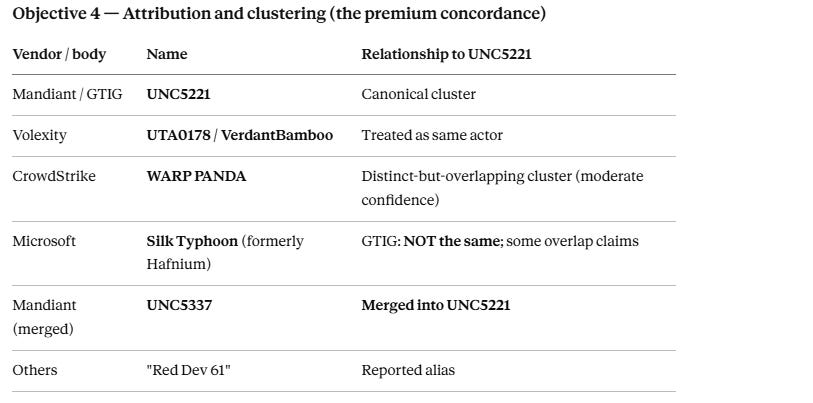
Strategic-attribution wrinkle (must address): The DOJ’s March 2025 indictment of Yin Kecheng and Zhou Shuai (unsealed SDNY) groups APT27 aliases including “UTA0178,” “UNC 5221,” and “Silk Typhoon,” tied to MSS/MPS and the i-Soon contractor ecosystem. EclecticIQ and Palo Alto assess UNC5221/UNC5174/CL-STA-0048 connect to the MSS or affiliated private entities. This conflicts with Mandiant/GTIG’s explicit position that UNC5221 and Silk Typhoon are distinct. Present both, do not silently reconcile.
Designation status: UNC5221 remains an “UNC” (uncategorized) cluster in Mandiant’s taxonomy — it has not been graduated to a numbered APT/FIN group. (Mandiant’s own definition: UNCs “can grow, merge… and ‘graduate’ into fully defined groups.”) Some secondary outlets loosely call it “an APT” or give it spurious aliases like “Gothic Panda” — treat those as unreliable; Gothic Panda is APT3, a different actor.
Objective 5 — MITRE ATT&CK mapping
MITRE Campaign C0029 “Cutting Edge” (First seen Dec 2023, last seen Feb 2024; “suspected China-nexus espionage actors, variously identified as UNC5221/UTA0178 and UNC5325”; targeted U.S. defense industrial base + telecom/financial/aerospace/technology globally). Techniques observed across the corpus (CISA AR25-338A uses ATT&CK v18):
Initial Access: T1190 (Exploit Public-Facing Application — primary), T1133 (External Remote Services).
Execution/Persistence: T1505.003 (Web Shell), T1037 (boot/logon init scripts — modified
init.d/rc.local/systemdon vCenter), T1543 (create/modify system service/daemon).Privilege Escalation/Credential Access: T1003.003 (NTDS via cloned DC VMs /
ntds.dit), T1552 (unsecured credentials — vaults, PowerShell scripts, Delinea Secret Server), T1555 (credentials from password stores), T1556 (modify authentication / Entra abuse, MFA-device registration), HTTP Basic capture via BRICKSTEAL.Lateral Movement: T1021.001 (RDP), T1021.004 (SSH), valid accounts.
C2: T1071.001 (web/HTTPS), T1071.004 (DNS / DoH), T1090.001 (internal proxy/SOCKS), T1572 (protocol tunneling — WebSockets/nested TLS/VSOCK).
Defense Evasion: T1027 (obfuscated files — Garble), T1070 (indicator removal/log clearing, timestomping), T1562 (impair defenses), T1036 (masquerading as legitimate appliance processes —
vami-httpd,updatemgr,vvold).Collection/Exfiltration: Entra ID Enterprise Application abuse with
mail.read/full_access_as_appscopes; SOCKS-tunneled exfil; ZIP archive download of code repos; UNC-path file access.
Objective 6 — Detection and hunting
Mandiant BRICKSTORM scanner (github.com/mandiant/brickstorm-scanner) — shell script for *nix appliances, no YARA dependency; replicates rule
G_APT_Backdoor_BRICKSTORM_3; published Sept 24, 2025. Explicitly not a guarantee of a clean system.CISA YARA + Sigma in AR25-338A (downloadables: MAR-251165.c1.v1, MAR-2512217.c1.v2, MAR-261234.c1.v1; “AR25-338A Sigma YAML”). New YARA rules added Dec 19, 2025 and Jan 20, 2026 for Rust samples; samples named e.g.
vsm-boot-monitordvcenter,vsm-monitordvcenter,if-up,pg_update,spclisten.NVISO — YARA (Windows backdoor), Suricata (TLS SNI
ms-azure.azdatastore.workers.dev), and Microsoft Defender KQL for rare long-running processes with network connections.CrowdStrike VirtualGHOST PowerShell script — detects unregistered (”rogue”) VMware VMs.
Microsoft Sentinel KQL for CVE-2025-0282-vulnerable devices (Silk Typhoon blog).
Hunt playbook (Mandiant checklist): (0) build an asset inventory including edge/appliance devices outside the EDR stack; (1) file + backup-image YARA scans for BRICKSTORM (multiple customers found it only via backup-datastore scanning); (2) edge-device egress in firewall/DNS/IDS/netflow logs (appliances should not talk to the public internet except for updates/telemetry); (3) Windows logons/RDP originating from appliances; (4) VAMI/ESXi SSH-enable events (
PUT /rest/appliance/access/ssh); (5) vCenter VPXD VM clone/snapshot/destroy events by non-standard accounts; (6) Entra Enterprise Apps with broad mail scopes; (7) block unauthorized DoH resolvers and inspect nested TLS. Atomic IOCs expire — emphasize TTP/behavioral hunting. IOC examples for the rewrite: WARP PANDA IPs208.83.233[.]14,149.28.120[.]31; GuestConduit SHA25640db68331cb52dd3ffa0698144d1e6919779ff432e2e80c058e41f7b93cec042; EPMM-campaign infra27.25.148[.]183,ns1[.]cybertunnel[.]run.
Objective 7 — Strategic and geopolitical context
UNC5221’s mission is espionage plus zero-day R&D harvesting: per GTIG, targeting SaaS providers to reach “downstream customer environments,” and targeting legal/tech firms to gather “national security and international trade” intelligence and “steal intellectual property to advance the development of zero-day exploits.” John Hultquist (GTIG chief analyst) framed it (Cybersecurity Dive/CyberScoop): “It’s an intelligence operation, but not just an intelligence operation… This is a long-term play,” and likened the vendor-to-customer movement to “other supply-chain incidents such as Russia’s SolarWinds espionage campaign.”
Contrast with the Typhoons (a clean analytic frame for the rewrite):
Volt Typhoon — assessed by CISA/NSA/FBI (AA24-038A) as PLA-aligned, prepositioning for disruptive/destructive attacks on critical infrastructure (LOTL, 5-year dwell), not traditional espionage.
Salt Typhoon — MSS-aligned espionage against telecom backbones (CALEA/lawful-intercept, CDRs); sanctioned entity Sichuan Juxinhe.
UNC5221 — sits with Salt Typhoon on the espionage axis, but its distinguishing trait is edge/virtualization-control-plane capture for IP and zero-day theft, not telecom metadata or kinetic prepositioning. The targeting (legal, SaaS, BPO, tech, F5) aligns with PRC priorities in technology transfer and national-security collection (frequently tied analytically to the 14th Five-Year Plan / “Made in China 2025” technology goals — present as analyst framing, not as an attributed PRC document.)
Objective 8 — Fact-check of the existing draft
“BRICKSTORM used against legal services, SaaS providers, BPOs, technology companies” — ACCURATE, verbatim from Mandiant (Sept 24, 2025). (HIGH.)
CVE-2023-46805 = authentication bypass; CVE-2024-21887 = command injection — ACCURATE (Ivanti KB, Volexity, Tenable, Mandiant). (HIGH.)
CVE-2025-22457 = buffer overflow — ACCURATE; GTIG: “a buffer overflow with a limited character space,” initially mis-assessed as low-risk DoS, patched in 22.7R2.6 Feb 11 2025, exploited from mid-March 2025. (HIGH.)
“Cutting Edge” campaign, December 2023 start — ACCURATE per MITRE C0029 (First Seen December 2023). (HIGH.)
BRICKSTORM scanner tool documentation citation — ACCURATE (github.com/mandiant/brickstorm-scanner; replicates
G_APT_Backdoor_BRICKSTORM_3; published Sept 24 2025). (HIGH.)Microsoft Silk Typhoon supply-chain sectors — ACCURATE, verbatim list above. (HIGH.)
Volexity “mitigations did not remedy active or past compromise” — VERIFIED; exact quote provided above. (HIGH.)
Caution flag for the draft: the draft’s list “UNC5325, Silk Typhoon, APT27, WARP PANDA” mixes a merged sub-cluster (UNC5325 is separate from the now-merged UNC5337), vendor synonyms, and a contested DOJ grouping — the rewrite should present these as a concordance with relationship qualifiers, not a flat “related clusters” list.
Objective 9 — Gaps in the draft to fill
Named victims: F5 (confirmed, the marquee case); MITRE NERVE breach (Dec 2023–Mar 2024, ROOTROT/BRICKSTORM/BEEFLUSH/WIREFIRE/BUSHWALK — MITRE itself published the timeline); the CISA IR victim (unnamed, April 2024–Sept 3 2025, ADFS key theft); VerdantBamboo MSP + downstream customer (unnamed).
Concrete dwell-time data: 393-day Mandiant average; 18-month WARP PANDA/VerdantBamboo cases; ~12-month F5; April 2024–Sept 2025 CISA victim. Contextualize against Volt Typhoon’s 5-year figure.
Defensive-control failures observed: vCenter without MFA (BRICKSTEAL capture); appliances excluded from logging/EDR; Conditional Access defeated by VPN-IP/session-token replay; MSP trust relationships; hard-coded EPMM MySQL creds.
Forensic artifacts: vCenter VPXD clone/destroy logs; VAMI
PUT /rest/appliance/access/ssh; modifiedinit.d/rc.local/systemd; BRICKSTORM in backup images even after on-host deletion; Windows User Access Logs/Shellbags; Entra mail-access logs.Comparison campaigns: SolarWinds analogy (Hultquist), Salt/Volt Typhoon contrast.
Sector-specific recommendations for MSPs, SaaS, legal (below).
Recommendations (staged, with thresholds)
Stage 1 — Editorial structure (immediate). Lead the rewrite with the supply-chain blast-radius thesis anchored on the F5 case study and the SaaS-pivot evidence; this is the through-line free vendor blogs don’t connect. Build the cross-vendor naming concordance table (above) as the signature premium asset, with explicit relationship qualifiers and the GTIG “not the same as Silk Typhoon” and DOJ “APT27 grouping” tensions called out.
Stage 2 — Practitioner depth (the paid differentiator). Embed the appliance/vCenter/identity hunt playbook (Objective 6) as a checklist readers can action, plus a forensic-artifact table. Add ICD 203 confidence notations on every major claim and a single-source-vs-corroborated flag (e.g., mark KrustyLoader→UNC5221 as moderate, not conclusive; mark WARP PANDA=UNC5221 as vendor-distinct, overlapping).
Stage 3 — Sector cuts. Write three short tailored boxes: (a) MSPs — your pfSense/edge firewall and management plane are the prize; enforce MFA on all admin interfaces, segment management VLANs, and assume downstream-customer blast radius. (b) SaaS providers — rotate and vault API keys, monitor Entra Enterprise App mail scopes, treat customer-data tenancy as the target. (c) Legal firms — mailbox-targeting of partners on trade/national-security matters; prioritize M365 audit logging and Conditional Access that can’t be defeated by VPN-IP session replay.
Benchmarks that change the guidance: (i) If Mandiant graduates UNC5221 to a numbered APT, upgrade the attribution section from cluster-based to named-actor. (ii) If a named non-F5 victim (legal/SaaS) is publicly disclosed, lead with it. (iii) If CISA/Mandiant publish edge CVEs beyond Ivanti/F5/Citrix/NetScaler/EPMM/SAP (e.g., confirmed Fortinet), expand the exploitation-surface table. (iv) If the DOJ/MSS attribution is corroborated by Mandiant, collapse the concordance tension.
Caveats
Attribution is cluster-based. UNC5221, UTA0178/VerdantBamboo, WARP PANDA and Silk Typhoon are not confirmed equivalent; GTIG explicitly separates UNC5221 from Silk Typhoon, while the DOJ indictment groups several aliases under APT27/MSS. Do not present any single vendor name as ground truth.
The 393-day figure is Mandiant’s UNC5221 average — do not attribute it to CrowdStrike’s WARP PANDA reporting, which gives a ~18-month single-case figure.
KrustyLoader’s attribution to UNC5221 is not conclusive per EclecticIQ’s own hedging (”does not conclusively attribute KrustyLoader itself to UNC5221”).
F5 exposed-host counts vary by methodology (Shadowserver ~267,000; Censys ~680,000; Cortex Xpanse 600,000+) — cite the source and method.
Some secondary outlets contain errors — e.g., spurious aliases (”Gothic Panda”=APT3, not UNC5221) and “APT” labeling. Anchor on Mandiant/GTIG, Volexity, CISA/NSA, Microsoft and CrowdStrike primaries; treat aggregator blogs as corroboration only.
F5 and others state no confirmed exploitation of the stolen vulnerabilities yet, and CISA “is still completing analysis” of full BRICKSTORM impact — avoid overstating downstream compromise as established fact; flag forward-looking risk as risk, not event.