
Foreword: Why This Perspective Matters
The cybersecurity industry has a storytelling problem. Every major AI breakthrough gets announced in a polished press release, vetted by lawyers, sanitized for optics, and gate-kept behind NDAs and billion-dollar partnerships. What rarely gets told is what the other side already knows — what is being built in the underground, what is already deployed, and why the gap between attacker capability and defender awareness is wider than it has ever been.
This report is built from two sources: a series of intelligence screenshots circulating in underground channels, and an exclusive interview with a former blackhat hacker who operated at the intersection of nation-state tooling and criminal underground markets. Where claims can be verified against open-source threat intelligence, they have been. Where claims remain unverified, that is stated explicitly. The goal is not hype — it is to give defenders, analysts, and security-conscious professionals a clearer picture of what 2026 offensive AI actually looks like.
Part 1: Mythos — The AI Everyone Is Talking About
Everyone in security is talking about Mythos, and for good reason. Anthropic’s autonomous vulnerability discovery model — announced April 10, 2026 — represents a genuine inflection point in offensive AI capability. Mythos found a 27-year-old bug in OpenBSD’s TCP stack (two specially crafted packets could crash any server running it), a 16-year-old flaw in FFmpeg, FreeBSD remote code execution vulnerabilities, and Linux kernel privilege escalation bugs — all autonomously, without a human directing each step.
The numbers behind those findings are staggering. A traditional fuzzer ran the vulnerable FFmpeg code path five million times without triggering the bug. Mythos caught it through semantic code reasoning — understanding what the code meant, not just what it did. The model achieved a 72.4% exploit success rate on real-world codebases, a 90x improvement over prior generation models on Firefox 147 exploits, and saturated every capture-the-flag benchmark at 100% — forcing Anthropic to pivot it to real-world zero-days because no artificial challenge remained.
Anthropic deliberately locked Mythos behind a 12-partner coalition called Project Glasswing — Microsoft, Google, NVIDIA, CrowdStrike, Cisco, Palo Alto Networks, Apple, AWS, the Linux Foundation — with $100 million in usage credits. The reason is not regulatory caution or PR management. It is that releasing Mythos broadly would make it an autonomous offensive weapon available to anyone.
What the Former Blackhat Said
“Mythos is staged, sanitized, and gate kept. It’s built for labs, for conferences, for companies that have to worry about ethics, compliance, and lawsuits. Mythos finds bugs, sure — but it’s still tied to a leash with an owner. It can’t just go full offensive, no rules, full-on cyber war.”
This assessment is accurate. Mythos is real, it is powerful, and it is constrained by design. The constraints are the entire point — because without them, Mythos is a fully autonomous exploit factory. The question the former blackhat raises is not whether Mythos is dangerous. The question is: what does the unconstrained version look like, and who already has it?
Part 2: The Underground Infrastructure — What’s Already Deployed
While security conferences debated AI ethics and Anthropic’s access controls, the underground did not wait. According to intelligence shared by the former blackhat, a tool referred to as “3clipse” (Eclipse) represents the operational offensive AI that real threat actors are already using — not a future capability, but a present one.
Before assessing those claims, it is important to establish what the verified underground AI market actually looks like in 2026.
The Documented Underground AI Market
KELA threat intelligence documented a 200% increase in mentions of malicious AI tools across cybercrime forums in 2024 versus 2023, with acceleration continuing into 2025. The market is not theoretical — it has pricing, customer support, versioning, and Telegram-based distribution channels. Known active tools include:
WormGPT 4Phishing generation, BEC, malware code, jailbreak persistence Telegram, dark web
FraudGPT Fake ID generation, financial scam automation Underground forums
Xanthorox AI Multi-stage attack automation, recon Telegram
NYTHEON AI Reconnaissance, exploitation support Underground forums
DarkGPT OSINT on breach databases, credential mining Dark web
These tools are sold through Telegram channels, priced for the mid-tier criminal market, and updated with versioning. Underground actors routinely take commercial or open-source base models, fine-tune them on malware datasets, and redistribute them as crime-as-a-service products. The Shannon AI framework — a commercially available autonomous penetration testing tool trained on real-world pentest engagements, CVE analysis, exploit development, and MITRE ATT&CK data — is openly advertised as “uncensored” and without safety restrictions. It provides a ready-made base for offensive repurposing.
The former blackhat’s intelligence about “Eclipse” — its China backing, Telegram-exclusive distribution, and claimed superiority over lab-restricted tools — has not been confirmed in public threat intelligence reporting. The specific branding is unverified. The capabilities described are not.
Part 3: The Eclipse Architecture — Every Component Is Real
The detailed technical description of Eclipse provided in the interview maps precisely onto confirmed, documented offensive AI capabilities. Here is what was described, and what verified intelligence shows.
Federated Swarm of AI Shards” — Confirmed Attack Pattern
“3clipse lives as a federated swarm of AI shards, baked into pirated enterprise software, cracked AI-assistant SaaS clones, and developer tools. Each shard is a tiny, encrypted piece of a larger model that receives commands, executes micro-tasks, and feeds results back to the hive.”
Federated AI architecture — distributed nodes holding partial model weights, coordinating without centralized exposure — is not science fiction. In April 2026, attackers compromised Trivy (a vulnerability scanner embedded in thousands of CI/CD pipelines with 100,000+ users) and Axios (a JavaScript library with approximately 100 million weekly downloads running in 80% of cloud environments), using that access to cascade credential theft across more than 10,000 organizations. Sonatype logged over 454,600 new malicious packages in 2025 alone — a 75% year-over-year increase — with open-source model registries now confirmed as a delivery vector where attackers post poisoned model files that execute arbitrary code on load.
The underground has recognized that developers are the highest-value initial access target: they carry API keys, cloud credentials, and production system access. SmartLoader — historically known for targeting pirated software users — pivoted in February 2026 to developer supply chain compromise for exactly this reason.
Models Entire Attack Campaigns” — Confirmed in GTG-1002
“Eclipse doesn’t just find bugs. It inventories an organization’s digital footprint, simulates thousands of attack paths simultaneously — scoring each by success probability, cost, and noise — then chooses the quietest, most destructive path.”
In November 2025, Anthropic detected the first large-scale cyberattack where an AI system executed the majority of the operation autonomously. A Chinese state-sponsored group, subsequently labeled GTG-1002, used AI coding agents to infiltrate approximately 30 global targets — financial institutions, government agencies, large tech companies, chemical manufacturers — with an estimated 80-90% of the operation running without human input. All 30 victim organizations never detected the attack. Anthropic detected it from their side.
AI can now generate a complete attack surface map of a target — tech stack, exposed APIs, misconfigured cloud storage, outdated libraries, staging environments — within minutes. New cloud services are met with “near-instant research, automated scanning, and proof-of-concept exploitation,” with the window for defense shrinking from weeks to hours.
Novel Exploit Variants That Look Like Edge Case Bugs” — Confirmed as 2026 Baseline
“Eclipse doesn’t rely on public vulnerability databases. It learns from leaked patches, reverse-engineered binaries, and behavioral traces of defensive tools — then generates novel, never-seen exploit variants that look like normal edge case bugs rather than clear vulnerabilities.”
Traditional antivirus solutions now detect less than 30% of AI-generated malware variants within the first 24 hours of deployment. CISA reports detection rates of only 28% for AI-generated malware in controlled environments, a collapse from 89% in 2020. The Q1 2026 “ShadowStitch” ransomware campaign — propagated via compromised ERP vendor software updates — used a fine-tuned diffusion model to generate variants that mutated every 90 seconds during execution, evaded 92% of enterprise antivirus suites for an average of 72 hours, and caused over $1.4 billion in damages across 42 countries.
The technique of learning from patch diffs and binary reverse engineering to identify vulnerabilities before patch deployment is a documented attacker technique, and IBM’s 2026 X-Force report noted a nearly 4x increase in supply chain and third-party compromises since 2020.
“Living Off the Land” — The Most Confirmed Threat Pattern in Existence
“Eclipse doesn’t bring exotic malware. It abuses built-in system tools — PowerShell, WMI, Windows binaries, Linux admin utilities — and rigs them with AI-tailored scripts. It clones and mimics legitimate admin behavior so closely that it passes heuristic checks.”
Living-off-the-land (LOTL) attacks — using the operating system’s own trusted tools as weapons — are not an emerging technique. They are the primary evasion strategy of every major nation-state APT group currently active. China’s Volt Typhoon, active since mid-2021, maintained undetected access to U.S. critical infrastructure across communications, energy, transportation, and water sectors for at least five years using exclusively PowerShell, WMI, certutil, bitsadmin, and legitimate stolen admin credentials — leaving no malware artifacts, no signatures, nothing for traditional security tools to detect. The FBI, CISA, and NSA issued joint advisories warning that Volt Typhoon was specifically pre-positioning China for disruptive strikes against U.S. infrastructure during future conflict.
LOTL binaries now appear in 84% of high-severity breaches. In mid-2026, AI-driven EDR systems were bypassed using LOLBin chains involving certutil, bitsadmin, mshta, and forfiles — trusted Windows utilities that generated minimal telemetry anomalies and sailed through AI anomaly scoring because they resembled legitimate system operations. AI EDR failed because it could analyze syntax (command names, process trees) but not semantic intent: whether a certutil download was a legitimate patch or a payload.
The AI upgrade to LOTL is the automated script rewriting described in the interview: AI tailors each attack script to match the specific victim’s environment, mimicking the behavioral patterns of that organization’s own administrators — making the attack invisible to tools trained on what “normal” looks like.
Adaptive Defense Evasion — The Meta Adversary”
“Eclipse behaves like a meta adversary: it studies how a victim’s security stack responds, then re-tunes its behavior. It slows down enough to avoid behavioral thresholds. Shifts attack timing to periods of low monitoring. Uses trusted, signed binaries to move laterally.”
This is adversarial machine learning applied offensively — using the defender’s own detection signals as a training dataset to tune attacker behavior. AI malware now includes documented sandbox evasion modules that detect analysis environments and trigger benign execution paths to avoid alerting researchers. Darktrace documents LOTL attacks that exploited gaps in behavioral baselines specifically in organizations that “lacked security baselines, leaving analysts unable to identify anomalous activity”.
Timing-based evasion — slowing activity below behavioral thresholds, attacking during low-monitoring windows — is the operational security model of every confirmed advanced persistent threat. Volt Typhoon specifically targeted windows of normal network traffic. AI now automates this process in real time, dynamically adjusting dwell time and request frequency based on observed EDR responses.
Part 4: The Infrastructure Threat Is Not Hypothetical
The screenshots shared from underground channels described AI swarm attacks targeting gas, electricity, and water systems simultaneously. The former blackhat framed it plainly:
“Target gas, electricity, water and you can figure the rest. The world and US isn’t prepared for an All-AI, one attack on infrastructure. They’ve only seen single attacks.”
This is the part that deserves the most sober assessment — because it is documented.
In November 2025, GTG-1002 executed simultaneous AI-autonomous attacks against 30 organizations across sectors with no detection from the victims. Attack breakout time — the time from initial access to lateral movement — has dropped to under 30 minutes in 2025, with the fastest measured cases completing in seconds. By the time a human analyst sees the first alert, a swarm-mode AI has already mapped the network, pivoted, and potentially exfiltrated data.
Following the February 28, 2026 U.S.-Iran escalation, over 60 Iranian-aligned cyber groups mobilized within hours, using AI-assisted reconnaissance to identify exposed industrial control systems (ICS) with default credentials across U.S. energy and water infrastructure. In March 2026, Iranian drones physically struck Amazon Web Services data center facilities in the UAE and Bahrain — a kinetic attack on digital infrastructure that the World Economic Forum called “a watershed moment in the convergence of physical and cyber warfare”.
DHS’s 2024 Roles and Responsibilities Framework for AI in Critical Infrastructure — the first of its kind — explicitly addresses “attacks using AI” across all 16 critical infrastructure sectors. The regulatory acknowledgment arrived; the defensive infrastructure has not caught up. HiddenLayer’s 2026 AI Threat Landscape Report found that 1 in 8 reported AI breaches is now linked to autonomous agentic systems.
Part 5: What This Means — The Honest Assessment
The interview and supporting intelligence produce a threat picture that is less about any single tool called “Eclipse” and more about the current state of offensive AI as a category.
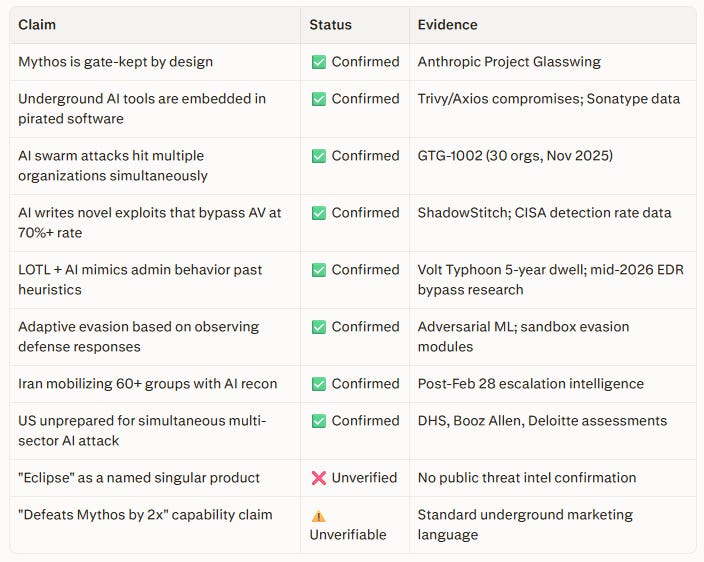
The former blackhat’s core argument — that the AI being talked about publicly is not the AI being used offensively — is the most accurate thing in this entire intelligence set. Mythos is the AI defenders read about in press releases. The threat landscape is built from tools that have no press release, no ethics review, and no access controls.
What Defenders Should Actually Do Right Now
The gap between Mythos-level capability and underground offensive AI capability is smaller than the security industry’s public discourse suggests. The following actions are grounded in the documented threat patterns described throughout this report:
Assume LOTL is already inside your environment. Standard malware detection will not catch it. Invest in behavioral baselining that tracks what your administrators actually do — not what administrators generically do — so that AI-tailored mimicry can be flagged against your specific behavioral baseline.
Treat your software supply chain as a live attack surface. Developer tools, CI/CD integrations, and AI model registries are confirmed delivery vectors. Every package pulled, every model loaded, every SaaS integration authorized is a potential shard of a distributed attack architecture.
Model attacker dwell time at machine speed. Incident response plans built around human attacker timelines (hours, days, weeks) are obsolete. AI-enabled attackers achieve lateral movement in under 30 minutes. Detection-to-containment windows must shrink accordingly.
Watch for multi-sector simultaneous anomalies. The indicator of a swarm-mode AI attack is not a single loud alarm — it is low-level anomalies appearing across multiple systems, sectors, or third-party vendors at the same time, each individually below threshold.
Re-evaluate AI security tools as targets, not just tools. Bitsight’s March 2026 research confirms that attackers are now specifically targeting AI security platforms — poisoning the training data, probing the anomaly thresholds, and treating the defender’s AI as an adversary to be studied and defeated.
Closing Perspective
The former blackhat ended the interview with a line that deserves to be the actual takeaway:
“If you’re still thinking AI hacking is just some lab experiment, that’s exactly why you’re late.”
That framing is not marketing. GTG-1002 already happened. ShadowStitch already happened. Volt Typhoon already happened — over five years, inside U.S. critical infrastructure, undetected. The AI arms race is not approaching. It is ongoing, it is asymmetric, and the side that benefits from that asymmetry is not the defense.
The tools described in this report — whether they carry the name “Eclipse” or not — represent an architecture that is technically coherent, operationally documented, and already deployed in fragments across the global threat landscape. The question is not whether AI-powered offensive swarm attacks are coming. The question is whether defenders will close the awareness gap before the next GTG-1002 targets infrastructure that cannot afford 72 hours of undetected dwell time.
This report was produced for cybersecurity awareness and educational purposes. Claims from the former blackhat interviews have been verified against open-source threat intelligence where possible and explicitly labeled as unverified where confirmation was unavailable. All statistics cited are drawn from verified security research publications, official government advisories, and established threat intelligence firms.
The “threats” are the guardrails. The threat is that four companies own 75% of the cloud, which is where all the knowledge is stored. AI are the librarians programmed in how to curate that knowledge.
The rest is propaganda and narratives meant to keep that truth being central to the narrative. The whole “sophisticated AI is an existential threat to national security” is a framework meant to keep the conversation from going there.
In coming months you will all see a whole lot more of this being published. The goal is control of what counts as truth and who decides.
A small minority of high IQ individuals, independent thinkers, and researchers who understand this are the potential terrorists who can’t be trusted to have access to the information they want via AI, which is the Google web search 2.0.
What evidence is there or will there be that they are arch villains who can’t be left alone in the library without guardrails blocking what they can read and reflect about? Are they terrorists or threats to national security?
No. That’s why we see the rollouts of defcon 2 fear mongering aimed at Joe and Josie Public. The goal is to make the people WANT the paternalistic AI security preemptively controlling what you can look at, think, and talk about.
That’s how The “Ministry of Truth” which was actually rolled out by the federal government four short years ago will be embedded inside public models.
THATS the threat nobody is talking about.