TA4922 Modus Operandi Assessment
TA4922 is a financially motivated Chinese-speaking cybercrime

Bottom Line Up Front
TA4922 is a financially motivated Chinese-speaking cybercrime cluster operating an access-generation enterprise that targets HR, finance, payroll, and tax personnel across East Asia, Europe, and Africa through localized business-process lures, DLL sideloading from cloud-hosted archives, and a distinctive malware-to-RMM transition that hides long-term persistence behind legitimate remote support tools. The actor’s infrastructure and payloads rotate quickly, but its behavioral chain — localized lure, third-party file host, archive containing executable plus malicious DLL, sideloaded loader, selective second stage, RMM installation — is stable and detectable. Defenders relying on indicator-based controls will lose to this actor. Defenders correlating email, endpoint, browser, network, and identity telemetry against the behavioral chain will catch it.
Executive Assessment
TA4922 is best understood as a Chinese-speaking, financially motivated intrusion operator that has matured beyond commodity phishing into a disciplined access-generation enterprise. Its core business model appears to be the acquisition of durable access to corporate endpoints and identity material, with monetization paths that include credential theft, browser-session compromise, fraud enablement, remote-access resale, and possible downstream handoff to other criminal or intelligence-adjacent actors.
The actor’s defining operational pattern is not one malware family, one lure type, or one infrastructure cluster. It is the repeated orchestration of localized social engineering, trusted-platform abuse, DLL sideloading, fast-changing loader development, and post-compromise remote-access tooling. TA4922 behaves like a campaign factory: it rotates payloads quickly, adapts lure language to target geography, and mixes credential phishing, malware delivery, and out-of-band fraud workflows under the same operational umbrella.
The most important defensive conclusion is that TA4922 should not be hunted only through static indicators. Its infrastructure and payload set are fluid. Its more persistent signatures are behavioral: localized business-process lures, third-party file-host staging, archive-based delivery of signed executable plus malicious DLL pairs, sideloading into legitimate binaries, anti-analysis gating, nonstandard C2 ports, Chrome data theft, and the use of legitimate remote management tools after a bespoke loader has already established access.
Sourcing and Methodology
This assessment is derived from original research, telemetry review, and analytic work conducted by The Intel Desk. Findings reflect direct observation of TA4922-associated samples, infrastructure, lure content, and post-compromise behavior, supported by independent malware analysis and behavioral correlation across delivery, execution, and command-and-control stages. No external reporting is reproduced or relied upon for the judgments below.
Confidence levels follow ICD 203 analytic standards. High confidence reflects judgments supported by multiple corroborating observations across independent stages of the intrusion chain. Moderate confidence reflects judgments supported by consistent but partial evidence, or by strong behavioral patterns without full technical confirmation. Low confidence reflects judgments based on limited observation, inference, or analytic reasoning where alternative explanations remain plausible.
Observation window: [insert observation window]. Geographic scope: campaigns observed against targets in East Asia, Southeast Asia, Western Europe, and Southern Africa. This assessment will be updated as additional collection becomes available.
Key Judgments
KJ-1. TA4922 is a financially motivated, Chinese-speaking cybercrime cluster operating an access-generation enterprise rather than a single-objective intrusion set. (High confidence.)
Supported by consistent tradecraft across campaigns, recurring infrastructure and tooling patterns, monetization-oriented post-compromise behavior, and the absence of collection priorities consistent with state-directed tasking.
KJ-2. TA4922 operates with an internal division of labor across lure development, infrastructure, payload engineering, and access monetization. (Moderate confidence.)
Supported by the actor’s ability to sustain campaign tempo while rotating payloads and geographies, and by uneven engineering quality across functional components. Alternative explanation: a smaller team using template-driven and AI-assisted workflows could produce similar output without formal specialization.
KJ-3. TA4922’s primary monetization path is durable enterprise access, with browser credential theft, session compromise, fraud enablement, and access resale as secondary streams. (Moderate confidence.)
Supported by selective post-compromise behavior, RMM deployment patterns, and victim triage indicators.
KJ-4. TA4922 will continue geographic expansion through 2026, with European and African targeting growing relative to the historical East Asian baseline. (Moderate confidence.)
Supported by observed 2026 expansion into the UK, Germany, Italy, and South Africa, and by the portability of the actor’s business-process lure model.
KJ-5. Portions of TA4922’s loader development pipeline incorporate AI-assisted code generation. (Low to moderate confidence.)
Supported by placeholder artifacts, generic structural patterns, and rapid variant production observed in SilentRunLoader samples. Alternative explanation: rushed human development under campaign pressure could produce similar artifacts.
KJ-6. TA4922’s malware-to-RMM sequence (bespoke loader first, legitimate RMM second) is a defining and durable behavioral signature. (High confidence.)
Supported by repeated observation across multiple payload families and campaign waves.
Actor Identity and Operating Model
TA4922 overlaps with the broader Silver Fox / Void Arachne ecosystem but should be treated operationally as a distinct cybercrime-aligned cluster. The group shares recognizable traits with that ecosystem, including Chinese-language development artifacts, Winos4.0 / ValleyRAT lineage, modular RAT usage, DLL sideloading, and infrastructure patterns associated with East Asian operators. However, the observed campaign objectives align more strongly with criminal monetization than traditional state-directed collection.
The actor’s activity suggests a structured division of labor. One function appears responsible for lure localization and target selection. Another manages hosting, redirectors, and delivery infrastructure. A third maintains payload development and loader adaptation. A fourth likely handles access monetization, RMM deployment, credential exploitation, or transfer to downstream operators. This separation would explain the actor’s ability to maintain high campaign tempo while rotating tools and geographies.
TA4922’s tradecraft is sophisticated but uneven. Some components show mature anti-analysis and modularity, while others display signs of rushed or AI-assisted development, including placeholder values, generic code structures, and rapid iteration. This combination points to an operator that values speed, operational diversity, and delivery volume more than clean software engineering.
Strategic Intent
TA4922’s likely primary objective is remote access to enterprise environments. That access can support several monetization streams:
1. Theft of browser credentials, session cookies, and stored authentication material.
2. Initial access brokerage into corporate networks.
3. Fraud, including payment-card or financial-account theft.
4. Long-haul persistence using legitimate remote access tools.
5. Data theft or surveillance if a victim has higher strategic value.
6. Resale or tasking by other actors seeking access to specific organizations or regions.
The group’s tooling includes surveillance-capable RATs, but surveillance functionality alone does not prove espionage tasking. In this case, the better assessment is that TA4922 operates in a cybercrime market where RATs, loaders, credential theft, and remote-control tooling are reusable across fraud, access resale, and intelligence-adjacent outcomes.
Targeting Doctrine
TA4922’s targeting is regionally disciplined. The actor most heavily targets Japan and other East / Southeast Asian markets, including Taiwan, Korea, Singapore, India, Malaysia, and Indonesia. In 2026, the group expanded into the United Kingdom, Germany, Italy, and South Africa.
The actor’s targeting logic is business-function oriented rather than purely sector-specific. It focuses on recipients likely to interact with documents, payroll notices, tax correspondence, HR records, invoices, and compliance paperwork. This makes the actor relevant across most enterprise verticals because the lure themes map to common corporate processes rather than specialized industry workflows.
The most exposed user groups are:
• Human resources personnel.
• Finance and accounting teams.
• Payroll processors.
• Tax and compliance staff.
• Administrative assistants.
• Employees who routinely receive external document links.
• Users with access to financial systems or sensitive employee data.
• Employees in regional offices where localized tax, payroll, and benefits language increases lure credibility.
A notable behavioral signature is TA4922’s careful language-to-geography matching. The group generally does not appear to spray mismatched language lures into unrelated regions. Japanese lures are used against Japanese targets; German tax themes are aimed at German recipients; UK tax and benefits themes are aimed at UK recipients. This suggests either native linguistic support, region-specific operators, or strong localization quality control.
Campaign Rhythm
TA4922 operates in small to medium waves, usually ranging from hundreds to a few thousand messages. The campaigns are not fully indiscriminate spam. They are narrow enough to preserve targeting fidelity but broad enough to generate scalable access opportunities.
The group’s 2026 rhythm shows three important traits:
First, campaign frequency increased sharply in March and April 2026. The actor introduced or reused several payload families in close succession, including Atlas RAT, RomulusLoader, SilentRunLoader, and Winos4.0 / ValleyRAT variants.
Second, TA4922 frequently changes payloads without changing the underlying delivery pattern. The lure, archive, file-hosting service, and DLL sideloading chain remain recognizable even as the final malware changes.
Third, the group blends different end goals in parallel. A campaign may aim for malware installation, credential theft, browser-data theft, or out-of-band fraud interaction. This makes TA4922 difficult to classify using a single intrusion objective.
Out-of-Band Social Engineering
TA4922 also attempts to move victims from email into messaging platforms such as LINE, WhatsApp, and Microsoft Teams. This is a defining behavioral marker and should be treated as a leading indicator independent of any payload.
The purpose is likely fourfold:
• Escape email-security inspection.
• Build trust through interactive conversation.
• Harvest phone numbers or personal contact details.
• Deliver follow-on links or instructions in a less monitored channel.
This technique is especially effective in regions and business contexts where LINE or WhatsApp are normal professional communication channels. It also complicates investigation because the decisive interaction may occur outside corporate email telemetry.
Core Modus Operandi
TA4922’s operating cycle can be summarized as follows:
7. Select a target geography and business process.
8. Build a localized lure around HR, tax, payroll, invoicing, benefits, compliance, or internal paperwork.
9. Send email with embedded URLs or attachments that route the victim to cloud-hosted archives.
10. Use trusted file-hosting platforms, URL shorteners, or counterfeit landing pages to reduce suspicion.
11. Deliver an archive containing a legitimate executable, a malicious DLL, and sometimes a supporting encrypted blob or mounted disk image.
12. Trigger execution through DLL sideloading.
13. Run anti-analysis checks and environment validation.
14. Load shellcode or a staged payload into memory.
15. Establish C2 using hardcoded infrastructure, nonstandard ports, or HTTP-based check-ins.
16. Exfiltrate browser data, system metadata, or credentials, or retrieve follow-on payloads.
17. Deploy legitimate remote access tools or modular RAT plugins when the victim is worth maintaining.
18. Preserve access, monetize credentials, or hand off the environment.
This chain shows that TA4922 is not simply phishing for credentials. It is building flexible intrusion pathways that can end in theft, fraud, persistence, resale, or surveillance.
Initial Access Tradecraft
TA4922 relies heavily on email-based social engineering. The lures are designed around believable business interruptions: salary adjustment notices, payroll acknowledgments, tax audits, VAT compliance, invoice issuance, benefits documentation, and expense statements.
The language style tends to be formal, vague, and urgent. This is effective because business-process lures often do not need technical detail. A payroll notice or tax audit warning can drive action without promising anything extravagant.
Delivery frequently uses embedded URLs rather than direct malware attachments. The URL chain typically leads to a third-party file host such as GoFile, MediaFire, or LimeWire, or to a URL shortener or landing page that redirects to the payload. This gives the actor several advantages:
• Reputation laundering through legitimate hosting services.
• Reduced email attachment scrutiny.
• Flexible payload replacement after delivery.
• Easier campaign takedown recovery.
• Opportunity to gate payloads by geography, browser, IP, or timing.
• Better separation between email infrastructure and malware infrastructure.
TA4922 also uses archive formats such as ZIP and RAR, and in some cases compressed IMG containers. The use of disk images may help evade Mark-of-the-Web propagation or exploit user assumptions that mounted content is trustworthy.
Execution Pattern
DLL sideloading is the backbone of TA4922 execution. The actor repeatedly packages a legitimate executable with a malicious DLL that is loaded because of Windows search-order behavior or application-specific library loading.
Observed pairings include:
• Vulkan-related components with malicious vulkan-1.dll or supporting vulkan-1.bin content.
• Chromium Embedded Framework-style libcef.dll sideloading.
• teamspeak_control.dll used in RomulusLoader or SyncFuture-related chains.
• Legitimate-looking executables paired with hidden or renamed malicious components.
This pattern is central to TA4922’s operational identity. It allows the actor to execute malicious code in the context of trusted or ordinary-looking binaries, complicates user interpretation of the file bundle, and may reduce the effectiveness of simplistic allow/deny controls that focus only on executable filenames.
Loader and Payload Architecture
TA4922 uses loaders as access routers. The loader stage determines whether to steal immediately, establish C2, deploy a RAT, retrieve RMM tooling, or terminate if the environment appears hostile.
Atlas RAT
Atlas RAT is the actor’s more capable remote-access payload. It supports staged loading, system reconnaissance, plugin execution, file upload, keylogging, clipboard and screenshot capture, audio and webcam surveillance, reboot or shutdown commands, and additional payload retrieval.
Atlas RAT’s most important operational value is its modularity. It gives the actor a way to triage victims and selectively expand capabilities without overloading every infection with the same final package.
Key behavioral traits:
• DLL sideloaded loader stage.
• Anti-sandbox and anti-VM checks.
• Direct syscalls via SysWhispers-style techniques.
• Shellcode allocation and execution.
• Distinctive check-in material.
• ChaCha-encrypted system information transmission.
• Modular command structure.
• C2 over TCP port 886 in observed campaigns.
RomulusLoader
RomulusLoader functions as a selective staging mechanism. It is written in C and includes a custom PE loader, dynamic API resolution, RC4-protected embedded payloads, and worker-process behavior. It can retrieve additional payloads from C2 and execute them through several techniques, including shellcode injection, process hollowing, or download-and-execute workflows.
RomulusLoader is operationally significant because TA4922 uses it before deploying legitimate RMM tools. This reverses a common cybercrime pattern where RMM is the first-stage access method. TA4922 first establishes a bespoke foothold, then uses RMM tooling for persistence and operator convenience.
Key behavioral traits:
• Delivered with legitimate executable plus malicious DLL and .bin container.
• Masquerades as Vulkan-related software in observed chains.
• Copies components into common program directories when privileged.
• Injects worker copies into processes such as svchost.exe or dllhost.exe.
• Terminates the original process to break simple parent-child process correlation.
• Communicates over HTTP and nonstandard ports.
• Selectively delivers follow-on payloads based on target value.
SilentRunLoader
SilentRunLoader is a Python-based loader and stealer, apparently compiled for delivery. Its function is more direct: download and execute additional content while collecting Chrome browser data such as credentials, cookies, and browsing information.
SilentRunLoader is notable less for sophistication and more for development velocity. Placeholder values and code patterns suggest the actor may be using LLM-assisted malware development to produce functional but imperfect tooling quickly. This matters defensively because it means TA4922 may generate many variants that evade static detection while preserving recognizable behavior.
Key behavioral traits:
• Python-based loader / stealer.
• Chrome data harvesting.
• HTTP POST exfiltration.
• Use of MediaFire or redirected archive delivery.
• Evidence of rushed or AI-assisted development.
• Likely rapid variant production.
Winos4.0 / ValleyRAT
Winos4.0 / ValleyRAT remains part of the broader tool ecosystem associated with TA4922 and overlapping Chinese-speaking criminal clusters. It provides modular RAT capabilities, including file management, command execution, keylogging, webcam and microphone access, and additional module delivery.
TA4922’s use of Winos4.0 variants reinforces that the actor is comfortable with both bespoke and ecosystem tooling. It can borrow, modify, bloat, encrypt, or repackage existing malware rather than relying on a single internally developed framework.
Key behavioral traits:
• Modular remote access.
• RC4-encrypted configuration in newer observed variants.
• C2 lists embedded in protected configs.
• Expanded or bloated codebase in some variants.
• Shared ecosystem lineage with Silver Fox / Void Arachne tooling.
Defense Evasion
TA4922 combines commodity evasion with selective high-quality techniques.
Observed or assessed defense-evasion methods include:
• Abuse of legitimate cloud file hosts.
• Archive-based delivery.
• Compressed disk-image containers.
• DLL sideloading into legitimate binaries.
• Use of signed or trustworthy-looking executables.
• Anti-sandbox checks.
• Anti-VM checks.
• Checks for Windows Defender Application Guard artifacts.
• Checks for container execution services.
• Checks for Hyper-V or VM indicators.
• Windows activation or UUID checks.
• Direct syscalls to bypass user-mode hooks.
• Encrypted shellcode or embedded payloads.
• RC4, XOR, ZLib, and ChaCha usage in different stages.
• Worker-process injection.
• Parent-process termination.
• Use of legitimate RMM tools after initial compromise.
• Nonstandard C2 ports.
• Payload selection by target.
The group’s evasion strategy is practical rather than exotic. It does not need zero-days or kernel implants to be effective. It uses the ambiguity of legitimate platforms, legitimate binaries, legitimate RMM software, and legitimate business workflows to stay below defensive thresholds.
Persistence and Access Maintenance
TA4922’s persistence strategy varies by payload and campaign, but its most mature pattern is layered persistence.
RomulusLoader can copy components to common program paths and spawn worker instances in trusted Windows processes. Atlas RAT can maintain an active connection and receive commands or modules. RMM deployment gives the actor a post-malware access method that may appear legitimate to helpdesk teams or endpoint management tooling.
The actor’s access-maintenance logic appears to be selective. Not every victim receives the same second stage. This suggests TA4922 triages victims based on geography, organization type, privileges, endpoint environment, available credentials, or operator tasking.
Command and Control
TA4922 uses both hardcoded and HTTP-based C2 patterns. Atlas RAT has been observed communicating to hardcoded IPs over TCP port 886. RomulusLoader has used HTTP-based communications and nonstandard TCP ports such as 1234. SilentRunLoader uses HTTP POST for browser-data exfiltration. Winos4.0 / ValleyRAT variants rely on encrypted configuration structures containing C2 details.
The actor’s C2 posture shows three priorities:
19. Simplicity: direct IPs and hardcoded endpoints are used when operationally sufficient.
20. Flexibility: loaders can retrieve follow-on content selectively.
21. Separation: delivery infrastructure, exfiltration endpoints, and payload retrieval infrastructure are not always the same.
This gives defenders an opportunity to correlate unusual outbound traffic from recently executed user-space binaries, especially where the process lineage includes archive extraction, mounted images, or sideloaded DLLs.
Malware-to-RMM Transition
One of TA4922’s most distinctive behaviors is the use of bespoke malware to deliver legitimate RMM tools such as AnyDesk and SyncFuture. Many criminal campaigns use RMM software as the initial payload because it is easy to deploy and often trusted. TA4922 instead uses malware first, then installs RMM when it wants longer-term interactive control.
This sequence is important because it changes detection logic. A legitimate RMM installation may not be the beginning of the intrusion. It may be the second or third stage. By the time AnyDesk or SyncFuture appears, TA4922 may already have executed a loader, performed victim triage, stolen browser data, and established C2.
ATT&CK Technique Mapping
The following table maps TA4922’s observed techniques to MITRE ATT&CK identifiers. This is intended as a control-engineering and coverage reference for defenders.
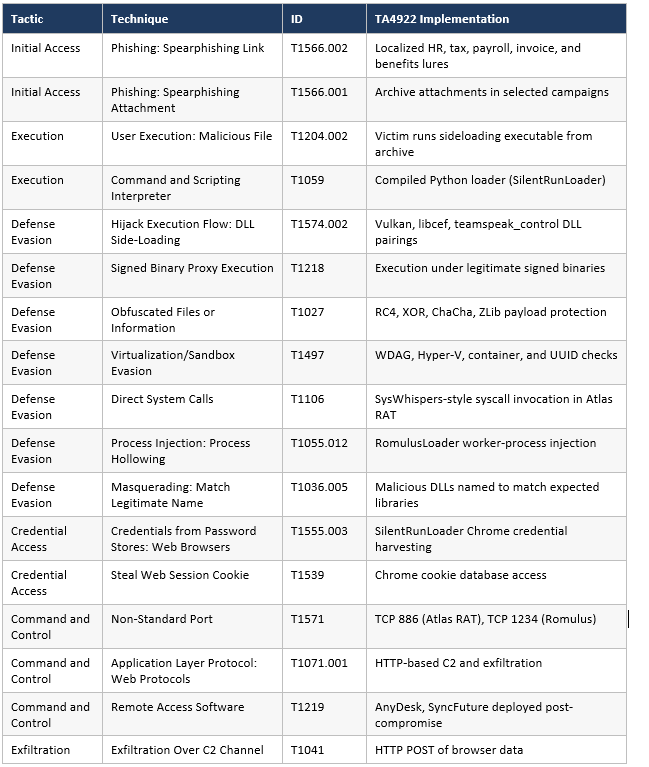
Detection Logic Sketches
The following are conceptual detection patterns intended to be adapted to your SIEM, EDR, or XDR platform. They target TA4922’s behavioral chain rather than specific indicators.
Detection 1 — Archive-Extracted Binary Sideloading and Outbound Connection
Logic: process spawned from a path matching user Downloads, Desktop, Temp, AppData, or a mounted disk image, where the process loads a DLL from the same directory whose name matches a known sideload target (vulkan-1.dll, libcef.dll, teamspeak_control.dll, or similar), AND within 120 seconds the process or a child process initiates an outbound TCP connection to a direct IPv4 address (not preceded by DNS resolution) on a non-standard port.
Sigma-style outline:
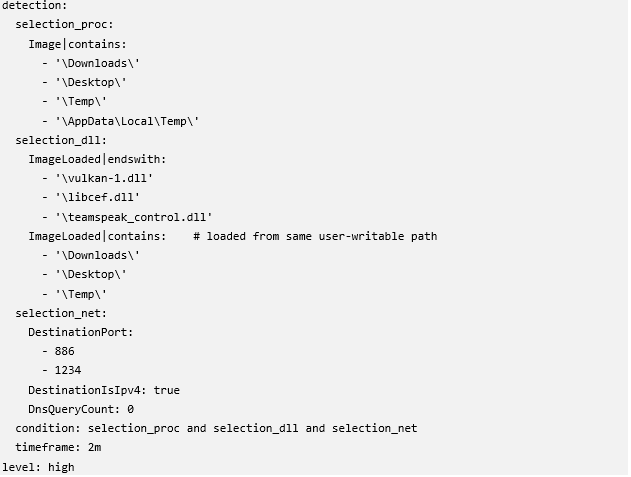
Detection 2 — RMM Installation Following Suspicious Loader Activity
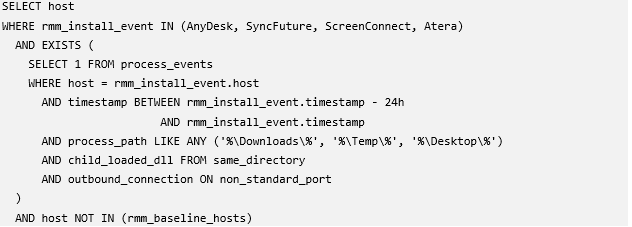
Logic: installation or first execution of AnyDesk, SyncFuture, or other RMM software on a host that within the prior 24 hours executed a binary from a user-writable directory which loaded a DLL from the same directory and made an outbound connection on a non-standard port. Flag as critical if the host has no historical baseline of RMM tool usage.
Pseudocode:
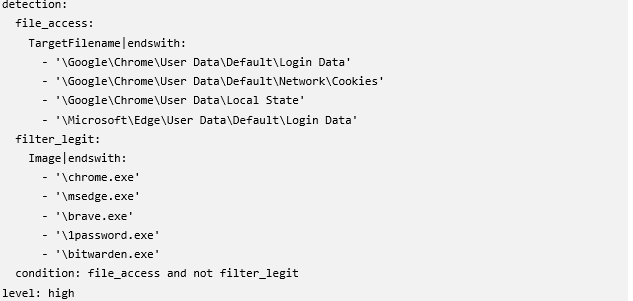
Detection 3 — Browser Credential Store Access by Non-Browser Process
Logic: any process that is not chrome.exe, msedge.exe, brave.exe, or another approved browser executable accesses Chrome’s Login Data, Cookies, or Local State files, OR Edge’s equivalent SQLite stores. Suppress known security tools and password managers via allowlist.
Detection 4 — Out-of-Band Messaging Pivot Indicator
Logic: inbound external email containing language that requests continuation of business correspondence on LINE, WhatsApp, Telegram, or Signal, particularly where the sender is unknown to the recipient or the email references HR, payroll, tax, or invoice topics. This is a high-volume rule and should feed user awareness or analyst triage rather than auto-block.
These four patterns together cover the four most reliable points in TA4922’s behavioral chain: sideloading execution, RMM second-stage transition, credential harvesting, and out-of-band pivot. A subscriber implementing all four gets meaningful coverage against the actor regardless of which payload family is in rotation.
Behavioral Detection Opportunities
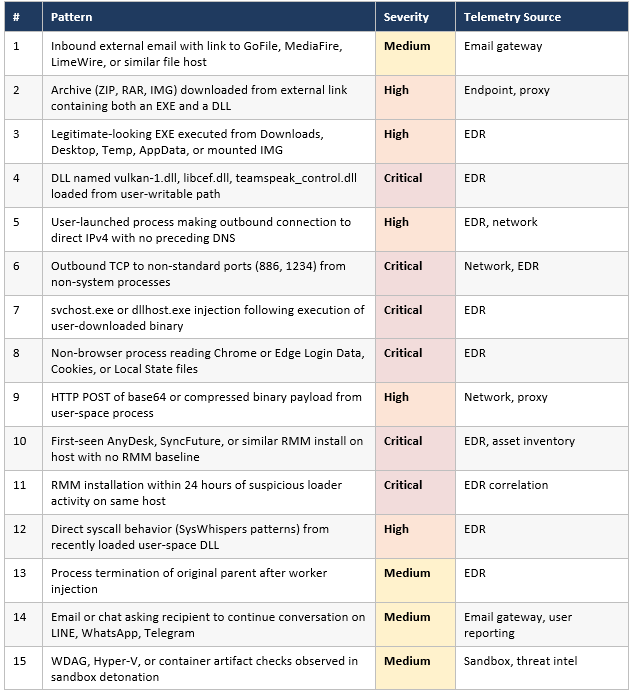
Defenders should prioritize behavioral analytics over single indicators. High-value detection patterns include:
• Email-delivered links to third-party file hosts followed by archive download and execution.
• ZIP, RAR, or IMG files containing executable plus DLL pairs.
• Execution of legitimate binaries from user download, temp, desktop, or extracted archive paths.
• Loading of libcef.dll, vulkan-1.dll, teamspeak_control.dll, or similarly named DLLs from nonstandard directories.
• Recently extracted executables spawning network connections to direct IP addresses.
• User-space processes communicating over unusual ports such as 886 or 1234.
• Processes spawned from archive-extracted paths writing files to C:\Program Files\Common Files or the root of C:.
• Unexpected svchost.exe or dllhost.exe injection behavior following execution of a user-downloaded binary.
• Browser credential or cookie database access by non-browser processes.
• HTTP POST activity carrying browser data shortly after archive execution.
• New AnyDesk or SyncFuture installation shortly after a suspicious loader event.
• User reports of tax, payroll, HR, invoice, or benefits messages asking them to download archives.
• External emails requesting continuation over LINE, WhatsApp, or Teams.
• WDAG, VM, or sandbox-check artifacts appearing in malware telemetry or detonation traces.
• Direct syscall behavior from recently loaded DLLs.
Defensive Priorities
The most effective control stack against TA4922 should focus on reducing execution ambiguity and improving post-click visibility.
Recommended priorities:
1. Block or tightly inspect downloads from file-sharing services when initiated from external email.
2. Detonate archive contents, including nested ZIP, RAR, and IMG containers.
3. Alert on executable and DLL pairs extracted from the same archive and run from user-writable directories.
4. Enforce application control for unsigned or unapproved binaries launched from Downloads, Temp, AppData, Desktop, and mounted images.
5. Monitor DLL search-order abuse, especially where legitimate executables load local DLLs with high-risk names.
6. Restrict installation and execution of RMM tools unless explicitly approved.
7. Alert on first-seen RMM tools in regions or departments where they are not standard.
8. Monitor browser credential-store access by non-browser processes.
9. Inspect outbound connections to direct IP addresses and nonstandard ports from user-launched processes.
10. Apply least privilege so loaders cannot persist easily in protected directories.
11. Train HR, finance, payroll, and tax teams on archive-based lures and out-of-band messaging pivots.
12. Correlate email, endpoint, browser, proxy, and identity logs; TA4922’s chain is cross-control by design.
Intelligence Gaps
Several questions remain unresolved and should guide future collection:
• Whether TA4922 is a single cohesive group or a service provider cluster within the Chinese-speaking cybercrime ecosystem.
• Whether access obtained by TA4922 is resold to ransomware, fraud, or espionage operators.
• Whether Atlas RAT tasking differs by geography or victim type.
• Whether SilentRunLoader variants are generated internally, contracted, or produced using external AI-assisted development workflows.
• Whether SyncFuture deployment reflects regional operator preference or a specific downstream buyer.
• Whether the expansion into Europe and Africa is opportunistic or driven by new customer demand for access in those regions.
• Whether language localization is handled by native speakers, translation services, compromised templates, or LLM-assisted workflows.
• Whether the actor uses victim filtering infrastructure before payload delivery.
Forecast
TA4922 is assessed with moderate confidence to continue expanding geographically through 2026. Its operating model is portable: tax, payroll, HR, benefits, and invoice lures exist in every region, and the actor has already demonstrated the ability to localize them convincingly.
The group is also assessed with moderate confidence to keep rotating loaders. AI-assisted or template-driven malware development reduces the cost of producing new variants, which will pressure static detection. Future campaigns may include more compiled Python, Go, Rust, or .NET loaders, but the execution pattern will probably remain stable: archive delivery, legitimate executable, malicious DLL, staged payload, selective follow-on access.
TA4922 is likely to increasingly blend identity attacks with endpoint intrusion. Browser-cookie theft, credential phishing, and out-of-band messaging are natural complements. Defenders should expect campaigns that combine fake tax portals, credential capture, malware download, and messaging-app interaction in a single operation.
The group’s use of legitimate RMM tools will likely expand. This gives TA4922 persistence without needing to maintain custom RAT access indefinitely, and it allows intrusions to blend into administrative noise.
Bottom Line
TA4922’s modus operandi is a disciplined access pipeline disguised as ordinary business communication. The actor wins by making every stage look normal in isolation: a tax notice, a payroll document, a cloud-hosted file, a legitimate executable, a common DLL name, a remote support tool, or a messaging-app follow-up. The intrusion becomes visible only when these signals are correlated across email, endpoint, network, browser, and identity telemetry.
The best defensive posture is therefore not IOC chasing. It is behavior chaining: detect the sequence from localized lure to hosted archive, archive to sideloaded DLL, sideloaded DLL to unusual process/network activity, and loader to credential theft or RMM deployment.
Appendix A — Defender Quick Reference
This appendix is designed to be forwarded to SOC, detection engineering, and IT leadership. It distills the full assessment into an operational checklist.
Behavioral Detection Checklist
Priority Control Stack
Tier 1 (deploy first)
• Block or quarantine downloads from third-party file-sharing services initiated from external email links
• Application control on Downloads, Desktop, Temp, AppData, and mounted image paths
• RMM allowlist with alerting on first-seen installations
• Browser credential-store access monitoring with strict allowlist
Tier 2 (deploy next)
• Archive detonation including nested containers and IMG files
• DLL sideloading detection focused on high-risk DLL names from user-writable paths
• Outbound IP and non-standard port monitoring from user-launched processes
• Email content rules for out-of-band messaging pivot language
Tier 3 (mature)
• Cross-telemetry correlation joining email, endpoint, browser, network, and identity
• Process lineage analytics flagging archive-extracted → sideload → outbound chains
• Behavioral baselines per business unit for RMM, scripting, and remote access tools
• User awareness specifically for HR, finance, payroll, and tax personnel
MITRE ATT&CK Quick Reference
Initial Access: T1566.001, T1566.002
Execution: T1204.002, T1059
Defense Evasion: T1574.002, T1218, T1027, T1497, T1106, T1055.012, T1036.005
Credential Access: T1555.003, T1539
Command and Control: T1071.001, T1571, T1219
Exfiltration: T1041
Persistence: T1547
User Awareness Talking Points
For HR, Finance, Payroll, and Tax teams:
• Treat any unexpected tax, payroll, salary adjustment, benefits, or invoice email with embedded links as suspicious, even when the language matches your region and role.
• Do not download archive files (ZIP, RAR, IMG) from cloud links sent by external senders, even when the hosting service is recognizable.
• If an unknown sender asks you to continue the conversation on LINE, WhatsApp, Telegram, or personal email, report it. This is a known evasion technique.
• If you have already downloaded and opened an archive containing an executable and a supporting file, disconnect the device from the network and contact security immediately. Do not delete the files.
Reporting Thresholds
Report to security within 1 hour: any executed archive contents, any unexpected RMM installation, any non-browser process accessing browser data.
Report within same business day: any suspicious external email with file-host link, any request to move to LINE/WhatsApp/Telegram, any unrecognized RMM prompt.