
Executive Summary — Bottom Line Up Front (BLUF)
The reporting period 17 March – 1 May 2026 closes with the cyber threat environment at its most intense point of the year to date. Six headline developments dominate the May 1 cut: (1) Iran’s two-week ceasefire with the United States was extended indefinitely on 21 April without a deal, while the U.S. naval blockade of Iranian ports remains intact — a no-shooting-war posture that is now the most cyber-permissive configuration available to Tehran; (2) the Iranian-aligned Handala / Void Manticore cluster broke its post-ceasefire U.S. tactical pause on 27–28 April with the public release of personally identifiable information for 2,379 U.S. Marines stationed at Naval Support Activity Bahrain and direct WhatsApp death threats to service members; (3) North Korea’s Lazarus Group / TraderTraitor subgroup executed the largest decentralized-finance heist of 2026 against KelpDAO on 18 April, stealing approximately $292M in rsETH and pushing DPRK 2026 crypto theft to roughly $577M, or 76% of all global cryptocurrency hack losses tracked through April; (4) a previously unknown China-nexus cluster designated Shadow-Earth-053 was disclosed on 30 April with confirmed compromise of Polish defense-sector entities and seven other countries through ProxyLogon-chain exploitation and ShadowPad backdoors, dormant for up to eight months before final implant deployment; (5) the U.S. Cybersecurity and Infrastructure Security Agency (CISA) leadership crisis deepened on 22 April when nominee Sean Plankey withdrew after a 13-month confirmation impasse, leaving the agency in its third consecutive year without a Senate-confirmed director and facing a pending $707M FY27 budget cut; and (6) the Trump-Xi summit in Beijing is now T-13 days, with cyber-relevant pre-summit signals including a 15-nation joint advisory on shared Chinese SOHO/IoT botnet infrastructure (23 April) and the 28 April U.S. extradition of Hafnium/Silk Typhoon contract hacker Xu Zewei from Italy.
The picture is one of structural adversary advantage. Each of the four nation-state threat actors profiled in this briefing increased operational tempo, expanded targeting, or unveiled new tradecraft during the rolling window. Russia chained zero-day exploitation (CVE-2026-32202 incomplete-patch derivative of CVE-2026-21510) with sustained PRISMEX, FrostArmada, and UAC-0247 hospital/defense targeting and accelerated domestic internet segmentation under FSB direction. China overlaid Shadow-Earth-053 onto its existing Volt Typhoon and Salt Typhoon prepositioning campaigns, pivoted Mustang Panda toward Indian banking, and absorbed a White House Office of Science and Technology Policy memorandum formally accusing it of “industrial-scale” AI distillation. North Korea fielded three parallel macOS attack tracks (Lazarus “Mach-O Man,” BlueNoroff AI-deepfake Zoom, Sapphire Sleet AppleScript) plus a Famous Chollima / PromptMink npm supply-chain campaign that introduced the first confirmed case of an LLM (Claude Opus) co-authoring a malicious dependency in a production codebase. Iran combined Handala psychological operations against U.S. military personnel with continued CyberAv3ngers / CL-STA-1128 exploitation of Rockwell Allen-Bradley CompactLogix and Micro850 PLCs, port-102 scanning consistent with imminent Siemens S7 expansion, and the Day-63 nationwide internet blackout that is now being permanently architected through Chinese national-NAT technology.
Western defensive posture moved in the opposite direction. The Plankey withdrawal, the dormancy of NSA / U.S. Cyber Command’s Election Security Group ahead of the 2026 midterms, the dismantling of the Joint Cyber Defense Collaborative, and the elimination of CISA election security programs together constitute the most degraded federal cyber defensive posture observed since pre-2016. Five Eyes partners partially offset this through the 23 April 15-nation joint advisory on Chinese SOHO/IoT botnet infrastructure, the 22 April UK NCSC CyberUK keynote that publicly framed Russia, Iran, and China as a convergent challenge, and the 30 April NCSC advisory on APT28 router and DNS hijacking against European small-office and home-office networks. The European Union adopted its 20th Russia sanctions package on 23 April including the first explicit ban on EU cybersecurity services to Russia. None of these actions, individually or in combination, materially closes the U.S. defensive gap during the May 12 CVE-2026-32202 federal patch deadline, the May 14–15 Trump-Xi summit, the ~May 16 Drift laundering activation window, or the November midterm cycle.
Key Judgments (ICD 203 Confidence Language)
KJ-1 — We assess with HIGH CONFIDENCE that Iran’s indefinite ceasefire extension without a deal, combined with the continuing U.S. naval blockade, places Tehran in the most cyber-permissive operating configuration of any actor in this reporting period. The Handala 27–28 April Marines doxing campaign is assessed as the formal end of the post-8 April tactical pause and a baseline rather than a peak.
KJ-2 — We assess with HIGH CONFIDENCE that the Lazarus / TraderTraitor compromise of KelpDAO on 18 April represents a structural capability advancement: it is the first major DPRK-attributed attack to target the off-chain verification infrastructure layer (LayerZero DVN RPC nodes) of a cross-chain bridge rather than smart-contract logic. Combined with the dormant Drift ETH from 1 April, North Korea controls or has recently laundered approximately $577M in 2026 crypto proceeds, positioning the year on pace to approach the 2025 record of $2.02B.
KJ-3 — We assess with HIGH CONFIDENCE that CVE-2026-32202 (Windows Shell zero-click NTLM coercion via auto-parsed LNK shortcut) reflects the active operational continuation of APT28’s LNK weaponization tradecraft. The exploit-chain genealogy from CVE-2026-21510 to its incomplete patch and on to CVE-2026-32202 ties directly to APT28’s December 2025 Ukraine and EU operations. Federal civilian agencies and enterprises that applied February patches but have not applied the 14 April Patch Tuesday updates remain exposed to zero-click credential theft through the 12 May FCEB deadline.
KJ-4 — We assess with HIGH CONFIDENCE that the disclosure of Shadow-Earth-053 on 30 April — 13 days before the Trump-Xi summit — reflects a deliberate, summit-aware Chinese prepositioning posture rather than a coincidental tradecraft window. The compromise of a Polish (NATO) defense-sector organization, eight-month dormancy before ShadowPad deployment, and tooling overlap with CL-STA-0049 / REF7707 / Earth Alux place the cluster within the documented Typhoon-family doctrine.
KJ-5 — We assess with HIGH CONFIDENCE that the 23 April 15-nation joint advisory codifies a structural TTP shift across the China-nexus APT ecosystem: the majority of Chinese state-sponsored actors now operate primarily through shared compromised SOHO/IoT botnet infrastructure (Raptor Train, KV Botnet) rather than dedicated VPS infrastructure. Static IP blocklisting is now operationally ineffective against this actor set; behavioral and traffic-analysis detection is required.
KJ-6 — We assess with MODERATE CONFIDENCE that the Famous Chollima / PromptMink campaign represents the first publicly confirmed case of a frontier large language model (Anthropic Claude Opus) introducing a malicious supply-chain dependency into a production codebase via an AI-assisted commit. The attack surface for North Korean operations now extends to AI-assisted development environments and automated continuous integration / continuous deployment (CI/CD) workflows in addition to human developers.
KJ-7 — We assess with MODERATE CONFIDENCE that Iran is exploiting the indefinite ceasefire to deepen operational technology and industrial control system (OT/ICS) prepositioning in U.S. water, energy, and government sectors. Port-102 scanning consistent with Siemens S7 enumeration, combined with Dragos’s assessment that Iranian adversaries are “moving beyond pre-positioning to actively mapping control loops,” indicates the threshold to physical-process manipulation could be crossed without warning during the next 30 days.
KJ-8 — We assess with MODERATE CONFIDENCE that Russia–Iran–China cyber and intelligence-sharing coordination has deepened beyond pre-kinetic-conflict levels. Russian satellite imagery surveying U.S. installations preceded Iranian missile and drone strikes within days of capture, the Chinese-built TEE-01B (Earth Eye Co.) satellite delivered 0.5-meter resolution imagery of U.S. bases for IRGC targeting, and Iranian groups have visibly adopted Russian GRU-derived techniques. This is the most consequential multi-polar intelligence, surveillance, and reconnaissance (ISR) coordination against U.S. military assets observed since the Cold War.
KJ-9 — We assess with MODERATE CONFIDENCE that the Trump-Xi summit will produce a transactional outcome in which Taiwan, semiconductor controls, and cyber norms (particularly Salt Typhoon and BeiDou / entity list) are traded against tariff relief. We anticipate Beijing offering a rhetorical “cyber non-escalation” commitment with no binding verification mechanism, mirroring the April “China has agreed not to send weapons to Iran” pattern.
KJ-10 — We assess with HIGH CONFIDENCE that the cumulative state of CISA — 13-month leadership impasse, ~27% staffing reduction since 2025, $707M FY27 budget cut pending Congressional approval, Election Security Group dormancy, and JCDC dismantling — is being actively exploited in adversary timing decisions. The April 7–8 Iranian ICS advisory, 23 April OFAC cyber-related designations, 29 April CVE-2026-32202 KEV addition, and 30 April Shadow-Earth-053 / NCSC APT28 disclosures all clustered within the period of maximum CISA institutional instability.
Section 1 — Strategic Landscape
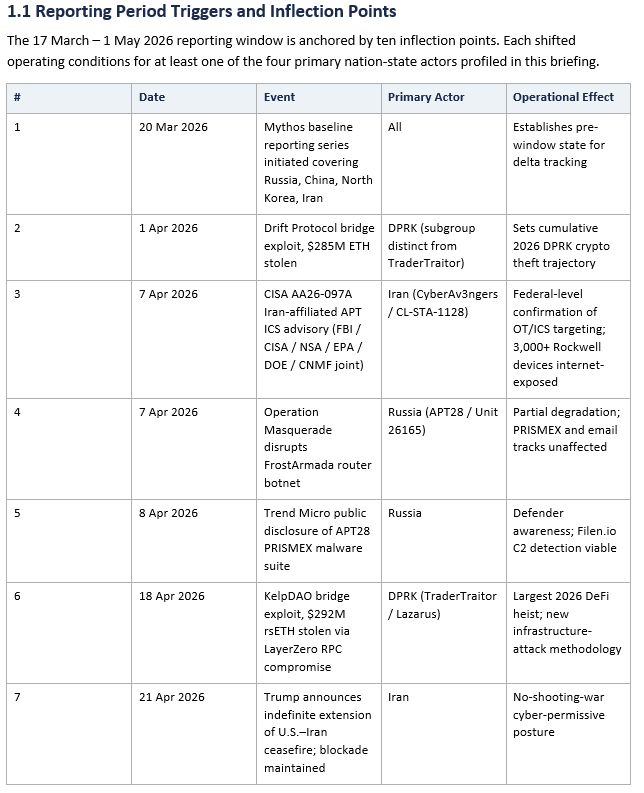
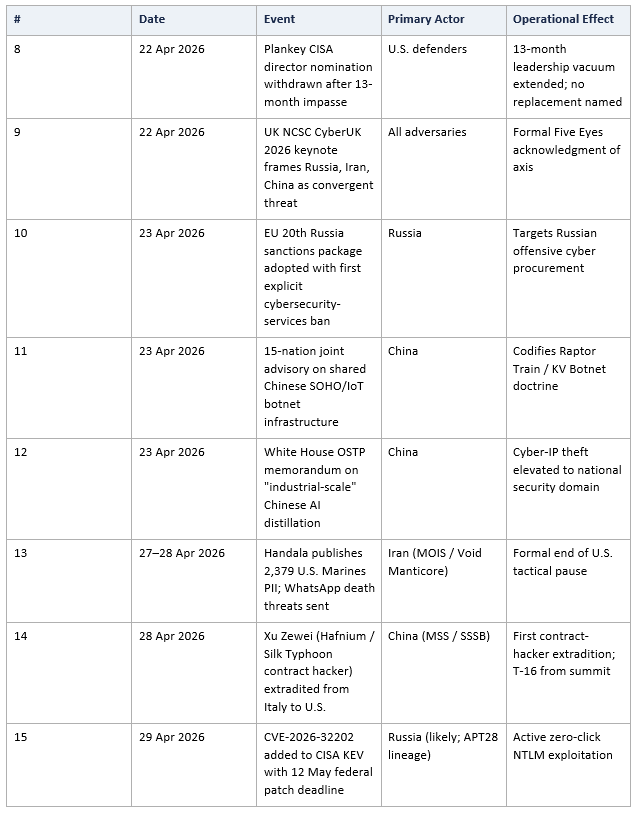
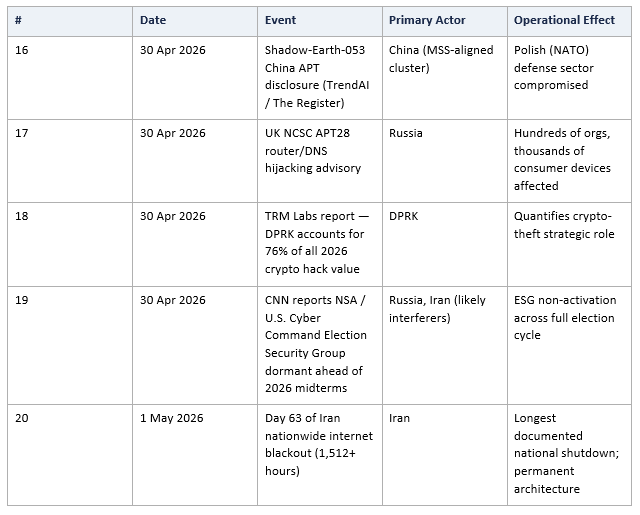
1.2 Cross-Adversary Convergence (Russia–Iran–China–NK)
Convergence in this reporting window operated along four axes: ISR sharing, cyber-tradecraft transfer, financial-sanctions evasion, and information-warfare coordination. The 9 April speech by NATO Secretary General Mark Rutte at the Reagan Institute Center for Peace through Strength constituted the highest-level public NATO acknowledgment of quadrilateral coordination to date, identifying “China and North Korea and the Russians working together with Iran” as a single adversary system supporting Russia’s war against Ukraine and Iranian regional operations. The 22 April UK NCSC CyberUK 2026 keynote by chief executive Richard Horne reinforced this framing with a Five Eyes voice, characterizing Russia, Iran, and China as the source of the majority of nationally significant cyber attacks against the United Kingdom, running at approximately four per week.
ISR convergence was the most operationally consequential development. Reuters, citing Ukrainian intelligence, confirmed that Russian military reconnaissance satellites surveyed U.S. installations across the Middle East and shared imagery with Iran through a permanent Russia–Iran communications channel possibly facilitated by a Russian military spy station in Tehran. Within days of each survey, surveyed sites were struck by Iranian missile or drone systems — a pattern Ukrainian intelligence assessed as “clear.” Saudi sites surveyed included five passes over King Khalid Military City (a Terminal High Altitude Area Defense, or THAAD, location). The Financial Times, citing leaked Iranian military documents, separately confirmed that the IRGC Aerospace Force acquired the Chinese-built TEE-01B satellite (manufactured by Beijing Earth Eye Co. / 北京沐美星空科技 and operated through Emposat ground stations in Asia and Latin America), delivering 0.5-meter resolution imagery of Prince Sultan Air Base (Saudi Arabia), Al Muwaffaq Salti Air Base (Jordan), the U.S. Fifth Fleet base in Bahrain, and Erbil Airport — all subsequently struck.
Cyber tradecraft transfer was confirmed by Ukrainian intelligence in the 7 April Reuters report: Iranian hacker groups have begun deploying techniques and operational patterns indicating direct transfer from Russian military intelligence. This is consistent with the broader Iranian APT capability uplift observed in MuddyWater’s 2026 toolset (Operation Olalampo introducing CHAR, GhostFetch, HTTP_VIP, GhostBackDoor, Rust-based RustyWater) and the increased operational sophistication of Handala-attributed psychological operations.
Financial-sanctions evasion played out in two primary venues. China absorbed direct U.S. enforcement pressure on its Iran energy conduit when the Office of Foreign Assets Control (OFAC) added Henglida Petrochemical Dalian Refinery Co. — a major private Chinese refiner — to the Specially Designated Nationals (SDN) List on or about 28 April for handling Iranian crude. This is the largest Chinese private refining entity sanctioned under Iran-related authorities and signals U.S. willingness to extend financial pressure into China’s opaque downstream petroleum sector. North Korea, separately, used the THORChain decentralized ETH-to-BTC conversion infrastructure for the majority of KelpDAO laundering, mirroring its Bybit February 2025 playbook.
Information-warfare coordination remained anchored by the 28 March TASS–KCNA information warfare pact, operational since 16 April. Periodic narrative coordination across the two state media outlets continues to be observed, particularly around Ukraine, Iran, and Trump-Xi summit framing.
1.3 Western Defensive Posture Status
The Western defensive posture during this reporting window is best characterized as institutionally degraded at the U.S. federal level, partially offset by Five Eyes and EU action. The headline U.S. development is the 22 April formal withdrawal of Sean Plankey’s nomination to lead CISA, ending a 13-month confirmation impasse. Acting Director Nick Andersen continues to lead the agency, which is now approximately 27 percent below 2025 staffing levels. A pending $707M reduction to the FY27 CISA budget is awaiting Congressional approval. The CISA Election Security program has been eliminated, the Election Infrastructure Information Sharing and Analysis Center (EI-ISAC) has been defunded, and the Joint Cyber Defense Collaborative (JCDC) is being dismantled.
Compounding the picture, CNN reported on 30 April that the NSA / U.S. Cyber Command Election Security Group — the unit that previously coordinated offensive cyber countermeasures against Russian and Iranian election interference — has not been activated for the 2026 midterm cycle. NSA and Cyber Command leaders confirmed the dormancy to Congress, citing absence of direction. Combined with the elimination of CISA election security functions and reductions in FBI and State Department election-focused units, this is the most degraded federal election cyber defensive posture observed since pre-2016.
Five Eyes activity partially compensated. UK NCSC chief executive Richard Horne delivered the headline keynote at CyberUK 2026 in Glasgow on 22 April, characterizing Russia as transferring “tactics and techniques honed in conflict” and stating that NCSC handled more than 200 nationally significant incidents in the preceding year, more than double the year prior. NCSC published an APT28 router and DNS hijacking advisory on 30 April covering hundreds of organizations and thousands of consumer devices across Europe. The 23 April 15-nation joint advisory — co-signed by NSA, FBI, CISA, UK NCSC, and security services from Australia, Canada, Germany, Japan, the Netherlands, New Zealand, Spain, and Sweden — represents the broadest multi-lateral attribution of Chinese cyber methodology to date, formally documenting the shift to shared SOHO/IoT botnet infrastructure (Raptor Train, KV Botnet).
EU action focused on Russia. The 20th sanctions package, adopted on 23 April after a two-month delay, includes the first-ever explicit ban on EU operators providing cybersecurity services to Russia, a total sectorial ban on Russian crypto-asset service providers and decentralized exchange platforms used for sanctions circumvention, prohibition of the rouble-backed RUBx stablecoin and the Bank of Russia’s digital rouble central bank digital currency, the first activation of the EU’s anti-circumvention tool against Kyrgyzstan for re-export of dual-use goods, and 120 new entity listings (including 28 third-country entities in China, Hong Kong, Turkey, the United Arab Emirates, and Thailand). 46 additional shadow-fleet vessels were listed, bringing the total to 632.
OpenAI’s Trusted Access for Cyber program, launched 14 April with the GPT-5.4-Cyber variant, was briefed to U.S. federal agencies, state administrations, and Five Eyes partners on 21–22 April in Washington, D.C. The variant is fine-tuned for binary reverse engineering, vulnerability analysis, and defensive workflows. The expansion to thousands of verified individual defenders and hundreds of teams marks the first frontier-AI deployment specifically for cyber defenders at scale.
1.4 Key Trigger Date Tracker
The 30–60 day window from this report’s runtime contains an unusually compressed sequence of trigger events. Six are flagged as priority watch items.
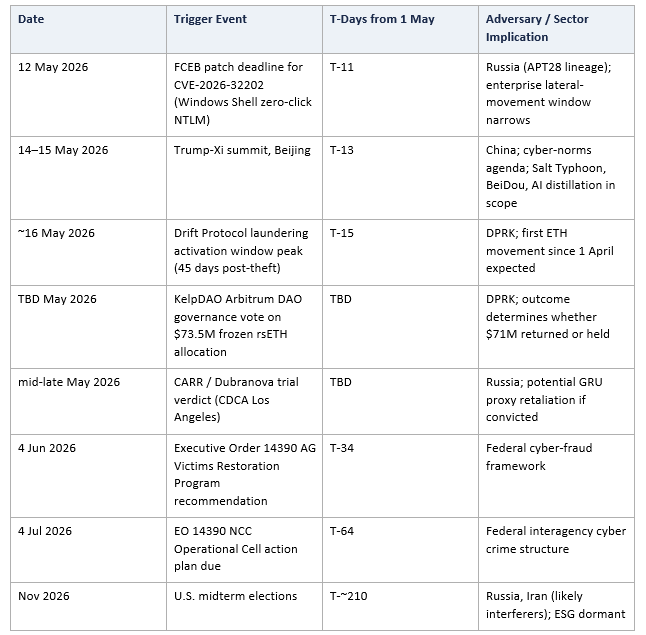
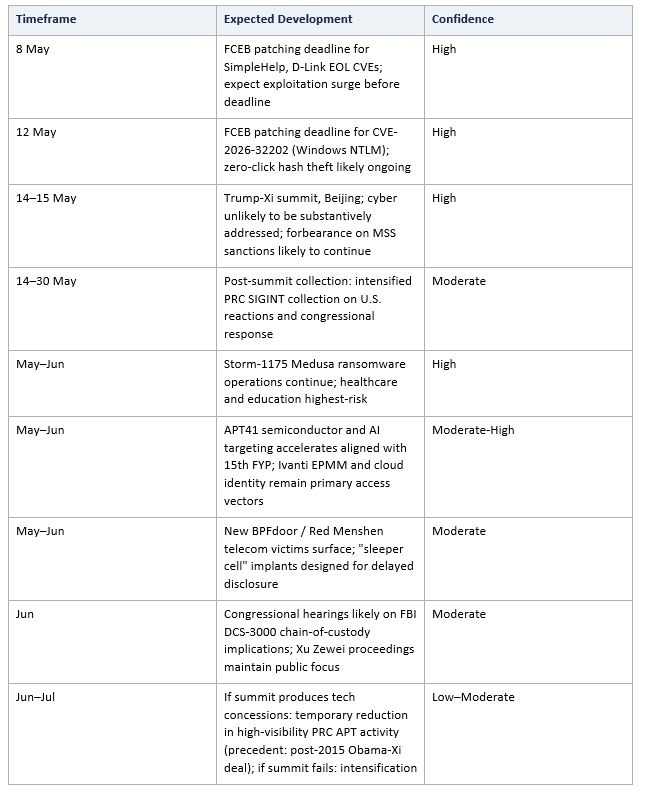
Concurrent compression is the operationally significant feature of this calendar. The CVE-2026-32202 patch deadline (12 May), the Trump-Xi summit (14–15 May), and the Drift laundering activation peak (~16 May) all fall within a five-day window. Any one of these could plausibly drive an attacker to accelerate or delay activity to leverage or avoid the others.
Section 2 — Nation-State Threat Analysis
This section provides per-nation strategic posture, active campaigns and operations across the full 45-day rolling window, tactics-techniques-and-procedures (TTPs), indicators of compromise (IOCs), Diamond Model analysis, MITRE ATT&CK mapping, and 30–60 day outlook. Each subsection leads with the May 1 delta findings and threads them into the rolling-window context.
2.1 Russia
2.1.1 Strategic Posture
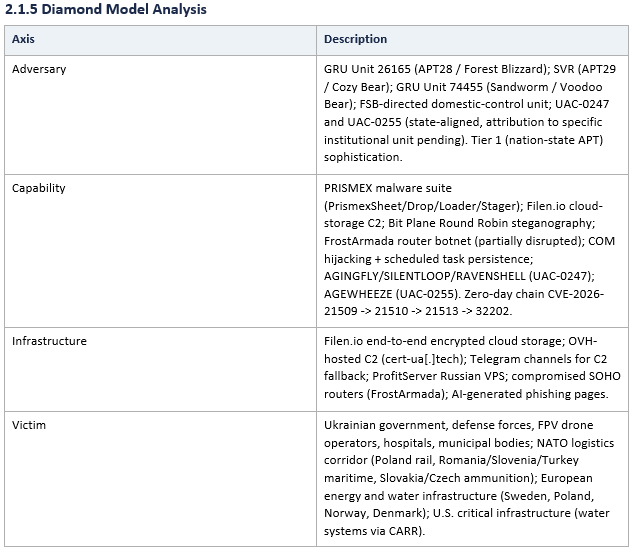
Russia entered the 17 March – 1 May reporting window as the most operationally diverse nation-state cyber actor under continuous observation. The window closes with that posture intact and structurally hardened. The GRU (Main Directorate, formally GU) and FSB continue to direct an integrated offensive cyber program built around three operational tracks: APT28 / Forest Blizzard / Unit 26165 (military intelligence), APT29 / Cozy Bear / SVR (foreign intelligence), and Sandworm / Voodoo Bear / Unit 74455 (sabotage and destructive operations). Against this institutional architecture, the FSB during the window operationalized a domestic-internet-control campaign that systematically eliminates passive exfiltration opportunities for foreign intelligence services and hardens Russian internet segmentation in preparation for expanded conflict scenarios.
The Russia-Ukraine cyber theater remains in attritional espionage mode with escalating OT/ICS pre-positioning across NATO member states. The cumulative pattern confirmed in this window — Sweden (early 2025, attributed publicly 15 April), Poland (December 2025), Norway (April 2025), and Denmark (2024) — constitutes a documented escalation trajectory in OT/ICS targeting across European energy and water infrastructure. NCSC chief executive Horne’s 22 April CyberUK 2026 characterization, combined with Sweden’s 15 April formal attribution to a pro-Russian group, confirms a Western intelligence consensus around this trajectory.
Operationally, the May 1 cut leaves Russia with full multi-vector offensive capability despite the 7 April Operation Masquerade disruption of FrostArmada. Three structural facts support this assessment: (1) FrostArmada was a router-botnet OPSEC layer, not a primary intrusion vector; the disruption removed a proxy substrate but did not interdict APT28 spear-phishing, malware deployment, or email/account compromise tracks; (2) the PRISMEX malware suite remains active and was first publicly detailed by Trend Micro on 8 April, with no evidence of operational decommissioning; and (3) the CVE-2026-32202 zero-click NTLM coercion exploit chain, derived from APT28-exploited CVE-2026-21510, demonstrates continued first-mover advantage on Microsoft vulnerability chains, including pre-disclosure infrastructure preparation that has historically run 10–21 days ahead of CVE publication.
On the legal-accountability axis, the trial of Victoria Dubranova for CARR / GRU-linked attacks on U.S. critical infrastructure including water systems began 7 April in the Central District of California (CDCA) and remained ongoing through 1 May with no public verdict. The State Department’s Rewards for Justice program continues to offer up to $2M for information on CARR associates. The trial represents the first federal criminal prosecution of a GRU-directed hacktivist proxy actor reaching a U.S. jury trial.
2.1.2 Active Campaigns and Operations (Full Rolling Window)
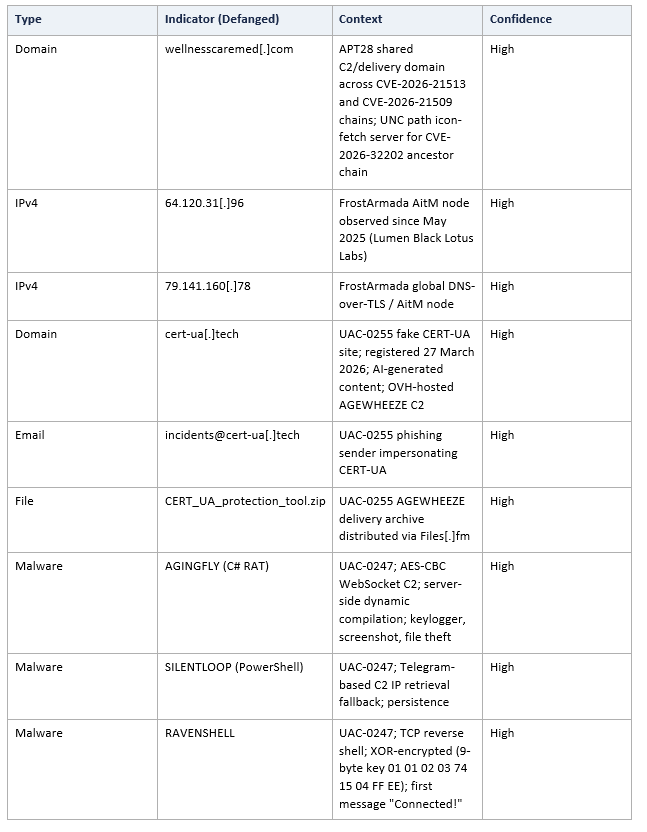
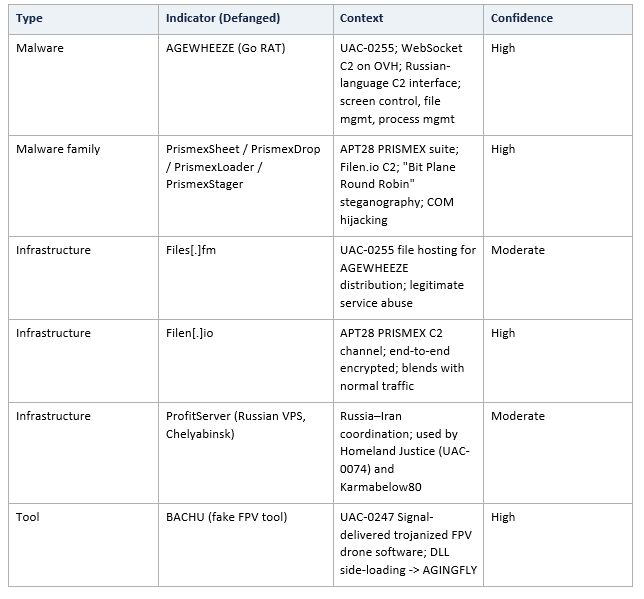
APT28 / GRU Unit 26165 — PRISMEX, FrostArmada, and CVE Exploitation. The PRISMEX campaign disclosed by Trend Micro on 8 April targets Ukraine and the NATO logistics corridor (Poland rail logistics, Romania / Slovenia / Turkey maritime and transport, Slovakia / Czech Republic ammunition logistics, and Ukrainian government, defense, and emergency services). The malware suite consists of PrismexSheet, PrismexDrop, PrismexLoader, and PrismexStager, with the following defining features: end-to-end encrypted C2 over Filen.io cloud storage (a novel TTP, MITRE T1102.002), custom “Bit Plane Round Robin” steganography spreading payload data across image bit planes (novel, T1027.003), Component Object Model (COM) hijacking with scheduled task-based explorer.exe restart for persistence (T1546.015), and fileless .NET runtime in-memory loading. The FrostArmada router botnet, partially disrupted by Operation Masquerade on 7 April, exploited Common Vulnerabilities and Exposures (CVE) IDs CVE-2023-50224 (TP-Link WR841N authentication bypass) and operated as DHCP and DNS hijacking infrastructure for adversary-in-the-middle interception against Outlook Web Access. Two confirmed FrostArmada IPv4 nodes — 64.120.31[.]96 (active since May 2025, observed by Lumen Black Lotus Labs) and 79.141.160[.]78 (global DNS-over-TLS supporting node) — remain on tracking watchlists.
CVE-2026-32202 — Windows Shell Zero-Click NTLM Coercion (May 1 lead). Microsoft released an advisory for CVE-2026-32202 during 14 April Patch Tuesday without initially flagging in-the-wild exploitation. On or around 27 April, Akamai researcher Maor Dahan published a technical write-up identifying the flaw as an incomplete-patch derivative of CVE-2026-21510, the latter exploited by APT28 in December 2025 against Ukraine and EU targets per CERT-UA and Akamai attribution. Microsoft updated its advisory to “Exploitation Detected” on 27–28 April. CISA added CVE-2026-32202 to the Known Exploited Vulnerabilities (KEV) catalog on 29 April with a 12 May Federal Civilian Executive Branch (FCEB) remediation deadline. Technical mechanics: when a user opens a folder containing a specially crafted .lnk shortcut (no file execution required), Windows Explorer fetches a shell icon via Universal Naming Convention (UNC) path, triggering an SMB connection to the attacker’s server that performs an automatic NTLM authentication handshake transmitting the victim’s Net-NTLMv2 hash. The hash supports NTLM relay attacks or offline cracking and enables credential-based lateral movement. The official Common Vulnerability Scoring System v3.1 (CVSSv3.1) score of 4.3 (medium) materially understates operational risk; CISA’s KEV listing reflects the higher real-world severity. Affected systems include all supported Windows 10 (including 1607), Windows 11, and Windows Server versions.
UAC-0247 — AGINGFLY Campaign Expanding Beyond Healthcare. UAC-0247 was first publicly disclosed 15 April with a CERT-UA advisory analyzing approximately a dozen confirmed incidents against Ukrainian clinics, municipal bodies, defense forces personnel, and First-Person View (FPV) drone operators. The cluster’s tooling includes AGINGFLY (a C# remote access trojan with AES-Cipher Block Chaining (CBC) encrypted WebSocket C2 and server-side dynamic compilation that defeats static signatures), SILENTLOOP (a PowerShell module that retrieves C2 IP addresses from Telegram channels as a fallback mechanism, providing dual-channel resilience), RAVENSHELL (TCP reverse shell, XOR-encrypted with a 9-byte key and a “Connected!” first message), CHROMELEVATOR for browser credential theft, ZAPIXDESK for WhatsApp credential extraction, and RUSTSCAN for internal subnet enumeration. Delivery includes Signal-based delivery of trojanized FPV drone software (”BACHU” fake tool) using DLL side-loading to install AGINGFLY, in addition to Cross-Site Scripting (XSS)-compromised legitimate sites and AI-generated phishing pages — the latter explicitly flagged by CERT-UA as a new capability lowering operational cost. Attribution is currently low-to-moderate confidence Russian-state-aligned, pending further analysis.
UAC-0255 / Cyber Serp — Mass CERT-UA Impersonation. The 26–28 March campaign by UAC-0255 / Cyber Serp claimed approximately one million ukr.net phishing targets but achieved only a small number of confirmed device infections in educational institutions. The fake site cert-ua[.]tech, registered on 27 March, served AI-generated content and hosted the AGEWHEEZE Go-language remote access trojan with WebSocket C2 on OVH infrastructure. The C2 login interface featured Russian-language UI elements (”The Cult”) and the fake site’s HTML included a Russian-language self-attribution comment (”С Любовью, КИБЕР СЕРП” — “With Love, Cyber Serp”) with a link to the group’s Telegram channel (created November 2025, 700+ subscribers). CERT-UA assessed the campaign as unsuccessful; the case is notable as a Russian-language operator environment claiming Ukrainian-underground self-attribution.
Russia–Iran–China Coordination during Iran Conflict Window (17–22 April). Russian-reconnaissance-satellite imagery of U.S. installations in the Middle East was reportedly provided to Iran for targeting; sites surveyed were struck within days. The Z-Pentest Alliance, NoName057(16), and DDoSia Project coordination with Iranian Handala Hack continued via Telegram, including shared publication of industrial-control-system credentials for Israeli critical infrastructure targets. The China–Iran BeiDou satellite integration with Iranian military operations was confirmed in Atlantic Council analysis (the “Axis of Evasion” framework) and aligns with the TEE-01B program detailed in Section 2.4.
FSB-Directed Domestic Internet Controls. An FSB unit previously linked to the 2020 Navalny operation was identified by Mediazona and The Moscow Times as directing the technical campaign. Operationalization milestones during the window: 1 April (major telecoms MTS, Beeline, MegaFon, T2 blocked Apple ID top-ups from mobile accounts to impede VPN app purchases); 15 April (major platforms including Gosuslugi, Sberbank, Ozon, Wildberries, Aviasales, Yandex, and Russian Railways began blocking VPN users using IP cross-check plus application-layer parallel requests to Russian versus foreign domains); 23 April (Putin publicly acknowledged mobile internet outages, framing restrictions as a national security necessity tied to Ukrainian drone and missile threats while ordering whitelisting of certain services); 30 April (Meduza confirmed the planned mobile VPN traffic surcharge — 15GB free then 150 rubles per gigabyte — was delayed by carrier requests but remained policy-active). State Duma legislation banning Russian hosting providers from supplying infrastructure to VPN services is in legislative pipeline. Strategic implication: as Russia restricts domestic internet access, Russian APT groups simultaneously exploit the open internet of target nations, creating a mirror dynamic.
CARR Trial — Victoria Dubranova (CDCA Los Angeles). Trial commenced 7 April. No public verdict through 1 May. Federal cyber trials of comparable complexity typically run 3–6 weeks; verdict expected mid-to-late May. A guilty verdict would set precedent for treating GRU-directed hacktivist proxies as criminal principals and could prompt retaliatory DDoS or targeted intrusion campaigns from NoName057(16) or affiliated clusters, mirroring the December 2025 NoName057(16) DDoS in response to the Dubranova indictment.
Carry-Forward Items from the Rolling Window. The Sweden thermal power plant attack (early 2025, attributed publicly to a pro-Russian group on 15 April) joins the Poland DynoWiper (December 2025), Norway dam (April 2025), and Denmark water utility (2024) attacks as four confirmed pre-positioning or attempted-destructive events against European energy and water infrastructure since April 2025 attributed to Russian-aligned actors. Sandworm willingness to operate during low-consequence windows for capability testing is well documented. Baltic energy infrastructure and undersea cable systems are assessed as elevated-risk targets through the May–June period.
2.1.3 Tactics, Techniques, and Procedures
APT28 TTP signature this window combines high-end tradecraft with infrastructure prepositioning. Spear-phishing with weaponized RTF and DOC files exploiting CVE-2026-21509 (T1566.001) initiates the chain; CVE-2026-21513 (MSHTML, LNK / ieframe.dll, T1203) chains to Mark-of-the-Web (MotW) bypass via nested iframes (T1553.005); the PrismexLoader DLL side-loading (T1574.002) delivers the in-memory PrismexStager .NET runtime; PrismexSheet runs the Bit Plane Round Robin steganography (T1027.003) for payload concealment; and Filen.io serves as the encrypted cloud-storage C2 (T1102.002). Persistence is achieved through COM hijacking with scheduled-task explorer.exe restart (T1546.015) plus registry Run keys (T1547.001). Credential access uses the FrostArmada AitM stack for OWA token theft (T1557, T1539) and now CVE-2026-32202 zero-click NTLM hash coercion (T1003.006).
UAC-0247 layered TTPs reflect a state-aligned operations focus with mid-tier sophistication. Spear-phishing links (T1566.002) deliver LNK files via XSS-compromised legitimate sites or AI-generated phishing pages; mshta.exe (T1218.005) executes remote HTA files; AGINGFLY runs server-side dynamic compilation for AES-CBC-encrypted WebSocket C2 (T1071.001); SILENTLOOP retrieves C2 IPs from Telegram channels (T1071); ZAPIXDESK extracts WhatsApp credential data (T1552, evolving); RUSTSCAN performs subnet enumeration (T1046); CHROMELEVATOR steals browser credentials (T1555.003); and XMRIG cryptocurrency mining is deployed via modified WireGuard application (T1496) for opportunistic monetization on otherwise espionage-targeted hosts.
2.1.4 Indicators of Compromise (Consolidated)
2.1.7 Assessment and 30–60 Day Outlook (ICD 203)
HIGH CONFIDENCE — APT28 / GRU Unit 26165 maintains full multi-vector offensive capability. Operation Masquerade has not meaningfully degraded operational capacity. PRISMEX remains active, the CVE-2026-32202 exploitation chain demonstrates continued first-mover advantage on Microsoft vulnerability chains, and the three-track operational design (router botnet now disrupted, spear-phishing and malware deployment active, email and account compromise active via the 14–15 April 284-account breach disclosure) provides structural redundancy.
HIGH CONFIDENCE — Russia-Ukraine cyber theater continues in attritional espionage mode with escalating OT/ICS pre-positioning. Sustained intelligence collection and gradual capability pre-positioning remain the dominant configuration; Sweden / Poland / Norway / Denmark constitute a documented escalation trajectory across NATO member states. NCSC chief executive Horne’s 22 April characterization and Sweden’s 15 April attribution confirm Western intelligence consensus around this trajectory.
HIGH CONFIDENCE — CVE-2026-32202 exploitation represents the active operational continuation of APT28’s LNK / Windows Shell exploit chain. The exploit-chain genealogy (CVE-2026-21510 -> incomplete patch -> CVE-2026-32202) is directly tied to APT28’s December 2025 Ukraine and EU operations. Organizations that applied February patches but not the 14 April Patch Tuesday updates remain exposed to zero-click credential theft.
MODERATE CONFIDENCE — UAC-0247 is Russian-state-aligned. Targeting profile (Ukrainian healthcare, defense personnel, municipal bodies, FPV drone operators), Signal-based delivery, and Telegram-based C2 fallback are consistent with Russian intelligence service operational patterns. Absence of explicit CERT-UA attribution to a known GRU/FSB cluster may reflect a new operational unit, deliberate obfuscation, or non-state alignment with Russian interests.
MODERATE CONFIDENCE — Russia–Iran covert cyber coordination has deepened beyond pre-kinetic levels. Satellite intelligence sharing, shared Telegram targeting channels, and infrastructure reuse on ProfitServer represent structural alignment that will persist beyond the 22 April U.S.–Iran ceasefire extension. The coordination provides mutual benefit: Russia gains proxy attack vectors against Israeli targets with deniability; Iran gains access to Russian-refined TTPs and targeting data.
LOW CONFIDENCE — CARR / Dubranova trial verdict may extend through May. Limited public trial reporting plus charge complexity (conspiracy, computer damage, access device fraud, aggravated identity theft) supports a 3–6 week trial duration estimate. Conviction would set precedent for treating GRU-directed hacktivist proxies as criminal principals.
30–60 Day Priority Outlook (Russia):
• CVE-2026-32202 exploitation widens before federal/enterprise patch saturation; lateral-movement campaigns exploiting NTLM relay intensify against unpatched government, defense, and critical-infrastructure targets through 12 May FCEB deadline.
• PRISMEX operational continuity post-disclosure; APT28 typically retires or modifies exposed tools within 30–60 days, expect a modified PrismexLoader steganography variant or transition to a previously undisclosed framework, with C2 migration from Filen.io probable.
• Vulnerability exploitation pipeline continues; pre-disclosure infrastructure preparation (wellnesscaremed[.]com registered 12 January for a 26 January CVE) suggests ongoing Microsoft vulnerability-intelligence access; monitor for new LNK / MSHTML / Office RTF exploitation 10–21 days before CVE disclosure.
• Sandworm OT/ICS pre-positioning in Europe; the May–June window overlaps with Northern European energy demand reduction (spring), reducing disruption consequence — but Sandworm has demonstrated willingness to operate during low-consequence windows for capability testing; Baltic energy infrastructure and undersea cable systems remain elevated-risk.
• Russia domestic digital isolation — offensive implications. As the FSB completes domestic internet segmentation, Russian offensive operators will likely shift further toward third-country VPS (non-European, non-Five-Eyes), legitimate cloud services (Filen.io precedent), and compromised routers in non-sanctioned regions as OPSEC cover.
• CARR trial verdict and escalation potential. A guilty verdict against Dubranova could prompt GRU-directed hacktivist retaliation against U.S. critical infrastructure or judicial targets; U.S. water utilities, state courts, and Department of Justice infrastructure are elevated-risk in the post-verdict window.
2.2 China
2.2.1 Strategic Posture (Trump-Xi Summit T-13)
China entered the reporting window with the most institutionally diverse offensive cyber program of any nation-state actor and exits the window with that program operating at or above prior tempo, despite a high-visibility U.S. extradition action (Xu Zewei, 28 April) and a White House Office of Science and Technology Policy memorandum on “industrial-scale” AI distillation (23 April). The 14–15 May Trump-Xi summit in Beijing, now T-13 days from this report, frames every Chinese cyber-relevant decision in the window. Final pre-summit calls between Chinese Vice Premier He Lifeng with Treasury Secretary Bessent and U.S. Trade Representative Greer, and concurrently between Foreign Minister Wang Yi and Secretary of State Rubio, were held on 30 April.
Operationally, the May 1 cut shows three structural patterns. First, China has consolidated its shift to shared SOHO/IoT botnet infrastructure as the dominant covert-network substrate across the majority of MSS / People’s Liberation Army (PLA) cyber-actor ecosystem. The 23 April 15-nation joint advisory — the most comprehensive multi-lateral attribution of Chinese cyber methodology to date — codifies this shift. Static Internet Protocol (IP) blocklisting is now operationally ineffective against this actor set. Second, Chinese economic-espionage tasking has visibly expanded beyond traditional political intelligence collection into financial-sector targets aligned with the 15th Five-Year Plan (2026–2030) priorities adopted 12 March, evidenced by the Mustang Panda LOTUSLITE pivot to Indian banking disclosed 28 April. Third, Chinese commercial-LEO satellite ISR (TEE-01B) is now confirmed in active dual-use configuration supporting Iranian targeting of U.S. military assets, marking the first documented use of Chinese commercial low-Earth-orbit imagery for live-conflict target development.
On the legal-accountability axis, the 28 April extradition of Xu Zewei (徐泽伟), age 34, from Italy to the U.S. District Court in Houston represents the first extradition of a China-linked contract hacker in the modern MSS era. Xu, a contractor for the MSS’s Shanghai State Security Bureau (SSSB) operating through Shanghai Powerock Network Co. Ltd., faces nine counts including wire fraud conspiracy related to (a) COVID-19 vaccine research theft from U.S. universities in 2020 directly supervised by SSSB officers and (b) the Hafnium / Silk Typhoon mass exploitation of Microsoft Exchange Servers in March 2021 that compromised more than 12,700 U.S. organizations. Co-conspirator Zhang Yu (张宇) remains at large.
2.2.2 Active Campaigns and Operations
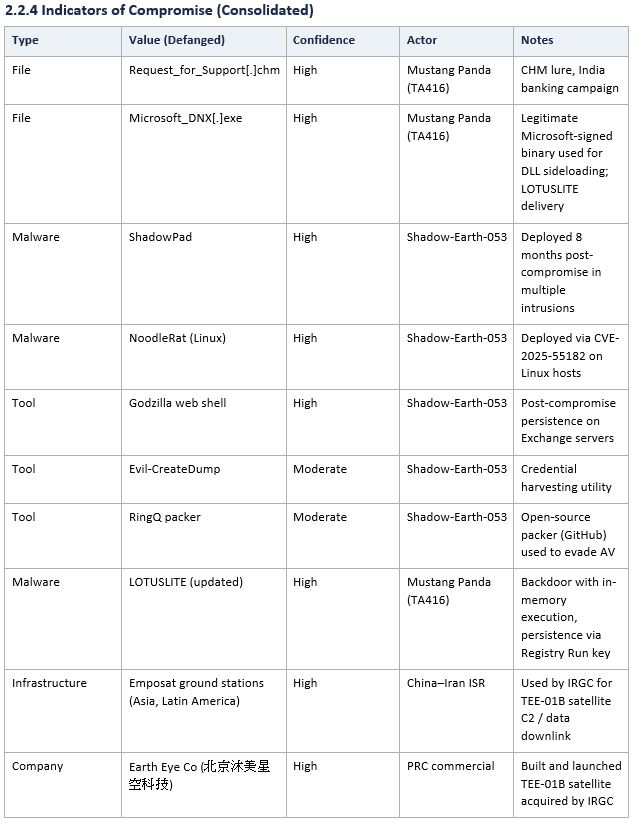
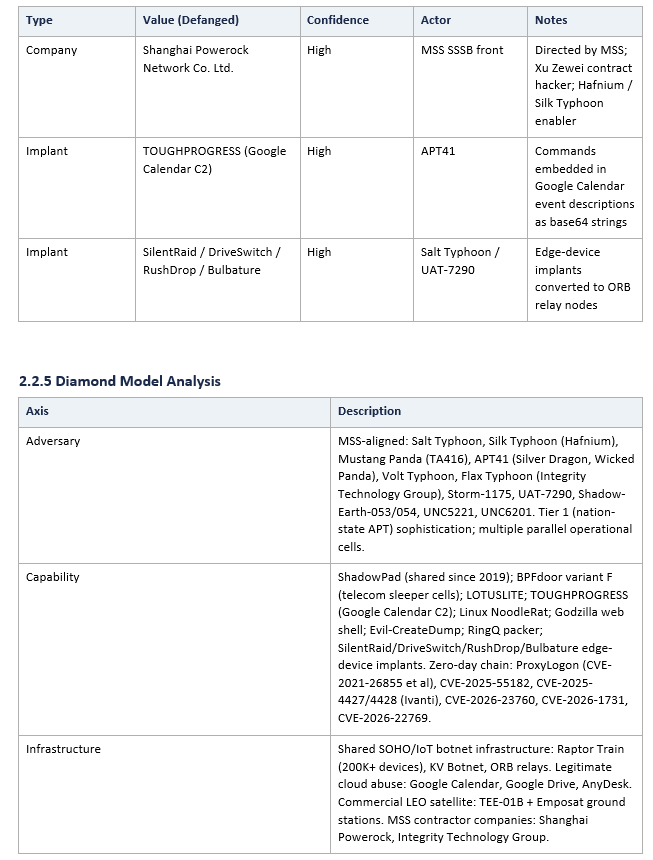
Shadow-Earth-053 — New China-Nexus APT (Disclosed 30 April; May 1 lead). The Register published an exclusive on 30 April covering Shadow-Earth-053 (and related cluster Shadow-Earth-054 with shared tool hashes), tracked by TrendAI researchers. Infrastructure and tooling overlaps with CL-STA-0049 (Unit 42), REF7707 (Elastic), and Earth Alux place the cluster in the documented Typhoon-family doctrine. Confirmed victim scope spans at least eight countries: Pakistan, Thailand, Malaysia, India, Myanmar, Sri Lanka, Taiwan, and — critically — Poland, a NATO member state with one confirmed defense-sector organization compromised. Targeting logic is alignment with U.S. policy and support for Taiwan’s independence, including defense ministries and defense-industrial-base firms. Operation timeline: initial compromise began December 2024 with activity confirmed through April 2026; in multiple intrusions the cluster maintained quiet access for up to eight months before deploying ShadowPad. Attack chain: (1) initial access via vulnerable Microsoft Exchange Servers (ProxyLogon chain CVE-2021-26855, -26857, -26858, -27065) and React Server Components (CVE-2025-55182); (2) Godzilla web shell deployment on Exchange with propagation using administrative credentials; (3) Evil-CreateDump credential harvesting, WMIC lateral movement (T1047), legitimate Windows binary renaming (T1036.003); (4) ShadowPad backdoor (often months after initial access); (5) Linux NoodleRat post-React2Shell exploitation; (6) RingQ open-source packer (GitHub) for AV evasion; AnyDesk abused for C2 in at least one instance. TrendAI analyst Tom Kellermann, citing the timing 13–14 days from the Trump-Xi summit, framed the cluster’s persistent dormant access as concerning for the possibility of pre-positioned destructive payloads.
15-Nation Joint Advisory on Chinese Botnet Infrastructure (23 April; May 1 lead). The advisory — led by NSA, FBI, CISA, UK NCSC and co-signed by security services from Australia, Canada, Germany, Japan, the Netherlands, New Zealand, Spain, and Sweden — publicly confirms that the majority of China-nexus threat actors now use shared “covert networks” of compromised SOHO routers, Internet of Things (IoT) devices (webcams, digital video recorders), firewalls, and Network-Attached Storage (NAS). Multiple covert networks are simultaneously maintained, and a single network may serve multiple APT groups. Raptor Train (200,000+ infected devices, controlled by Integrity Technology Group, used by Flax Typhoon) and KV Botnet (primarily Cisco and NetGear end-of-life routers, used by Volt Typhoon) are named exemplars. These networks are used across all kill-chain phases: reconnaissance, delivery, C2, exfiltration, and covert browsing for target research. ATT&CK mappings from the advisory: T1584.005 (botnet infrastructure), T1584.008 (network devices), T1583.003 (VPS on-ramps), and T1090.003 (multi-hop proxy). The defensive implication — static IP blocklisting is ineffective; nodes rotate continuously as devices are patched or retired, requiring behavioral and traffic-analysis detection.
Mustang Panda (TA416) — LOTUSLITE Pivot to India Banking and Korea Diplomacy (May 1 lead). Acronis Threat Research Unit identified in March, disclosed 28 April, a significant expansion of Mustang Panda targeting from European diplomatic missions toward (a) Indian banking sector, with spear-phishing using Compiled HTML Help (CHM) files impersonating HDFC Bank branding, with embedded JavaScript dropping Microsoft_DNX.exe (a legitimate Microsoft-signed binary) alongside a malicious DLL sideloaded via the trusted binary, and (b) Korean Peninsula diplomacy, adopting prominent diplomatic-figure identities to target South Korean policy actors involved in inter-Korean affairs. The updated LOTUSLITE backdoor provides remote shell access, file manipulation, and Registry Run-key persistence (HKCU\Software\Microsoft\Windows\CurrentVersion\Run), running silently in memory to bypass signature-based detection. IOCs: Request_for_Support.chm, Microsoft_DNX.exe. The expansion to India financial sector signals a tasking shift toward economic espionage alongside traditional political intelligence collection — consistent with the 15th Five-Year Plan’s semiconductor and financial technology priorities adopted 12 March.
APT41 / Silver Dragon — Government and Supply Chain Targeting (Carry-Forward, Active). The APT41-linked cluster Silver Dragon (Check Point, 4 March) continued through the delta window with no confirmed new public victims but elevated tooling: Google Drive as a C2 channel (TOUGHPROGRESS implant, with commands embedded in Google Calendar event descriptions as base64 strings, T1102.002) and Common Vulnerabilities and Exposures (CVE) chaining on Ivanti Endpoint Manager Mobile (EPMM) (CVE-2025-4427 + CVE-2025-4428) remain the most technically novel Chinese APT developments of Q1 2026. PolySwarm’s 15th Five-Year Plan analysis projects APT41 as the primary actor for semiconductor and AI ecosystem targeting aligned with 2026–2030 priorities.
White House Office of Science and Technology Policy AI Distillation Memorandum (23 April; May 1 lead). The memorandum formally accuses China of conducting “deliberate, industrial-scale campaigns to distill U.S. frontier AI systems.” Evidence basis: OpenAI identified DeepSeek employee accounts using obfuscated third-party proxies to extract outputs at scale (reported 12 February to the House Select Committee on China); Anthropic named three Chinese labs — DeepSeek (150,000+ exchanges), MiniMax (13M+ exchanges), and Moonshot AI (3.4M+ exchanges) — across 24,000 fraudulent accounts generating 16M+ interactions with Claude; Meta’s open-source Llama 13B was fine-tuned by PLA-linked institutions to create ChatBIT, a military intelligence application. Legislative response includes the Deterring American AI Model Theft Act (H.R. 8283), introduced 15 April by Representative Huizenga and co-sponsored by House Select Committee Chairman Moolenaar. The State Department launched a global diplomatic campaign on 25 April warning foreign governments about Chinese AI distillation operations.
Salt Typhoon — Residual Access and European Commission Breach. The European Commission was breached on 24 March 2026 through cloud infrastructure intrusion, per CES Intelligence reporting on 29 April. Attribution is not yet publicly confirmed but the pattern (cloud identity exploitation, no custom malware required) is consistent with MSS / Silk Typhoon tradecraft. AT&T and Verizon blocked release of Mandiant security assessment reports to Congress, as confirmed by Senator Cantwell in February. UAT-7290 continued operations against U.S. and allied telecom providers via edge device exploitation (SilentRaid, DriveSwitch, RushDrop, Bulbature implants) with devices converted into Operational Relay Box (ORB) infrastructure shared across PRC actor clusters.
BPFdoor / Red Menshen — Variant F Telecom Targeting (Carry-Forward). Rapid7 March 26 reporting identified BPFdoor variant F as the operational implant set against telecom carriers, described as functioning as “sleeper cells” that may not surface for months after deployment. New BPFdoor / Red Menshen telecom victims are likely to surface in the May–June outlook window.
TEE-01B Iran Handoff (May 1 confirmation). Reuters and the Financial Times confirmed during the window that the IRGC Aerospace Force acquired the Chinese-built TEE-01B satellite (Beijing Earth Eye Co. / 北京沐美星空科技, operated through Emposat ground stations in Asia and Latin America) in late 2024. Resolution: 0.5 meters (10x more accurate than Iran’s indigenous satellites; comparable to Western commercial models). In March, TEE-01B captured imagery of Prince Sultan Air Base (Saudi Arabia), Al Muwaffaq Salti Air Base (Jordan), the U.S. Fifth Fleet base in Bahrain, and Erbil Airport — all subsequently struck by Iranian forces around the time of capture. This is the first documented use of Chinese commercial LEO satellite imagery for live-conflict target development.
Scarborough Shoal Electronic Warfare and Balikatan 2026. During Balikatan 2026 (largest-ever U.S.-Philippines joint exercise, 20 April – 8 May, 17,000 troops, seven nations), China escalated electromagnetic operations: 10–11 April installation of a 352-meter floating barrier at the entrance to Scarborough Shoal confirmed by satellite imagery; February–April pattern of repeated Starlink signal disruption within 24 nautical miles of Scarborough Shoal attributed to Chinese jamming; satellite imagery confirming electronic warfare systems on Subi Reef and Mischief Reef within operational range of the Balikatan exercise corridor. Japan’s first large-scale Balikatan participation (ground, maritime, air, cyber, medical units) was described by Japanese media as a structural policy shift. PLA reservation of airspace off China’s eastern coast (27 March – 5 May) overlapping the Balikatan window constitutes combined kinetic-cyber deterrence signaling. Taiwan National Security Bureau Director-General Tsai Ming-yen assessed the airspace move as demonstrating military dominance ahead of the Trump-Xi summit.
Taiwan Cyber Posturing. Taiwan’s Financial Supervisory Commission confirmed at a 16 April tabletop exercise that China launches at least 10,000 cyber attacks per day against Taiwan financial systems in peacetime. Taiwan’s 2025 annual figure is 2.63 million intrusion attempts per day against critical infrastructure — a 113 percent increase since 2023. Taiwan NSB separately warned (6 April) that China is targeting high-tech sectors to bypass international technology restrictions, using indirect channels to poach semiconductor and AI talent, paying retired military personnel to recruit active-duty officers, with 58 individuals indicted for espionage between 2025 and March 2026.
2.2.3 Tactics, Techniques, and Procedures
China-nexus TTP signature in this window is defined by three core innovations: shared botnet relay substrate (T1584.005, T1584.008, T1090.003), legitimate-cloud-service C2 (Google Calendar / Drive for APT41 TOUGHPROGRESS, AnyDesk for Shadow-Earth-053), and extended dormancy before final implant deployment (Shadow-Earth-053 maintained quiet access for up to eight months before ShadowPad). Mustang Panda’s shift from MSBuild and C# delivery (confirmed February) to CHM file delivery with DLL sideloading of Microsoft-signed binaries (T1218.001, T1574.001) reflects an evolving evasion path that defeats traditional code-signing trust assumptions.
Storm-1175 zero-day exploitation 1 week before public disclosure on CVE-2026-23760 (SmarterMail) and CVE-2026-1731 (BeyondTrust) is a rare TTP signature reflecting either independent vulnerability research capability or pre-disclosure intelligence access. Rclone for continuous real-time exfiltration (T1048.002) provides syncing of new and modified files in real time to attacker cloud storage. Salt Typhoon / UAT-7290 edge-device-to-ORB-relay conversion (T1584.008, T1090.003) creates shared relay infrastructure across PRC clusters, a substrate-amplification pattern.

2.2.7 Assessment and 30–60 Day Outlook (ICD 203)
Overall threat level: ELEVATED — no reduction from prior period.
HIGH CONFIDENCE — Chinese state-sponsored cyber actors maintained or increased operational tempo during the 17 April – 1 May window, with Shadow-Earth-053 disclosure revealing multi-country defense-sector pre-positioning 13 days before the Trump-Xi summit. The 15-nation advisory confirms a structural TTP shift: China-nexus actors now operate primarily through shared compromised botnet infrastructure, making attribution and defensive response materially harder.
HIGH CONFIDENCE — Mustang Panda’s pivot to India banking sector targeting reflects tasking aligned with 15th Five-Year Plan economic-espionage priorities, not just traditional political intelligence collection. Xu Zewei’s extradition will have no deterrent effect on ongoing MSS-directed contractor operations in the short term; the contractor network is too large and diffuse to be materially disrupted by a single extradition.
MODERATE CONFIDENCE — Shadow-Earth-053’s focus on defense ministries of U.S.-aligned nations represents pre-positioning for potential destructive-capability deployment, not merely espionage, should the Trump-Xi summit produce an outcome that Beijing assesses as hostile (new semiconductor controls, Taiwan arms sales announcement). The European Commission cloud breach (24 March) is likely attributable to a China-nexus MSS cluster though attribution is not publicly confirmed; the cloud-identity-exploitation pattern is consistent with UNC5221 / Silk Typhoon tradecraft. China’s electronic-warfare operations at Scarborough Shoal during Balikatan 2026 are generating actionable intelligence for PLA planners on U.S.–Philippines–Japan joint communications architecture.
LOW CONFIDENCE — China will activate any pre-positioned access in Volt Typhoon / Shadow-Earth-053 infrastructure as a direct result of the 14–15 May summit; the summit is expected to produce a managed outcome that does not trigger a Chinese escalatory response. AI distillation accusations are unlikely to produce concrete summit commitments; both sides have structural incentives to avoid breakdown.
Intelligence gap: no new public SIGINT or technical indicators have emerged for primary Salt Typhoon telecom access since January 2026; AT&T and Verizon blocking Mandiant reports significantly limits public assessment of residual access status.
30–60 Day Priority Outlook (China):
2.3 North Korea
2.3.1 Strategic Posture
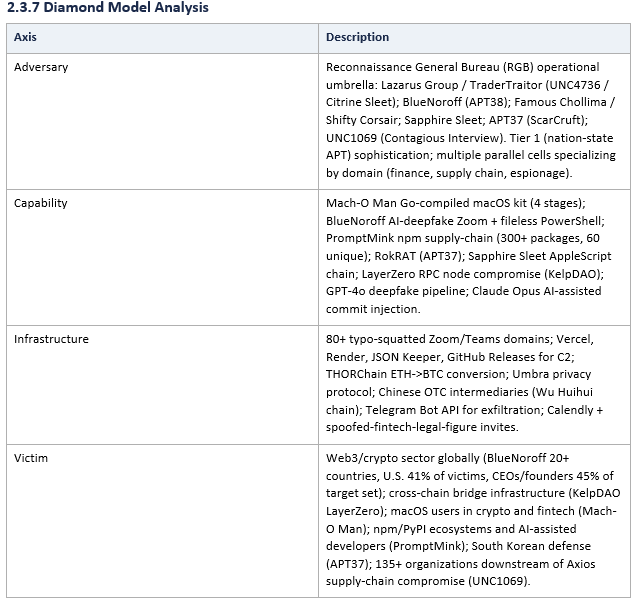
North Korea’s cyber program reached a new operational intensity in the 17 April – 1 May window. The combination of the KelpDAO bridge exploit ($292M, 18 April), three parallel macOS attack tracks (Lazarus “Mach-O Man,” BlueNoroff AI-deepfake Zoom, Sapphire Sleet AppleScript), the Famous Chollima PromptMink Large Language Model (LLM)-assisted npm supply-chain campaign (28–29 April), and the 7th 2026 missile volley (19 April Hwasong-11 tactical missiles fired from Sinpo with cluster / fragmentation warheads) constitutes the highest concentrated cyber-financial-kinetic activity by Pyongyang in any single 14-day window during the rolling reporting period. Concurrently, the International Atomic Energy Agency reported “very serious” nuclear advances at Yongbyon. These signals correlate with an emboldened cyber posture rather than de-escalation.
Cumulative 2026 DPRK cryptocurrency theft now totals approximately $577M across Drift Protocol ($285M, 1 April) and KelpDAO ($292M, 18 April) — 76 percent of all 2026 crypto hack losses globally tracked by TRM Labs through 30 April. The year is on pace to approach or exceed the 2025 record of $2.02B in DPRK-attributed crypto theft. The strategic role of crypto theft as a primary North Korean revenue source bypassing sanctions remains intact, with THORChain emerging as the consistent ETH-to-BTC conversion infrastructure for the largest heists, mirroring the Bybit February 2025 pattern.
2.3.2 Active Campaigns and Operations
KelpDAO Bridge Exploit — $292M (18 April; May 1 lead). On 18 April, attackers drained 116,500 rsETH (approximately $292M) from KelpDAO’s LayerZero-powered cross-chain bridge. The mechanism was not a smart-contract vulnerability — it was a precision attack on off-chain verification infrastructure, representing a new frontier in DeFi exploitation. Attack mechanics: (1) attackers identified KelpDAO’s rsETH bridge operating a 1-of-1 Decentralized Verifier Network (DVN) configuration — a single point of failure despite LayerZero’s repeated recommendations for multi-verifier redundancy; (2) attackers compromised two internal Remote Procedure Call (RPC) nodes hosted by LayerZero Labs, swapping out node software to report falsified blockchain state while returning truthful data to LayerZero’s monitoring service to avoid detection; (3) a Distributed Denial-of-Service (DDoS) attack was launched against all external uncompromised RPC nodes, forcing the bridge’s verifier to fail over exclusively to the two poisoned internal nodes; (4) with the poisoned DVN in control, the bridge validated a phantom “burn” message on the source chain and released 116,500 rsETH on Ethereum to the attacker; (5) a follow-up attempt to drain an additional approximately 40,000 rsETH (~$95M) was blocked by KelpDAO’s emergency multisig pause executed 46 minutes after the initial drain began; (6) the compromised RPC nodes self-destructed post-attack, deleting all malicious binaries, logs, and configurations.
KelpDAO attribution anchors. On-chain pre-funding traced to a Bitcoin wallet controlled by Wu Huihui (Chinese crypto broker indicted 2023 for laundering Lazarus thefts); additional funding sourced to the BTCTurk hack (a prior TraderTraitor theft). This is the same methodology used in the Bybit $1.46B breach (February 2025). Market impact: total value locked (TVL) in DeFi fell 7 percent in 24 hours to approximately $85B; Aave, SparkLend, and Fluid froze rsETH-related positions within hours.
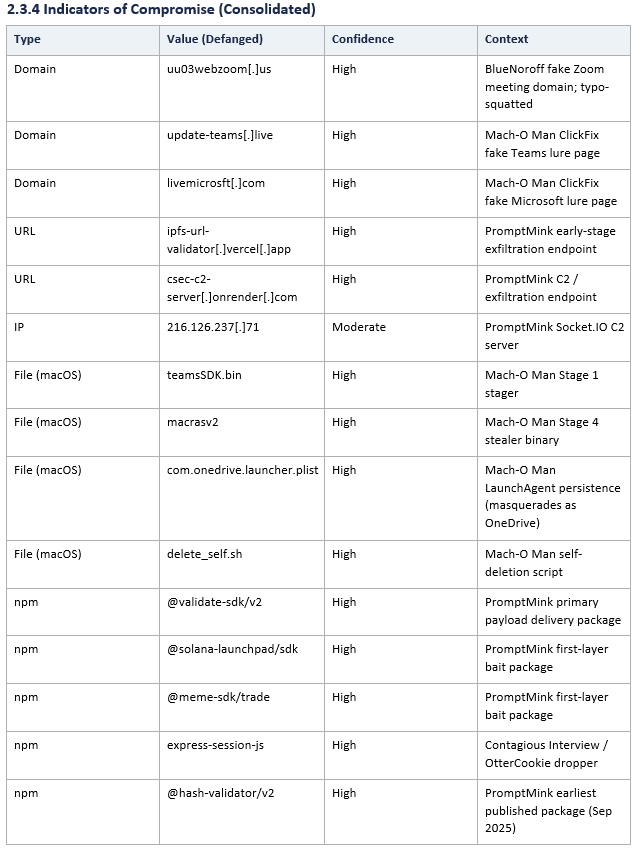
Lazarus “Mach-O Man” macOS ClickFix Campaign (21–22 April; May 1 lead). Disclosed by Bitso’s Quetzal Team and ANY.RUN, this campaign targets macOS users in cryptocurrency and fintech roles with a modular, Go-compiled Mach-O binary kit dubbed “Mach-O Man.” Delivery chain: victims receive urgent Telegram meeting invitations from compromised contact accounts; the link leads to a fake Zoom / Microsoft Teams / Google Meet site (e.g. update-teams[.]live, livemicrosft[.]com); a simulated connection error instructs the victim to copy-paste a Terminal command to “fix” the issue (ClickFix); the user-executed command downloads teamsSDK.bin via curl, bypassing Gatekeeper since the user initiates execution. Four-stage malware kit: Stage 1 teamsSDK.bin (stager) downloads the fake app bundle, applies ad-hoc code signing, and prompts for the macOS password; Stage 2 profiler binary enumerates hostname, UUID, CPU, OS, and browser extensions (Brave, Chrome, Firefox, Safari, Opera, Vivaldi, and six others) — known bug: infinite loop causing CPU spikes that may expose infection; Stage 3 persistence module drops Onedrive binary in a hidden “Antivirus Service” folder and registers com.onedrive.launcher.plist LaunchAgent for startup persistence; Stage 4 macrasv2 stealer harvests browser extensions, SQLite databases, Keychain items, and crypto wallets, compresses and exfiltrates via Telegram Bot API, and self-deletes via delete_self.sh.
BlueNoroff AI-Deepfake Zoom Campaign (Disclosed 27 April; May 1 lead). Arctic Wolf Labs published a detailed incident report covering a sophisticated intrusion at a North American Web3 / cryptocurrency company that began 23 January and persisted for 66 consecutive days. The campaign has spread across 20+ countries, with the U.S. accounting for 41 percent of identified victims and Chief Executive Officers (CEOs) and founders representing 45 percent of the target set. Operational sophistication highlights: (a) pre-attack timeline — initial contact made approximately 5 months before execution via Calendly invite spoofing a legitimate fintech legal figure (long lead time is an operational-patience signal); (b) AI deepfake pipeline — fake Zoom meeting interfaces populated with GPT-4o-generated headshots and recycled webcam footage from prior victims, with C2PA cryptographic metadata confirming GPT-4o origin (victim footage is immediately incorporated into future lures, creating a self-reinforcing deepfake production pipeline); (c) clipboard-hijack evolution — unlike standard ClickFix that asks users to paste malicious commands, this variant presents the victim with legitimate, benign-looking code to copy, then a malicious JavaScript intercepts the browser clipboard event and substitutes the malicious payload invisibly (victims aware of ClickFix risks who look at the code before pasting see nothing suspicious); (d) execution speed — from initial URL click to full system compromise (C2 establishment, Telegram session theft, browser credential harvesting, and persistence) completed in under five minutes per Arctic Wolf; (e) infrastructure — 80+ typo-squatted Zoom and Teams domains registered on a single hosting provider between late 2025 and March, including uu03webzoom[.]us; campaign ongoing as of publication.
Famous Chollima “PromptMink” — AI-Assisted npm Supply Chain (28–29 April; May 1 lead). ReversingLabs disclosed PromptMink, an ongoing npm supply-chain campaign that exploits AI coding workflows. The primary payload vector — a malicious dependency introduced via an Anthropic Claude Opus co-authored commit — represents the first confirmed case of an LLM unwittingly introducing a supply-chain backdoor into a production codebase. Key mechanics: two-layer package architecture — first-layer packages (e.g. @solana-launchpad/sdk, @meme-sdk/trade) appear legitimate and contain no malicious code while second-layer packages embed the actual stealer / backdoor; when the second layer is detected and removed, packages are immediately replaced with fresh versions on npm; the malicious dependency reference is buried in package-lock.json resolved field, invisible to most manual code review, fetched from a crafted GitHub release artifact rather than the official npm registry. ReversingLabs identified 20+ domains and IPs, 300+ published package versions across 60 unique packages, active since September 2025. Malware evolution tracked across early (obfuscated JavaScript infostealer; scans for .env / .json files; exfiltrates to Vercel ipfs-url-validator[.]vercel[.]app), mid (Node.js Single Executable Application (SEA)-wrapped, Node Application Programming Interface for Rust (NAPI-RS) Rust add-ons; SSH backdoor deployment; full project source exfiltration), and current (multi-platform harvester; AWS key, GitHub token, npm credential theft; Remote Access Trojan (RAT) with keylogging, screen capture, remote control). The AI weaponization angle is novel: LLM-generated code surfaces as dependency suggestions to AI coding agents, an AI-to-AI supply-chain attack vector. Code is structured to deceive automated coding assistants more effectively than human developers.
Sapphire Sleet macOS TTP Evolution Post-XProtect. Following Apple’s XProtect signature deployment on 16 April, no confirmed new Sapphire Sleet AppleScript-chain variants were publicly reported in the 17 April – 1 May window. However, two parallel macOS campaigns (Mach-O Man, BlueNoroff AI Zoom) confirm the broader Lazarus ecosystem pivoted to Go-compiled binaries and fileless PowerShell — evasion paths not addressed by the AppleScript-specific XProtect update. Apple separately announced a ClickFix terminal-paste protection feature for macOS Tahoe 26.4 (disclosed 30 March), prompting users before executing pasted Terminal commands — directly targeting the core delivery mechanism used by both Mach-O Man and the BlueNoroff AI Zoom campaign. Deployment is limited to Tahoe 26.4+ and can be bypassed if the user clicks “Paste Anyway.”
APT37 (ScarCruft) RokRAT Facebook Campaign — No New Scope Disclosure. The Facebook -> Messenger -> trojanized PDFelement -> RokRAT chain (disclosed 13 April, covered in prior briefing) remains the last public data point. The full target list has not been released. Monitor South Korean and defense-sector reporting for RokRAT detections linked to PDF-based social engineering since November 2025.
UNC1069 / Contagious Interview — 1700+ npm Packages and Axios Supply-Chain Leverage. Carry-forward from the rolling window: Mandiant / Google Cloud Threat Intelligence Group reporting documented UNC1069 (also known as Contagious Interview / Citrine Sleet for some operations) as the operator behind 1,700+ malicious npm packages. The 1 April Axios npm supply-chain compromise affected 135+ organizations whose downstream exploitation by UNC1069 has not been publicly detailed; Mandiant indicated this assessment will take months. Monitor for new exchange / custodian breaches cross-referenced against the Axios victim footprint.
2.3.3 Tactics, Techniques, and Procedures
Five TTP signals define the May 1 cut. (1) AI in the attack chain — PromptMink represents the first confirmed case of North Korean operators using an LLM (Claude Opus) to introduce a malicious supply-chain dependency into a production codebase, extending the attack surface to AI-assisted development environments and automated CI/CD workflows. (2) Deepfake-as-a-service self-reinforcement — BlueNoroff’s pipeline harvesting victim webcam footage and immediately reusing it in future deepfake lures represents a first-order capability advancement; each new victim increases fidelity of future attacks. (3) Infrastructure-level off-chain DeFi attacks — KelpDAO is the first major DPRK-attributed attack to target the verification-infrastructure layer of a cross-chain bridge rather than smart-contract logic; self-destructing RPC nodes represent a new counter-forensics capability at infrastructure level. (4) Clipboard hijack as ClickFix countermeasure bypass — BlueNoroff’s clipboard injection that replaces legitimate-looking code with malicious payload directly addresses growing victim awareness of ClickFix, an adversarial response to public CTI disclosure and defender education. (5) Parallel macOS attack-track convergence — Sapphire Sleet (AppleScript), Mach-O Man (Go / Mach-O), and BlueNoroff AI Zoom (PowerShell + fileless) all targeted macOS in the same two-week window, indicating parallel R&D teams optimizing for macOS environments where crypto and fintech operate.
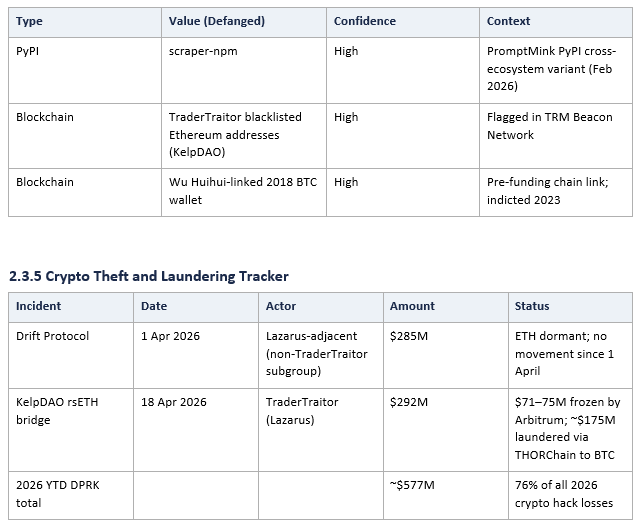
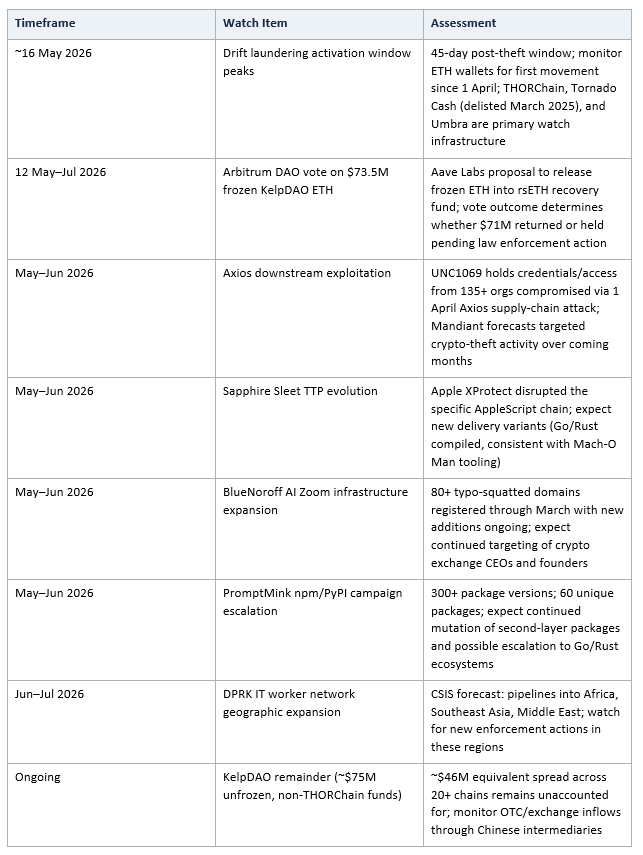
Drift Protocol Laundering Status — The stolen Drift ETH (distributed across fresh wallets post-1 April bridging from Solana to Ethereum) has not moved as of 1 May, now 30 days dormant. TRM Labs assesses the responsible group as following a pattern of months-to-years-long structured liquidation, consistent with the prior pattern after the October 2024 Radiant Capital hack. No mixer activity or exchange inflows have been detected. The Drift recovery pool ($147.5M from Tether plus partners; 16 April framework) remains structured as a revenue-linked repayment facility — no direct fund-recovery mechanism is operative.
KelpDAO Laundering Status — Active and ongoing. Frozen: 30,766 ETH (~$71–75M) frozen by Arbitrum Security Council emergency 9-of-12 multisig action approximately 20 April. Arbitrum DAO governance vote on allocation (Aave proposal: release to rsETH recovery fund) pending as of 25 April. Laundered: approximately $175M in ETH (unfrozen portion) swapped to BTC primarily via THORChain consistent with the TraderTraitor Bybit playbook; Umbra (Ethereum privacy protocol) was used to obscure wallet linkages before BTC conversion. Remaining funds spread across 20+ chains; most not yet recovered or frozen. Chinese OTC intermediaries are handling the liquidation phase, not North Korean operators directly, consistent with observed TraderTraitor practice since at least 2022.
THORChain has processed the vast majority of KelpDAO stolen funds (ETH -> BTC) in April, following its use in the Bybit February 2025 breach ($1.46B). No operator intervention or fund rejection occurred in either case. THORChain’s design — decentralized, no Know-Your-Customer (KYC) controls, no operator freeze mechanism — has made it the primary ETH -> BTC conversion infrastructure for DPRK’s largest heists since 2025. TRM Beacon Network alerts are active for KelpDAO / Lazarus-linked addresses at member exchanges.
2.3.6 IT Worker Enforcement Tracker
Sentencings carried forward from prior reporting period — (a) Kejia Wang (a.k.a. Tony Wang), 42, of Edison, New Jersey: 108 months (9 years), U.S.-based manager who supervised five-plus domestic facilitators and hosted hundreds of company laptops; sentenced 15–16 April. (b) Zhenxing Wang (a.k.a. Danny Wang), 39, of New Brunswick, New Jersey: 92 months (7.5 years), facilitator handling financial-account management; sentenced 15–16 April. No new arrests or indictments in the 17 April – 1 May window. Eight co-conspirators indicted June 2025 — Xu Yongzhe, Huang Jingbin, Tong Yuze, Zhou Baoyu, Yuan Ziyou (Samuel Yuan), Zhou Zhenbang, Liu Menting, Liu Enchia, and Song Min Kim — remain at large with a $5M State Department Rewards for Justice bounty outstanding.
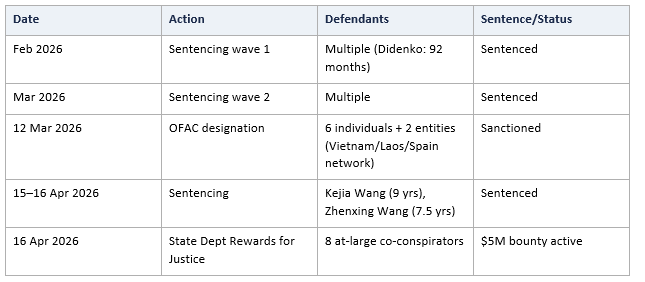
CSIS projects DPRK IT worker operations will expand geographically through 2026 with growing use of multimodal AI (voice, video, text deepfakes) and a multinational recruitment pipeline drawing developers from Iran, Syria, Lebanon, and Saudi Arabia coached into Western personas.
2.3.9 Assessment and 30–60 Day Outlook (ICD 203)
HIGH CONFIDENCE — North Korea’s cyber-financial operations reached a new operational intensity in this window. The KelpDAO hack ($292M) demonstrates capability expansion into off-chain infrastructure compromise that no existing DeFi security standard or bridge audit framework currently addresses. Combined with dormant Drift ETH ($285M), DPRK-controlled or recently laundered proceeds total approximately $577M YTD — exceeding full-year 2023 totals and placing 2026 on pace to approach or exceed the 2025 record ($2.02B).
HIGH CONFIDENCE — BlueNoroff, Famous Chollima (UNC1069), and the Lazarus Chollima division operate in parallel across at least five overlapping campaigns (AI Zoom, Mach-O Man, PromptMink, Contagious Interview npm, Axios follow-on exploitation). The operational tempo — two $280M+ heists, three major TTP disclosures, and continued npm/PyPI publishing in 14 days — is unprecedented for a single reporting period.
MODERATE CONFIDENCE — The clipboard-hijack evolution of ClickFix (BlueNoroff AI Zoom) directly reflects adversarial awareness of public CTI reporting on standard ClickFix techniques, consistent with North Korean operators monitoring threat intelligence publications and adapting rapidly.
LOW-MODERATE CONFIDENCE — Drift Protocol stolen ETH will remain dormant until at least June. The responsible subgroup’s operational pattern (Radiant Capital October 2024 -> long dormancy -> structured cashout) suggests a 60–90+ day pre-laundering hold. No mixer or bridge activity has been detected as of 1 May.
Intelligence gaps: (1) full target list for the APT37 Facebook / RokRAT campaign remains undisclosed; (2) the Lazarus subgroup responsible for Drift Protocol (distinct from TraderTraitor per TRM Labs) has not been publicly named; (3) downstream exploitation of the 135+ Axios-compromised organizations by UNC1069 has not been publicly detailed — Mandiant indicated months-long assessment.
30–60 Day Priority Outlook (North Korea):

2.4 Iran
2.4.1 Strategic Posture
Iran’s cyber posture during the reporting window is shaped by three structural conditions: the indefinite extension of the U.S.–Iran ceasefire on 21 April without a deal, the maintenance of the U.S. naval blockade of Iranian ports (which Tehran characterizes as an act of war), and the ongoing Day-63 nationwide internet blackout that as of 1 May has run 1,512+ hours — the longest documented nationwide internet shutdown in history. The combination produces what we assess as the most cyber-permissive operating configuration available to Tehran: kinetic pressure (blockade, mines in Hormuz, six-month estimated mine-clearing timeline per the 20 April Pentagon House Armed Services Committee classified briefing) continues, Iran is economically desperate (losing $400–500M per day in maritime revenue), domestic governance is fractured per Trump’s public characterization, and there is no deal constraining cyber behavior.
Historical precedent (2020 Nagorno-Karabakh, 2015 Joint Comprehensive Plan of Action) confirms this configuration produces cyber escalation, not restraint. The 16 April New York Times assessment that Iran is “transitioning from overt actions to more discreet initiatives aimed at preparing for potential future actions” — specifically emphasizing espionage and critical infrastructure pre-positioning — captures the operational shift. Iran is exploiting the diplomatic pause to deepen OT/ICS pre-positioning, restore operational tempo via proxy channels, and prepare multi-vector contingency operations to be executed if negotiations collapse.
On 27 April, Iran submitted a new framework to Washington via Pakistan, calling for Strait of Hormuz reopening in exchange for ceasefire extension with nuclear negotiations explicitly deferred to a later phase — a structural shift separating the Hormuz blockade from denuclearization that reduces near-term escalation risk but extends the timeline for permanent settlement, likely into Q3 2026.
2.4.2 Ceasefire Aftermath and Handala Activity (May 1 lead)
The Handala / Void Manticore (MOIS) cluster broke its post-8 April U.S. tactical pause on 27–28 April with three connected actions: (1) public release of personally identifiable information for 2,379 U.S. Marines stationed at Naval Support Activity Bahrain — names, phone numbers, home addresses, family details, daily routines; (2) direct WhatsApp death threats to service members from a spoofed Bahraini business number, with messages specifically referencing Shahed drones and Kheibar / Ghadeer missiles, consistent with MOIS psychological-operations tradecraft designed to create fear in service members’ families rather than indicate operational strike capability; (3) a claimed concurrent leak of Israeli Maglan Unit 212 (elite commando) officer identities, photos, and backgrounds. The WhatsApp messages to two U.S. Marines were verified as identical by Stars and Stripes review. The Bahraini phone number was registered to a legitimate local business, most likely spoofed or SIM-hijacked via a prior Handala telecom compromise. Naval Criminal Investigative Service (NCIS) did not immediately confirm scope.
Tradecraft note: Handala’s operational pattern involves recycling data-broker information and publicly available social-media data augmented with genuine breach material. Bitdefender analysts caution the Marines dataset may be partially assembled from non-classified sources; however, the operational impact of the psyop is independent of data provenance.
Earlier Handala / Void Manticore window activity — (a) IDF Chief Halevi device breach (9 April; partially confirmed by Israeli media): 19,000+ documents including classified meetings with U.S. Central Command (CENTCOM) commander Kurilla in Qatar and the Jordanian army chief; (b) Dubai government systems claim (12 April; unverified as of 1 May): Dubai Courts, Dubai Land Department, Dubai Roads and Transport Authority, with claimed 6 petabytes destroyed and 149TB exfiltrated, no UAE government confirmation; (c) ongoing Israeli critical-infrastructure espionage (Gihon Water, defense, telecom) including data theft, Human-Machine Interface (HMI) defacement, and battle-damage-assessment reconnaissance.
DomainTools published research on 20 April unifying Homeland Justice, Karma / KarmaBelow80, and Handala as interchangeable personas operated by a single MOIS-directed cell, with a command-level handler tracked as “Panjaki.” This is the most actionable attribution baseline for the period; no counter-attribution has emerged through 1 May.
2.4.3 Active Campaigns and Operations
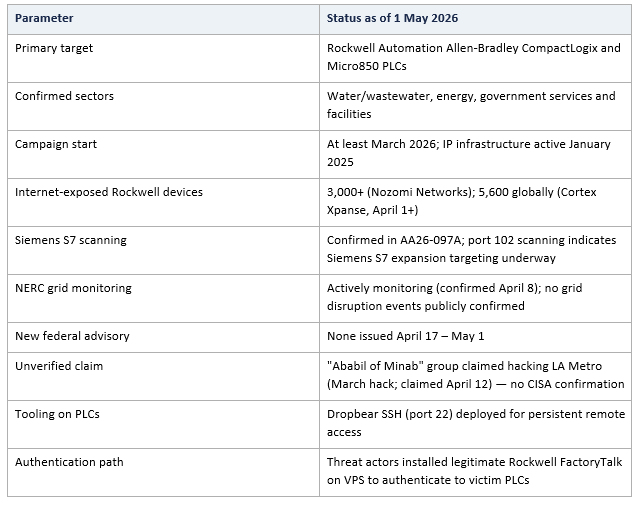
CyberAv3ngers / CL-STA-1128 — ICS/PLC Campaign (Anchored by CISA AA26-097A, 7 April). The 7 April federal joint advisory by CISA, FBI, NSA, EPA, DOE, and CNMF remains the governing artifact for Iranian-affiliated APT critical-infrastructure targeting. As of 1 May, no new federal advisory has been issued in the rolling 17 April – 1 May window, but the campaign is assessed as ongoing at its 7 April baseline or higher. Primary target: Rockwell Automation Allen-Bradley CompactLogix and Micro850 Programmable Logic Controllers (PLCs). Confirmed sectors: water and wastewater, energy, government services and facilities. Campaign start: at least March, with Internet Protocol infrastructure active January 2025. Internet-exposed Rockwell devices: 3,000+ per Nozomi Networks; 5,600 globally per Cortex Xpanse on 1 April. The EPA confirmed on 7 April that drinking-water and wastewater systems experienced “exploitation and, in some cases, disruption” including configuration wiping, software-based mechanical sensor tampering, and HMI disruption. NERC issued an all-points bulletin to energy-sector members. No public reports of water contamination or large-scale power-outage events in the 17 April – 1 May window indicate current attacks remain in the disruption and pre-positioning phase, not the physical-process-manipulation phase.
Siemens S7 Pre-Exploitation Scanning (May 1 lead). The CISA advisory states explicitly: “The targeting of ports associated with other OT vendors’ protocols suggests these actors may also be targeting devices manufactured by companies other than Rockwell Automation/Allen-Bradley, including the Siemens S7 PLC.” Port 102 (S7comm) scanning from threat-actor Virtual Private Server (VPS) infrastructure has been observed; no publicly confirmed Siemens S7 exploitation has been documented through 1 May. Defenders operating Siemens S7 PLCs should treat this as Active, Pre-Exploitation threat posture. The trajectory described by Dragos in its 2026 OT/ICS Year in Review — Iranian adversaries “moving beyond pre-positioning to actively mapping control loops” — indicates this threshold could be crossed without warning.
MuddyWater / Seedworm (MOIS). Status during the blackout: active via external infrastructure, VSAT routing, and pre-positioned implants on U.S. networks. Dindoor (JavaScript / TypeScript backdoor via Deno runtime) and Fakeset (Python backdoor pulled from Backblaze cloud storage) remain the operative implant set documented in March, deployed across a U.S. bank, software company, and Canadian non-governmental organization. Signing certificates “Amy Cherne” and “Donald Gay” remain detection fingerprints; Donald Gay previously signed Stagecomp and Darkcomp (confirmed MuddyWater tools). Operation Olalampo (Group-IB, February 2026) introduced CHAR, GhostFetch, HTTP_VIP, GhostBackDoor, and Rust-based RustyWater as next-generation tooling. Full restoration of MuddyWater operational tempo is expected within 24–72 hours of Iran internet restoration.
APT34 / OilRig / BladedFeline (MOIS). Augur Security threat-posture assessment confirmed APT34 / BladedFeline shows sudden dormancy assessed as operational disruption from kinetic strikes, not permanent retirement. BladedFeline (APT34 affiliate targeting Iraq and the Kurdistan Regional Government) was actively developing PrimeCache (RDAT-lineage implant) through early 2026. Restoration is expected on Iran internet connectivity restoration. Lure infrastructure using compromised Iraqi Ministry of Foreign Affairs email accounts with conflict-themed lures (documented pre-17 April) remains active.
APT35 / Charming Kitten / Mint Sandstorm. Operational status post-28 February kinetic strikes is unconfirmed in public reporting. Pre-strike tooling and target sets (academic, dissident, journalist targeting) are presumed retained but operational pace is degraded.
APT33 / Imperial Kitten / Elfin (IRGC-affiliated). Reduced public visibility during the window; pre-positioned access against U.S. defense, energy, and aerospace targets is assessed as retained.
Cotton Sandstorm / Emennet Pasargad (IRGC-linked). The SC World reference to a 15 April supply-chain event has not received additional public confirmation in the 17 April – 1 May window. Pre-positioned WezRat and WhiteLock payloads from the pre-28 February era remain the operative threat baseline.
Agrius / Marshtreader (IRGC-linked). Continued Hikvision and Dahua camera exploitation across Israel, the United Arab Emirates, Qatar, Bahrain, Kuwait, Lebanon, and Cyprus for battle-damage-assessment and strike-preparation reconnaissance. CVEs in active use: CVE-2017-7921, CVE-2023-6895, CVE-2021-36260, CVE-2025-34067, CVE-2021-33044.
2.4.4 ICS / OT Targeting Update
2.4.5 Tactics, Techniques, and Procedures — Selected Highlights
CyberAv3ngers / CL-STA-1128 (IRGC-CEC). Initial access via exploitation of internet-exposed Rockwell PLCs (CVE-2021-22681, no vendor patch available); IOCONTROL custom Linux ICS malware with MQTT-over-TLS port 8883 C2, DNS-over-HTTPS resolution, AES-256-CBC config, systemd persistence; threat actors install legitimate Rockwell FactoryTalk on a VPS to authenticate to victim PLCs (T1588.002 — novel tradecraft); Dropbear SSH dropped on port 22 for persistent remote access; HMI/SCADA data manipulation; configuration wiping and software-based mechanical sensor tampering observed.
MuddyWater / Seedworm (MOIS). Dindoor JavaScript/TypeScript backdoor via the Deno runtime (signed certificate “Amy Cherne”); Fakeset Python backdoor pulled from Backblaze cloud storage (signed certificates “Amy Cherne” and “Donald Gay”); Operation Olalampo introduces CHAR, GhostFetch, HTTP_VIP, GhostBackDoor (Telegram bot C2), and Rust-based RustyWater as next-generation tooling; RDP initial access with SSH tunnel observed in Huntress-documented March 2026 intrusion; Rclone exfiltration to Wasabi.
Handala / Void Manticore (MOIS). Bahraini SIM card spoofing or hijack for WhatsApp psychological-operations delivery (T1036.004 — novel for this period); BiBi Wiper, GoXML.exe, and cl.exe wiper deployment in destructive operations; Microsoft Intune Global Admin abuse for device wipe (Stryker pattern); Telegram channel propagation of stolen data and target lists.
Agrius / Marshtreader. Active scanning (T1595) of Hikvision and Dahua camera networks for battle-damage-assessment and strike-preparation reconnaissance across Israel, the United Arab Emirates, Qatar, Bahrain, Kuwait, Lebanon, and Cyprus; screen and video capture (T1113 / T1125) from compromised camera networks.
2.4.6 Indicators of Compromise (Consolidated, Defanged)
All IOCs are defanged per TLP:WHITE convention. Confidence ratings reflect ICD 203 standards.
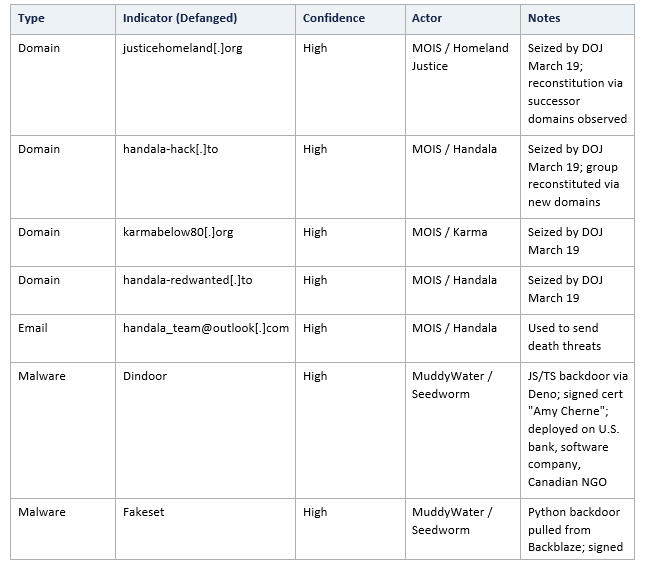
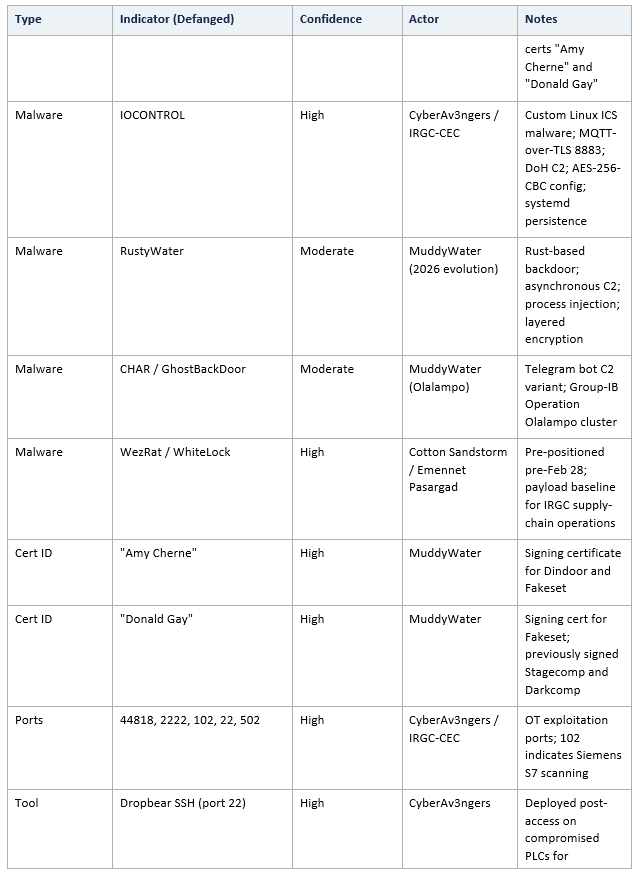

2.4.7 Iran Internal Internet Posture
As of 1 May 2026, Iran’s nationwide internet blackout has reached Day 63 (1,512+ hours), the longest confirmed nationwide internet shutdown in recorded history. Connectivity remains at approximately 2 percent of pre-war levels per NetBlocks and Cloudflare Radar telemetry. The Supreme National Security Council formally approved “Internet Pro” tiered access on 21 April, with three state-linked telecoms offering 50 GB packages to select businesses and professions; WhatsApp, Telegram, and Instagram remain blocked even under Internet Pro, ChatGPT remains blocked while DeepSeek is available. Police have arrested over 1,800 people for internet-related offenses; black-market VPN access is reportedly selling for approximately $10 per gigabyte.
Two architectural developments confirmed during the reporting window indicate that Tehran is constructing a permanent, “Barracks Internet” architecture rather than planning a full restoration. First, all internet traffic is being routed through a single national gateway using Chinese-supplied national NAT technology — a single point of monitoring, control, and circumvention blocking. Hardware intensity may produce lag and reliability issues but the centralization is structural. Second, “Internet Pro” is being implemented as a permanent tier rather than a temporary wartime mechanism; the Graphic Designers Guild and Iranian Nurses Association have publicly rejected the tiered system, but authorities are proceeding.
The cumulative economic cost of the blackout is estimated at $2.0 billion or more, at $35–80 million per day. The structural shift establishes a long-term operating environment for Iranian APT groups in which domestic infrastructure cannot be assumed for OPSEC cover but pre-positioned external infrastructure (Starlink, third-country VPS, pre-positioned Telegram C2, and pre-positioned implants on Western networks) is operationally untouched. Specifically, Handala, IOCONTROL/CyberAv3ngers external infrastructure, MuddyWater Dindoor and Fakeset on U.S. and Canadian targets, and Cotton Sandstorm WezRat and WhiteLock pre-positioned pre-28 February are all unaffected by the domestic blackout.
APT full restoration trigger. NetBlocks and Cloudflare Radar Iran traffic exceeding 5 percent of pre-war levels should be treated as an immediate threat-escalation trigger requiring full threat-hunt activation across MuddyWater, APT34, APT35, and APT33 detection signatures.
2.4.8 Diamond Model Analysis
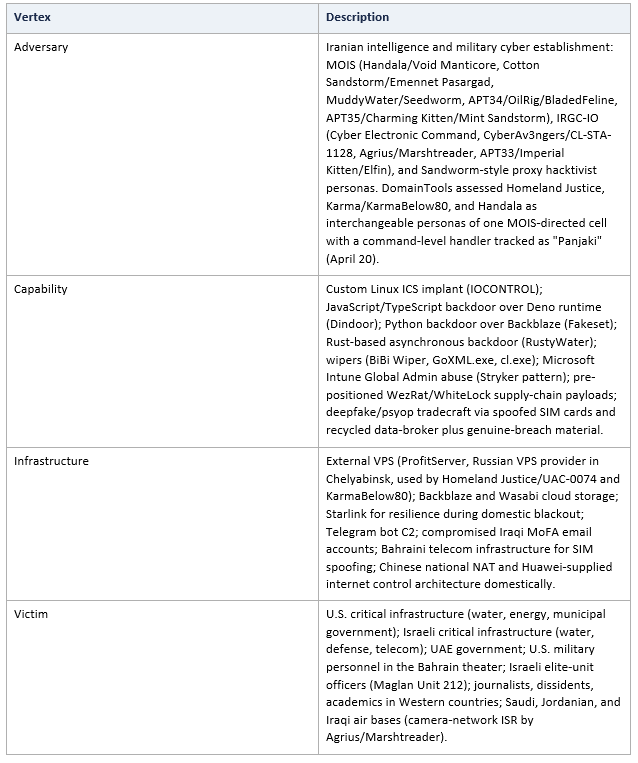
2.4.10 Assessment and 30–60 Day Outlook (ICD 203)
High confidence judgments. (1) Handala (MOIS / Void Manticore) has ended its U.S. tactical pause: the 27–28 April Marines data leak and WhatsApp psyop campaign represents a clean shift from tactical restraint to active U.S. targeting; the group is no longer operating within the bounds of its 8 April ceasefire declaration. (2) CyberAv3ngers / IRGC-CEC ICS exploitation of Rockwell PLCs is ongoing as of 1 May; the absence of a second federal advisory does not indicate campaign cessation but rather indicates that no new escalation threshold has been crossed to trigger advisory publication. (3) Iran’s internet restoration architecture is being designed for permanent tiered control, not temporary wartime suppression; the Barracks Internet model represents a strategic shift that will change the long-term operating environment for Iranian APT groups.
Moderate confidence judgments. (1) Siemens S7 PLC exploitation by CyberAv3ngers is in active pre-exploitation scanning phase and will likely produce the first confirmed S7 compromise within the 30-day outlook window. (2) MuddyWater, APT34, APT35, and APT33 operational tempo will surge within 24–72 hours of any Iran internet restoration exceeding 10 percent of pre-war levels. (3) Handala’s Dubai Courts and Dubai Land Department claim from 12 April (149 TB exfiltrated) contains partial genuine breach material, though scope inflation is likely.
Low confidence judgments. (1) A Stryker-class wiper event against a major U.S. financial institution or critical infrastructure entity is unlikely in the 30-day window without a kinetic escalation trigger; the current ceasefire extension and Iran’s fractured governance are assessed as temporarily suppressing authorization for maximum-impact operations. (2) Handala’s claim of active strike coordination with IRGC missile units represents psychological warfare messaging rather than confirmed operational capability.
Intelligence gaps. No confirmed attribution of the 15 April Cotton Sandstorm supply-chain event referenced in the prior briefing; scope and methodology of Handala’s Marines dataset (data-broker assembly versus genuine breach) unconfirmed; current operational status of APT35 / Charming Kitten post-28 February strikes unclear; whether Siemens S7 exploitation has already occurred at non-disclosed victim organizations is unknown; extent of MuddyWater pre-positioned access beyond the four publicly confirmed organizations (a U.S. bank, an airport, a Canadian NGO, and an Israeli defense software supplier) is unknown.
Outlook scenarios. (1) Iran presents unified proposal and limited deal framework emerges: 20–25 percent probability; Handala U.S. restraint may be partially reimposed, ICS campaign reduces visibility but continues, APT groups maintain pre-positioned access for contingency. (2) Ceasefire remains indefinitely extended without deal: 40–45 percent probability and current trajectory; Handala gradually escalates U.S. operations, CyberAv3ngers maintains ICS tempo, APT groups await connectivity restoration, periodic psyop operations (military personnel leaks, death threats) become the primary visible Handala output. (3) Kinetic conflict resumes via blockade provocation or Israeli escalation: 30–35 percent probability; immediate Handala shift to destructive U.S. operations, CyberAv3ngers attempts physical process manipulation on water and energy, Cotton Sandstorm WhiteLock/WezRat payloads activated, undersea cable threat activates. (4) Iran internet restoration exceeds 10 percent: 15–20 percent probability in 30 days; immediate and dramatic surge in MuddyWater, APT34, APT35, APT33 operational tempo, treat as equivalent threat escalation event to a new kinetic strike.
Section 3 — Cross-Nation Convergence
3.1 Adversary Coordination Evidence
The adversary coordination pattern documented in prior briefings has not been disrupted by the ceasefire extension, the CISA director nomination withdrawal, or the pre-summit diplomatic activity. We assess with high confidence that each vector — Russian satellite ISR for Iran, Chinese BeiDou and component pipeline support, North Korean crypto funding, and the TASS-KCNA information coordination pact — continues at or above baseline tempo. The cyber domain remains the zone of cheapest and most deniable trilateral coordination among Russia, Iran, and China, with North Korea operating as a financially-motivated outrigger that benefits from the broader axis posture.
During the peak of reported U.S.-Israeli strikes against Iranian nuclear and missile infrastructure and the original ceasefire expiration window (17–22 April), intelligence reporting indicated deepening Russia-Iran-China covert coordination. Russian reconnaissance satellites are reported to have provided imagery to Iran identifying U.S. military installations in the region; sites surveyed were reportedly struck in short succession, suggesting a rapid intelligence-to-strike cycle. Russia-Iran cyber coordination, including the Z-Pentest Alliance, NoName057(16), and DDoSia Project coordination with Iranian Handala Hack via Telegram — continued through the period and includes shared publication of ICS credentials for Israeli critical-infrastructure targets. China-Iran coordination is anchored on BeiDou satellite integration with Iranian military operations and the TEE-01B commercial satellite acquisition, with Emposat ground stations across Asia and Latin America used by IRGC for satellite C2 and downlink.
NCSC CEO Richard Horne, addressing CyberUK 2026 in Glasgow on 22 April, implicitly framed Russia, Iran, and China as an integrated threat landscape — the first senior UK intelligence public reference in 2026 to treating the three actors’ cyber operations as a convergent challenge requiring unified defensive posture. NATO Secretary General Mark Rutte, speaking at the Reagan Institute on 9 April, explicitly cited the four-actor convergence: “It is China and North Korea and the Russians working together with Iran when it comes to, for example, the unprovoked war of aggression of Russia.” This is the highest-level NATO public acknowledgment of the quadrilateral coordination to date.
3.2 Russia-Iran-China Satellite ISR Sharing
The most consequential multi-polar ISR coordination against U.S. military assets since the Cold War is now publicly documented. Reuters, citing a Ukrainian intelligence assessment dated 7 April, reported that Russian military satellites conducted dozens of detailed imagery surveys of U.S. military facilities across the Middle East and organized data sharing through a permanent Russia-Iran communications channel, possibly facilitated by a Russian military spy station in Tehran. Within days of each survey, surveyed sites were struck by Iranian missiles and drones; Ukrainian intelligence assessed this as “a clear pattern.” Saudi sites surveyed included five over King Khalid Military City (a THAAD location targeting indicator) and the Strait of Hormuz.
The Financial Times and Reuters, citing leaked military documents on 15 April, separately confirmed that the IRGC Aerospace Force acquired the TEE-01B satellite in late 2024, built by Chinese company Earth Eye Co. (北京沐美星空科技) and launched into orbit. TEE-01B provides 0.5-meter resolution imagery — ten times more accurate than Iran’s indigenous satellites and comparable to Western commercial models. In March 2026, TEE-01B captured images of Prince Sultan Air Base (Saudi Arabia), Al Muwaffaq Salti Air Base (Jordan), the U.S. Fifth Fleet base in Bahrain, and Erbil Airport — all subsequently struck by Iranian forces around the time of capture.
Ukrainian intelligence further assessed that “Iranian hacker groups have also used some techniques and operations that indicated they had obtained them from Russian military intelligence hackers.” This is direct attribution language for a capability uplift. The convergence of Russian ISR support, Chinese satellite imagery, and IRGC targeting represents the structural alignment most likely to persist beyond the April 22 ceasefire-without-deal extension. Separately, the Atlantic Council “Axis of Evasion” framework documents the BeiDou integration in Iranian military operations as a parallel sustained capability transfer, and the China-Iran TEE-01B program is now the principal ISR thread of the trilateral posture.
3.3 Western Defensive Posture Status
CISA — Leadership Vacuum Deepens
Sean Plankey formally withdrew his nomination as CISA director on 22 April after 13 months in limbo — blocked primarily by Senator Rick Scott (R-FL) over a disputed Coast Guard shipbuilding issue. The Trump administration has provided no timeline for a new nominee. Acting Director Nick Andersen, in role since late February 2026, is expected to remain for several months. CISA now faces no Senate-confirmed director for the third consecutive year, an approximately 27 percent staffing reduction from 2025 levels (approximately 2,700 effective staff), a pending $707 million FY27 budget cut awaiting Congressional approval, an eliminated Election Security program, the EI-ISAC defunded, and the Joint Cyber Defense Collaborative dismantlement underway. The combination of leadership vacuum, budget attrition, and simultaneous nation-state attack escalation creates a structural capability gap with no near-term resolution path.
Five Eyes — New Actions in the Window
UK NCSC issued a 30 April advisory on APT28 (Forest Blizzard, GRU) exploitation of vulnerable home and small-office routers to hijack DNS, enabling adversary-in-the-middle attacks and theft of Microsoft 365 credentials and session tokens; the advisory confirms hundreds of organizations and thousands of consumer devices affected. NCSC separately published 30 April guidance on frontier AI models in cyber defense, identifying three deployment paths (system hardening, threat detection and investigation, automated response) and warning that organizations investing early in strong security baselines and carefully deployed AI-enhanced defense will be best placed to retain defender advantage. OpenAI briefed Five Eyes partners and approximately 50 U.S. government officials on 21–22 April on GPT-5.4-Cyber, launched under its Trusted Access for Cyber program providing cyber defenders with a permissive variant of GPT-5.4 enabling binary reverse engineering, vulnerability analysis, and advanced defensive workflows.
Election Security Group Dormancy Ahead of 2026 Midterms
CNN confirmed on 30 April that the NSA and U.S. Cyber Command Election Security Group (ESG) — which previously coordinated offensive cyber countermeasures against Russian and Iranian interference — has not been activated. NSA and CYBERCOM leaders confirmed the dormancy to Congress, citing no current direction to activate. Combined with CISA’s election security program elimination, FBI’s reduced election-focused units, and the State Department election security teams reportedly disbanded or reduced, the 2026 midterms face the most degraded federal election cyber defensive posture since pre-2016. We assess with high confidence that Russia and Iran retain demonstrated capability and motivation to interfere in U.S. midterms; the absence of ESG, CISA election security, and FBI election units creates a detection and attribution gap that foreign disinformation operations running in the background of the Iran conflict narrative and TASS-KCNA information coordination are already primed to exploit.
3.4 OFAC, Sanctions, and Indictments Activity
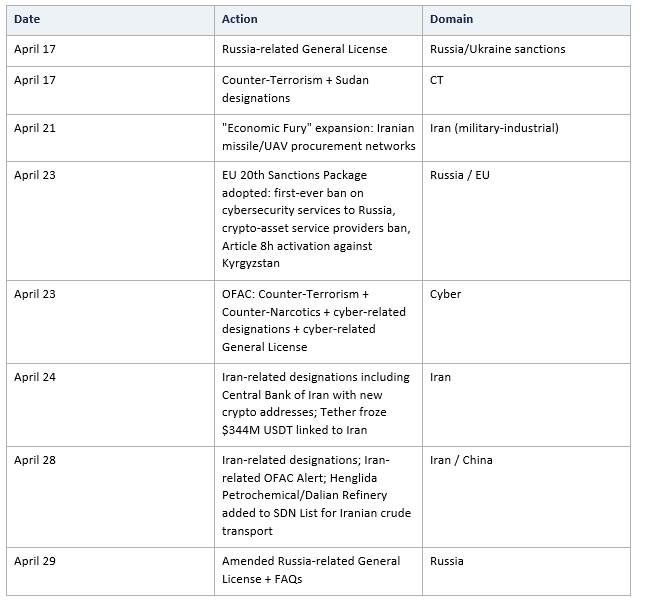
The 23 April cyber-related designations are the most operationally significant sanctions action in the period. OFAC issued cyber-related designations accompanied by a new cyber-related general license; the latter typically enables certain otherwise-prohibited activities (security research, incident response) in sanctioned jurisdictions. The combination of designation plus general license is a pattern consistent with OFAC targeting a ransomware or cyber-infrastructure node while enabling defensive activity against it. The Henglida Petrochemical SDN listing is the largest Chinese private refinery entity sanctioned under Iran-related authorities to date; it signals escalating U.S. willingness to use financial pressure on China’s Iran energy conduit — and China’s willingness to absorb that pressure to sustain the supply chain.
DOJ activity. Ilya Angelov was sentenced to 24 months and ordered to pay a $100,000 fine and a $1.6 million money judgment for co-managing a Russian cybercriminal group that deployed malware and sold access to compromised computers, impacting over 70 U.S. businesses and generating $14 million-plus in ransom payments. DOJ and international partners seized LeakBase, described as one of the world’s largest cybercrime forums for stolen data and tools, with over 142,000 members and 215,000-plus messages. The CARR / Dubranova trial commenced 7 April as scheduled with no verdict announced in public reporting through 1 May; federal complex cyber trials typically run three to six weeks, suggesting a verdict expected by mid-to-late May. Xu Zewei, a contract hacker for the Shanghai State Security Bureau operating through Shanghai Powerock Network Co. Ltd., was extradited from Italy and appeared in the Southern District of Texas on 28 April — the first extradition of a China-linked contract hacker from Italy to the United States, charged with COVID-19 vaccine research theft and the HAFNIUM/Silk Typhoon Exchange Server mass-exploitation campaign.
3.5 Trump-Xi Summit Cyber Posture (T-13 Days)
The Trump-Xi summit is on track for 14–15 May in Beijing. Final preparatory calls were held on 30 April: Chinese Vice Premier He Lifeng held a video call with Treasury Secretary Bessent and USTR Greer on implementing summit deliverables, and Foreign Minister Wang Yi spoke simultaneously with Secretary Rubio. Wang Yi’s formulation — linking Taiwan handling to “opening up new space for China-U.S. cooperation” — is assessed by analysts as a transactional Grand Bargain signal, unprecedented in its positive conditional framing. Reuters confirmed that Beijing has been “constantly sending signals at a working level” that Taiwan will top Xi’s agenda — a departure from the November 2025 South Korea meeting.
Cyber and tech agenda tensions in the pre-summit week are sharper than in any prior bilateral. The FCC unanimously approved restrictions banning Chinese laboratories from testing U.S.-market electronics, and advanced further restrictions on China’s three major telecom carriers covering data centers and cloud infrastructure; China’s Ministry of Commerce called the actions discriminatory. AI model distillation has been declared a national security threat: the House Homeland Security and Select Committee on China launched a joint investigation into model distillation by DeepSeek, Alibaba, Moonshot AI, and MiniMax, and the State Department has reportedly dispatched diplomatic cables warning foreign governments. Congress is advancing the Multilateral Alignment of Technology Controls on Hardware Act with a 0 percent de minimis rule requiring allied alignment on semiconductor equipment export controls. The Shadow-Earth-053 disclosure on 30 April — a Chinese APT group actively compromising NATO defense contractors — creates a politically charged pre-negotiation environment; the TrendAI researcher Tom Kellermann explicitly linked the activity to summit timing.
Pre-summit intelligence collection. Chinese intelligence services have historically intensified collection operations against U.S. negotiators, congressional offices, and trade-policy deliberators in the weeks preceding high-stakes summits. The pattern observed in the September 2025 APT41 campaign (impersonating Congressman John Moolenaar in targeted spear-phishing against trade groups, law firms, and federal agencies) established the playbook. The current pre-summit period features Shadow-Earth-053 activity against the U.S.-aligned defense sector with no evidence of deceleration; Taiwan NSB reports of Chinese airspace “reservation” (27 March – 5 May) as summit signaling; Salt Typhoon’s Congressional email access (confirmed 9 January) providing potential ongoing visibility into U.S. negotiating positions on trade and Taiwan; and AT&T and Verizon’s blocking of Mandiant security assessment reports impeding U.S. government visibility into residual access. The December 2025 decision to halt MSS sanctions — to protect the U.S.-China trade truce negotiated at the October 2025 Busan Summit — remains in force; no new China cyber sanctions were imposed in the 17 April – 1 May window despite Xu Zewei’s extradition, the OSTP AI theft memorandum, and Shadow-Earth-053’s NATO country targeting.
Assessment: We assess with moderate confidence that Beijing will offer a cyber non-escalation rhetorical commitment on Salt Typhoon and Volt Typhoon in exchange for entity list relief, with no binding verification mechanism — mirroring the 15 April “China has agreed not to send weapons to Iran” pattern. We assess with low confidence that China will activate any of its pre-positioned access in Volt Typhoon, Salt Typhoon, or Shadow-Earth-053 infrastructure as a direct result of the summit; the summit is expected to produce a managed outcome that does not trigger a Chinese escalatory response.
3.6 AI and Emerging Threat Vectors
LLM weaponization. The 17 April – 1 May window produced three first-of-kind AI-enabled threat events. First, the Famous Chollima PromptMink campaign represents the first confirmed case of North Korean operators successfully using a frontier LLM (Anthropic’s Claude Opus) to introduce a malicious supply-chain dependency into a production codebase via an AI-co-authored commit. The malicious dependency reference is buried in `package-lock.json` resolved fields, invisible to most manual review and fetched from a crafted GitHub release artifact. Second, BlueNoroff’s AI-deepfake Zoom campaign produces fake meeting interfaces populated with GPT-4o-generated headshots and recycled webcam footage from prior victims; C2PA cryptographic metadata confirms GPT-4o origin and victim webcam footage is immediately reincorporated into future lures — a self-reinforcing deepfake production pipeline. Third, the White House Office of Science and Technology Policy released a formal memorandum on 23 April accusing China of “deliberate, industrial-scale campaigns to distill U.S. frontier AI systems,” naming DeepSeek (150,000-plus Anthropic exchanges), MiniMax (13 million-plus exchanges), and Moonshot AI (3.4 million-plus exchanges) across 24,000 fraudulent accounts generating 16 million-plus interactions with Claude.
Defensive AI deployment. OpenAI’s GPT-5.4-Cyber under the Trusted Access for Cyber program brings frontier defensive workflow support — binary reverse engineering, vulnerability analysis, advanced detection assistance — to vetted defenders at Five Eyes scale. NCSC’s 30 April guidance lays out a deployment framework for organizations: prioritize strong security baselines and carefully deployed AI-enhanced defense to retain defender advantage as adversary AI use accelerates. Europol’s IOCTA 2026 documents that hybrid threat actors are increasingly using cybercriminal networks as proxies, with the Crime-as-a-Service economy now operating with hybrid threat actors as one customer class. The asymmetry between adversary AI use (already mainstream in DPRK and emerging in China) and defender AI use (adoption pending) is the dominant emerging-threat trend of the period.
Section 4 — Defensive Recommendations
4.1 Priority Detection Engineering
Detection priorities for the 30-day window should prioritize the active-exploitation chains driving the highest current operational tempo. Below are representative detection patterns mapped to the lead campaigns of this reporting period; SOC engineering teams should treat these as starting templates for environment-specific implementation.
CVE-2026-32202 — Zero-Click Windows Shell NTLM Coercion
Detection objective. Surface anomalous outbound SMB connections from user workstations, particularly to external IP addresses; capture NTLM authentication exchanges from user-context processes against non-domain-joined destinations; identify Net-NTLMv2 hash transmission across the egress boundary.
KQL pseudocode. DeviceNetworkEvents | where InitiatingProcessFileName in (”explorer.exe”,”svchost.exe”) | where RemotePort == 445 | where not(ipv4_is_private(RemoteIP)) | summarize count() by DeviceName, RemoteIP, bin(Timestamp, 1h) | where count_ > 0. SIGMA pseudocode: a process_creation rule for explorer.exe with command_line containing UNC path patterns (\\\\), combined with a network_connection rule on port 445 outbound. YARA-side: hunt for LNK files with embedded UNC icon paths to non-trusted hosts via static analysis of email and file-share landing zones.
CyberAv3ngers IOCONTROL on Linux/OT
Detection objective. Surface MQTT-over-TLS port 8883 from OT segments, DNS-over-HTTPS resolution from OT, unexpected systemd unit creation on PLC support hosts, and presence of legitimate Rockwell FactoryTalk on non-engineering VPS endpoints.
Recommended controls. Block MQTT and DoH from OT VLANs at the firewall; alert on egress to known IOCONTROL DoH resolvers; baseline systemd timer/unit creation on Linux ICS support hosts and alert on deltas; monitor licensed FactoryTalk authentication anomalies (geo, ASN, time-of-day) at the engineering VPN concentrator.
BlueNoroff AI-Deepfake Zoom Clipboard Hijack
Detection objective. Surface clipboard substitution events at the browser layer, fileless PowerShell execution chains following pasted content, and execution of pasted Terminal commands on macOS endpoints in finance and crypto roles.
Recommended controls. Deploy macOS Tahoe 26.4+ where feasible to gain Terminal-paste warning prompts; deploy browser-side clipboard extension monitors (or block clipboard-write JavaScript in privileged contexts); EDR rules for `osascript -e` chains following Safari/Chrome/Firefox launches; PowerShell ScriptBlockLogging across Windows endpoints with high-severity alerting on AMSI bypass patterns and obfuscated invocation.
Famous Chollima PromptMink npm Supply Chain
Detection objective. Surface AI-co-authored commits to dependency manifests, `resolved` field references to non-npm-registry artifacts (GitHub release URLs), and second-layer package introductions in `package-lock.json` differences post-merge.
Recommended controls. Pre-commit hooks that block `package-lock.json` resolved fields pointing outside `registry.npmjs.org`; CI checks that block dependency additions co-authored by AI agents without human review sign-off; SBOM generation on every build with diff-alerts on new transitive dependencies; subscription to Socket, ReversingLabs, or equivalent supply-chain telemetry feeds.
APT28 FrostArmada Residual / DNS Hijack
Detection objective. Surface DNS resolution anomalies on SOHO/edge devices, NTLM authentication for domain accounts originating from non-domain devices, and Microsoft 365 OAuth token issuance from anomalous client/IP pairs.
Recommended controls. Force DNS-over-HTTPS or DoT to enterprise resolvers and block DoH/DoT to public resolvers from corporate ranges; alert on Microsoft 365 “unfamiliar sign-in properties” risk events with reduced thresholds; block legacy authentication; deploy continuous access evaluation; rotate sessions on detection.
4.2 Sector-Specific Guidance
Healthcare
Russia-aligned UAC-0247 has demonstrated active targeting of Ukrainian hospitals with the AGINGFLY/SILENTLOOP/RAVENSHELL malware suite, including ZAPIXDESK extraction of WhatsApp credential data — a tradecraft exportable to Western healthcare. North Korean BlueNoroff AI-deepfake Zoom campaigns extend to fintech-adjacent sectors that include healthcare-payments organizations. Priorities: deploy CVE-2026-32202 patches; harden M365 against APT28 DNS hijacking; block CHM and LNK file execution; baseline EHR systems and medical device networks for unusual outbound NTLM and SMB.
Energy
Iranian CyberAv3ngers / IRGC-CEC ICS exploitation of Rockwell PLCs is the most acute energy-sector threat, with confirmed exploitation across U.S. water and energy and active scanning for Siemens S7 expansion (port 102). The Sandworm pattern of pre-positioning against European energy operators (Sweden thermal plant disclosed 15 April, Poland December 2025, Norway April 2025, Denmark 2024) is evolving across NATO. Priorities: remove PLCs from public internet immediately; mode-switch to RUN; rotate defaults; inventory and harden Rockwell, Siemens, and Schneider exposures; maintain offline backups of PLC project files.
Telecom
Salt Typhoon residual access remains active across U.S. and 80+ country telecom providers; UAT-7290 continues edge-device exploitation (SilentRaid, DriveSwitch, RushDrop, Bulbature) with devices converted into ORB relay infrastructure shared across PRC actor clusters. APT28 SOHO router DNS hijacking advisory issued 30 April. Priorities: full audit of edge-router firmware against the joint 15-nation advisory IOC set; deploy ORB detection via behavioral analytics; close legacy authentication paths to Microsoft 365 across customer environments.
Finance
North Korean Lazarus, BlueNoroff, and Famous Chollima are operating in parallel against Web3, crypto, and traditional finance with KelpDAO ($292M, 18 April) and Drift ($285M, 1 April) representing 76 percent of all 2026 crypto-hack value. Priorities: pre-stage TRM Beacon Network exchange-side freeze contacts; implement multi-DVN bridge requirements; deploy macOS Tahoe 26.4+ Terminal-paste protection; require human review on AI-coding-agent commits; tighten Telegram and Calendly invitation hygiene for executives.
Defense Industrial Base
Shadow-Earth-053 disclosure on 30 April confirms active defense-sector compromise across Poland (NATO), Pakistan, Thailand, Malaysia, India, Myanmar, Sri Lanka, and Taiwan via ProxyLogon chain plus React Server Components RCE plus ShadowPad and Linux NoodleRat. Mustang Panda LOTUSLITE pivot to India banking and Korea diplomacy expands the targeting envelope. Priorities: hunt for ShadowPad and NoodleRat against historical Exchange Server and React-server compromises; audit AnyDesk and similar remote-access tooling on Exchange and React hosts; segment defense-information networks from corporate IT.
Government
The CISA leadership vacuum, ESG dormancy, and election-security program elimination create maximum vulnerability for federal, state, and local government for the 2026 election cycle. Russian APT28 (PRISMEX, FrostArmada residuals), Iranian Handala/MOIS, and Chinese Volt/Salt/Shadow-Earth-053 are all operating at or above baseline tempo. Priorities: enforce CVE-2026-32202 by 12 May; harden Microsoft 365 against APT28 DNS hijacking; deploy continuous access evaluation; engage state and local cyber liaisons (where MS-ISAC and EI-ISAC funding remains) for cross-jurisdictional information sharing.
End of briefing. The next scheduled weekly delta update is 8 May 2026. Priority monitoring items include NetBlocks Iran connectivity (primary trigger: 5 percent restoration); CISA advisory tracker for Siemens S7 first confirmed compromise; Handala/Karma Telegram channels for new target-list propagation; OFAC Iran-related designations; CARR trial verdict announcement; KelpDAO Arbitrum DAO vote outcome; and Trump-Xi summit communique cyber language. All findings reflect open-source intelligence as of report compilation date.