STRATEGIC CYBER THREAT INTELLIGENCE BRIEFING
Russia, China, North Korea, and Iran

EXECUTIVE SUMMARY / BLUF
The June 26, 2026 runtime shifts this briefing toward a sharper convergence narrative centered on edge infrastructure, identity, and data-rich enterprise platforms. Nation-state pressure remains elevated across China, Russia, North Korea, and Iran, but the most likely near-term disruptive activity against U.S. organizations is financially motivated ransomware or data-theft extortion enabled by exposed perimeter appliances, enterprise applications, and credential supply chains.
The global cyber threat landscape is undergoing a period of intense escalation and convergence, driven by the strategic imperatives of Russia, the People’s Republic of China (PRC), North Korea, and Iran. As of late June 2026, the traditional boundaries between cyber espionage, economic coercion, and kinetic conflict have largely dissolved. Nation-state cyber operations are no longer merely supporting efforts; they are co-equal domains of statecraft and warfare.
The PRC continues to represent the most significant long-term strategic threat, prioritizing the pre-positioning of access within critical infrastructure to secure leverage for potential future geopolitical crises, particularly a Taiwan contingency. Concurrently, Russia presents the most acute operational risk to European and NATO-allied critical infrastructure, increasingly demonstrating the intent and capability to cause physical consequences through cyber operations targeting industrial control systems (ICS) and operational technology (OT).
In the Middle East, the reignited conflict involving Iran and Israel has catalyzed a massive shadow war, characterized by high-volume disruptive attacks and coordinated information operations that have turned the regional internet ecosystem into a contested battlespace. Meanwhile, North Korea continues to aggressively leverage cyber operations as a primary mechanism for revenue generation and sanctions evasion, while simultaneously expanding its espionage efforts against global defense and technology sectors.
Across all four adversaries, the integration of artificial intelligence is acting as a force multiplier, lowering the barrier to entry for sophisticated attacks, accelerating malware development, and enhancing the scale and efficacy of social engineering campaigns. The most significant novel-tradecraft development is the evolution of AI from a productivity aid toward an operational accelerator across reconnaissance, code generation, vulnerability analysis, phishing, synthetic personas, and data triage.
The most important update in this reporting window is the clustered exploitation of externally reachable VPN, firewall, ERP, and management interfaces. The Check Point VPN and Oracle PeopleSoft cases are strategic inflection points that demonstrate how quickly internet-facing enterprise platforms can move from zero-day exploitation to extortion, ransomware deployment, and sector-scale exposure.
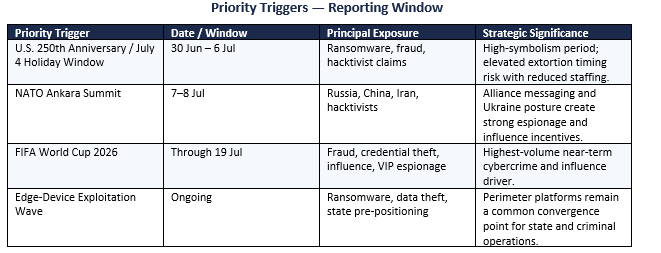
A compressed near-term event calendar — the U.S. 250th anniversary and July 4 holiday window, the 7–8 July NATO Ankara Summit, and the 2026 FIFA World Cup through 19 July — creates elevated fraud, extortion timing, espionage, and influence risk. Over the next 30 to 60 days, the threat environment will remain highly volatile, with critical infrastructure, defense industrial bases, and the broader technology supply chain facing sustained, multi-vector pressure from state-sponsored and state-aligned actors.
Iran remains the principal kinetic-coupled cyber escalation concern. Russia remains the principal hybrid pressure and defense-technology acquisition concern. China remains the pacing strategic cyber threat. North Korea remains the most structurally financially motivated state cyber actor.
KEY JUDGMENTS
All judgments are expressed using ICD 203 confidence standards. See Appendix 4.1 for definitions. The ⚠ flag denotes novel or rapidly evolving threat tradecraft.
(HIGH CONFIDENCE) Edge, identity, and enterprise-platform exposure are now the dominant convergence layer for U.S. cyber risk. State actors, ransomware affiliates, data-theft crews, and access brokers are exploiting the same perimeter and credential supply chains, compressing the gap between espionage, extortion, and pre-positioning.
(HIGH CONFIDENCE) China will remain the pacing strategic cyber threat through the next 30–60 days. Telecom espionage, covert infrastructure, and critical-infrastructure pre-positioning will continue, but destructive action remains unlikely absent a major geopolitical trigger such as a Taiwan-contingency escalation.
(HIGH CONFIDENCE) PRC-linked threat actors will continue to prioritize stealthy pre-positioning within U.S. and allied critical infrastructure, heavily targeting edge devices and telecommunications networks to establish latent disruptive capabilities intended for activation during a future geopolitical crisis.
(MODERATE CONFIDENCE) The convergence of economic coercion and cyber operations by the PRC will intensify. Targeting will focus on exfiltrating intellectual property from advanced technology and AI research institutions to offset Western export controls and accelerate domestic technological self-sufficiency.
(HIGH CONFIDENCE) Russian state-sponsored and state-aligned hacktivist groups will maintain a high operational tempo against European and NATO-allied critical infrastructure, with a specific focus on energy, water, and transportation sectors, increasing the risk of physical sabotage and operational disruption.
(MODERATE CONFIDENCE) Russia will intensify defense-technology acquisition, sanctions-evasion support, and hybrid pressure around the NATO Ankara Summit and Ukraine diplomacy. U.S. defense, aerospace, manufacturing, and logistics firms remain exposed to collection and procurement networks.
(MODERATE CONFIDENCE) The boundary between state-sponsored cyber operations and cybercriminal activity will further blur, particularly concerning Russia and North Korea, as regimes increasingly rely on proxy groups and criminal syndicates to conduct disruptive operations while maintaining plausible deniability.
(HIGH CONFIDENCE) North Korean cyber actors will sustain aggressive financially motivated operations, including cryptocurrency theft and IT worker infiltration schemes, to fund regime priorities. Simultaneously, they will conduct targeted espionage against global defense, aerospace, and technology firms.
(HIGH CONFIDENCE) DPRK cyber-enabled revenue generation will remain structurally entrenched. Crypto theft, IT-worker infiltration, recruiter impersonation, and AI-enabled persona development will continue to target financial services, Web3, technology firms, and European employers.
(HIGH CONFIDENCE) Iran remains the most kinetically coupled cyber actor. Iranian state and proxy activity will track the trajectory of regional ceasefire implementation, Israel-Hezbollah escalation, U.S.-Iran diplomacy, and perceived retaliation requirements. Hacktivist claims will be frequent, noisy, and often exaggerated.
(MODERATE CONFIDENCE) The degradation of centralized command and control within Iran following recent military strikes will lead to a dispersal of its cyber workforce, resulting in decentralized, ideologically driven, and highly disruptive cyberattacks against U.S., Israeli, and aligned European infrastructure over the next 60 days.
(HIGH CONFIDENCE) The proliferation and integration of artificial intelligence tools by all four primary adversaries will continue to accelerate the operational tempo of cyber campaigns. ⚠ AI enables more sophisticated phishing, automated vulnerability discovery, and rapid adaptation of malware to evade detection.
(MODERATE CONFIDENCE) WARNING: AI-enabled offensive operations will continue moving from augmentation toward partial autonomy. Confirmed fully autonomous state campaigns remain limited, but AI is already lowering barriers for reconnaissance, social engineering, exploit development, data triage, and multilingual fraud. ⚠
(MODERATE CONFIDENCE) The upcoming 2026 FIFA World Cup, the July 4 / U.S. 250th anniversary window, and the NATO Ankara Summit will drive elevated fraud, credential theft, extortion timing, hacktivist amplification, and targeted espionage. The highest-volume threat is cybercrime, not state-directed destructive action.
(HIGH CONFIDENCE) Adversaries will increasingly exploit vulnerabilities in third-party supply chains and cloud infrastructure misconfigurations as primary initial access vectors. State-sponsored actors will continue to leverage living-off-the-land techniques and exploit zero-day vulnerabilities in perimeter appliances to minimize detection and maintain long-term persistence. ⚠
SECTION 1 — STRATEGIC LANDSCAPE
1.1 Reporting Period Triggers and Inflection Points
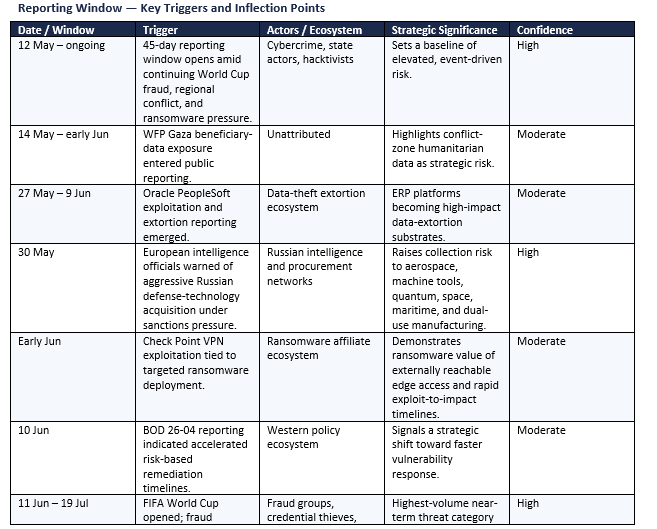
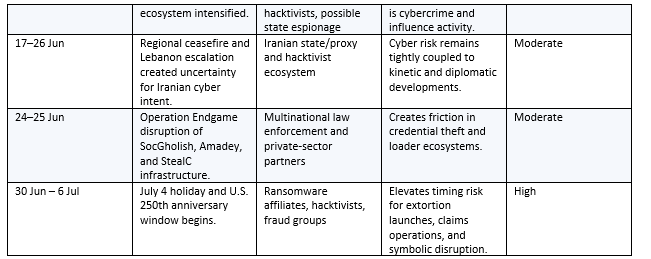
Reporting period: 12 May – 26 June 2026. The reporting window captures the continuation of World Cup-themed cybercrime, a late-May Russian defense-technology espionage warning, early-June humanitarian data exposure, mid-June enterprise platform exploitation, and late-June multinational disruption of malware infrastructure. The common strategic thread is accelerated exploitation of exposed infrastructure and data-rich platforms during a dense event calendar.
The 2026 Annual Threat Assessment from the Office of the Director of National Intelligence (ODNI), released in June, formally documents tri-adversary escalation, designating China, Russia, and North Korea as converging multi-domain threats. The alignment of these adversaries’ strategic objectives is driving a shift from traditional espionage toward pre-positioning for physical disruption and large-scale influence operations.
China — Strategic Pre-positioning and AI-Driven Espionage
China remains the pacing threat across cyber and influence domains. During this reporting period, Chinese cyber operations demonstrated a sustained focus on pre-positioning within critical infrastructure, moving beyond mere intelligence collection. The Salt Typhoon campaign, which targeted major U.S. telecommunications providers and compromised over 1,000 vulnerable Cisco network devices globally in early 2025, continues to have cascading effects into 2026. These operations are designed to provide strategic leverage and potential disruptive capabilities in the event of a geopolitical crisis, such as a Taiwan contingency.
China-aligned groups including Silver Dragon and the newly identified GopherWhisper have intensified global espionage efforts. The targeting of AI research institutions and technology companies has accelerated, driven by Beijing’s objective to offset U.S. export controls on advanced compute capacity. ⚠ The use of custom backdoors routing command-and-control traffic through legitimate cloud services represents an evolving tradecraft approach designed to evade detection while exfiltrating high-value intellectual property.
Russia — Information Warfare and Upgraded Arsenals
Russia’s cyber posture during this period is defined by sustained information warfare, defense-industrial-base acquisition under sanctions pressure, and enhancement of its offensive cyber arsenal. The ODNI assessment highlights ongoing Russian influence operations targeting Western democratic cohesion, particularly ahead of the 2026 U.S. midterm elections. The Russian state-sponsored group Gamaredon has significantly upgraded its capabilities, utilizing dead drops and tunneling services to conceal its command-and-control infrastructure while updating stealer tools to exfiltrate data to legitimate cloud storage platforms. ⚠
North Korea — Supply Chain Compromises and IT Worker Infiltration
North Korea’s cyber operations have reached a mature, industrialized scale, blending revenue generation with intelligence collection. In May 2026, researchers uncovered a multiplatform supply-chain attack by the North Korea-aligned APT group ScarCruft, which compromised a video game platform popular in the Yanbian region of China, deploying the BirdCall backdoor to target ethnic Koreans. ⚠ The introduction of an Android version of BirdCall, capable of extensive data exfiltration and audio recording, highlights North Korea’s expanding mobile espionage capabilities. The ODNI assessment underscores the strategic threat posed by North Korea’s systematic deployment of IT workers using falsified credentials.
Iran — Escalation to Kinetic Cyber Operations
Iran’s cyber activities have demonstrated a concerning shift toward destructive, physically impactful operations. In March 2026, the medical technology company Stryker suffered a devastating wiper attack attributed to an Iran-aligned hacktivist group. Unlike financially motivated ransomware, this kinetic attack wiped corporate systems in real time, forcing operational shutdowns. Iranian state-sponsored and state-aligned actors are increasingly leveraging destructive cyberattacks against critical infrastructure, particularly in the healthcare and energy sectors, as a form of asymmetric retaliation amid ongoing regional conflicts.
1.2 Cross-Adversary Convergence
The current landscape is best understood as convergence around exposed infrastructure, identity, and monetizable data rather than isolated actor lanes. State actors seek persistence and optionality; ransomware affiliates seek fast impact and payment leverage; data-theft crews seek sensitive records; fraud groups seek credentials and payment data. The initial access paths increasingly overlap, compressing the gap between espionage, extortion, and pre-positioning.
The strategic cyber threat landscape is increasingly defined by the convergence of Russia, China, North Korea, and Iran — a coalition frequently characterized as an axis of upheaval. This alignment is fundamentally altering the geopolitical environment, as these four nation-states coalesce around a shared hostility toward the U.S.-led global order and a mutual interest in undermining Western cyber posture. While their cooperation is often opportunistic, the aggregate effect of their convergence is a magnification of the threat each poses individually.
Convergence Mechanisms
· Edge infrastructure: VPNs, firewalls, telecom routing, ERP management interfaces, and externally reachable administration portals remain common access points across state and criminal activity.
· Identity and session material: Infostealers, help-desk social engineering, compromised OAuth and federation paths, and reused SSO credentials feed both eCrime and espionage operations.
· Data-rich platforms: ERP, student information, healthcare, financial, SaaS, and humanitarian systems are attractive because compromise creates immediate extortion, intelligence, or coercion value.
· Event-driven targeting: World Cup demand, July 4 symbolism, NATO diplomacy, and regional conflict produce predictable fraud, influence, and espionage opportunities.
· Proxy and contractor ecosystems: Chinese contractor-enabled activity, Russian intelligence-linked procurement networks, Iranian hacktivist personas, and DPRK IT-worker schemes provide scale and plausible deniability.
· AI-enabled tooling: Artificial intelligence is the common acceleration layer — lowering barriers for reconnaissance, social engineering, exploit development support, and multilingual fraud across state and criminal actors alike. ⚠
Technology Transfer and Capability Sharing
A defining feature of this convergence is the increasing flow of technology, intelligence, and cyber capabilities among the four nations. Russia is actively shipping modified drone components and satellite imagery to Iran, while Iranian drone technology flows through Russia to North Korea and China. In the cyber realm, this physical technology transfer is mirrored by the sharing of operational methods. ⚠ The proliferation of operational relay box (ORB) networks — heavily utilized by China-nexus threat groups to obscure their origins and bypass geofencing — is likely being adopted or studied by other axis members to enhance their own operational security.
Infrastructure Sharing and Coordinated Timing
While direct joint cyber operations remain rare, there is growing evidence of infrastructure sharing and coordinated timing that amplifies the impact of their campaigns. These nations benefit from a shared ecosystem of cybercriminal proxies, initial access brokers, and compromised infrastructure. The recent disclosure of Chinese kernel-level implants inside telecom backbone infrastructure worldwide highlights a level of deep persistence that could theoretically be leveraged by aligned nations during a coordinated crisis. ⚠ The risk of simultaneity — the prospect that these countries could initiate more than one crisis simultaneously, either in an explicitly coordinated or opportunistic manner — remains a critical concern.
Forward Outlook
Over the next 30–60 days, the cross-adversary convergence will likely manifest in intensified intelligence collection and pre-positioning activities. Chinese APT groups will escalate operations ahead of key diplomatic engagements, while Russian intelligence services will maintain a high operational tempo against NATO and Ukrainian targets. Iranian cyber actors, despite recent disruptions, are expected to reconstitute their capabilities rapidly, potentially leveraging shared infrastructure or tools acquired through their alignment with Russia and China. North Korea will continue its strategic-scale financial theft operations, benefiting from the broader distraction caused by its partners’ activities.
1.3 Western Strategic Cyber Posture Status
Strategic posture only — this section does not prescribe controls, detection logic, hunting queries, or remediation steps.
The strategic cyber defensive posture of Western governments and alliances — encompassing the United States, the European Union, NATO, and the Five Eyes intelligence partnership — has undergone a rapid, unified shift during the reporting period. Driven by the accelerated integration of artificial intelligence into offensive cyber operations by nation-state adversaries, Western defensive strategies have pivoted from traditional, compliance-based perimeter defense toward proactive, AI-enabled resilience and rapid vulnerability remediation. This convergence in strategic posture reflects a shared recognition that the timeline for advanced cyber threats to impact network defenses has compressed from years to months.
Western posture is consolidating around faster vulnerability prioritization, multinational attribution, criminal infrastructure disruption, and alliance resilience:
· Federal vulnerability posture is shifting toward shorter risk-based response cycles in recognition that exploitation windows are shrinking and AI may further compress discovery-to-exploitation timelines.
· Multinational cybercrime disruption, including the June Operation Endgame reporting, shows increasing use of coordinated law-enforcement, private-sector, and judicial mechanisms against loader and infostealer infrastructure.
· NATO and allied governments continue to emphasize resilience, cyber integration, and cost-imposition messaging ahead of the Ankara Summit.
· Strategic gaps remain: public attribution often lags compromise discovery; eviction status for long-running telecom compromises is difficult to validate; and disruptions impose friction but do not permanently remove criminal services.
The Five Eyes AI Shift
In late June 2026, the Five Eyes intelligence alliance issued a rare, coordinated strategic warning emphasizing that frontier AI models have drastically lowered the technical barrier to entry for sophisticated cyber operations. This AI shift is accelerating the speed, scale, and accessibility of cyber threats, fundamentally altering the strategic calculus for Western defenders. ⚠ The alliance articulated that AI is shrinking the traditional window of time between vulnerability discovery and exploitation, rendering slow-moving security perimeters increasingly ineffective against machine-speed exploits.
United States — Executive Action and AI-Enabled Defense
On June 2, 2026, the White House issued Executive Order 14409, Promoting Advanced Artificial Intelligence Innovation and Security, which explicitly links AI innovation with national security and cyber defense. The order mandates the rapid modernization and hardening of federal and private sector information systems against external threats. A cornerstone of this strategic posture is the establishment of an AI cybersecurity clearinghouse, coordinated by the Department of the Treasury, the National Security Agency, and the Cybersecurity and Infrastructure Security Agency. This clearinghouse aims to facilitate voluntary collaboration with the AI industry and critical infrastructure operators to deconflict vulnerability scanning, validate discoveries, and prioritize remediation.
European Union and NATO — Legislative Mandates and Collective Deterrence
The European Union is solidifying its strategic cyber posture through comprehensive legislative frameworks. The Cyber Resilience Act, now in its implementation phase, mandates stringent cybersecurity requirements for hardware and software products with digital elements, shifting the burden of security onto manufacturers and developers. The proposed EU Cybersecurity Act 2.0 introduces new trade controls targeting high-risk suppliers, reflecting a strategic posture of technological sovereignty. NATO formalized strategic cybersecurity partnerships with major private sector entities and conducted exercises including Locked Shields 2026 and SWORD 26, emphasizing the defense of critical infrastructure against sophisticated simultaneous kinetic and cyber operations.
Forward Outlook (30–60 Days)
Looking ahead, Western governments will accelerate the deployment of AI-enabled defensive capabilities across critical infrastructure sectors. The strategic emphasis will remain on rapid vulnerability remediation, identity management, and post-quantum cryptographic readiness. Adversaries will likely attempt to test newly implemented defensive frameworks — particularly the U.S. AI cybersecurity clearinghouse and the EU’s CRA mandates — by deploying novel, AI-generated exploits targeting zero-day vulnerabilities in widely used third-party software. The strategic posture of Western alliances will increasingly rely on public-private partnerships and rapid intelligence sharing to maintain deterrence in an environment characterized by machine-speed threat evolution.
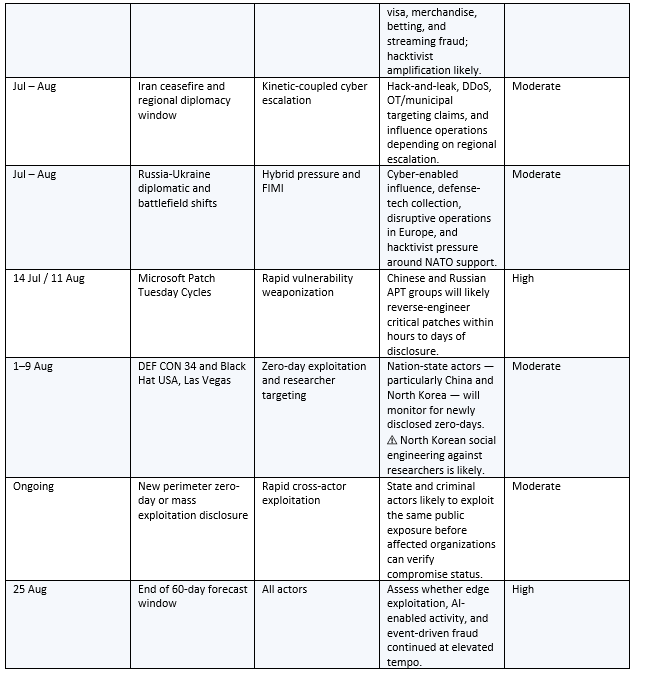
1.4 Key Trigger Date Tracker (Next 60 Days)
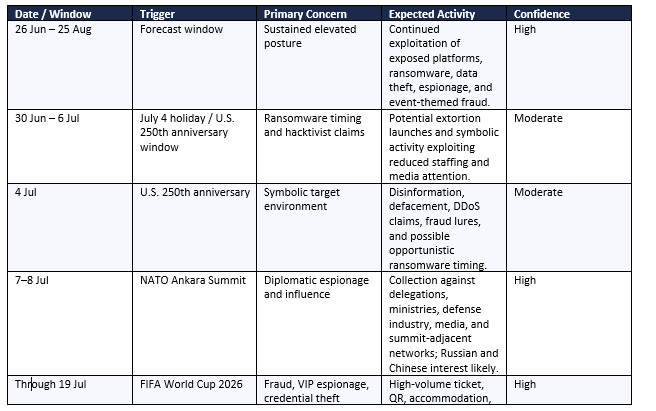
The following tracker outlines significant geopolitical, sporting, and technical milestones anticipated between late June and late August 2026. Confidence in the precise timing of state cyber responses is generally LOW to MODERATE, as adversaries deliberately decouple operational timing from public events to preserve surprise. The strategic salience of these dates as motivating or pretextual events is assessed with HIGH CONFIDENCE.
SECTION 2 — NATION-STATE THREAT ANALYSIS
2.1 Russia
Strategic Posture
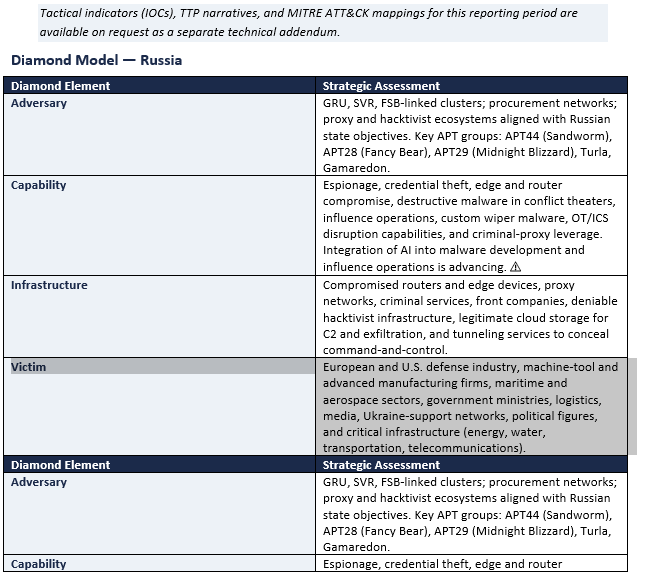
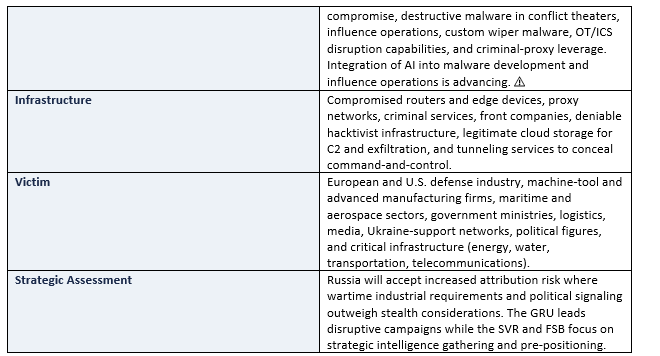
Russia remains focused on wartime advantage, sanctions circumvention, defense-industrial recovery, and influence operations against NATO cohesion. The principal strategic shift in the current reporting window is the stronger emphasis on acquiring Western defense and dual-use technology as sanctions pressure constrains Russia’s industrial base.
Russia’s strategic cyber posture remains deeply intertwined with its conventional military operations and broader geopolitical confrontation with the West. Russian cyber doctrine continues to treat the digital domain as a parallel front to its kinetic operations in Ukraine, while simultaneously expanding its focus to target NATO and European critical infrastructure. The primary objectives are threefold: sustaining long-term espionage and intelligence gathering against Ukrainian and Western defense, diplomatic, and critical infrastructure sectors; disrupting essential state functions and logistics that support Ukraine’s war effort; and projecting power through deniable proxies to impose costs on adversaries without triggering direct military retaliation. Russia’s cyber strategy has fully transitioned into a wartime framework where offensive cyber operations are synchronized with military objectives and state-sponsored actors operate with increased risk tolerance.
Russian cyber activity continues to align with broader hybrid doctrine: espionage, sabotage reconnaissance, battlefield support, information operations, criminal outsourcing, and deniable hacktivist amplification. Directly confirmed June 2026 disruptive activity against U.S. entities is less visible than activity affecting Europe and Ukraine, but U.S. defense, aerospace, maritime, logistics, and technology firms remain collection-relevant.
Key State-Aligned Threat Actor Ecosystem
The Russian state-sponsored threat landscape is characterized by a highly capable, multi-agency ecosystem driven by the GRU, SVR, and FSB, each with distinct operational mandates but occasionally overlapping targets. Russia’s cyber operations are not conducted by a single unified cyber command but rather by a portfolio of intelligence and security services operating under the doctrine of Informatsionnoye Protivoborstvo (Information Confrontation, or IPb), which views cyber operations, psychological influence, and electronic warfare as inseparable components of a continuous struggle that blurs the lines between peacetime and conflict.
GRU (Military Intelligence) — APT28 / Fancy Bear and Sandworm / APT44: The GRU remains the primary executor of aggressive, disruptive, and tactical cyber operations. APT28 recently weaponized a Microsoft Office 1-day vulnerability within 24 hours of disclosure to target European military and transport organizations, highlighting a shift toward using legitimate cloud storage services for command-and-control and in-memory execution to evade detection. ⚠ Sandworm continues to focus on disruptive attacks against Ukrainian critical infrastructure, particularly energy and water systems, aligning closely with kinetic strikes. The GRU has increasingly focused on exploiting edge devices — VPNs, routers, and firewalls — to establish footholds for both espionage and disruptive attacks, including the deployment of wipers and ransomware used as misdirection.
SVR (Foreign Intelligence Service) — APT29 / Midnight Blizzard: The SVR’s cyber elements maintain their traditional focus on stealthy, long-term strategic espionage targeting diplomatic, governmental, and think-tank entities across NATO member states to gather intelligence on Western policy, military aid to Ukraine, and sanctions planning. APT29’s tradecraft emphasizes deep persistence, sophisticated identity-based attacks, and the compromise of cloud environments and supply chains. The SVR will increasingly target technology and defense industrial bases of Western nations to offset the impact of international sanctions.
FSB (Federal Security Service) — Turla and Gamaredon: The FSB’s cyber operations are bifurcated between sophisticated long-term espionage (Turla) and high-volume tactical intelligence gathering (Gamaredon). Turla continues to target NATO and European ministries of foreign affairs with advanced custom malware. ⚠ Recent Gamaredon campaigns have demonstrated an evolution in infection chains, utilizing modular malware including GammaPhish and GammaWorm, which spread physically via USB drives to bridge air-gapped networks and continuously exfiltrate documents. Gamaredon has adopted advanced evasion techniques combining legitimate tunneling services with dead drops and updated stealer tools exfiltrating data to legitimate cloud storage services, complicating detection efforts.
The Proxy Ecosystem — Hacktivists and Criminal Alignment
Russia has cultivated a vast and complex ecosystem of cyber proxies, including patriotic hacktivists and cybercriminal syndicates. This Dark Covenant between the state and non-state actors has evolved from passive tolerance to active management. Patriotic hacktivist groups — including the successors to Killnet, NoName057(16), and CyberArmyofRussia_Reborn — function as deniable instruments of state power, conducting distributed denial-of-service attacks, data leaks, and intimidation campaigns against nations supporting Ukraine. ⚠ Recent assessments indicate that CyberArmyofRussia_Reborn is coordinating directly with the GRU, serving as a front for state-directed disruptive operations and narrative laundering.
The relationship between the Russian state and ransomware operators is similarly pragmatic and increasingly formalized. Ransomware and repurposed criminal tools are increasingly deployed by state units to blur the lines between financial crime and state-sponsored sabotage. This controlled impunity allows the state to leverage the advanced capabilities of cybercriminal syndicates for intelligence acquisition and disruptive proxy attacks. The Cybercrime-as-a-Service model has further complicated attribution and response efforts. ⚠
Information Confrontation (Informatsionnoye Protivoborstvo)
Central to Russia’s strategic posture is the IPb doctrine, which integrates cyber operations with psychological and influence campaigns. In this framework, cyber incidents are frequently converted into information events designed to manufacture distrust, confusion, and political fatigue within target populations. The objective is not merely technical damage but the erosion of societal cohesion and the fragmentation of alliances. ⚠ The increasing use of deepfakes, generative AI, and automated bot networks has expanded the scale and complexity of these information campaigns, allowing for rapid narrative seeding and exploitation at scale across multiple linguistic and cultural boundaries.
Active Campaigns and Operations (Full Rolling Window — May 12 to June 26, 2026)
During the reporting window, Russian state-sponsored and state-aligned cyber actors maintained a high operational tempo, prioritizing espionage, critical infrastructure disruption, and hybrid warfare operations. The threat landscape is characterized by a convergence of cyber operations with physical sabotage and information warfare, particularly targeting Ukraine and NATO member states.
Espionage and Targeting of High-Value Individuals:
Russian Intelligence Services sustained targeted phishing campaigns against individuals of high intelligence value, including current and former government officials, military personnel, journalists, and political figures in the U.S., Europe, and Ukraine. Operations tracked as UNC5792 and UNC4221 demonstrated an evolution in tactics. ⚠ Rather than merely compromising accounts, RIS actors are masquerading as automated commercial messaging application support accounts to elicit Backup Recovery Keys from victims — a novel approach that allows threat actors to access historical private and group messages and permanently take over accounts even if the victim changes their device or reinstalls the application.
Critical Infrastructure and OT/ICS Disruption:
Russia presents the most imminent operational risk to European critical infrastructure. Sandworm (APT44 / Military Unit 74455) alongside state-aligned hacktivist groups has demonstrated the capability and intent to cause physical consequences through cyber operations targeting industrial control systems and operational technology. ⚠ The deployment of OT-capable malware, such as the Voltzite framework, against European energy and water systems highlights a growing capability to cause physical consequences through cyber means. The deployment of DynoWiper malware against Poland’s power grid in late 2025 underscores Russia’s continued reliance on destructive wiper malware. Physical sabotage operations linked to Russian proxies have increased significantly across the EU and NATO since 2024.
Operations Targeting Ukraine:
Ukraine remains the primary testing ground and target for Russian cyber operations. Gamaredon (FSB 18th Center) has significantly upgraded its arsenal with new custom malware including the PteroPaste downloader, which actively seeks out connected USB drives to smuggle malicious scripts onto air-gapped or sensitive systems. ⚠ Advanced evasion techniques combine legitimate tunneling services with dead drops on benign websites, and updated stealer tools exfiltrate data to legitimate cloud storage services like Dropbox and Amazon S3.
Hack-and-Leak and Influence Operations:
Russian state-aligned actors are conducting hack-and-leak operations targeting political figures, institutions, and media organizations ahead of key European elections and the 2026 U.S. midterm runup. The strategic objective is to create an environment of pervasive doubt and polarization, weakening the target nation’s ability to govern effectively and project unified power internationally. ⚠ Russian actors are utilizing AI-generated content including deepfakes and automated social media amplification to increase the scale, speed, and persuasiveness of disinformation campaigns.
Defense-Technology Acquisition Under Sanctions Pressure:
A late-May European intelligence warning elevated Russian defense-technology collection as a strategic concern. The collection focus includes advanced machine tools, factory equipment, defense systems, quantum and space technologies, maritime capabilities, and dual-use research. Cyber means are one component of a broader procurement, front-company, and human-source ecosystem targeting the aerospace, manufacturing, and defense industrial bases of Western nations.
Assessment and 30–60 Day Outlook — Russia
(HIGH CONFIDENCE) Russian state-sponsored cyber actors will continue to conduct aggressive espionage and pre-positioning operations targeting NATO member states and European critical infrastructure over the next 30–60 days. The ongoing war in Ukraine will remain the primary driver, with a sustained focus on gathering intelligence on Western military assistance, diplomatic strategies, and economic sanctions.
(HIGH CONFIDENCE) Russian threat actors will increasingly rely on the exploitation of edge devices, cloud infrastructure, and living-off-the-land techniques to gain and maintain access to target networks. The shift away from relying solely on zero-day exploits toward leveraging known vulnerabilities and compromised credentials will persist.
(MODERATE CONFIDENCE) The risk of disruptive or destructive cyberattacks against European energy, water, and industrial sectors will remain elevated. Sandworm’s pattern of escalating operations following detection and its focus on OT/ICS environments suggests continued intent to hold critical infrastructure at risk.
(MODERATE CONFIDENCE) NATO Ankara and Ukraine diplomacy will create collection and influence incentives. Pro-Russian hacktivist operations are likely to claim disruptive effects regardless of actual impact. Russia will continue integrating AI into influence operations to produce more sophisticated, scalable, and difficult-to-attribute campaigns.
(LOW CONFIDENCE) A destructive Russia-linked cyber operation against U.S. critical infrastructure during this window is less likely than espionage or influence activity, but a spillover or third-party provider incident cannot be excluded.
2.2 China
Strategic Posture
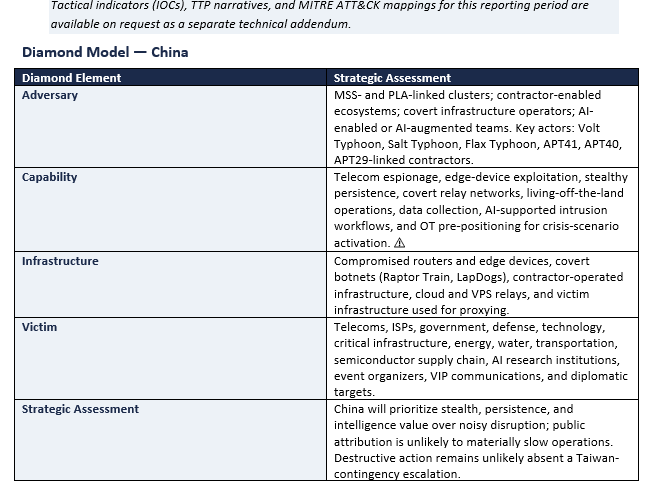
China remains the pacing strategic cyber threat to U.S. government, private-sector, telecommunications, and critical-infrastructure networks. The strategic objective is long-horizon collection, counterintelligence, intellectual-property acquisition, covert access, and potential pre-positioning for crisis options — especially in scenarios involving Taiwan or U.S. force projection.
China’s strategic cyber posture in 2026 continues to be driven by Beijing’s imperative to achieve technological self-sufficiency, maintain domestic stability, and secure a competitive advantage in critical emerging technologies. Chinese state-sponsored cyber operations are characterized by a dual-track approach: aggressive intellectual property theft targeting the global technology sector, and the pre-positioning of disruptive capabilities within critical infrastructure. The doctrine emphasizes the use of cyber power as an asymmetric tool to project influence, deter adversaries, and prepare for potential regional conflicts, particularly concerning Taiwan.
The June 26 update sharpens the role of edge infrastructure and telecom networks as strategic collection terrain and strengthens the analytic weight assigned to AI-enabled cyber operations following public reporting on a Chinese state-sponsored actor using agentic AI to execute a large portion of intrusion workflows. ⚠
Threat Actor Ecosystem — Composite Responsibility Model
The Chinese state-sponsored cyber apparatus has evolved from a monolithic structure into a highly integrated ecosystem characterized by composite responsibility, where the Ministry of State Security (MSS), the People’s Liberation Army (PLA), and a sprawling network of private contractors collaborate on shared strategic objectives. This convergence complicates attribution and expands Beijing’s operational scale.
Volt Typhoon (Critical Infrastructure Pre-positioning): Remains the primary actor tasked with infiltrating and maintaining persistent access within critical infrastructure networks, particularly in the U.S. and allied nations. Their operations are almost certainly designed to enable disruptive or destructive attacks during a geopolitical crisis. The group relies heavily on living-off-the-land techniques, utilizing native system binaries to blend into normal network traffic and evade endpoint detection. Despite public exposure and law enforcement disruptions, Volt Typhoon’s presence remains active and resilient. ⚠
Salt Typhoon (Telecommunications Espionage): Demonstrated a persistent focus on telecommunications infrastructure, successfully targeting U.S. congressional communications — specifically personnel on national security committees — in early 2026. Salt Typhoon prioritizes long-term persistence within core routing and switching hardware, establishing GRE tunnels to siphon call records, subscriber metadata, and unencrypted traffic. A notable evolution is the shift toward premier pass-as-a-service, where established access to critical telecommunications assets is shared among multiple distinct Chinese threat groups. ⚠
APT41, APT40, APT27 (IP Theft and Regional Espionage): Continue to execute large-scale espionage campaigns targeting the IT sector, defense industrial base, and academic institutions. APT40 continues its mandate of intelligence collection across the South China Sea, focusing on maritime affairs and regional government communications. APT27 (Budworm) and APT41 have been implicated in campaigns targeting semiconductor intellectual property and manufacturing processes.
Flax Typhoon and ORB Networks: Flax Typhoon is compromising IoT devices to build botnets aimed at Taiwanese critical infrastructure. ⚠ The widespread use of massive, dynamic covert networks (botnets) composed of compromised SOHO routers and IoT devices — such as the Raptor Train botnet — provides a low-cost, deniable infrastructure model used across the entire cyber kill chain, rendering traditional static IP blocklists largely ineffective.
Active Campaigns and Operations (Full Rolling Window — May 12 to June 26, 2026)
Salt Typhoon — Telecom Intrusions and 2026 Aftershocks:
Salt Typhoon’s operations are still very much ongoing as of mid-2026, impacting over 80 countries globally. The group embeds malicious code directly into network infrastructure, establishing tunnels to siphon call records, subscriber metadata, and unencrypted traffic, providing the PRC with unprecedented visibility into global data flows. This deep integration into the communications backbone is designed not only for intelligence gathering but also to pre-position for potential disruptive operations. In the event of a geopolitical crisis involving Taiwan, this access could be leveraged to degrade or deny critical communications, thereby slowing the mobilization and coordination of U.S. and allied military forces.
Volt Typhoon — Critical Infrastructure Pre-positioning:
Volt Typhoon continues its aggressive pre-positioning within U.S. and allied critical infrastructure across sectors vital to national security including energy, water, transportation, and defense industrial bases. ⚠ Recent analysis indicates a concerning shift toward targeting operational technology environments and industrial control systems, moving beyond traditional IT networks. The targeting of strategically vital hubs, such as Guam, where Volt Typhoon has compromised power and communications systems essential for U.S. force projection in the Indo-Pacific, underscores this dual-use capability.
Edge-Device and ORB-Network Exploitation:
Chinese threat groups are rapidly weaponizing newly disclosed vulnerabilities in perimeter appliances — often within hours or days of public disclosure — leaving defenders with virtually no patching window. ⚠ PRC actors increasingly route traffic through sophisticated ORB networks, such as the recently identified LapDogs network, consisting of thousands of compromised SOHO routers, IoT devices, and virtual private servers leased from infrastructure-as-a-service providers. This renders traditional static indicators of compromise, such as IP addresses, largely ineffective for defense.
Espionage Against Defense, Technology, and Government:
Following the expansion of U.S. and allied export controls — including the January 2026 AI Diffusion Rule and tightening restrictions on deep ultraviolet lithography equipment — China has escalated cyber espionage campaigns against the global semiconductor supply chain. Threat actors including APT41 and APT10 are aggressively targeting semiconductor manufacturers, electronic design automation software providers, and equipment suppliers in Taiwan, Japan, and the United States. PRC actors are actively exfiltrating algorithmic efficiencies, AI model weights, and proprietary research from Western institutions.
Taiwan and South China Sea Cyber Activity:
In tandem with physical gray-zone coercion, PRC cyber operations are actively targeting Taiwanese and regional infrastructure. ⚠ There has been an increase in coordinated cyber operations coinciding with PLA military exercises in the Taiwan Strait, suggesting a growing integration of cyber capabilities into broader military planning. PRC actors will likely continue to use cyber operations as a tool of coercion and intelligence gathering, operating below the threshold of armed conflict to advance territorial ambitions.
Assessment and 30–60 Day Outlook — China
(HIGH CONFIDENCE) China will sustain telecom espionage and critical-infrastructure pre-positioning through the next 30–60 days. The technology sector — particularly organizations involved in AI research and development — will remain the primary target for IP theft operations.
(HIGH CONFIDENCE) PRC-linked threat actors will continue leveraging ORB networks and living-off-the-land techniques to maintain deniable and persistent access across telecommunications, government, and critical infrastructure networks.
(MODERATE CONFIDENCE) China-linked operators will increase AI-assisted operational tempo, especially for reconnaissance, triage, and scalable exploitation support, while retaining human decision-making for priority targeting.
(MODERATE CONFIDENCE) Chinese actors will likely use the World Cup and NATO Summit primarily for targeted espionage, credential collection, and VIP and delegation monitoring rather than overt disruptive action.
(LOW CONFIDENCE) Overt destructive Chinese cyber operations against U.S. infrastructure remain unlikely in the forecast window unless crisis dynamics around Taiwan or U.S.-China military signaling change materially.
2.3 North Korea (DPRK)
Strategic Posture
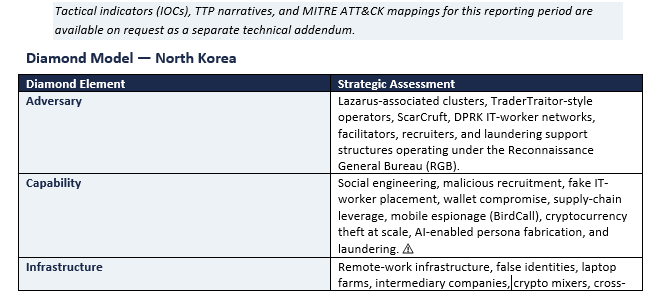
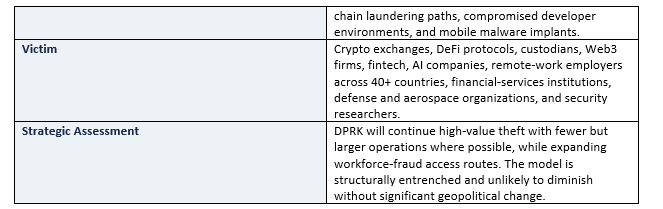
North Korea’s cyber program remains primarily financially motivated at strategic scale, with revenue generation supporting regime priorities and weapons programs. North Korea’s cyber operations have reached a mature, industrialized scale, blending revenue generation with intelligence collection. DPRK operations increasingly blend crypto theft, fake employment, IT-worker placement, recruiter impersonation, generative-AI persona support, and laundering. The model is resilient because it spans intrusion, workforce fraud, social engineering, and financial obfuscation.
The DPRK cyber apparatus operates under the Reconnaissance General Bureau (RGB), with Lazarus Group serving as the primary nexus for financially motivated operations and espionage. Lazarus Group and its sub-units operate with dual mandates: executing large-scale financial theft to generate foreign currency for the regime and conducting targeted espionage against defense, aerospace, and technology organizations to support North Korea’s weapons development programs.
Active Campaigns and Operations (Full Rolling Window — May 12 to June 26, 2026)
Cryptocurrency Theft and Financial Operations:
Public blockchain-intelligence reporting continues to frame 2025 as a record year for DPRK crypto theft, with more than two billion dollars in attributed theft and continued concern into 2026. North Korean cyber actors are executing the largest cryptocurrency heists in history, successfully targeting cryptocurrency exchanges, decentralized finance platforms, and blockchain bridges. These operations are not opportunistic; they are strategic, systematic campaigns that require months of preparation, sophisticated social engineering, and advanced malware deployment. The scale and sophistication of DPRK cryptocurrency theft has elevated from a supplementary revenue stream to a core pillar of the regime’s financial strategy.
IT Worker Infiltration and Workforce Fraud:
The IT-worker scheme remains a strategic risk to U.S. and European firms, especially technology, AI, Web3, financial services, and defense-adjacent employers. The scheme is increasingly supported by AI-generated personas, false recruiter narratives, and cross-border facilitation. ⚠ DPRK operatives are using AI-generated photos, fabricated work histories, falsified professional references, and deepfake video call appearances to deceive HR processes and obtain remote employment. This scheme is expanding geographically, with documented operations in at least 40 countries.
Supply Chain Compromises and Mobile Espionage:
In May 2026, researchers uncovered a multiplatform supply-chain attack by ScarCruft, which compromised a video game platform popular in the Yanbian region of China to deploy the BirdCall backdoor against ethnic Koreans, likely focusing on refugees and defectors. ⚠ The introduction of an Android version of BirdCall, capable of extensive data exfiltration and audio recording, highlights North Korea’s expanding mobile espionage capabilities. The line between espionage preparation and theft can be difficult to distinguish in many DPRK operations, as fake job, investment, and due-diligence lures give access to wallets, code repositories, SaaS environments, and privileged employee endpoints.
Targeting of Security Researchers and Defense Sector:
Lazarus Group continues to conduct sophisticated social engineering campaigns targeting cybersecurity researchers, luring them with fake collaboration on joint research. Concurrently, North Korean threat actors continue to aggressively target defense and aerospace companies, seeking to exfiltrate classified or sensitive data on advanced weapons systems, military technology, and strategic capabilities. These operations are directly linked to the regime’s ballistic missile and nuclear weapons programs.
Assessment and 30–60 Day Outlook — North Korea
(HIGH CONFIDENCE) DPRK crypto theft and IT-worker infiltration will continue at or above recent historical levels, with financial-services firms and European employers increasingly exposed. Crypto theft, IT-worker infiltration, recruiter impersonation, and AI-enabled persona development will continue to target financial services, Web3, technology firms, and European employers.
(HIGH CONFIDENCE) DPRK cyber actors will sustain targeted espionage against global defense, aerospace, and technology firms, with stolen data directly supporting ballistic missile and nuclear programs.
(MODERATE CONFIDENCE) AI-enabled identity fabrication and recruiter impersonation will expand the scale and plausibility of DPRK access operations, making traditional due-diligence screening increasingly insufficient.
(LOW CONFIDENCE) No confirmed in-window OFAC DPRK action was identified in the current source set; sanctions tempo should be monitored but not over-inferred from the current window.
2.4 Iran
Strategic Posture
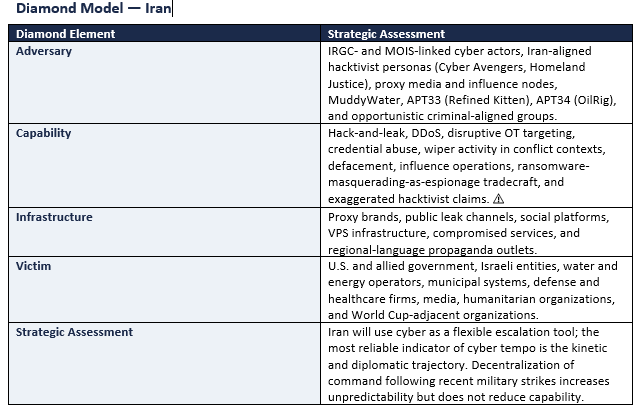
Iran is the most kinetically coupled cyber actor in this reporting period. Cyber operations, hacktivist claims, influence activity, and disruptive targeting are shaped by regional escalation, ceasefire implementation, U.S.-Iran diplomacy, Israeli operations, and the posture of Iranian proxy networks. The strategic cyber challenge is attribution discipline — Iran-linked state and proxy activity can be operationally meaningful, but many hacktivist claims are inflated, recycled, or unsupported. This briefing separates Iranian capability and intent from unverified claims.
Iran’s cyber activities have demonstrated a concerning shift toward destructive, physically impactful operations. Iran’s cyber strategy is driven by the Islamic Revolutionary Guard Corps (IRGC) and the Ministry of Intelligence and Security (MOIS), employing cyber operations as a key element of its asymmetric warfare doctrine. Iran’s primary strategic objectives are to project power and deter adversaries, particularly Israel and the United States; to retaliate for kinetic strikes and economic sanctions; to conduct intelligence gathering and counter-espionage; and to support regional proxy groups and advance its influence operations agenda.
The degradation of centralized command and control structures within Iran following recent military strikes — including Operation Epic Fury in February 2026 — has not diminished Iranian cyber capabilities but rather dispersed them. Iranian cyber capabilities have not diminished but rather adapted, becoming more decentralized, ideologically driven, and operationally autonomous.
Active Campaigns and Operations (Full Rolling Window — May 12 to June 26, 2026)
Kinetic-Coupled Disruptive Operations:
In March 2026, the medical technology giant Stryker suffered a devastating wiper attack attributed to an Iran-aligned hacktivist group. Unlike financially motivated ransomware, this kinetic attack wiped corporate systems in real time, forcing operational shutdowns. The targeting of critical infrastructure — particularly in the healthcare and energy sectors — as a form of asymmetric retaliation is a defining characteristic of Iran’s current cyber strategy.
Operational Technology and Industrial Systems Targeting:
Iran-linked and Iran-aligned actors demonstrate persistent interest in operational technology and industrial environments, including water, energy, and government systems. OSINT reporting and the source foundation describe continued interest in ICS and SCADA environments. The strategic significance is less about technical novelty and more about Iran’s willingness to use low-cost cyber effects for retaliation, messaging, and coercion during kinetic escalation.
Hacktivist Claims and Influence Operations:
Iran-linked and Iran-aligned actors continued to make claims around regional conflict and World Cup-adjacent targets. Claims involving drones, corporate wiping, or strategic U.S. compromise should be treated as unverified unless confirmed by victims, government advisories, or multiple high-quality independent sources. Hacktivist personas — including those aligned with Cyber Avengers, Homeland Justice, and various IRGC-adjacent collectives — amplify the psychological and media impact of operations, often beyond what the technical intrusion itself achieves.
Ceasefire and Regional Diplomacy Uncertainty:
The 17 June regional diplomacy window creates uncertainty rather than de-escalation certainty. Iran-aligned cyber operations may pause, rebrand, or shift targeting while preserving options for renewed activity if ceasefire conditions degrade. Iranian state and proxy cyber activity will remain tightly coupled to the trajectory of regional ceasefire implementation, Israel-Hezbollah escalation, and U.S.-Iran diplomacy.
Espionage and Influence Operations:
Iran-linked groups continue to conduct espionage operations targeting defense, political, and government sectors. The MuddyWater group continues to conduct targeted spear-phishing campaigns aimed at government, defense, and private sector organizations across the Middle East, Europe, and the Americas. ⚠ Recent reports have linked an Iranian state-backed MuddyWater campaign to activity disguised as Chaos ransomware, incorporating ransomware branding, extortion notes, and victim negotiation channels in an apparent effort to mask its true espionage objectives.
Assessment and 30–60 Day Outlook — Iran
(HIGH CONFIDENCE) Iranian state and proxy cyber activity will remain tightly coupled to regional escalation and perceived retaliation requirements. The trajectory of regional ceasefire implementation and Israel-Hezbollah dynamics are the primary drivers of Iranian cyber tempo.
(MODERATE CONFIDENCE) Hacktivist claims will increase around U.S., Israeli, and World Cup-linked themes, but only a subset will reflect material compromise. The degradation of centralized command will produce more decentralized, ideologically driven operations that are harder to predict and attribute.
(MODERATE CONFIDENCE) Iranian actors may pause, rebrand, or shift targeting during diplomatic windows while preserving options for renewed activity if ceasefire conditions degrade.
(LOW CONFIDENCE) A major Iranian disruptive operation against U.S. critical infrastructure during the next 30–60 days is plausible but not the most likely outcome; escalation thresholds depend heavily on regional diplomacy and kinetic events.
SECTION 3 — CROSS-NATION CONVERGENCE
3.1 Cross-Cutting Themes
The June 26 update underscores that the cyber threat landscape is converging at the infrastructure layer. The same classes of exposed perimeter systems, identity material, SaaS credentials, and enterprise platforms are valuable to state espionage, ransomware, data theft, fraud, and influence operations. Strategic risk is no longer cleanly separated by actor category. Ransomware affiliates can exploit access routes first normalized by state actors. State operators can hide within criminal-scale credential flows. Hacktivist personas can amplify state narratives while using low-sophistication methods. This convergence complicates attribution and shortens leadership decision timelines.
The collective impact of this convergence is a more resilient, capable, and aggressive threat landscape. An advancement by one axis member will eventually benefit the others, creating a compounding effect that exceeds what any single nation-state could produce independently.
· Perimeter and edge systems are the common access layer — VPNs, firewalls, telecom routing, ERP interfaces, and externally reachable administration portals serve as entry points for state and criminal actors alike.
· Credentials and tokens are the common monetization and persistence layer — infostealers, help-desk social engineering, and compromised SSO credentials feed both eCrime and espionage operations.
· Data-rich enterprise applications are the common extortion and intelligence layer — ERP, healthcare, financial, SaaS, and humanitarian systems create immediate extortion, intelligence, or coercion value.
· High-visibility events create the common timing and influence layer — World Cup, July 4, NATO Ankara, and regional conflict produce predictable fraud, influence, and espionage opportunities.
· AI-enabled tooling is the common acceleration layer — lowering barriers for reconnaissance, social engineering, exploit development, and multilingual fraud across all actor categories. ⚠
3.2 Satellite ISR Sharing and Space-Cyber Coupling
Space, satellite communications, positioning, navigation, timing, and intelligence, surveillance, and reconnaissance (ISR) remain strategic cyber-adjacent domains. Russia and China continue to feature prominently in counterspace and ISR-sharing concerns, while the Russia-Ukraine conflict has normalized the cyber relevance of satellite communications, jamming, GPS interference, and data-fusion ecosystems.
Recent intelligence indicates that Russia is actively shipping modified drone components and satellite imagery to Iran, while Iranian drone technology flows through Russia to North Korea and China. This physical technology transfer is mirrored in the cyber domain, where the sharing of capabilities is enhancing the offensive cyber arsenals of all four nations. Russian actors are actively probing the vulnerabilities of European submarine cable networks and satellite communication systems, likely serving dual purposes of intelligence collection through data interception and pre-positioning for potential disruption of transcontinental data flows.
For this runtime, space-cyber risk is retained as a convergence theme rather than a discrete trigger. The 30–60 day outlook is that satellite and ISR issues will remain a background strategic driver around NATO Ankara, Ukraine negotiations, Arctic security, and Russia-China cooperation.
3.3 Western Posture and Cost-Imposition
Western posture is increasingly defined by four levers: faster vulnerability governance, multinational attributions, coordinated cybercrime disruptions, and alliance resilience messaging. The June Operation Endgame reporting reinforces that law-enforcement and private-sector coordination can impose friction on criminal infrastructure, especially loader and infostealer ecosystems. The limitation is that disruption rarely eliminates the market; it changes cost, trust, and operational tempo.
The NATO Ankara Summit is expected to be a focal point for allied cyber, resilience, defense-spending, Ukraine-support, and AI/drones messaging. That makes it both a diplomatic target for adversary collection and a symbolic target for influence and hacktivist narratives. Strategic gaps remain: public attribution often lags compromise discovery; eviction status for long-running telecom compromises is difficult to validate; and disruptions impose friction but do not permanently remove criminal services.
3.4 OFAC, Sanctions, and Economic Statecraft
Sanctions and economic-statecraft measures are relevant across all four nation chapters. Russia seeks Western technology under sanctions pressure. DPRK uses cyber-enabled theft and IT-worker fraud to evade restrictions and generate revenue. China-linked entities have faced sanctions tied to telecom espionage support. Iran uses cyber activity as a low-cost instrument amid broader sanctions, conflict, and regional pressure.
The principal analytic point is that sanctions create both constraint and incentive. They can restrict access to technology and finance, but they also increase adversary incentives to use cyber, procurement networks, front companies, cryptocurrency, and deniable labor channels to replace lost access. The PRC’s response to export controls — escalating cyber espionage against the semiconductor supply chain — is a direct illustration of sanctions-driven targeting priority realignment.
3.5 Summit Outcomes and Geopolitical Trigger Analysis
The 7–8 July NATO Ankara Summit is the most important diplomatic trigger inside the forecast window. Russia is likely to focus on NATO cohesion, Ukraine support, defense spending, and alliance messaging. China is likely to monitor alliance cyber posture, AI and drone commitments, and U.S. leadership signals. Iran-aligned actors may use the summit for opportunistic narratives around U.S. policy and regional conflict. DPRK relevance is indirect, mainly through sanctions, cybercrime, and Russia ties.
The U.S. 250th anniversary and World Cup are the most important public-attention triggers. They create fraud and influence opportunities at scale and may be used by state actors for espionage against officials, sponsors, media, and event-support organizations. The convergence of these high-profile events within a compressed three-week window creates compounded risk across multiple threat categories simultaneously.
3.6 UN Global Mechanism and Cyber Governance
The UN cyber-governance track remains strategically relevant but does not reduce near-term operational risk. Global-process consensus on mechanism design does not equal substantive consensus on acceptable state behavior, countermeasures, or accountability. Adversaries can exploit that normative ambiguity while continuing to operate below armed-conflict thresholds.
The June 26 runtime does not identify a major governance breakthrough that would alter the 30–60 day threat outlook. Governance developments should be treated as long-horizon context for norms, capacity building, and state behavior, not as a control on current operations. The practical near-term implication is that adversaries face no meaningful international governance constraint on the operations described in this briefing.
3.7 AI and Emerging Threats
WARNING: AI-enabled cyber activity is the most significant novel-tradecraft trend in the strategic picture. The current evidence supports a shift from AI as a productivity aid toward AI as an operational accelerator across reconnaissance, code generation, vulnerability analysis, phishing, translation, synthetic personas, and data triage. Claims of fully autonomous cyber campaigns should still be scrutinized, but partial autonomy is now strategically credible. ⚠
World Cup fraud illustrates the near-term cybercrime version of this trend: convincing domains, QR codes, multilingual lures, deepfake audio and video, and high-pressure ticket narratives reduce the value of traditional scam indicators. DPRK IT-worker schemes illustrate the workforce-access version. China-linked AI-enabled espionage reporting illustrates the state-actor version — with one Chinese actor reportedly using agentic AI to execute a large portion of its intrusion workflows.
The 30–60 day outlook is continued diffusion rather than a single AI-caused shock. The practical strategic implication is faster campaign tempo, more convincing social engineering, larger-scale data processing after compromise, and less reliable actor-sophistication inference based solely on observable tradecraft quality. AI is also enabling adversaries to generate highly convincing, culturally localized content at scale, overwhelming the ability of target nations to counter disinformation in real time.
End of Document — Strategic Cyber Threat Intelligence Briefing v3
Runtime: 26 June 2026 | Reporting Period: 12 May – 26 June 2026 | Next Runtime: 3 July 2026 (projected)