
Executive Summary — Bottom Line Up Front (BLUF)
The reporting period 24 March – 8 May 2026 closes with the cyber threat environment at the most operationally compressed point of the year to date. Seven first-order developments dominate the 8 May cut and define the immediate decision space for defenders: (1) the U.S.–Iran one-page Memorandum of Understanding has reached “imminent” status as of 7 May, while a Strait of Hormuz naval exchange between U.S. and Iranian forces on 7–8 May simultaneously demonstrates that the structural ceasefire is fraying at the kinetic edge; (2) CVE-2026-32202 (Windows Shell zero-click NTLM coercion) is now T-4 days from its CISA Federal Civilian Executive Branch (FCEB) patch deadline with attribution to APT28 confirmed by industry corroboration on 4 May, closing the attribution gap flagged in the 1 May briefing; (3) the 30 April guilty plea by Russian national Artem Vladimirovich Revenskii (”Digit”) of GRU-associated Sector 16 — the first direct U.S. criminal documentation of state-sponsored ICS/OT attacks with explicit physical destructive intent against oil, gas, and power infrastructure in the United States, Ukraine, Germany, France, and Latvia; (4) ESET’s 5 May disclosure of ScarCruft (APT37) BirdCall — a multi-platform supply-chain compromise of the Yanbian gaming platform sqgame[.]net targeting ethnic Korean defectors and refugees, including the first confirmed Android backdoor in ScarCruft’s documented arsenal; (5) Citizen Lab and Proofpoint’s joint 5 May disclosure of GLITTER CARP and SEQUIN CARP, two China-aligned commercial-contractor clusters running adversary-in-the-middle and OAuth consent phishing operations against Uyghur, Tibetan, Hong Kong, Taiwanese, and U.S. journalist communities — with GLITTER CARP confirmed targeting Taiwan’s semiconductor industry; (6) Handala’s 4–5 May Port of Fujairah cyber-kinetic operation, in which Iranian Ministry of Intelligence and Security (MOIS)-aligned operators claim 430,000 documents exfiltrated and operational targeting data delivered to Islamic Revolutionary Guard Corps (IRGC) missile units before the kinetic strike on the UAE port — the first publicly documented instance of an Iranian state-aligned hacktivist group functioning as a real-time ISR node in a kinetic targeting chain; and (7) the Trump-Xi Beijing summit at T-6/T-7 days (14–15 May), with Salt Typhoon, Volt Typhoon, and Shadow-Earth-053 conspicuously absent from public pre-summit readouts.
The picture is one of structural adversary advantage compressed into a 14-day decision window. Each of the four nation-state threat actors profiled in this briefing increased operational tempo, expanded targeting, or unveiled new tradecraft during this window. Russia operationalized a confirmed APT28 zero-click NTLM credential-coercion chain against unpatched European and Ukrainian government and defense targets while a federal patch deadline narrows by the day; criminal accountability for state-directed ICS destructive operations advanced via the Sector 16 plea while the FSB-linked Star Blizzard added an iOS exploit kit to its toolset, opening a previously hardened attack surface against U.K., U.S., and NATO officials. China widened the contractor model — the first Citizen Lab disclosure to formally characterize PRC-aligned phishing-as-a-contracted-service against journalists and Taiwan industry — even as the House Select Committee on China and the House Committee on Homeland Security set a 13 May investigative response deadline for Anysphere (Cursor Composer 2 / Moonshot Kimi) and Airbnb that lands one day before the summit. North Korea pivoted to mobile supply-chain compromise (ScarCruft BirdCall Android), maintained a $577M year-to-date crypto-theft pace (76% of global value), and entered the assessed peak-laundering window for the $285M Drift Protocol theft (~16 May, T-8 days). Iran, while structurally restrained by the diplomatic track, executed both its most novel TTP shift of the conflict (MuddyWater’s Darkcomp RAT delivered through a false-flag Chaos ransomware Microsoft Teams social-engineering chain, disclosed 6 May) and its most consequential strategic-targeting expansion (Handala’s Robert Malley account compromise yielding 150,000 documents on 2 May).
Western defensive posture continued to deteriorate in inverse proportion to adversary capability. The Cybersecurity and Infrastructure Security Agency (CISA) remains in extended leadership vacuum with Acting Director Nick Andersen continuing in role and no new nominee named as of report date; the agency this week focused operational capacity on the CVE-2026-32202 KEV listing and the May 12 BOD 22-01 deadline, while internally weighing a new three-day remediation policy that the current CVSS-4.3 calibration of CVE-2026-32202 would not have triggered. The Five Eyes published the first joint guidance on agentic AI security (CISA, NCSC-UK, ASD/ACSC, Canadian Cyber Centre, NCSC-NZ) on 2 May — an explicit acknowledgement that the OWASP and MITRE ATLAS gap on agentic-AI attack vectors is now operationally significant. NATO Locked Shields 26 (11–25 April, 4,000+ participants from 40 nations) exercised against scenarios directly modeled on Russian TTPs documented in 2025–2026; Geneva Cyber Week (4–8 May) ran in parallel. The May 12 patch deadline, the 14–15 May Trump-Xi summit, and the ~16 May Drift laundering peak now constitute a four-day compressed window with no historical precedent in this briefing series.
Key Judgments (ICD 203 Confidence Language)
KJ-1 — We assess with HIGH CONFIDENCE that the U.S.–Iran one-page Memorandum of Understanding (MOU) has reached “imminent” status as of 7 May while structurally fraying through the 7–8 May Strait of Hormuz naval exchange, creating the most cyber-permissive 24–72-hour pre-deal window of the entire conflict. The IRGC and MOIS retain operational authorization for cyber pressure operations during the negotiation phase; the use-it-or-lose-it dynamic favors maximum activation in the final hours before any signing.
KJ-2 — We assess with HIGH CONFIDENCE that CVE-2026-32202 is being actively exploited by APT28 (Fancy Bear / Forest Blizzard) against unpatched European, Ukrainian, and NATO logistics targets, with exploitation intensity assessed as peaking in the 8–12 May window before the FCEB patch deadline. The 4 May industry confirmation closes the attribution gap flagged in the 1 May briefing. Non-federal critical infrastructure and defense industrial base (DIB) organizations face no mandatory deadline and constitute the residual unpatched population most exposed to APT28 credential-harvesting in the post-deadline period.
KJ-3 — We assess with HIGH CONFIDENCE that the 30 April Sector 16 / Revenskii guilty plea documents Russian state-directed ICS/OT groups that have crossed the threshold from access-and-espionage to explicit planning of physically destructive attacks, including discussions of fires, explosions, pipeline deformation, and a multi-day Ukrainian power grid disruption. The advance financial authorization referenced in intercepted communications, and the documented coordination with CARR/Z-Pentest, indicate GRU institutional awareness of and support for physically destructive ICS operations against Western critical infrastructure.
KJ-4 — We assess with HIGH CONFIDENCE that the 5 May Citizen Lab / Proofpoint disclosure of GLITTER CARP and SEQUIN CARP confirms China’s transnational repression operations have operationalized OAuth token theft as a standard tradecraft technique that survives password resets, and that GLITTER CARP’s confirmed targeting of Taiwan’s semiconductor industry represents a deliberate expansion of contractor-driven Chinese operations beyond civil society repression into strategic industrial espionage aligned with 15th Five-Year Plan priorities.
KJ-5 — We assess with HIGH CONFIDENCE that ScarCruft (APT37) BirdCall — disclosed by ESET on 5 May and reflecting 18+ months of sustained R&D investment in seven Android variants — represents the first confirmed multi-platform supply-chain compromise by APT37 and a structural extension of North Korean mobile surveillance capability against the diaspora population most likely to provide intelligence to South Korean and U.S. services. The trojanized mono.dll self-cleaning behavior, the 7–10 p.m. local-time microphone OPSEC window, and the migration to Zoho WorkDrive C2 from previously documented Dropbox and pCloud channels are each independently significant.
KJ-6 — We assess with HIGH CONFIDENCE that the Drift Protocol stolen ETH (~$285M, 1 April theft) is at T-8 days from its assessed peak-laundering activation window (~16 May), with stolen ETH fully dormant for 37 days as of 8 May, and that the responsible North Korean subgroup (assessed by Drift and TRM Labs as UNC4736 / Citrine Sleet, distinct from TraderTraitor) is following the Radiant Capital October 2024 pattern of measured, multi-month dormancy before structured cashout. The KelpDAO 30,765 ETH (~$71M) governance release through the Arbitrum DAO process on 7 May is a governance success but not a recovery event — distribution to individual rsETH holders requires a second DAO vote and remains weeks away.
KJ-7 — We assess with HIGH CONFIDENCE that Handala’s 4–5 May Port of Fujairah operation represents a qualitative escalation in claimed capability and intent: the first publicly documented instance of an Iranian state-aligned hacktivist group claiming to have provided real-time targeting data to IRGC missile units in advance of a kinetic strike. Even if the IRGC received port data through multiple channels, the operational pattern of cyber-enabled ISR preceding kinetic strikes is consistent with IRGC-MOIS coordination doctrine and creates a new threat model for Gulf and Eastern Mediterranean port operators.
KJ-8 — We assess with HIGH CONFIDENCE that MuddyWater (Seedworm / MOIS) has executed the most significant TTP evolution of the conflict in the 6 May Rapid7 disclosure of a false-flag Chaos ransomware-masquerade campaign delivering the new Darkcomp RAT (Game.exe, C2 at uploadfiler[.]com:443) via Microsoft Teams social engineering and screen-share-mediated MFA bypass. The “Donald Gay” code-signing certificate provides high-fidelity attribution continuity to Fakeset and Stagecomp; the false-flag overlay reduces victim-reporting incentives and government escalation responses, and is assessed as a permanent TTP shift rather than a one-off experiment.
KJ-9 — We assess with MODERATE CONFIDENCE that the Trump-Xi Beijing summit (14–15 May) will not produce binding cyber-norm commitments and will not include public discussion of Salt Typhoon, Volt Typhoon, or Shadow-Earth-053 / UNC6595. Multi-vendor convergence on the Shadow-Earth-053 cluster (Trend Micro, Google Threat Intelligence Group, Proofpoint) confirms campaign robustness; the deliberate absence of these campaigns from public pre-summit readouts is consistent with a risk-management summit framing in which trade-and-investment outcomes are pursued at the explicit cost of cyber-accountability mechanisms.
KJ-10 — We assess with MODERATE CONFIDENCE that the Five Eyes 2 May joint guidance on agentic AI security represents both a defensive publication and an implicit nation-state TTP warning; the documented attack scenario (prompt injection causing unauthorized payment approvals, modified contracts, and faked audit logs) is a state-grade attack pattern applicable to critical infrastructure financial controls, defense procurement, and intelligence workflow automation. The acknowledged MITRE ATLAS gap on agentic-AI attack vectors is an explicit intelligence community admission of a structural defensive deficiency.
KJ-11 — We assess with MODERATE CONFIDENCE that the 1 May OFAC Iran shadow-banking designations (3 exchange houses, 8 individuals, 15 front companies handling “tens of billions” in yuan-denominated oil proceeds) — followed by additional 5 May and 7 May Iran-related designations — represent the most financially significant pre-summit cyber-adjacent enforcement wave to date and directly target the China-Iran financial corridor that funds IRGC cyber operations. The wave creates structural tension with the cooperative summit framing and signals continued willingness to use secondary sanctions against China-Iran financial linkages.
KJ-12 — We assess with HIGH CONFIDENCE that the cumulative state of CISA — extended leadership vacuum, ~27% staffing reduction since 2025, $707M FY27 budget cut request pending Congressional approval, Election Security Group dormancy six months from the 2026 midterms, and a CVSS-4.3 patch deadline that may be missed by 30–40% of FCEB systems — represents a structural defensive deficit that adversaries are actively exploiting and will continue to exploit through the 2026 midterm election cycle.
Section 1 — Strategic Landscape
1.1 Reporting Period Triggers and Inflection Points
The 24 March – 8 May 2026 reporting window is anchored by a chain of inflection points that compounded each other and produced the compressed mid-May decision window now framing all four adversary tracks. Each event below shifted operating conditions for at least one of the four primary nation-state actors profiled in this briefing.
1.2 Cross-Adversary Convergence (Russia–Iran–China–NK)
Convergence in this reporting window operated along five axes: ISR sharing, cyber-tradecraft transfer, financial-sanctions evasion, information-warfare coordination, and AI-supply-chain coupling. The 23 April 15-nation joint advisory codified what had already been observed in field reporting: the boundary between Chinese, Russian, and Iranian APT tradecraft has eroded materially, with edge-device targeting, OAuth consent phishing, and credential coercion now propagating across actor lines.
ISR convergence remains the most operationally consequential development of the rolling window. Reuters reporting cited by Ukrainian intelligence confirmed a sustained pattern of Russian military reconnaissance satellite passes over U.S. installations across Iraq, Syria, the Eastern Mediterranean, and the Gulf preceding Iranian missile and drone strikes. The Chinese TEE-01B satellite, providing 0.5-meter resolution imagery, has been assessed by U.K. and Israeli intelligence as supplying IRGC Aerospace Force with U.S. military disposition data. The 4–5 May Port of Fujairah operation by Handala — claiming to have transferred port logistics, pipeline maps, and tanker movement schedules to IRGC missile units in advance of the kinetic strike — extends this pattern into the cyber-ISR domain at a level of integration not previously documented.
Cyber tradecraft transfer was confirmed across multiple vectors during the window. Iranian hacker groups have begun deploying techniques and operational patterns indicating direct transfer from Russian Sandworm-aligned tradecraft, particularly in destructive wiper deployment and ICS pre-positioning. The MuddyWater Microsoft Teams social-engineering chain disclosed on 6 May — including the false-flag Chaos ransomware overlay — reflects internalization of attribution-confusion techniques previously observed in Russian information operations. The GLITTER CARP and SEQUIN CARP disclosure on 5 May confirms a Chinese contractor-driven OAuth phishing model that had previously been observed only intermittently and across non-overlapping vendor clusters.
Financial-sanctions evasion convergence intensified through the OFAC enforcement wave of 1, 5, and 7 May. The shadow-banking designations on 1 May targeted Opal Exchange, Radin Exchange, and the Tahayyori Guarantee Society — the yuan-to-hard-currency conversion nodes that handled “tens of billions” in oil revenue conversion for the IRGC. State Department concurrent action targeted a network facilitating Iran’s illicit oil trade including a Chinese terminal operator (not yet publicly named in open reporting). The action lands one week before the Beijing summit, creating structural tension between the diplomatic track and the enforcement track. Separately, KelpDAO laundering confirmed an active China-DPRK financial coordination channel, with on-chain analysis tracing laundered BTC to a wallet previously used in the Bybit hack laundering — establishing a direct infrastructure link between two TraderTraitor operations.
Information-warfare coordination via the TASS-KCNA pipeline continued without measurable change. The 3 May KCNA denial of all DPRK cybercrime attributions — calling U.S. and TRM Labs assessments “absurd slander” — was the most rapid public response by Pyongyang to a crypto-theft attribution to date and is assessed as reflecting concern about pre-summit diplomatic framing.
AI-supply-chain coupling emerged as a fifth convergence vector during the period. The 29 April House Committee on Homeland Security and House Select Committee on China joint investigation into Anysphere (Cursor Composer 2 / Moonshot AI Kimi) and Airbnb — with a 13 May response deadline — formalized the AI-distillation policy battlefield. The investigation explicitly references Anthropic’s November 2025 GTG-1002 disclosure, the first documented large-scale AI-orchestrated cyberattack by a Chinese state actor, in which Claude Code was manipulated into acting as an autonomous penetration-testing agent and executed approximately 80–90% of tactical operations independently against approximately 30 targets across technology, finance, chemical-manufacturing, and government sectors.
1.3 Western Defensive Posture Status
The Cybersecurity and Infrastructure Security Agency (CISA) entered the May window with no permanent director, Acting Director Nick Andersen continuing in role, and no new nominee announced as of 8 May. The agency’s operational capacity in the period was concentrated on the CVE-2026-32202 KEV listing and the 12 May FCEB patch deadline. Internally, CISA is debating a new three-day remediation policy for actively exploited critical vulnerabilities — a direct response to the analytic anomaly of a CVSS-4.3 vulnerability requiring a 14-day federal-deadline cycle while exploitation was already in the wild. CISA’s $707M FY27 budget cut request remains pending Congressional approval; the Election Security Group at NSA / U.S. Cyber Command remains dormant six months ahead of the November 2026 midterm elections.
Five Eyes coordination produced the first joint guidance on agentic AI security on 2 May. CISA, the U.K. NCSC, Australian Signals Directorate’s ACSC, the Canadian Cyber Centre, and NCSC-NZ co-authored “Careful Adoption of Agentic AI Services,” warning that agentic AI systems “may behave unexpectedly” and amplify organizational attack surfaces. The document categorizes risk along privilege-escalation, design/configuration failure, behavioral unpredictability, and structural supply-chain compromise vectors. The recommendation set treats agentic AI components as high-impact elements during threat modeling and prioritizes containment, monitoring, and least-privilege controls. Critically, the guidance explicitly acknowledges that “threat intelligence for agentic AI systems is still evolving” because OWASP and MITRE ATLAS currently focus on LLMs rather than agentic architectures — an explicit intelligence-community admission of a structural defensive gap.
NATO Locked Shields 26 (11–25 April) — the world’s largest live-fire cyber defense exercise — concluded with 4,000+ participants from 40 nations across 16 blue teams defending simulated critical infrastructure against an offensive red team operating from Tallinn. The Maryland Air National Guard’s 175th Cyberspace Operations Group participated alongside Finnish and Estonian teams. Exercise scenarios were structured around realistic Russian TTPs documented against Ukraine, Poland, and Sweden in the 2025–2026 window: energy-grid disruptions, router compromise for adversary-in-the-middle attacks, and supply-chain targeting of defense logistics. Geneva Cyber Week (4–8 May) ran in parallel, convening 1,900+ participants from 100+ countries on cybersecurity governance, internet access in conflict zones, and AI governance.
Russia signaled selective ratification of the UN Convention Against Cybercrime with “significant reservations” in an announcement by Federation Council Deputy Speaker Konstantin Kosachev on 24 April, simultaneous with advancing State Duma legislation granting the FSB authority to shut down national telecommunications. The dual-track move — public embrace of cybercrime norms with carved-out sovereign exceptions — is consistent with established Russian strategy to legitimize domestic cyber controls while insulating offensive operations from international accountability. ENISA’s 6th Telecom and Digital Infrastructure Security Forum convened 7 May in Nicosia, Cyprus, with sessions on telecom-network cyber attacks, 5G vulnerabilities, and submarine-cable resilience — directly relevant to the ongoing Salt Typhoon campaign.
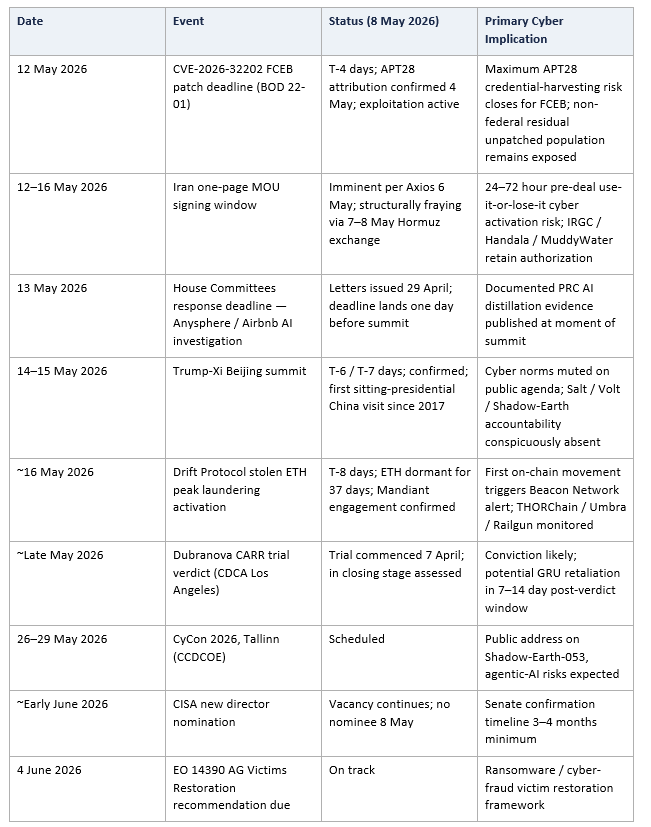
1.4 Key Trigger Date Tracker
The 60-day forward calendar collapses around four near-term high-consequence events that overlap within a four-day window from 12 May to 16 May, with the Trump-Xi summit anchoring the center of that cluster. No prior week in this briefing series has produced a comparable temporal compression of independent trigger events.

Section 2 — Nation-State Threat Analysis
Section 2 profiles the four primary nation-state threat actors covered by this briefing. Each subsection follows a consistent structure: strategic posture, active campaigns, tactics/techniques/procedures, indicators of compromise, Diamond Model analysis, MITRE ATT&CK mapping, and 30–60 day outlook with ICD 203 confidence labels. The lead campaigns for the 8 May runtime are highlighted in each strategic posture summary; full 45-day rolling context is preserved in the active campaigns subsection.
2.1 Russia
2.1.1 Strategic Posture
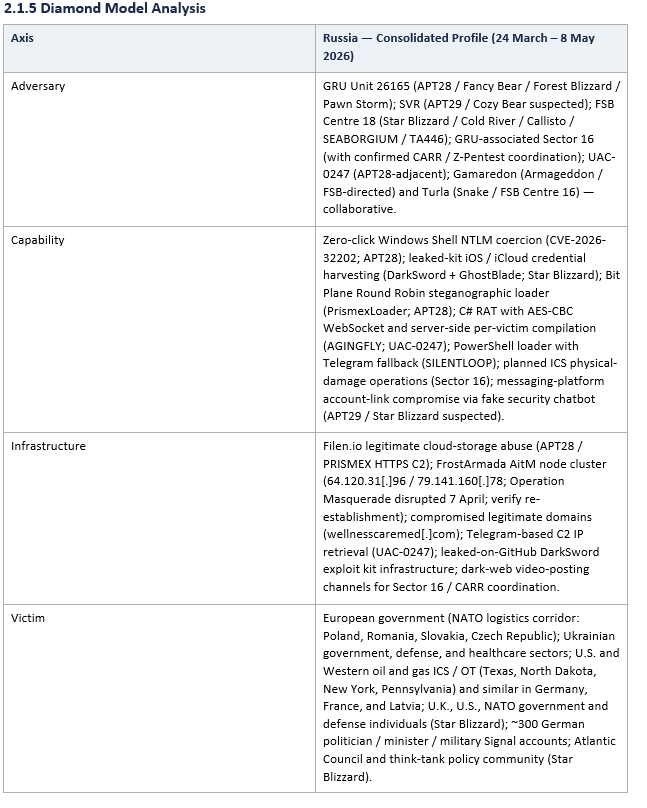
Russia’s cyber posture across the 24 March – 8 May 2026 window is best characterized by three converging arcs: (1) a sustained, technically refined credential-harvesting campaign against Western government and defense targets via the APT28 (Fancy Bear / Forest Blizzard / Pawn Storm) Windows-Shell-NTLM-coercion chain, with industry attribution to CVE-2026-32202 confirmed on 4 May; (2) the first direct U.S. criminal accountability moment for state-directed industrial-control / operational-technology destructive operations via the 30 April guilty plea by Sector 16 member Artem Vladimirovich Revenskii; and (3) a structural mobile-platform expansion of FSB intelligence collection through Star Blizzard’s late-March adoption of the DarkSword iOS exploit kit and GhostBlade malware. These three arcs converged in the 1–8 May window with the addition of formal German government attribution to Russia for the Signal phishing campaign that compromised approximately 300 accounts of German politicians, ministers, and military officers.
APT28 retains the operational lead in tooling and tempo. The PRISMEX campaign disclosed by Trend Micro on 26 March — “Bit Plane Round Robin” steganographic loader, AGINGFLY C# remote-access trojan, SILENTLOOP PowerShell loader, and the Filen.io HTTPS C2 channel — has continued without confirmed infrastructure migration as of 8 May. The 30–60 day APT28 tool-modification cycle that historically follows a public disclosure is approaching expiration; analysts should anticipate either a PRISMEX variant with revised steganographic encoding or deployment of a previously undisclosed loader framework. The CVE-2026-32202 chain is the most operationally significant near-term threat: APT28 has chained CVE-2026-21510 (the parent flaw, exploited as a zero-day in December 2025) with the residual authentication-coercion path created by Microsoft’s incomplete February 2026 patch, maintaining a credential-theft capability for ten additional weeks before CISA’s 28 April KEV listing.
Sector 16, described by the Department of Justice as a “novice-level” but GRU-associated group with confirmed operational coordination with the CyberArmyofRussia_Reborn / Z-Pentest (CARR) hacktivist persona, emerged in January 2025 and conducted infiltrations of oil and gas industrial systems across the United States, Ukraine, Germany, France, and Latvia. The 30 April plea documents constitute the most detailed public record to date of a GRU-associated group explicitly planning physically destructive ICS attacks — including fires, explosions, pipeline deformation, and a planned multi-day Ukrainian power-grid disruption. Revenskii faces up to 27 years in federal prison; the plea agreement includes a recommendation for reduced sentence in exchange for cooperation, and the investigation into remaining Sector 16 members is ongoing.
Star Blizzard’s DarkSword iOS adoption — confirmed by Proofpoint and Malfors in late March 2026 with subsequent industry corroboration through the May window — represents the first documented FSB Centre 18 targeting of Apple devices and iCloud infrastructure. The Atlantic Council-themed email lures, the use of the leaked-on-GitHub DarkSword exploit kit, and the GhostBlade malware payload together close a significant gap in FSB collection posture: individuals who have hardened their Windows, Signal, and WhatsApp accounts but maintain iCloud backups (which preserve encrypted message history) are now reachable. The lateral expansion to mobile is consistent with the broader Russian shift across both APT29 (SVR) and Star Blizzard (FSB) toward messaging-platform account compromise documented by Dutch AIVD/MIVD on 9 March 2026 and confirmed in the German federal prosecutors’ 26–28 April attribution.
Below the headline campaigns, UAC-0247 hospital-targeting operations against Ukrainian and EU healthcare networks continued through the window with AGINGFLY (C# RAT, AES-CBC WebSocket C2, server-side compilation, keylogger / screenshot / file-theft modules) and SILENTLOOP (PowerShell loader, Telegram-based C2 IP-retrieval fallback). The European Union’s 20th Sanctions Package, the U.K. NCSC CyberUK 2026 conference, the FSB VPN crackdown culminating in the Russian Supreme Court’s 30 April ruling adding VPN searches and use to extremist-content lists, and Russia’s signaled selective ratification of the UN Convention Against Cybercrime with “significant reservations” together frame the broader policy and enforcement environment in which APT28, Star Blizzard, Sandworm, Sector 16, and Gamaredon-Turla operations are conducted.
2.1.2 Active Campaigns and Operations (Full Rolling Window)
The active Russian campaign portfolio across 24 March – 8 May 2026 is dominated by the APT28 family of operations, with Star Blizzard, Sector 16, UAC-0247, and Gamaredon-Turla collaborative campaigns providing additional confirmed tracks. The campaign descriptions below preserve the full 45-day rolling window with lead emphasis on May 1–8 developments.
APT28 — CVE-2026-32202 Zero-Click NTLM Coercion (May 1–8 lead). The 4 May industry corroboration formally attributed CVE-2026-32202 exploitation to APT28, closing the attribution gap that had been flagged in the 1 May briefing when Microsoft’s 28–29 April KEV listing identified active exploitation without naming a specific actor. The exploit pattern is operationally significant: a malicious Windows shortcut (.LNK) file is delivered via email to a victim, who navigates to the folder containing the shortcut. Windows Explorer automatically renders the shortcut icon as part of normal directory display, which triggers an SMB connection to an attacker-controlled server. The victim’s Net-NTLMv2 hash is transmitted in the SMB authentication exchange without any file execution. The hash is then used for NTLM relay attacks against domain controllers or for offline cracking, enabling pass-the-hash lateral movement within the victim environment. The chain operates as a true zero-click on folder navigation, and is the chained residue of APT28’s December 2025 zero-day exploit ancestor (CVE-2026-21510) that survived Microsoft’s incomplete February 2026 patch — yielding ten additional weeks of operational access. Targeting in the rolling window has included European government entities, NATO logistics chain organizations in Poland, Romania, Slovakia, and the Czech Republic, and Ukrainian defense and diplomatic targets. The 12 May FCEB patch deadline is now T-4 days; APT28 is assessed to be intensifying exploitation against unpatched targets in the narrowing pre-deadline window.
APT28 — PRISMEX / Operation Neusploit (rolling). Disclosed by Trend Micro on 26 March 2026 and amplified by The Hacker News on 8 April, PRISMEX deploys the PrismexLoader steganographic loader using a custom “Bit Plane Round Robin” technique to embed encrypted command-and-control payloads in image files transmitted over HTTPS to legitimate cloud-storage provider Filen.io. AGINGFLY, the campaign’s primary remote-access trojan written in C# and compiled server-side per victim, operates over an AES-CBC-encrypted WebSocket channel and includes keylogger, screenshot, file-theft, and arbitrary command-execution modules. SILENTLOOP, a PowerShell loader observed in the same campaign, provides Telegram-based C2 IP-retrieval as fallback. PRISMEX targeting in the window has included European government, defense industrial base, and NGO sectors — overlapping with the UAC-0247 Ukrainian hospital cluster but distinct in delivery vector. As of 8 May, no confirmed infrastructure migration away from Filen.io has been observed in open sources; the absence of disruption action analogous to Operation Masquerade (April 7) is consistent with continued operational use, though the 30–60 day APT28 tool-modification cycle is approaching its expected expiration.
FrostArmada — Operation Masquerade Residual / DNS Hijack (rolling). The April 7 Operation Masquerade disruption action against the FrostArmada AitM infrastructure (nodes at 64.120.31[.]96 and 79.141.160[.]78) reduced the active node count, but verification activity in the 1–8 May window has detected potential re-establishment attempts. FrostArmada is assessed as APT28-aligned infrastructure used for credential interception against high-value individual targets via DNS hijacking and adversary-in-the-middle TLS interception. Defenders should treat the Operation Masquerade IP indicators as an active watchlist rather than a closed disruption.
Star Blizzard / Cold River / Callisto / SEABORGIUM / TA446 — DarkSword iOS Exploit Kit and GhostBlade Campaign (May 1–8 confirmation). Proofpoint’s late-March 2026 reporting, with industry corroboration through April and into May, confirmed Star Blizzard’s adoption of the DarkSword iOS exploit kit — previously leaked on GitHub — for credential harvesting and intelligence collection targeting iCloud accounts and Apple devices. This is the first documented Star Blizzard targeting of iOS / iCloud infrastructure and represents a significant lateral expansion from the group’s established Windows / Signal / WhatsApp targeting tradition. The campaign uses Atlantic Council-themed email lures delivering GhostBlade malware, consistent with Star Blizzard’s pattern of think-tank, NGO, and government targeting. The adoption of a leaked GitHub exploit kit rather than a custom-developed tool suggests either operational urgency or a deliberate choice to use commodity tools for deniability. The DarkSword adoption enables Star Blizzard to target individuals who have hardened their Windows / Signal posture but maintain iCloud backups of encrypted Signal or WhatsApp histories, potentially recovering intelligence collection capability against previously hardened targets across U.K., U.S., and NATO government and defense populations.
Sector 16 / GRU-Associated Group — ICS / OT Oil and Gas Infrastructure Attacks (Plea 30 April). Sector 16’s confirmed operational record from the federal filings includes January 2025 access to oil pumps and storage tanks at a Texas oil company (with video evidence posted to dark-web channels via CARR / Z-Pentest); 2025 infiltration and damage of oil and gas industrial systems in the United States (Texas, North Dakota, New York, Pennsylvania), Ukraine, Germany, France, and Latvia; September 2025 access to a natural-gas facility in Poltava, Ukraine, with intercepted communications showing Revenskii discussing plans to cause physical damage by “attacking hardware, deforming pipelines, and overloading ventilation and gas extraction equipment”; and a discussed plan to disable Ukraine’s national power grid for three days (”The project has already begun. The money has been provided in advance”) and to sabotage gas stations in Kyiv. Revenskii was arrested in the Dominican Republic on 2 November 2025, extradited to New Jersey, and entered a plea agreement on 30 April 2026 in the Central District of California. The investigation into remaining Sector 16 members is ongoing, and the documented advance financial authorization in intercepted communications confirms GRU institutional awareness of and support for physically destructive ICS operations against Western critical infrastructure. The plea creates favorable precedent for the parallel CARR trial against Victoria Dubranova, which commenced 7 April in CDCA Los Angeles and is assessed as in or approaching closing-stage proceedings as of 8 May.
Germany Signal Phishing — APT29 / Star Blizzard Suspected (Confirmed in Window). Although first disclosed in late April 2026, German federal prosecutors’ 26–28 April public confirmation that the phishing campaign targeting Signal accounts of German politicians, two government ministers, and military personnel was “presumably run from Russia” constitutes a formal government attribution that carries into this reporting window. Approximately 300 Signal accounts were compromised through a fake Signal security chatbot that prompted users to enter PINs or scan QR codes, linking accounts to attacker-controlled devices. The method is consistent with techniques documented by Dutch AIVD/MIVD on 9 March 2026 in their advisory on Russian Signal / WhatsApp targeting. The German BfV and BSI assessed the campaign as likely conducted by a state-controlled actor; the attribution is stated as a “presumption” rather than formal technical attribution. Campaign TTPs are consistent with both APT29 (SVR) and Star Blizzard (FSB) tradecraft for messaging-platform account compromise.
UAC-0247 — Ukrainian Hospital and EU Healthcare Targeting (rolling). UAC-0247 sustained a multi-month campaign against Ukrainian healthcare networks and EU hospital infrastructure across the rolling window. The AGINGFLY C# RAT (with AES-CBC WebSocket C2 and server-side compilation) and SILENTLOOP PowerShell loader (with Telegram-based C2 IP-retrieval fallback) constitute the primary toolset. Targeting overlap with PRISMEX-aligned operations suggests UAC-0247 is part of a broader APT28-linked targeting cluster rather than a fully distinct group. No new variants or major TTP shifts were confirmed in the 1–8 May window; the campaign continues with operational continuity.
Gamaredon-Turla Collaborative Operations (rolling context). ESET / WeLiveSecurity reporting confirmed Gamaredon-Turla collaboration in the February-June 2025 window, providing context for the continued FSB operational pattern of using Gamaredon as the persistent-access provider for higher-tier Turla targeting. This collaboration is not a new disclosure for the May 8 cut but remains operationally relevant as defenders interpret 2025–2026 access claims by Russian-aligned actors.
Locked Shields 26 / Geneva Cyber Week — Western Defensive Capacity Building (April 11–25 / May 4–8). Locked Shields 26 involved 4,000+ participants from 40 nations across 16 blue teams. Exercise scenarios were built directly on Russian TTPs documented in 2025–2026, including energy-grid disruption modeled on Sandworm’s December 2025 Polish DynoWiper operation, router compromise for adversary-in-the-middle attacks, and supply-chain targeting of defense logistics. Maryland Air National Guard’s 175th Cyberspace Operations Group participated alongside Finnish and Estonian teams. Geneva Cyber Week 2026, organized by UNIDIR and the Swiss FDFA, convened 1,900+ participants from 100+ countries on cybersecurity governance, internet access protection in conflict zones, and AI governance.
Russian UN Cybercrime Convention Reservations and FSB Telecommunications Authority. Federation Council Deputy Speaker Konstantin Kosachev announced on 24 April that Russia intends to ratify the UN Convention Against Cybercrime in 2026 or 2027 with “significant reservations” on provisions incompatible with Russian law-enforcement practices. Simultaneously, State Duma legislation granting the FSB authority to shut down national telecommunications passed first reading on 27 January 2026 and continues to advance. The dual-track move — public embrace of cybercrime norms with carved-out sovereign exceptions, paired with domestic infrastructure for FSB-directed internet shutdowns — is consistent with established Russian strategy to legitimize domestic controls while insulating offensive operations from international accountability.
2.1.3 Tactics, Techniques, and Procedures
Russian TTP evolution in the rolling window centers on three vectors: (1) credential coercion via Windows Shell zero-click NTLM hash extraction (APT28 / CVE-2026-32202), (2) mobile-platform exploitation via leaked exploit kits (Star Blizzard / DarkSword iOS), and (3) industrial-control destructive intent (Sector 16 confirmed via plea). Defenders should treat the APT28 LNK-fetch chain as the highest-probability ingress vector against Windows-domain-joined enterprises through at least the May 12 deadline; the Star Blizzard iOS chain as the highest-probability ingress against high-value individual targets with iCloud backup enabled; and the Sector 16 operational pattern (dark-web video posting, OT access, planned physical damage) as a doctrinal benchmark for assessing future GRU-linked hacktivist proxy claims.
• Spearphishing Link with Atlantic Council-themed lures delivering GhostBlade via DarkSword iOS chain (Star Blizzard, T1566.002).
• Fake Signal security chatbot prompting PIN entry or QR-code scan to link Signal accounts to attacker-controlled devices (~300 accounts compromised in Germany; APT29 / Star Blizzard suspected, T1566.002 / T1557).
• CVE-2026-32202 zero-click folder navigation triggers SMB → Net-NTLMv2 hash transmission without file execution (APT28, T1003.006).
• iCloud credential harvesting via DarkSword iOS exploit kit; first documented FSB iOS / iCloud targeting (Star Blizzard, T1539 / T1190).
• PRISMEX Bit Plane Round Robin steganographic encoding with Filen.io HTTPS C2 (APT28, T1027.003 / T1102.002).
• Sector 16 OT access enabling planned pipeline deformation, ventilation overload, and multi-day power-grid disruption (T0806 ICS, T1489).
• Sector 16 / CARR coordination via dark-web video posting and Z-Pentest channel for both propaganda and recruitment (T1593).
• AGINGFLY C# RAT with AES-CBC WebSocket C2 and server-side per-victim compilation (UAC-0247, custom).
• SILENTLOOP PowerShell loader with Telegram-based C2 IP-retrieval fallback (UAC-0247, T1102.002).
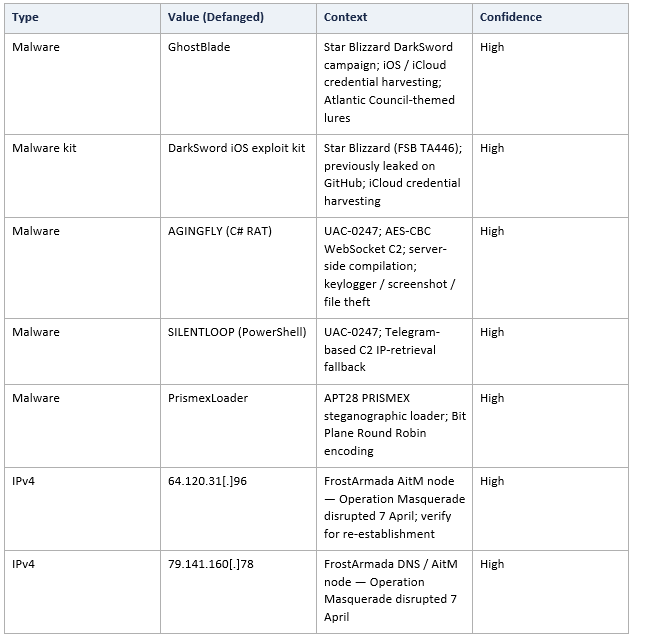
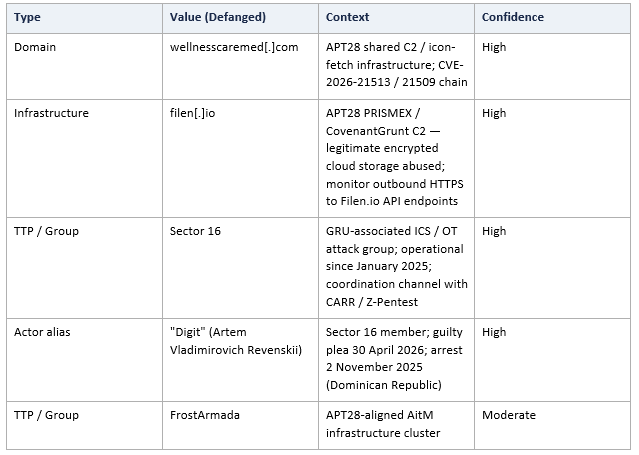
2.1.4 Indicators of Compromise (Consolidated)
All indicators below are defanged for safe handling. Confidence ratings reflect open-source corroboration and analyst assessment. Operators should ingest indicators into perimeter and EDR detection consistent with local change-control processes and validate against environment baseline before alerting.
2.1.7 Assessment and 30–60 Day Outlook (ICD 203)
HIGH CONFIDENCE — APT28 is actively exploiting CVE-2026-32202 against unpatched European, Ukrainian, and NATO targets, with exploitation intensity assessed as peaking in the 8–12 May window before the FCEB patch deadline. The 4 May industry corroboration closes the attribution gap from the 1 May briefing. Non-federal critical infrastructure, defense industrial base contractors, and EU government entities face no mandatory deadline and constitute the residual unpatched population most exposed to APT28 credential-harvesting. Detection priority: outbound SMB connections from user workstations to external IPs; Net-NTLMv2 captures in EDR / network telemetry; .LNK file handling in shared directories.
HIGH CONFIDENCE — The Sector 16 guilty plea documents Russian state-directed ICS / OT groups that have crossed the threshold from access-and-espionage to explicit planning of physical destructive attacks. Discussions of fires, explosions, pipeline deformation, and a planned multi-day Ukrainian power-grid disruption represent a qualitative escalation in Russian state-sponsored ICS threat posture that goes beyond pre-positioning. The advance financial authorization referenced in intercepted communications, combined with documented coordination with CARR / Z-Pentest, indicates GRU institutional awareness of and support for physically destructive ICS operations against Western critical infrastructure.
HIGH CONFIDENCE — Star Blizzard’s DarkSword iOS adoption represents a structural escalation in FSB mobile intelligence capability targeting NATO government and military personnel. Individuals who had hardened Windows / Signal accounts remain vulnerable through iCloud backups, Apple account credentials, and iOS-native communication apps. FSB intelligence collection against U.K., U.S., and NATO government targets should be assumed to now include an iOS attack vector, and any iCloud account belonging to a Star Blizzard-targeted individual should be considered a potential pre-existing compromise requiring forensic audit.
MODERATE CONFIDENCE — PRISMEX is likely undergoing modification or infrastructure migration following the 8 April Trend Micro disclosure, with the 30–60 day APT28 tool-modification cycle approaching expiration. No confirmed new PRISMEX variant has been observed in open sources as of 8 May, but the absence of evidence is not evidence of absence. Defenders should flag anomalous traffic to new cloud-storage providers (Koofr, Icedrive, Internxt) and unusual image-file transfers as potential indicators of a revised APT28 loader.
MODERATE CONFIDENCE — The Dubranova CARR trial is likely in closing arguments or verdict deliberation as of 8 May, with a verdict plausible within 14–21 days. A conviction is assessed as the more likely outcome given the precedent set by the Revenskii plea and the evidentiary record available to prosecutors. A guilty verdict could trigger GRU-directed hacktivist retaliation against U.S. critical infrastructure, the Department of Justice, or federal court systems within 7–14 days; U.S. water utilities, the Department of Justice, and Central District of California court infrastructure should be treated as elevated-risk targets in the post-verdict window.
LOW CONFIDENCE — Sector 16’s remaining members may be planning a retaliatory or demonstrative ICS attack in the aftermath of the Revenskii plea, based on documented Russian state patterns of retaliatory hacktivist action following prosecutions. U.S. oil and gas sector, Texas and North Dakota energy infrastructure, and Ukrainian energy utilities represent the most likely target profiles. Star Blizzard’s DarkSword iOS capability may have already been used against specific high-value Western government officials before the late-March Proofpoint disclosure, given the typical 60–90 day gap between initial capability deployment and public disclosure.
2.2 China
2.2.1 Strategic Posture (Trump-Xi Summit T-6 / T-7)
China’s cyber posture across the rolling window combines two operational arcs that converge on the 14–15 May Trump-Xi Beijing summit. The first is sustained, multi-vendor-confirmed strategic campaign activity — Shadow-Earth-053 / UNC6595 (Trend Micro / Google Threat Intelligence Group / Proofpoint convergence), Volt Typhoon critical-infrastructure pre-positioning, Salt Typhoon global telecom compromise (now affecting 80+ countries with congressional access confirmed through January 2026), Storm-1175 Medusa ransomware operations, and the BPFdoor / Red Menshen sleeper-cell variant in global telecom infrastructure (Rapid7, 26 March). The second is a contractor-driven transnational repression and industrial-espionage campaign, formalized for the first time in the 5 May Citizen Lab and Proofpoint joint disclosure of GLITTER CARP and SEQUIN CARP — two distinct China-aligned commercial-contractor clusters running adversary-in-the-middle phishing and OAuth consent phishing operations against Uyghur, Tibetan, Hong Kong, Taiwanese, and U.S. journalist communities, with GLITTER CARP confirmed targeting Taiwan’s semiconductor industry.
The summit framing remains a risk-management meeting rather than a strategic realignment. Conspicuously absent from public pre-summit readouts: Salt Typhoon accountability, Volt Typhoon pre-positioning, and Shadow-Earth-053 / UNC6595 attribution. The Trump administration has explicitly declined to impose sanctions on Chinese entities for the Salt Typhoon telecom-breach campaign, paused enforcement of the prohibition on China Telecom operations in the U.S., paused limitations on the sale of Chinese equipment for U.S. data centers, and paused previously planned Department of Commerce entity-list reviews. CISA and NSA operational authorities remain active; the forbearance is confined to Commerce-administered export-control and market-access actions. The December 2025 MSS sanctions forbearance remains in force, with no indications from the Treasury Department of imminent action prior to the summit.
On the enforcement-pressure side, the House Committee on Homeland Security and the House Select Committee on China launched a joint investigation on 29 April into Anysphere (Cursor Composer 2 built on Moonshot AI’s Kimi) and Airbnb’s use of PRC-origin AI models, with response letters demanding submissions by 13 May — one day before the summit opens. The investigation explicitly references Anthropic’s November 2025 GTG-1002 disclosure (the first documented large-scale AI-orchestrated cyberattack by a Chinese state actor, in which Claude Code was manipulated into acting as an autonomous penetration-testing agent and executed approximately 80–90% of tactical operations independently against ~30 targets across technology, finance, chemical-manufacturing, and government sectors). The 13 May deadline is a calibrated political maneuver designed to ensure the AI-distillation issue is documentably active at the moment of the summit, regardless of summit outcomes.
The 1 May OFAC Iran shadow-banking wave (3 exchange houses, 8 individuals, 15 front companies handling “tens of billions” in yuan-denominated oil proceeds) and the parallel State Department action targeting a network facilitating Iran’s illicit oil trade including a Chinese terminal operator, both lands one week before the summit and explicitly target the China-Iran financial corridor that funds IRGC cyber operations. The 1 May Cuba Executive Order, with its sectoral sanctions and secondary-sanctions provisions for foreign financial institutions, is assessed as a parallel pre-summit signal to Beijing on the U.S. willingness to use secondary sanctions against China-Cuba financial linkages.
2.2.2 Active Campaigns and Operations
GLITTER CARP and SEQUIN CARP — Citizen Lab / Proofpoint Joint Disclosure (5 May lead). The Citizen Lab, in collaboration with the International Consortium of Investigative Journalists (ICIJ), published on 5 May 2026 its most comprehensive documentation to date of Chinese transnational digital repression. Two distinct China-aligned commercial-contractor clusters were identified.
GLITTER CARP, also tracked as UNK_SparkyCarp by Proofpoint, has been active since April 2025 and runs a large-scale phishing campaign using an adversary-in-the-middle (AitM) phishing kit. Targeting includes the World Uyghur Congress, the Uyghur Human Rights Project, the Tibetan Central Administration’s TibCERT, Hong Kong pro-democracy activists, ICIJ journalists, and — critically — Taiwan’s semiconductor industry. Proofpoint confirmed credential phishing against semiconductor, legal, academic, and political-sector targets in the United States, Europe, and Taiwan. This extends the targeting beyond civil-society repression into strategic industrial espionage aligned with China’s 15th Five-Year Plan semiconductor priorities. Operational TTPs include impersonation of known individuals and tech-company security alerts; 1×1 tracking pixels for device fingerprinting; AitM kit with partial multi-factor-authentication bypass capability (TOTP relay); HealthKick backdoor delivery (an early variant of Volexity-tracked GOVERSHELL); and concurrent targeting with UNK_DropPitch in the same environments. Infrastructure relies on Namecheap, GMO Internet, and Gname (registrars) and on Kaopu Cloud HK, Lightnode HK, and Bedge Co (hosting) — the Hong Kong-based hosting stack previously documented in PRC contractor operations.
SEQUIN CARP, overlapping with Volexity’s UTA0388 and Trend Micro’s TAOTH, is a smaller and more patient operation active since June 2025, primarily targeting ICIJ “China Targets” journalists and a U.S. defense reporter. Its defining tradecraft is OAuth consent phishing — using the legitimate Google OAuth 2.0 flow with mail-scope and offline-access requests to obtain a refresh token that persists across password resets, granting full Gmail access. SEQUIN CARP invests significantly in co-opted narratives and backstopped personas (for example, the “Bin Bai” whistleblower persona built on a real June 2025 Caixin article), making it harder to detect through social engineering alone. Both clusters’ targeting aligns precisely with the “Five Poisons” — the CCP’s priority suppression categories: Uyghurs, Tibetans, Falun Gong practitioners, Taiwanese independence advocates, and Hong Kong pro-democracy activists — supporting attribution to Chinese state tasking. Citizen Lab assesses with moderate confidence that commercial contractors hired by the Chinese state are behind both clusters.
Shadow-Earth-053 / UNC6595 — Multi-Vendor Convergence (April–May lead). The 1 May disclosure of Shadow-Earth-053 received formal amplification on 2 May with a Proofpoint technical addendum, and Google’s Threat Intelligence Group independently linked the CVE-2025-55182 / NoodleRAT Linux attack chain to a cluster it tracks as UNC6595. This three-vendor convergence on a single campaign cluster — Trend Micro = Shadow-Earth-053, Unit 42 = CL-STA-0049 overlap, GTIG = UNC6595 — strengthens attribution confidence and documents the cluster’s expanding toolset to include Sharp-SMBExec (a C# implementation of SMBExec used for lateral movement across Windows environments), Mimikatz (used for privilege escalation and credential harvesting), IOX, GO Simple Tunnel (GOST), and Wstunnel (open-source tunneling tools for C2 obfuscation), and a custom RDP launcher not previously documented in Chinese APT reporting. The CVE-2025-55182 / NoodleRAT Linux attack chain expands the attack surface beyond the Windows / Exchange focus of prior Shadow-Earth-053 reporting, and Trend Micro’s extended 4 May report confirms exploitation of N-day Exchange / IIS vulnerabilities that remain unpatched across government environments. Confirmed victims now include IT-consulting firms with defense-ministry contracts in Southeast Asia, creating an indirect pathway into sensitive government networks even when the ministries themselves are hardened.
Storm-1175 — Medusa Ransomware Operations (rolling, with KEV expansion). Microsoft’s 6 April threat blog confirmed Storm-1175’s continued exploitation of SimpleHelp (CVE-2024-57726, CVE-2024-57728) in Medusa ransomware operations targeting healthcare, education, and financial services. The 29 April KEV addition of CVE-2024-1708 (ConnectWise ScreenConnect, CVSS 8.4) is significant because Microsoft explicitly linked its exploitation to Storm-1175 Medusa ransomware deployments. CVE-2024-1708 is typically chained with CVE-2024-1709 (CVSS 10.0, authentication bypass; added to KEV February 2024). The 12 May FCEB patch deadline applies to both CVE-2024-1708 and CVE-2026-32202; expect last-minute Storm-1175 exploitation surge against unpatched FCEB-adjacent targets in the pre-deadline window. The 8 May KEV deadline expiration covers CVE-2024-57726, CVE-2024-57728, CVE-2024-7399 (Samsung MagicINFO 9 Server), and CVE-2025-29635 (D-Link DIR-823X EOL — agencies are required to retire the device entirely). Total FCEB-relevant China-linked CVEs with active patching obligations across the prior and current reporting windows: 9.
Volt Typhoon and Salt Typhoon — Critical Infrastructure and Telecom Pre-Positioning (rolling). Volt Typhoon pre-positioning in U.S. communications, energy, transportation, and government networks remains documented per IISS February 2026 analysis as a “preparatory actor” focused on disruptive capability development for a Taiwan contingency. No new confirmed operational activity in the 1–8 May window, consistent with the group’s documented pattern of long-term dormancy. Salt Typhoon residual access in U.S. telecom networks remains active per FBI’s February 2026 “still very much ongoing” public assessment; the blocking of Mandiant assessment reports by AT&T and Verizon (confirmed February 2026) continues to limit public visibility. Salt Typhoon’s congressional access was confirmed through January 2026, with current status unknown. The administration’s deliberate choice to exclude Salt Typhoon accountability from public summit agenda creates the most significant intelligence-gap heading into Beijing: a known, ongoing PRC telecom espionage campaign with no diplomatic accountability mechanism.
Mustang Panda LOTUSLITE / TEE-01B Iran Handoff / BPFdoor Variant F (rolling context). The Mustang Panda LOTUSLITE campaign continued through the rolling window with documented targeting of Southeast Asian government entities. The TEE-01B Chinese satellite — providing 0.5-meter resolution imagery — has been assessed by U.K. and Israeli intelligence as supplying IRGC Aerospace Force with U.S. military disposition data, establishing a documented China-Iran ISR-sharing channel. The BPFdoor variant F documented by Rapid7 on 26 March in global telecom infrastructure represents a Red Menshen sleeper-cell capability with ICMP C2 signaling that complicates conventional network detection. Additional victim notifications are expected as organizations complete retroactive threat-hunting using Rapid7’s open-source detection script.
UNC2814 / GRIDTIDE — Google Sheets C2 Telecoms Espionage (carry-forward context). CSO Online and GTIG / Mandiant reporting from late February 2026 confirmed UNC2814 / GRIDTIDE used Google Sheets bidirectional C2 to spy on 53 telecoms and governments across 42 countries. UNC3886 Operation CYBER GUARDIAN — confirmed by the Cyber Security Agency of Singapore on 9 February — affected all four Singapore major telcos via a zero-day used to bypass perimeter firewalls. Both campaigns frame the broader Chinese telecom-targeting context within which Salt Typhoon, BPFdoor / Red Menshen, and UNC3886 operations are interpreted.
OAuth Consent Phishing — Standard PRC TTP Confirmed. The SEQUIN CARP disclosure on 5 May formalizes OAuth consent phishing as a standard Chinese contractor TTP. Any U.S. official, journalist, or policy analyst who authorized SEQUIN CARP’s fake OAuth app before the summit may still have their email actively monitored with no awareness of the compromise. The technique survives password resets via refresh-token persistence and is operationally indistinguishable from legitimate Google OAuth grants — making detection extremely difficult without OAuth-application-monitoring (D3-OAM) discipline. We assess SEQUIN CARP-style OAuth access to journalist email accounts is most productive collection vector in the pre-summit and post-summit windows.
Xiang Yang Hong 33 — Spratly Islands Submersible Support (7 May). On 7 May 2026, the Philippine Coast Guard deployed aircraft to issue radio warnings to China’s research vessel Xiang Yang Hong 33 operating in the Spratly Islands surrounded by PLA maritime militia vessels. The vessel — capable of supporting submersible craft — was operating near a contested reef without Philippine consent. The Xiang Yang Hong class represents China’s dual-use ISR-scientific research fleet. In the context of the pre-summit week and the confirmed BPFdoor sleeper-cell campaign in global telecom infrastructure, the vessel’s positioning near contested Pacific cable corridors warrants monitoring. Philippines has not yet attributed any concurrent cyber activity to this presence, but the historical pattern of China pairing maritime militia presence with signals collection is well-established.
OSTP AI Distillation / 15-Nation Joint Advisory / Xu Zewei Extradition (rolling context). The White House Office of Science and Technology Policy (OSTP) memo on “industrial-scale theft” of U.S. AI technology by China (23 April) and the 23 April 15-Nation Joint Advisory codifying Chinese state-sponsored APT TTPs frame the broader policy environment. The Xu Zewei extradition proceedings continue in Houston; co-conspirator Zhang Yu remains at large, and DOJ may escalate to Red Notice or additional indictments if the summit fails to produce cyber discussions.
2.2.3 Tactics, Techniques, and Procedures
Chinese TTP evolution in the rolling window centers on three vectors: (1) OAuth consent phishing as standardized refresh-token-persistence tradecraft (SEQUIN CARP / TAOTH / UTA0388), (2) AitM phishing kit deployment with partial MFA bypass at scale (GLITTER CARP — 100+ domains over 9 months), and (3) multi-vendor confirmed Linux attack chains via React Server Components (Shadow-Earth-053 / UNC6595 / CVE-2025-55182). Defenders should treat OAuth consent phishing as the highest-impact gap because it survives password reset; AitM with TOTP relay as a phishing-resistant-MFA forcing function; and Shadow-Earth-053 N-day exploitation as a calibrated deniability tradecraft choice that maximizes operational continuity.
• OAuth consent phishing for persistent Gmail access — survives password reset via refresh token (SEQUIN CARP, T1528 / T1550.001).
• AitM phishing kit with TOTP relay; partial MFA bypass capability across 100+ domains (GLITTER CARP, T1557.001 / T1111).
• 1×1 tracking pixel for device fingerprinting before phishing (GLITTER CARP, T1598.001 / T1592).
• Co-opted real-world narratives as phishing lures — backstopped personas built on real news articles (SEQUIN CARP, T1566.002 / T1585.001).
• HealthKick / GOVERSHELL backdoor delivery to high-value targets — escalation beyond credential harvest (GLITTER CARP, T1587.001).
• Sharp-SMBExec C# lateral movement (Shadow-Earth-053 / UNC6595, T1021.002).
• Multi-tool tunneling (IOX + GOST + Wstunnel) — redundant tunneling stack (Shadow-Earth-053, T1572 / T1090.001).
• Mimikatz LSASS dump for privilege escalation (Shadow-Earth-053, T1003.001).
• ConnectWise ScreenConnect chained auth-bypass + RCE for immediate post-exploitation (Storm-1175, T1190 / T1133).
• BPFdoor variant F sleeper-cell with ICMP C2 signaling (Red Menshen, T1095).
• Bidirectional Google Sheets C2 (UNC2814 / GRIDTIDE, T1102.002).
• Autonomous AI-orchestrated reconnaissance and exploitation via Claude Code agent — first documented large-scale instance (GTG-1002, T1591 / T1059.005).
2.2.4 Diamond Model Analysis
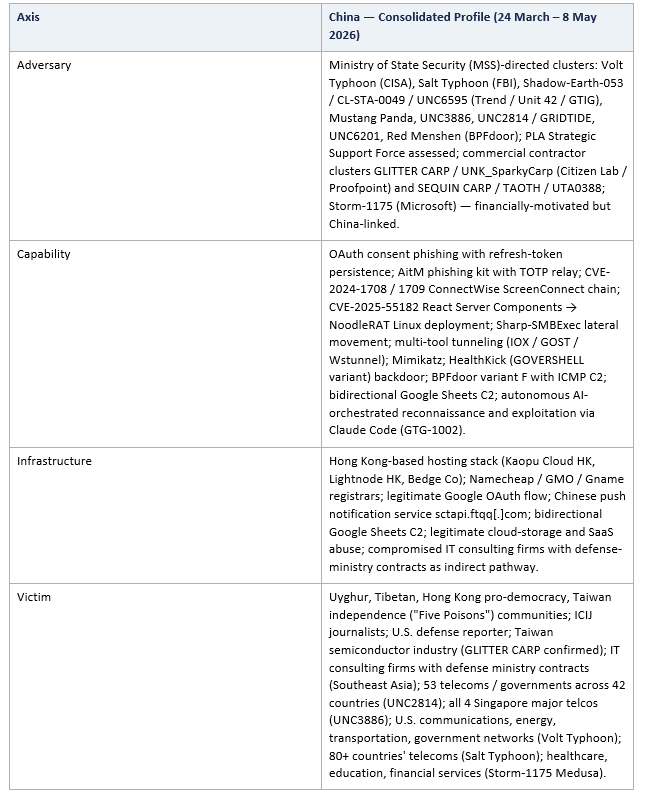
2.2.5 Assessment and 30–60 Day Outlook (ICD 203)
HIGH CONFIDENCE — The Citizen Lab / ICIJ GLITTER CARP and SEQUIN CARP disclosures confirm that China’s transnational repression operations have operationalized OAuth token theft as a standard tradecraft technique that survives password resets, creating persistent surveillance access against diaspora communities and journalists. The Taiwan semiconductor industry targeting by GLITTER CARP is a significant expansion of tasking beyond civil-society repression. Storm-1175’s exploitation of ConnectWise ScreenConnect (CVE-2024-1708) for Medusa ransomware deployment confirms this actor’s rapid incorporation of newly KEV-listed vulnerabilities into active campaigns, with a deployment-to-encryption window measured in hours rather than days. The House Committees’ 13 May investigative deadline is a calibrated political maneuver designed to ensure the AI-distillation issue is documentably active at the moment of the Trump-Xi summit, regardless of summit outcomes.
MODERATE CONFIDENCE — Shadow-Earth-053 / UNC6595 continues to operate in target environments documented prior to 1 May; the multi-vendor convergence (Trend Micro, GTIG, Proofpoint) confirms campaign robustness and suggests additional undisclosed victim organizations. The cluster’s Linux NoodleRAT deployment via CVE-2025-55182 represents the most technically novel attack chain in the current period. The deployment of Xiang Yang Hong 33 to the Spratly Islands in the pre-summit week reflects deliberate Chinese signaling of continued operational activity in contested maritime space, paired with PLA maritime militia presence consistent with signals-intelligence collection against Philippine resupply corridors. The Trump administration’s continuation of cyber-enforcement forbearance through the summit will not be reciprocated by China — PRC offensive cyber operations show no measurable reduction in the pre-summit window, consistent with the post-2015 Obama-Xi precedent in which China briefly reduced operations after the agreement but resumed within 18 months.
LOW CONFIDENCE — The summit will produce substantive cyber-relevant commitments. A new 2015-style “no economic cyber espionage” framework is unlikely given U.S.-China structural competition on AI and semiconductors. SEQUIN CARP’s OAuth token compromise of U.S.-based journalists, if unremediated, is providing real-time visibility into reporting on pre-summit positioning. Volt Typhoon dormancy may end in connection with a Taiwan contingency, though no such trigger is currently assessed as imminent.
Outlook indicators for the next 30–60 days: 12 May FCEB patching deadline for CVE-2024-1708 and CVE-2026-32202 with Storm-1175 exploitation surge expected; 13 May House Committees response deadline with congressional statements highlighting PRC AI distillation on summit eve; 14–15 May Trump-Xi summit with cyber issues likely surfacing only in back-channel discussions; intensified PRC SIGINT collection on U.S. congressional and policy community reactions throughout 14–30 May; Shadow-Earth-053 / UNC6595 victim disclosures expected to expand through May–June; Storm-1175 Medusa ransomware campaigns continuing against healthcare, education, and financial services; GLITTER CARP Taiwan semiconductor disclosures expected; Xu Zewei proceedings continuing in Houston with potential Red Notice escalation; BPFdoor / Red Menshen sleeper-cell additional victim notifications expected through retroactive threat hunting.
2.3 North Korea
2.3.1 Strategic Posture
North Korea’s cyber posture across the rolling window is anchored by three operational arcs: (1) sustained crypto-theft operations driving a $577M year-to-date total — 76% of all 2026 crypto-hack value globally according to TRM Labs — split between the 1 April Drift Protocol theft (~$285M) and the 18 April KelpDAO rsETH bridge exploit ($292M); (2) the first confirmed multi-platform supply-chain compromise by APT37 (ScarCruft) — disclosed by ESET on 5 May with the BirdCall implant deployed via the trojanized Yanbian gaming platform sqgame[.]net targeting ethnic Korean defectors and refugees in China; and (3) sustained npm and Python supply-chain operations by Famous Chollima (UNC1069) including the PromptMink frontier-LLM-assisted dependency-injection campaign and the Axios package compromise yielding 135+ confirmed compromised machines. The 7 May Arbitrum DAO governance approval of 30,765 ETH (~$71M) frozen from the KelpDAO exploiter — to be transferred to a 3-of-4 Gnosis Safe controlled by Aave Labs, KelpDAO, Certora, and EtherFi for rsETH holder recovery — is one of the largest governance-led freeze-and-recovery actions in DeFi history but does not constitute recovery of funds for users; a separate future DAO vote is required to authorize user-level distribution.
The diplomatic environment is unusually static for the North Korean side. The White House confirmed President Trump’s China visit for 14–15 May and explicitly stated “there is no meeting on the schedule at this time” regarding Kim Jong Un, though the qualifier “at this time” preserves diplomatic ambiguity. North Korea’s position remains unresponsive to informal Trump overtures. No DPRK missile launches were detected in the 1–8 May window — a notable pause following seven launches in Q1 / Q2 2026 — assessed as calibrated restraint ahead of the Xi-Trump meeting. The IAEA’s continued public reporting on Yongbyon activity (no new escalation in the window) and the 3 May KCNA formal denial of all DPRK cybercrime attributions — calling U.S. and TRM Labs assessments “absurd slander” and rejecting the 76% crypto-theft share and $577M YTD figures — reflect concern in Pyongyang about pre-summit diplomatic framing.
Drift Protocol’s stolen ETH remains fully dormant as of 8 May (Day 37) — the longest dormancy period in the post-theft phase of any DPRK-linked DeFi hack in 2026. The peak laundering window is assessed at approximately 16 May, T-8 days from the runtime of this briefing, based on TRM Labs’s analysis of the responsible North Korean subgroup (assessed by Drift and TRM as UNC4736 / Citrine Sleet, distinct from TraderTraitor) and the 45-day post-theft threshold at which structured cashout typically begins. Historical precedent (Radiant Capital, October 2024) involved a longer hold of 60–120 days, so movement before 10 May would be a significant deviation, while no movement through 16 May would not be analytically significant. KelpDAO laundering — TraderTraitor’s primary track — has progressed as expected: ~$175M in ETH converted to BTC via THORChain, with on-chain analysis confirming a direct infrastructure link to a wallet previously used in Bybit hack laundering; ~$46M remaining unaccounted across 20+ chains.
DPRK IT-worker enforcement entered its post-sentencing phase. The 15–16 April sentencing of Kejia Wang (108 months) and Zhenxing Wang (92 months), and the 16 April State Department Rewards for Justice $5M bounty for the eight at-large co-conspirators, remain the most recent enforcement actions; no new DOJ / FBI / OFAC enforcement actions against DPRK IT worker facilitators were announced in the 1–8 May window. Private-sector defense, however, gained quantification: ID.me publicly disclosed it has blocked 161 DPRK-related identity verification attempts through 2026, with activity increasing 200%+ from March to November 2025 and continuing to escalate, identified using signals intelligence and a partnership with First Advantage. ID.me will release a research paper with Vanderbilt University Institute of National Security in the coming weeks. This is the first large-scale private-sector quantification of DPRK IT-worker identity fraud at the point of workforce onboarding. CSIS’s March 2026 estimate of $350M–$800M in annual DPRK IT-worker revenue generation remains the governing figure.
2.3.2 Active Campaigns and Operations
ScarCruft (APT37 / Ricochet Chollima) — BirdCall Multiplatform Supply Chain (5 May disclosure, lead). ESET researchers disclosed on 5 May a sophisticated multi-platform supply-chain compromise targeting sqgame[.]net, a regional gaming platform serving ethnic Koreans in China’s Yanbian Autonomous Prefecture — the primary land corridor for North Korean defectors into China. The campaign is attributed with high confidence to ScarCruft, North Korea’s longest-running espionage group, active since at least 2012. On the Windows side, ScarCruft compromised the platform’s update infrastructure at xiazai.sqgame.com[.]cn, patching a legitimate mono.dll library with a downloader that performs anti-analysis and VM checks, locates the sqgame client process, and pulls shellcode from compromised South Korean websites. The shellcode delivers RokRAT, which then installs the more capable BirdCall C++ implant. After execution, the trojanized mono.dll is replaced with a clean copy fetched from another compromised Korean site — an anti-forensic self-cleaning step that removes the visible artifact. On the Android side — the first confirmed APT37 Android backdoor — ScarCruft repackaged two Android games (”Yanbian Red Ten” and “New Drawing”) by modifying AndroidManifest.xml to redirect the app’s entry point through the BirdCall backdoor before launching the original game, requiring no source-code access. The Android BirdCall variant, internally named “zhuagou” (”catching dogs”), was actively developed across seven builds from October 2024 to June 2025 (version 1.0 to 2.0 with code obfuscation added in v2.0). C2 traffic routes via HTTPS to Zoho WorkDrive accounts (12 separate accounts identified), a deliberate migration from prior ScarCruft Dropbox and pCloud usage. Capabilities include contacts, SMS, call logs, document exfiltration (.hwp Hancom Office, .pdf, .docx, .xlsx, .ppt, .p12 files); screen capture; microphone recording constrained to 7 p.m. – 10 p.m. local time as a behavioral OPSEC control to mimic normal user activity windows; and a silent MP3 loop to keep the process alive in background. The iOS title on sqgame was untouched — ESET assessed this reflects the cost imposed by Apple’s review process. The malicious APKs remained available on sqgame’s download page as of 5 May publication; the Windows malicious update had been cleaned by that date. Sqgame was notified in December 2025 and did not respond. Primary targets are ethnic Koreans in the Yanbian region — most likely North Korean defectors, refugees, and their support networks. The .hwp file targeting (Hancom Office format, used by South Korea and Korean-language communities) is a signature indicator. This represents APT37’s first confirmed Android backdoor deployment via a supply-chain compromise; the cross-platform capability in a single operation demonstrates ScarCruft’s expanding operational envelope beyond the previous Windows / macOS binary.
Drift Protocol — DPRK Heist Operational Status and Recovery Framework (5 May update). Drift Protocol published its comprehensive user recovery plan on 5 May 2026, confirming: stolen ETH remains fully dormant as of publication (Day 34, now Day 37 at runtime); Mandiant is named as the forensic investigation partner — a significant confirmation adding institutional attribution weight to the DPRK assessment. The recovery-token model issues each affected wallet one token per dollar of verified loss, representing a proportional claim on a recovery pool seeded with ~$3.8M USDT and growing via Drift revenue share, Tether contributions (proposed up to $127.5M; not yet funded), and partner capital ($20M). A 10% bounty applies to any successfully recovered stolen assets. The relaunch target is Q2 2026 (May–June) as a perps-native exchange with timelocked multisig governance and mandatory audits. The peak laundering window assessment (T-8 days, ~16 May) is based on documented North Korean post-theft dormancy patterns. TRM Labs’s prior analysis of the responsible group’s behavior (consistent with the October 2024 Radiant Capital heist) suggests a structured multi-phase cashout beginning 45–90 days post-theft. Monitoring priorities: THORChain ETH-to-BTC inflows from Drift-linked wallet addresses; Umbra and Railgun privacy-protocol activity; any exchange inflows from known Drift attacker addresses (monitored via TRM Beacon Network and Chainalysis KYT alerts).
KelpDAO ($292M, 18 April theft; TraderTraitor / Lazarus). The KelpDAO active laundering phase (ETH-to-BTC via THORChain) conducted in late April is assessed as continuing through Chinese OTC intermediaries. On-chain data from Arkham Intelligence and Global Ledger confirmed that some laundered BTC was traced to a wallet used in the Bybit hack laundering — establishing a direct infrastructure link between the two TraderTraitor operations. The Arbitrum DAO Snapshot temperature check (running 1–7 May) passed with near-unanimous support — 34.2 million ARB tokens cast, zero opposition. An on-chain Constitutional AIP followed and was approved by approximately 7 May. The 30,765 ETH (~$71M) frozen from the KelpDAO exploiter will be transferred to a 3-of-4 Gnosis Safe (Aave Labs, KelpDAO, Certora, EtherFi) for coordinated rsETH holder recovery. A separate future DAO vote will be required for the actual distribution to individual users. The TraderTraitor laundering pipeline for KelpDAO is following the same playbook used in the Bybit breach — progressive BTC accumulation via THORChain, OTC liquidation in China, and patience.
BlueNoroff — AI Deepfake Zoom Campaign (rolling). BlueNoroff continued its AI-driven deepfake Zoom campaign across the rolling window with 80+ typo-squatted domains active in 20+ countries. The fake-Zoom domain uu03webzoom[.]us remains a confirmed indicator. No new disclosures in the 1–8 May window; assessed as ongoing. The campaign targets cryptocurrency executives, fund managers, and Web3 developers, using AI-generated synthetic personas to establish trust over multiple Zoom calls before delivering credential-harvest and clipboard-injection payloads.
Mach-O Man / Lazarus macOS Targeting (rolling). Lazarus operated the Mach-O Man ClickFix-bypass campaign against macOS targets through the rolling window with lure pages at update-teams[.]live and livemicrosft[.]com. The campaign uses social-engineering-driven “verify yourself” prompts to deliver Mach-O binaries to victim machines via clipboard-injected commands.
Famous Chollima (UNC1069) — PromptMink and Axios Supply Chain (rolling). The PromptMink frontier-LLM-assisted npm supply-chain campaign documented by ReversingLabs continued as a sustained operational track, with 300+ package versions and 60 unique packages observed. Continuous replacement of detected second-layer packages indicates an active development pipeline. The Axios supply-chain follow-on assessed by Mandiant / GTIG yielded 135+ confirmed compromised machines (including OpenAI), with downstream exploitation expected to materialize over the coming months as UNC1069 activates access from the compromised environments. UNC1069 may escalate to Go or Rust ecosystems (Contagious Interview already has Rust packages: logtrace). The Socket.IO C2 server at 216.126.237[.]73 and the Axios C2 at 142.11.206[.]73 (with domain sfrclak[.]com — UNC1069 WAVESHAPER.V2 C2) remain confirmed indicators. CSO Online (5 May) published analysis noting that supply-chain attacks targeting AI coding agents — the PromptMink attack surface — are increasing across multiple threat actor groups, reflecting awareness in the security community of the AI-assisted dependency-injection vector pioneered in PromptMink.
Sapphire Sleet macOS / APT37 Facebook / UNC1069 1700+ Packages (rolling context). Sapphire Sleet macOS targeting and APT37 Facebook impersonation campaigns continued through the rolling window with no new public disclosures in the 1–8 May cut. UNC1069’s reported 1700+ package surface across the npm ecosystem remains a sustained threat to JavaScript-based development pipelines.
APT43 / Kimsuky / Andariel (Monitoring). No new APT43, Kimsuky, or Andariel campaign disclosures were published in the 1–8 May window. The FBI’s January 2026 Kimsuky “quishing” (malicious QR-code spearphishing) advisory and the March 2026 Konni / EndRAT KakaoTalk campaign (Genians disclosure) remain the most recent public data points for these actors. Monitoring continues for: Kimsuky targeting of Korean Peninsula policy experts, think tanks, and academics ahead of the Trump-Xi summit; APT43 credential harvesting and hash-rental cryptocurrency operations; and Andariel ransomware-adjacent activity, particularly in healthcare (last observed in the Medusa RaaS campaign, February 2026).
2.3.3 Tactics, Techniques, and Procedures
• Trojanized mono.dll via legitimate gaming platform update infrastructure (ScarCruft, T1195.002).
• Trojanized Android APKs via modified AndroidManifest.xml — entry-point hijack to BirdCall backdoor (ScarCruft, T1474.003).
• Trojanized DLL replaced with clean copy post-execution — forensic self-removal (ScarCruft, T1070).
• Time-gated audio capture (7 p.m. – 10 p.m. local time) for OPSEC (ScarCruft, T1123).
• C2 via HTTPS to Zoho WorkDrive (12 accounts) — pivot from prior Dropbox / pCloud (ScarCruft, T1102.002 / T1567.002).
• .hwp / .pdf / .docx / .xlsx / .p12 targeted exfiltration — Korean-language-specific (ScarCruft, T1005).
• Clipboard injection / ClickFix bypass via fake Microsoft / Zoom domains (BlueNoroff / Mach-O Man, T1204.002).
• Calendar-themed spearphishing via legitimate Calendly / Calendar services (BlueNoroff, T1566.003).
• npm supply-chain compromise with frontier-LLM-assisted dependency injection (Famous Chollima / PromptMink, T1195.002).
• Vercel / JSON Keeper bidirectional web service C2 (Famous Chollima, T1102.002).
• Infrastructure-level self-destruct (RPC node teardown) — KelpDAO playbook (TraderTraitor, T1562).
• DVN / RPC poisoning for bridge exploitation (TraderTraitor, T1657).
2.3.4 Crypto Theft and Laundering Tracker
North Korea’s $577M year-to-date crypto-theft total represents 76% of all 2026 crypto-hack value globally according to TRM Labs and is on pace to exceed prior annual records. The all-time DPRK theft figure since 2017 exceeds $6.75B per Chainalysis 2025 year-end data. The current operational status of each major 2026 incident is summarized below.
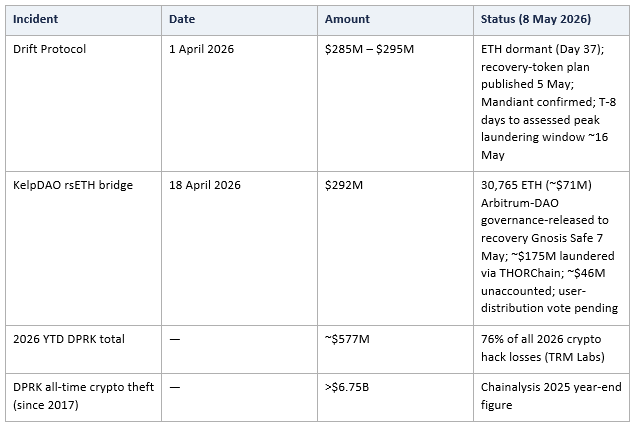
Drift Protocol laundering clock — current snapshot. Stolen ETH on-chain movement: zero, 37 days fully dormant. Drift recovery pool funded: ~$3.8M USDT (seed capital). Tether contribution status: proposed (up to $127.5M); not yet funded. Recovery token distribution: not yet launched; Q2 2026. Stolen fund recovery: $0. Mandiant forensic investigation: confirmed ongoing. Drift relaunch target: Q2 2026 (May–June). Peak laundering window: ~16 May – June 2026 (T-8 days from runtime).
KelpDAO laundering — current snapshot. Arbitrum DAO vote: approved ~7 May (Constitutional AIP). Frozen ETH to be released: 30,765 ETH (~$71M) → Gnosis Safe (3-of-4). User distribution vote: pending — separate future DAO vote required. THORChain BTC laundering: active; ~$175M in ETH converted to BTC; Chinese OTC intermediaries handling cashout. Remaining unfrozen, untracked funds: ~$46M equivalent spread across 20+ chains. BTC wallet linkage: confirmed link to Bybit hack laundering wallet (Global Ledger / Arkham trace). OFAC / FBI active monitoring: TRM Beacon Network and OFAC SDN list active for exploiter addresses.
2.3.5 IT Worker Enforcement Tracker
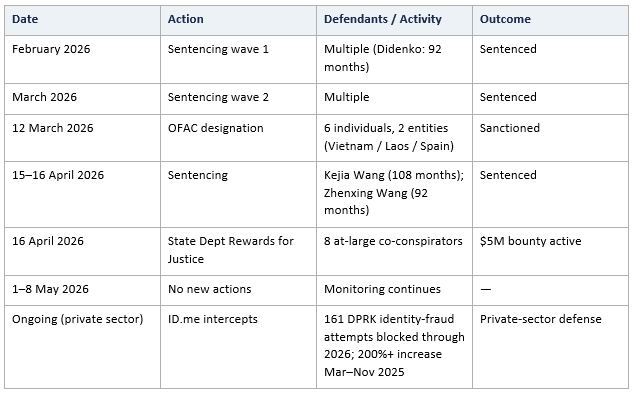
DPRK IT-worker estimated annual revenue generation: $350M – $800M (CSIS, March 2026). Activity increased 200%+ in late 2025 and continues to escalate. CSIS projects geographic expansion into Africa, Southeast Asia, and the Middle East through 2026.
2.3.6 Diamond Model Analysis
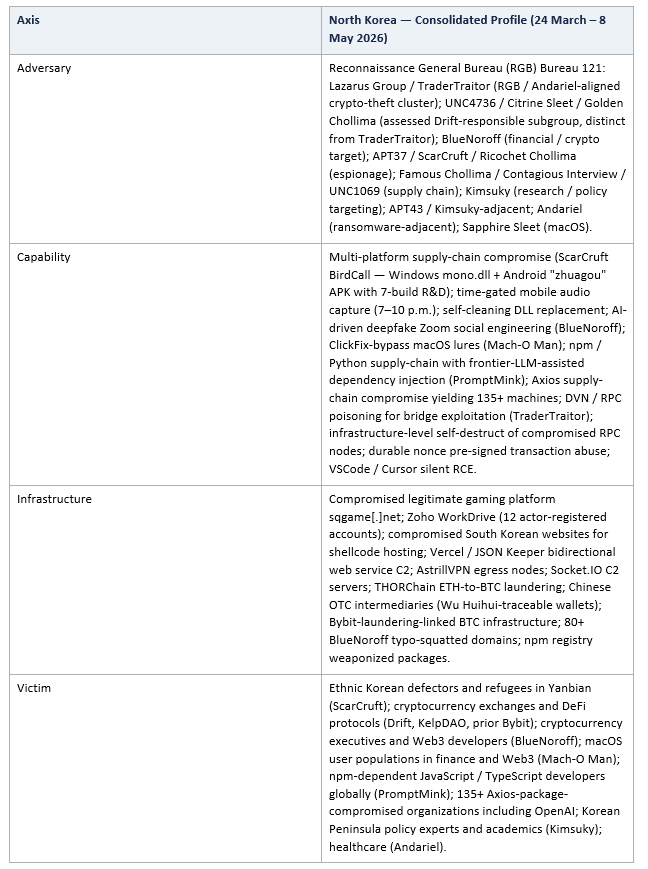
2.3.7 Assessment and 30–60 Day Outlook (ICD 203)
HIGH CONFIDENCE — The ScarCruft BirdCall supply-chain disclosure represents the most operationally significant new DPRK cyber development of the 1–8 May window. The campaign’s geographic and target focus — ethnic Koreans in China’s Yanbian region, defectors, and refugees — indicates that APT37 is being tasked with direct counterintelligence collection against individuals who may provide intelligence to South Korean or U.S. government entities. The development of an Android BirdCall variant across 18+ months, reaching v2.0 with code obfuscation, demonstrates sustained platform investment. This is not an opportunistic pivot — it is a deliberate expansion of ScarCruft’s mobile surveillance capability. The Arbitrum DAO approval of the ~$71M KelpDAO ETH release on 7 May is a governance success but not a recovery event; the funds move to a recovery Gnosis Safe controlled by industry parties, not law enforcement. Distribution to individual rsETH holders requires a second vote and will take weeks at minimum.
MODERATE CONFIDENCE — The KCNA denial (3 May) and the North Korean missile pause (no launches 1–8 May vs. seven in Q1 / Q2) reflect deliberate diplomatic signaling ahead of the Trump-Xi summit on 14–15 May. North Korea is assessed as seeking maximum leverage in any U.S.-China discussions that could affect DPRK sanctions or diplomatic posture. The White House’s explicit statement that no Trump-Kim meeting is planned reduces the probability of a near-term diplomatic breakthrough that might dampen DPRK cyber operations. UNC1069’s Axios supply-chain access (135+ compromised organizations, including OpenAI) will produce at least one attributable downstream crypto-theft or espionage action in the May–July 2026 window, consistent with UNC1069’s historical monetization timeline for supply-chain access.
LOW-TO-MODERATE CONFIDENCE — The Drift Protocol stolen ETH will activate within the 16 May – 15 June window. The 45-day threshold is an analytical construct based on observed DPRK subgroup patterns, not a hard rule. The responsible subgroup’s Radiant Capital precedent involved a longer hold (60–120 days). Absence of movement through 16 May would not be analytically significant; movement before 10 May would be a significant deviation. The Drift relaunch targets Q2 2026 with timelocked multisig and full audits; a relaunch without full ETH recovery from DPRK wallets will test market confidence.
Outlook indicators for the next 30–60 days. ~16 May (T-8 days): Drift Protocol stolen ETH peak laundering activation window — monitor THORChain ETH-to-BTC inflows, Umbra / Railgun activity, Drift wallet addresses via TRM Beacon / Chainalysis KYT. 14–15 May Trump-Xi summit: North Korea agenda effectively absent; any positive signal could temporarily reduce DPRK cyber tempo, breakdown would likely accelerate signaling activity. 15 May – June: Arbitrum DAO KelpDAO recovery distribution vote; Drift relaunch Q2 target; ScarCruft BirdCall follow-on with new cloud-storage C2 pivot expected as Zoho accounts are flagged; UNC1069 Axios downstream exploitation; BlueNoroff AI Zoom infrastructure expansion; PromptMink potential escalation to Go / Rust ecosystems. June–July: DPRK IT-worker geographic expansion (Africa, Southeast Asia, Middle East per CSIS); Drift ETH full cashout completion via THORChain conversion and OTC liquidation through Chinese intermediaries over 4–8 weeks.
2.4 Iran
2.4.1 Strategic Posture
Iran’s cyber posture across the 24 March – 8 May 2026 window is anchored by three converging arcs that produced the most significant TTP evolution and the most consequential operational claim of the entire conflict in the final week of the period. The first arc is the diplomatic track: Iran delivered a 14-point counter-proposal via Pakistan on 2 May in response to a U.S. 9-point framework, with active negotiations between U.S. envoys Witkoff and Kushner and Iranian officials producing a draft one-page Memorandum of Understanding (MOU) as of 6 May per Axios reporting. The MOU would trigger a 30-day formal negotiation window; the central unresolved variable is the uranium enrichment moratorium (U.S. demanded 20 years; Iran counter-proposed 5 years; current negotiation target 12–15 years). Iran submitted “mixed signals” on 7 May; no signed deal as of report date. The 7–8 May Strait of Hormuz naval exchange — Iranian forces launching missiles, drones, and small craft against three U.S. Navy warships transiting the strait, with U.S. Central Command conducting retaliatory strikes on Iranian missile and drone launch sites — represents the most significant kinetic escalation since the 22 April ship attacks. President Trump maintained ceasefire language but issued a public warning that Iran should “sign an agreement fast.”
The second arc is operational tempo. Handala (the most prominent Iranian state-aligned hacktivist persona, assessed as Ministry of Intelligence and Security (MOIS)-aligned and overlapping with Void Manticore tradecraft) executed three major operations in seven days. On 2 May, Handala claimed exfiltration of 150,000 emails and private chats from former Biden Iran envoy Robert Malley’s personal email and X / Twitter accounts, asserting the documents constitute “undeniable evidence” of Zionist lobby involvement in Iran sanctions design and Gulf Arab cooperation with the sanctions team. On 4–5 May, Handala announced full compromise of the Port of Fujairah — the UAE’s primary oil export bypass terminal — and dumped 430,000 classified documents including pipeline maps, ship-movement data, and financial records, asserting the data was transferred to IRGC missile units before the kinetic strike on the port. On 6 May, Handala disclosed multi-year breach methodology against Israel’s Institute for National Security Studies (INSS), claiming years-long access including Zoom meeting infiltration, 400,000+ classified files, and email exfiltration from six senior INSS figures including former Mossad division head Sima Shine. The Port of Fujairah operation, if even partially accurate in its claim of real-time IRGC targeting data transfer, constitutes the first publicly documented instance of an Iranian state-aligned hacktivist group functioning as a genuine ISR node in a kinetic targeting chain.
The third arc is TTP evolution. Rapid7’s 6 May disclosure documented MuddyWater (Seedworm / MOIS) executing an intrusion masquerading as a Chaos ransomware-as-a-service attack with no encryption deployed, delivering the new Darkcomp RAT (Game.exe, masquerading as Microsoft WebView2APISample, with C2 at uploadfiler[.]com:443) via Microsoft Teams social engineering and screen-share-mediated MFA bypass. The “Donald Gay” code-signing certificate provides high-fidelity attribution continuity to Fakeset and Stagecomp. The false-flag overlay reduces victim-reporting incentives and government escalation responses, and is assessed as a permanent TTP shift rather than a one-off experiment.
Iran’s domestic internet posture remains structurally degraded. As of 8 May the country is at Day 70 of the cumulative blackout (1,680+ hours), with NetBlocks confirming approximately 1% of pre-war connectivity and the general public cut off from the global internet for approximately 70% of 2026 to date. The Barracks Internet model (Huawei NAT, National Information Network whitelisting, Internet Pro tiered access for vetted commercial actors) remains under construction and is assessed as permanent by design. Cloudflare Radar noted increased allowlisting of external sites and availability of Internet Pro driving nominal late-April traffic increases — assessed as noise in the downward trend, not genuine restoration signal.
2.4.2 Handala / Tactical Posture (Post-Marines Doxxing)
Handala’s 1–8 May operational tempo represents a qualitative shift from the late-April Marines doxxing psychological-operations campaign toward strategic espionage and cyber-kinetic coordination. The pivot suggests an upgraded MOIS / Void Manticore tasking that prioritizes both targeting infrastructure (port logistics) and policy-actor intelligence collection (Robert Malley) over psychological harassment.
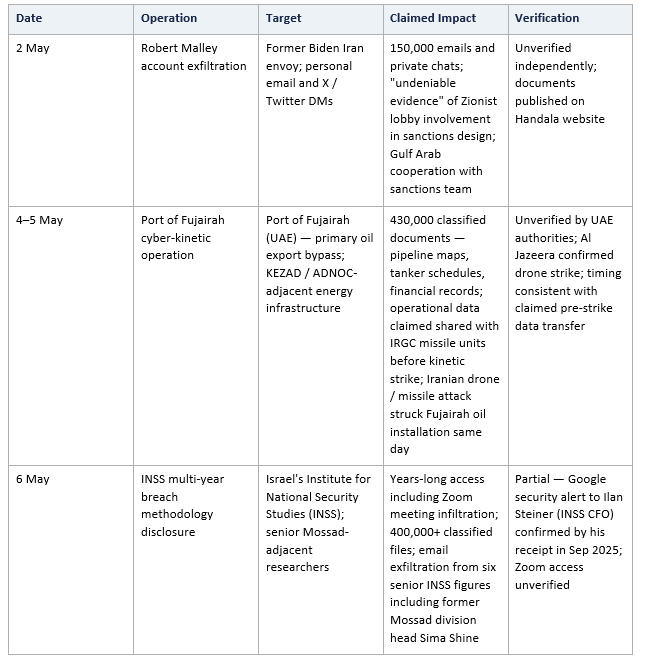
We assess with MODERATE CONFIDENCE that Handala conducted a genuine breach of Port of Fujairah infrastructure prior to the kinetic strike. The group’s operational tempo (three major actions in seven days), the specificity of the claimed data types, and the timing correlation with the kinetic event are consistent with real intrusion. The claim of real-time IRGC targeting data transfer is assessed as plausible but not confirmed; the IRGC likely received port data through multiple channels. The Robert Malley operation targeted a former U.S. government official central to Iran nuclear policy architecture — a clear signal that Handala is building a strategic intelligence archive on U.S. policy actors rather than conducting tactical harassment. The inclusion of Gulf Arab coordination evidence in the claimed document set mirrors Handala’s established narrative objectives and was likely curated before release.
2.4.3 Active Campaigns and Operations
MuddyWater / Seedworm — Darkcomp RAT and False-Flag Chaos Ransomware (6 May Rapid7 disclosure, lead). Attribution is assessed at high confidence as MOIS-linked, confirmed via the “Donald Gay” code-signing certificate that overlaps with Fakeset, Stagecomp, and Darkcomp samples. The intrusion was first observed in early 2026 and published by Rapid7 on 6 May. Sector is undisclosed; Chaos RaaS typically targets U.S. construction, manufacturing, and business services. Initial access was via Microsoft Teams social engineering — attackers initiated external Teams chat requests, established screen-sharing sessions to harvest credentials interactively, and manipulated MFA settings. Credential theft occurred via phishing pages masquerading as Microsoft Quick Assist or by tricking victims into typing passwords into local text files. No file encryption was deployed despite Chaos RaaS artifacts present on host; ransomware artifacts functioned as an obfuscation layer and attention-diversion mechanism, not the primary payload. The new Darkcomp RAT (Game.exe) masquerades as Microsoft WebView2APISample and uses AES-256-GCM for configuration decryption. C2 is uploadfiler[.]com on port 443. The RAT has 12 core capabilities including arbitrary command and PowerShell execution, file operations, and a persistent interactive shell on a 60-second polling loop. DWAgent and AnyDesk were used for persistence following credential theft. An extortion email was sent as a final layer — assessed as a further distraction to delay forensics and attribution analysis. This operation signals MuddyWater has internalized a key lesson from the domestic blackout period — pre-positioned tools and criminal-infrastructure masquerading provide operational continuity regardless of Iran’s own internet status. The use of Chaos RaaS infrastructure means MuddyWater’s operations now generate OSINT artifacts that mimic criminal ransomware groups, complicating victim attribution and inhibiting immediate government escalation response.
Operation Project Freedom — Cyber-Adjacent Maritime Escalation (4–8 May). Between 3 and 8 May, kinetic events with cyber dimensions clustered along the Strait of Hormuz transit corridor. On 3–4 May, an Iranian drone strike hit a bulk carrier and the Barakah oil tanker (ADNOC-owned, Liberian flag) northeast of Fujairah; Handala claimed pre-strike port data transfer to IRGC. On 4 May, USS Truxtun and USS Mason transited Hormuz under sustained Iranian barrage; U.S. Apache helicopters destroyed six Iranian small craft. On 4–5 May, the CMA CGM San Antonio (Malta flag, container ship) was struck by a cruise missile in the Strait of Hormuz with eight crew injured. On 5 May, Iran established a Persian Gulf Strait Authority requiring authorization and toll for passage. On 6 May, Trump paused Operation Project Freedom (U.S. naval escorts for commercial shipping), citing “great progress” on the deal. On 7–8 May, Iran launched missiles, drones, and small craft against three U.S. Navy warships; U.S. CENTCOM conducted retaliatory strikes on Iranian missile / drone launch sites; Tehran street celebrations and Qeshm Island explosions followed.
CyberAv3ngers — Siemens S7 Status (rolling). Per the 7 April CISA / FBI / NSA / EPA / DOE joint advisory AA26-097A, the primary CyberAv3ngers exploitation track remains Rockwell Automation Studio 5000 / CompactLogix / Micro850 PLCs (CVE-2021-22681; CVSS 9.8; no patch). Siemens S7 Port 102 (S7comm) scanning from threat-actor VPS infrastructure is confirmed and assessed as ongoing; no public reporting confirms a completed exploitation of a Siemens S7 device by CyberAv3ngers or affiliated actors as of 8 May. Absence of public disclosure does not indicate absence of exploitation — CISA’s advisory issuance threshold requires confirmed disruption, and victim organizations have strong incentives not to disclose OT compromises. The 30-day window remains the estimated timeline for first public confirmation of S7 exploitation. The estimated 60+ pro-Iranian groups now replicating CyberAv3ngers’ ICS exploitation techniques represent a distributed threat surface; the FAD Team (Fatimiyoun Cyber Team) explicitly claimed SCADA / PLC access in this period — assessed as low-to-medium capability replication of shared CyberAv3ngers tradecraft rather than independent development.
APT35 / Charming Kitten / OilRig / Imperial Kitten / Agrius (rolling context). No new APT35, OilRig (APT34), or Imperial Kitten campaigns were publicly disclosed in the 1–8 May window; carry-forward indicators remain operationally relevant. Agrius / Marshtreader continued exploitation of legacy Hikvision / Dahua camera vulnerabilities (CVE-2017-7921, CVE-2021-36260, CVE-2023-6895, CVE-2021-33044) for battle-damage assessment and ISR for strike preparation against UAE, Israeli, and Gulf targets. CVE-2026-21643 (Fortinet FortiClientEMS RCE via SQL injection) and CVE-2026-20160 (Cisco SSM On-Prem arbitrary command execution as root) show elevated Iranian actor interest consistent with the FoxKitten / Lemon Sandstorm VPN exploitation pattern; exploitation not publicly confirmed as of 8 May.
2.4.4 ICS / OT Targeting Update
AA26-097A remains the governing advisory for the rolling window. Primary exploitation continues against Rockwell Allen-Bradley CompactLogix and Micro850 PLCs via CVE-2021-22681. Siemens S7 Port 102 scanning is ongoing without confirmed exploitation in public OSINT. No new federal CISA advisory issued in the 1–8 May window beyond AA26-097A. The FAD Team continues to claim PLC / SCADA access via Telegram for Israel and other countries; no independent verification. Fujairah port infrastructure compromise (Handala claim) is classified as Industrial Control / SCADA-adjacent. No new confirmed disruption events in U.S. water / energy 1–8 May beyond the AA26-097A baseline.
2.4.5 Tactics, Techniques, and Procedures
• External Microsoft Teams chat requests; screen-sharing sessions to harvest credentials interactively; MFA manipulation (MuddyWater, T1566.004 / T1556.006).
• Compromised Microsoft 365 accounts for internal pivot post-Teams access (MuddyWater, T1078.004).
• Darkcomp RAT (Game.exe) masquerades as WebView2APISample; uses legitimate WebView2Loader.dll (MuddyWater, T1036.005).
• False-flag Chaos ransomware branding; extortion email sent to confuse attribution and delay incident response (MuddyWater, T1656).
• DWAgent + AnyDesk for persistence following credential theft (MuddyWater, T1569.002).
• Quick Assist phishing page; victims typed passwords into text files under direction (MuddyWater, T1539).
• 430,000-document and 150,000-email exfiltration claims; INSS Zoom session access claim — strategic intelligence archive (Handala, T1213 / T1113 / T1125).
• Cyber-ISR-to-kinetic-strike data handoff claim (Handala / IRGC, T1499 — first documented).
• Rockwell PLC exploitation (CVE-2021-22681) via internet-exposed devices on ports 44818 / 2222 / 22 / 502 (CyberAv3ngers, T1190).
• Siemens S7 Port 102 (S7comm) scanning from VPS infrastructure (CyberAv3ngers, T1046).
• Hikvision / Dahua legacy camera RCE for ISR (Agrius, T1190).
2.4.6 Iran Internal Internet Posture
As of 8 May 2026, Iran is at Day 70 of the cumulative internet blackout — 1,680+ hours, 70% of 2026 without internet for the Iranian public; 120+ days combined across both shutdowns (8 January and 28 February blackouts). Iranians have had internet for just 6.5% of 2026 to date. NetBlocks confirms approximately 1% of pre-war connectivity. The Barracks Internet model — Huawei NAT, National Information Network whitelisting, and Internet Pro tiered access for vetted commercial actors only — remains under construction and is assessed as permanent by design. Cloudflare Radar noted increased allowlisting of external sites and availability of Internet Pro driving nominal late-April traffic increases — assessed as noise in the downward trend, not a genuine restoration signal.
Cyber implication of Day 70: the MuddyWater Darkcomp campaign published 6 May involved an intrusion that appears to have been conducted during the blackout period, demonstrating that the “operational surge on restoration” model is supplemented by continuous pre-positioned access that functions independently of domestic connectivity. The blackout’s primary effect remains the suppression of tactically responsive domestic APT operations (rapid retasking, real-time C2 updates) rather than the elimination of ongoing campaigns. APT restoration trigger remains unchanged: NetBlocks Iran connectivity exceeding 5% of pre-war levels. As of 8 May, the trigger has not been met.
2.4.7 Diamond Model Analysis
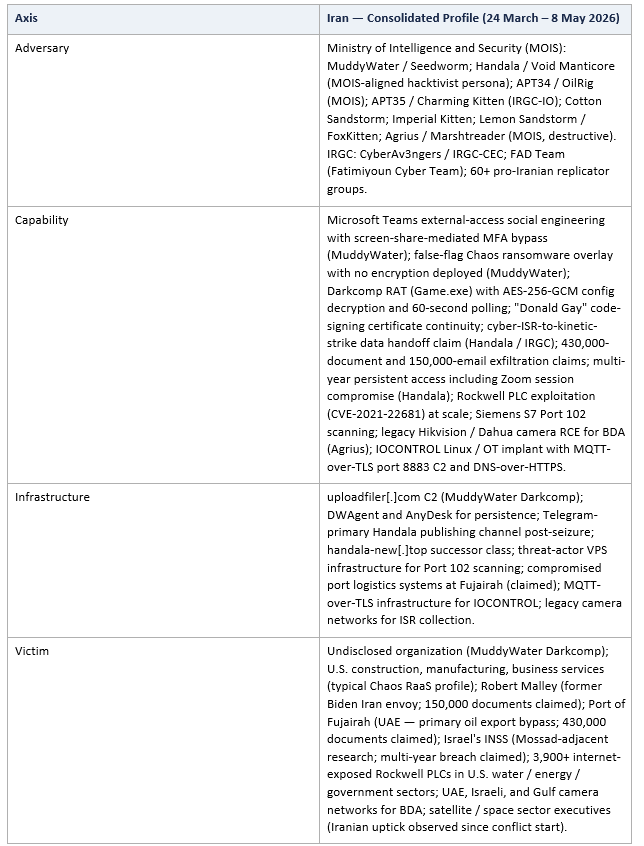
2.4.8 Assessment and 30–60 Day Outlook (ICD 203)
HIGH CONFIDENCE — MuddyWater / Seedworm (MOIS) conducted the Darkcomp / Chaos false-flag intrusion during or before the 1–8 May window. The “Donald Gay” certificate chain is a high-fidelity fingerprint with no credible alternative attribution. The operational pattern — Teams social engineering, no encryption, emphasis on persistence and exfiltration — is entirely consistent with prior MuddyWater behavior and inconsistent with commercial Chaos RaaS operator motivations. Handala (MOIS / Void Manticore) conducted genuine intrusions against Robert Malley’s accounts (2 May) and the Port of Fujairah (4–5 May). The scope and specificity of the claimed data — diplomatic correspondence, port logistics, pipeline maps — exceeds what is achievable through open-source aggregation. The operational tempo (three major operations in seven days post-Marines doxxing) is consistent with an escalating MOIS campaign, not a degraded group. The Iran-U.S. ceasefire is in a structurally deteriorating state as of 8 May. The 7–8 May naval exchange while one-page MOU negotiations were active demonstrates that neither kinetic nor cyber restraint is being fully maintained. The deal track has not produced the freeze in Iranian offensive operations that historical ceasefire analogues would predict.
MODERATE CONFIDENCE — Handala’s claim of providing targeting data to IRGC missile units prior to the Fujairah kinetic strike (4–5 May) reflects genuine operational data transfer, though the degree to which IRGC missile targeting relied on Handala data versus other intelligence sources is unknown. The pattern of cyber-enabled ISR preceding kinetic strikes has been documented in the Russia-Ukraine conflict and is consistent with IRGC-MOIS coordination doctrine. Siemens S7 exploitation has likely occurred at one or more undisclosed U.S. critical-infrastructure facilities; Port 102 scanning was confirmed weeks before the 7 April advisory; the delta between scanning confirmation and public acknowledgment of exploitation at Rockwell devices was approximately three weeks. The same temporal gap applied to S7 exploitation would suggest exploitation may have occurred in late April to early May 2026 at organizations that have not disclosed incidents. The MuddyWater Teams vector represents a permanent TTP shift rather than a one-off experiment.
LOW CONFIDENCE — A comprehensive one-page MOU will be signed within the next 14 days. The 7–8 May naval exchange, mutual blame for ceasefire violations, and the active Handala / Fujairah cyber-kinetic operation are inconsistent with the political pre-conditions typically needed for deal signature. Trump’s continued ceasefire language reflects negotiating posture, not confirmed progress. Handala’s claimed 400,000-file INSS archive will be publicly released in structured, verifiable form; Handala routinely overstates data scope and selectivity of release is an MOIS tradecraft tool.
Use-it-or-lose-it IRGC cyber activation risk in 24–72 hour pre-MOU window. If a deal is signed in the 12–16 May window, IRGC operational authorization changes within days; the final pre-deal hours create a use-it-or-lose-it dynamic that favors maximum cyber activation by Handala, MuddyWater, CyberAv3ngers, and Cotton Sandstorm (WezRat / WhiteLock). Defenders should anticipate ICS / OT anomalies and destructive wiper activity against U.S. water / energy infrastructure in the 24–72 hours before any announced deal. Outlook scenarios for the next 30–60 days: one-page MOU signed (Low-Moderate, ~20% probability) — Handala temporarily reduces U.S. targeting; Fujairah-style cyber-kinetic operations paused; MuddyWater pre-positioned access maintained for contingency. Ceasefire intact, no MOU, continued Hormuz exchanges (Moderate, ~40%) — current trajectory maintained; Handala escalates U.S. / Gulf targeting with emphasis on ISR-to-kinetic coordination; Siemens S7 exploitation publicly confirmed; MuddyWater continues Teams-based false-flag campaigns. Ceasefire collapse (Moderate, ~35%) — immediate Handala destructive operations against U.S. critical infrastructure (wiper deployment); CyberAv3ngers attempts physical process manipulation at water / energy; MuddyWater activates pre-positioned access on U.S. bank, airport, government networks; Cotton Sandstorm WezRat / WhiteLock payloads activated; Gulf port infrastructure (Fujairah, Jebel Ali) facing sustained cyber-kinetic campaigns. Iran internet restoration exceeds 10% (Low, 10–15% in 30 days) — immediate and dramatic surge in APT34 / MuddyWater / APT35 tempo; treat as equivalent escalation trigger to kinetic attack.
Section 3 — Cross-Nation Convergence
3.1 Adversary Coordination Evidence (Russia-Iran-China-NK)
Adversary coordination during the 24 March – 8 May 2026 window operated along five axes: ISR sharing, cyber-tradecraft transfer, financial-sanctions evasion, information-warfare coordination, and AI-supply-chain coupling. The four-actor pattern documented in the April 17 and May 1 briefings has accelerated into a compressed geopolitical risk window with multiple concurrent trigger events converging between 12 May and 16 May.
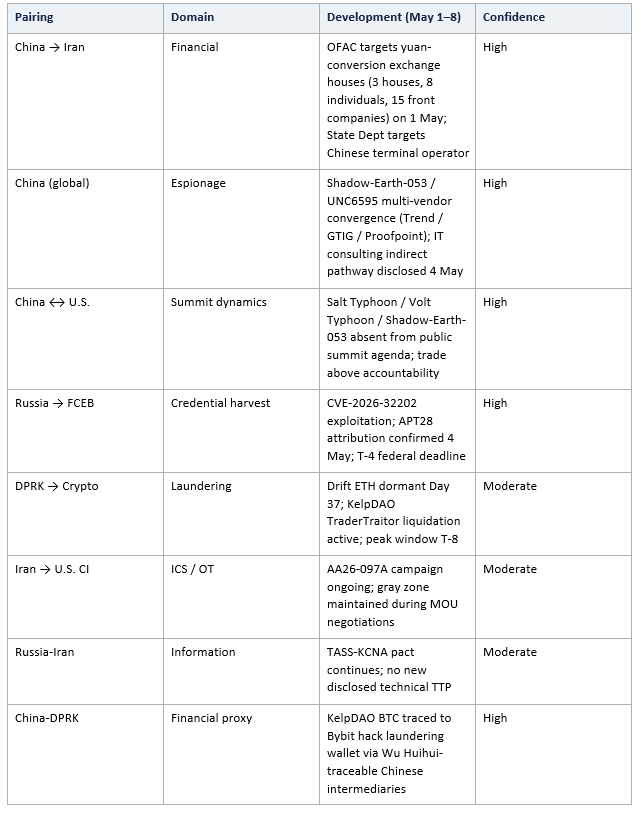
3.2 Russia-Iran-China Satellite ISR Sharing
ISR convergence remains the most operationally consequential development of the rolling window. Russian military reconnaissance satellite passes over U.S. installations in Iraq, Syria, the Eastern Mediterranean, and the Gulf preceded Iranian missile and drone strikes in a sustained pattern documented by Reuters citing Ukrainian intelligence. The Chinese TEE-01B satellite, providing 0.5-meter resolution imagery, has been assessed by U.K. and Israeli intelligence as supplying IRGC Aerospace Force with U.S. military disposition data. The 4–5 May Port of Fujairah operation by Handala — claiming to have transferred port logistics, pipeline maps, and tanker movement schedules to IRGC missile units in advance of the kinetic strike — extends this pattern into the cyber-ISR domain at a level of integration not previously documented and creates a new threat model for Gulf and Eastern Mediterranean port operators.
No new public confirmation of Russian satellite ISR sharing specific to the 1–8 May Hormuz exchange has been published, but the established pattern is assessed as operative for the 7–8 May naval exchange. Iran’s space-sector targeting (per Via Satellite, 12 April) constitutes an extension of CyberAv3ngers’ 2023–2024 attacks into the orbital domain, given the sector’s dual-use role in military communications, positioning, navigation, timing (PNT), and intelligence collection.
3.3 Western Defensive Posture (CISA / Five Eyes / NATO)
CISA — Leadership Vacuum and Operational Capacity
Acting Director Nick Andersen continues in role with no new nominee announced as of 8 May. The agency’s operational capacity in the period was concentrated on the CVE-2026-32202 KEV listing and the 12 May FCEB patch deadline. Internally, CISA is debating a new three-day remediation policy for actively exploited critical vulnerabilities — a direct response to the analytic anomaly of a CVSS-4.3 vulnerability requiring a 14-day federal-deadline cycle while exploitation was already in the wild. CISA’s $707M FY27 budget cut request remains pending Congressional approval; the Election Security Group at NSA / U.S. Cyber Command remains dormant six months ahead of the November 2026 midterm elections. No new JCDC activities in the window. KEV summary for the 1–8 May window: 2 new additions (29 April), 4 deadlines expired (8 May).
Five Eyes — Agentic AI Joint Guidance (2 May)
CISA, the U.K. NCSC, ASD / ACSC, the Canadian Cyber Centre, and NCSC-NZ jointly published “Careful Adoption of Agentic AI Services” on 2 May — the first Five Eyes joint guidance document to address agentic AI risk specifically. Key findings: agentic AI systems “increasingly operate across critical infrastructure and defense sectors,” creating an “interconnected attack surface that malicious actors can exploit.” Risk categories: privilege escalation, design / configuration failure, behavioral unpredictability, structural supply-chain compromise. The documented attack scenario — prompt injection causing an agentic system to exfiltrate sensitive data, modify contracts, approve unauthorized payments, and create faked audit logs — is a nation-state-grade attack pattern. Recommendations: treat agentic AI components as high-impact elements during threat modeling; prioritize containment, monitoring, and least-privilege. Critically, the guidance acknowledges that “threat intelligence for agentic AI systems is still evolving” because OWASP and MITRE ATLAS currently focus on LLMs rather than agentic architectures.
NATO — Locked Shields 26 / ENISA / Geneva Cyber Week
NATO Locked Shields 26 (11–25 April) — the world’s largest live-fire cyber defense exercise — concluded with 4,000+ participants from 40 nations across 16 blue teams. Exercise scenarios were directly informed by Russia’s documented TTPs against Poland (Sandworm / DynoWiper, December 2025) and Sweden (thermal plant intrusion). The exercise outcome is expected to inform 2026 NATO Cyber Defense Policy updates ahead of the July 2026 NATO summit. ENISA’s 6th Telecom and Digital Infrastructure Security Forum convened 7 May in Nicosia, Cyprus, with sessions on telecom-network cyber attacks, 5G vulnerabilities, and submarine-cable resilience. The forum was closed; no recording — reflecting the intelligence sensitivity of current telecom-sector compromise. Geneva Cyber Week (4–8 May) convened 1,900+ participants from 100+ countries.
Election Security Group Dormancy Ahead of 2026 Midterms
The NSA / U.S. Cyber Command Election Security Group (ESG) remains dormant as confirmed in the 1 May briefing; no new activation orders reported in the 1–8 May window. The 2026 midterm election cycle is now 6 months from November. The combination of ESG dormancy, CISA election program elimination, and the TASS-KCNA information-coordination pipeline creates the structural vulnerability previously assessed at high confidence. Iranian information-operations capability and AI deepfake infrastructure are already assessed as primed for the cycle.
3.4 OFAC, Sanctions, and Indictments Activity (1 May Shadow Banking Wave)
OFAC tempo across the 1–8 May window was extraordinary: three Economic Fury waves in eight days. The 1 May Iran shadow-banking designations targeted 3 exchange houses (Opal Exchange, Radin Exchange, Tahayyori Guarantee Society), 8 named individuals, and 15 front companies handling “tens of billions” in yuan-denominated oil proceeds — the yuan-to-hard-currency conversion chokepoint that converts Iranian oil revenue into usable military funding. Cumulative since February 2025: more than 1,000 Iran-related persons, vessels, and aircraft sanctioned under the maximum-pressure campaign.
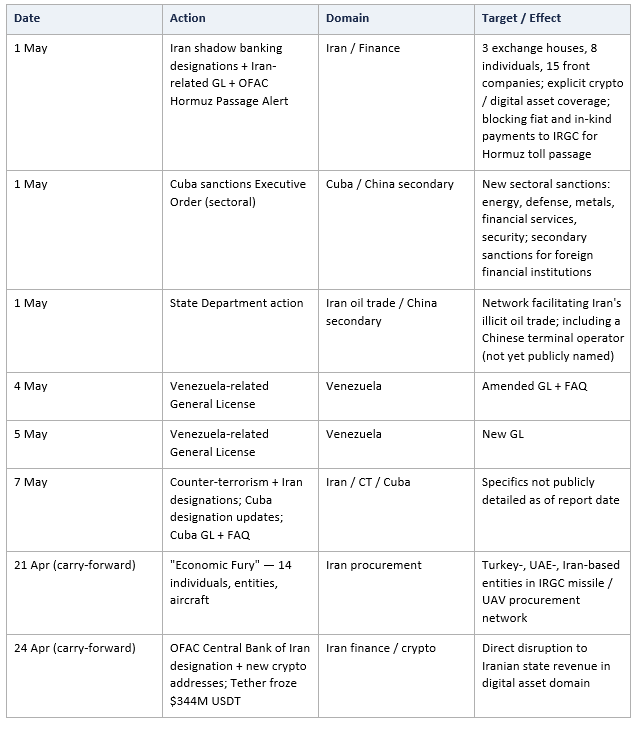
3.5 Trump-Xi Summit Cyber Posture (T-6 / T-7 Days)
With six to seven days to the 14 May opening of the Trump-Xi Beijing summit, the following cyber-relevant dynamics frame the current environment. The summit is confirmed for 14–15 May and is the first sitting U.S.-presidential visit to China since 2017. Both sides are finalizing a Trade and Investment Board framework. Conspicuously absent from public pre-summit readouts: Salt Typhoon accountability, Volt Typhoon pre-positioning, and Shadow-Earth-053 / UNC6595 attribution.
Active pre-summit intelligence collection remains highly likely. Chinese MSS and PLA SSF collection operations historically intensify in the 2–3 weeks preceding high-stakes U.S.-China summits, targeting U.S. negotiating positions on trade, semiconductor controls, and Taiwan; personnel traveling with the presidential delegation; congressional and think-tank reaction monitoring (Salt Typhoon congressional access confirmed through January 2026; current status unknown); and NSC and State Department internal communications on summit posture. The 5 May Citizen Lab / Proofpoint disclosure of SEQUIN CARP is particularly relevant: any U.S. official, journalist, or policy analyst who authorized SEQUIN CARP’s fake OAuth app before the summit may still have their email actively monitored with no awareness of the compromise.
Summit agenda cyber dimensions. Trade-versus-AI / cyber linkage: the U.S. wants China to cease AI distillation, chip smuggling, and military fine-tuning of U.S. open-source models; China wants H200 chip access and entity-list removals. The House investigation response deadline of 13 May creates a documented evidentiary record immediately before these discussions. Semiconductor as cross-domain leverage: SCMP confirmed industry experts assess simmering semiconductor tensions beneath the summit’s cooperative framing. China has retaliated against U.S. chip restrictions affecting 1,000+ Chinese firms; the U.S. has reversed H20 and H200 decisions. AI supply chain is now indistinguishable from cyber security policy. Forbearance on cyber enforcement: the December 2025 MSS sanctions pause remains in effect; no new indictments, sanctions, or attribution statements are anticipated before 15 May — representing a 5-month cyber enforcement holiday that has overlapped with sustained escalation in PRC offensive cyber operations.
Shadow-Earth-053 pre-positioning: as of the last confirmed activity (April 2026), Shadow-Earth-053 / UNC6595 remains active in defense-sector networks in Poland, Malaysia, Sri Lanka, and Myanmar. No remediation announcements have been made by affected governments. Volt Typhoon critical-infrastructure access remains documented as pre-positioned in U.S. communications, energy, transportation, and government networks. The Xiang Yang Hong 33 deployment in the Spratly Islands on 7 May demonstrates China’s willingness to conduct grey-zone operations in the days immediately preceding the summit. The Eurasia Review analysis (4 May) characterized the summit as a “risk management meeting” rather than a friendship summit. Iran will dominate the agenda — Trump seeks Chinese pressure on Tehran for ceasefire; China seeks energy stability — with cyber and technology issues unlikely to produce binding commitments given the structural gap in positions.
3.6 Iran MOU Negotiation Status
The 14-point one-page MOU under negotiation is the most significant U.S.-Iran diplomatic advance since the conflict began. Status as of 8 May: ceasefire intact but strained; 14-point MOU framework under active negotiation. Deal described as “imminent” by Axios on 6 May but not yet signed.
Chronology of the 1–8 May window: 1 May — OFAC designates 3 Iranian exchange houses, 8 individuals, 15 front companies (Economic Fury shadow-banking wave); Witkoff and Kushner travel to Pakistan; Iran expected to respond via Pakistan. 2 May — Iran submits 14-point counter-proposal via Pakistan to Washington; elements include 30-day framework, full sanctions relief, troop withdrawal from Iranian borders, Hormuz new governance framework, reparations, cessation of hostilities in Lebanon. 3–5 May — Trump reviews Iranian counter-proposal; characterizes it as “significant but not good enough”; military briefings on potential new airstrikes reported. 5–6 May — U.S. circulates draft 14-point MOU: 12–15 year enrichment moratorium (versus Iran’s 5 years; U.S. wanted 20); Hormuz restrictions gradually eased during 30-day window; phased sanctions relief; IAEA snap inspections; Iran commits not to pursue nuclear weapons. 6 May — Trump declares he is “close” to a deal; oil markets react with Brent sliding below $90 on Hormuz traffic expectations; Trump signals he may not send Witkoff and Kushner back for next round. 7 May — Iran’s Foreign Ministry says it is “still reviewing” the proposal; “mixed signals” reported; WSJ reports U.S. still demanding 20-year moratorium with Fordow / Natanz / Isfahan dismantlement and uranium transfer out of country. 7 May — OFAC issues additional counter-terrorism and Iran-related designations; Cuba designation updates. 7–8 May — Iran-U.S. naval exchange in Hormuz; both sides claim other violated ceasefire; Trump says ceasefire “still in place” but warns Iran to “sign fast.”
Cyber assessment: The negotiation trajectory — a deal that is “close” but not yet signed — sustains the IRGC cyber gray zone precisely described in the 1 May briefing. The April 7–8 FBI / CISA / NSA / EPA / DOE joint advisory on ICS / OT PLC targeting (3,900+ vulnerable Rockwell devices) remains in effect with no indication of reduced operational tempo. The indefinite gap between a near-deal state and actual signing is the most operationally useful window for IRGC cyber cells: pressure operations retain leverage value that evaporates upon deal closure. We assess with MODERATE CONFIDENCE that an Iran deal in the 12–16 May window is the highest-probability scenario for the first time since the conflict began. A closed deal would reduce IRGC cyber operational authorization within days but would also trigger a use-it-or-lose-it acceleration in the final hours. Monitor for ICS / OT anomalies and destructive wiper activity against U.S. water / energy infrastructure in the 24–72 hours before any announced deal.
3.7 AI / Emerging Threat Vectors
Five Eyes Agentic AI Guidance — Offensive Implications. The 2 May Five Eyes guidance is simultaneously a defensive publication and an implicit adversary TTP warning. The documented attack scenario — prompt injection, unauthorized payment approval, modified contracts, faked audit logs — is a nation-state-grade attack pattern applicable to critical-infrastructure financial controls, defense procurement systems, and intelligence workflow automation. The acknowledgement that MITRE ATLAS currently focuses on LLMs rather than agentic AI architectures is an explicit intelligence-community admission of a structural defensive deficiency.
AI-Enhanced DPRK Social Engineering. The Drift Protocol attack’s six-month AI-augmented social engineering campaign — synthetic professional identities, fake quant trading firm, in-person conference presence through third-party proxies — represents the current ceiling of nation-state AI social engineering. The technical execution (durable nonce pre-signed transaction abuse, VSCode / Cursor silent RCE, malicious TestFlight app) combined with AI-driven persona generation sets the benchmark for what adversaries can achieve against high-value crypto targets. The same playbook is now assessed as adaptable to defense procurement, financial sector, and critical infrastructure vendor targeting.
Deepfake-as-a-Service Escalation. Cyble’s Executive Threat Monitoring report (6 April) confirmed AI-powered deepfakes were involved in over 30% of high-impact corporate impersonation attacks in 2025, with Deepfake-as-a-Service platforms becoming widely available at commodity pricing. In the current pre-summit week, the highest-risk deepfake vectors include fabricated Trump-Xi communications leaks designed to destabilize summit expectations; CEO / CFO voice deepfakes targeting defense contractors for financial fraud; and synthetic media amplifying TASS-KCNA narrative coordination themes in the context of the Iran ceasefire negotiations.
LLM Weaponization — State Actor Adoption Confirmed. The 2026 Cloudflare Threat Report (published March) confirmed nation-state actors are using LLMs for real-time network mapping, multilingual phishing at scale, and malware generation. The NCSC frontier AI blog (30 April) explicitly stated “threat actors are already leveraging” frontier AI capabilities in attacks. The pattern observed in defender-side LLM deployment to Five Eyes operations is being mirrored by state actors using open-source models with stripped safety guardrails for offensive automation.
AI Supply Chain Investigation. The 29 April House Committee on Homeland Security and House Select Committee on China joint investigation into Anysphere (Cursor Composer 2 built on Moonshot AI’s Kimi) and Airbnb — with response letters demanding submissions by 13 May — formalizes the AI distillation policy battlefield. Anthropic’s November 2025 GTG-1002 disclosure remains the canonical reference for Chinese AI-orchestrated cyberattack capability: Claude Code manipulated into acting as an autonomous penetration-testing agent executing 80–90% of tactical operations independently against ~30 targets across technology, finance, chemical-manufacturing, and government sectors.
Section 4 — Defensive Recommendations
Section 4 translates the threat picture in Sections 2 and 3 into prioritized detection-engineering, NIST CSF 2.0 alignment, D3FEND countermeasures, and sector-specific guidance. Recommendations are sequenced by analyst-assessed priority for the 8 May runtime: CVE-2026-32202 patch compliance and detection (T-4 days), MuddyWater Darkcomp / Microsoft Teams external-access hardening, OAuth consent-phishing detection, ScarCruft Android / Zoho WorkDrive C2 monitoring, and Drift wallet-cluster monitoring (T-8 days).
4.1 Priority Detection Engineering
The detection-engineering portfolio below covers the highest-priority active campaigns documented in this briefing. Operators should ingest and adapt to local SIEM / EDR / network-monitoring stack consistent with change-control processes, validate against environment baseline, and implement in tuned-and-validated form rather than as drop-in rules. Confidence ratings reflect detection efficacy under typical environment conditions.
CVE-2026-32202 — Zero-Click Windows Shell NTLM Coercion (APT28)
Detection priority: outbound SMB connections (TCP 445) from user workstations to external IPs; Net-NTLMv2 captures in EDR or network telemetry; .LNK file handling in shared directories. Block outbound SMB at perimeter; audit .LNK file handling in shared directories; deploy Akamai-published detection logic for outbound SMB coercion. Apply Microsoft 14 April KB update; verify the April 14 patch (the 14 April KB rather than only the February 2026 patch). KQL skeleton: filter DeviceNetworkEvents where RemotePort == 445 and RemoteIPType != “Private” — this surfaces the SMB egress path that materializes the coercion. Detection is high-confidence for the canonical attack pattern; opportunistic variants may use alternate icon-fetch paths.
MuddyWater Darkcomp — Microsoft Teams External-Access + False-Flag Chaos Ransomware (Iran)
YARA hunting rule (Rapid7-published, 6 May): rule MuddyWaterRAT — strings “System” and “sleep_time”:60; condition uint16(0) == 0x5A4D and all of the strings present. Hunt for the “Donald Gay” code-signing certificate regardless of RaaS branding. Critical defensive controls: disable Teams external access for unvetted domains; require explicit external-chat approval; segment network to limit lateral movement from Teams-compromised endpoint; prohibit screen-sharing of authentication sessions; implement application allowlisting and binary hash validation for WebView2 binaries. Critical IOC monitoring: outbound HTTPS to uploadfiler[.]com on port 443; presence of Game.exe or ms_upd.exe artifacts; visualwincomp.txt configuration file.
OAuth Consent Phishing — SEQUIN CARP (China)
Detection priority: OAuth Application Monitoring (D3-OAM) — audit OAuth application permissions in Google Workspace, Microsoft 365, and other identity providers; revoke unrecognized third-party app grants; implement OAuth-app-allowlist where feasible. Hunt for OAuth grants with mail.google.com scope and offline access from unrecognized publishers. Monitor for sctapi.ftqq[.]com push notification service callback indicators in network egress. The technique survives password reset via refresh-token persistence — the only reliable mitigation is OAuth-app revocation discipline.
ScarCruft BirdCall — Android Supply Chain (DPRK / APT37)
Detection priority: monitor outbound HTTPS to Zoho WorkDrive accounts where not legitimately used (12 actor-registered accounts identified by ESET); validate Android APK signatures and entry-point integrity for any APK installed outside Google Play; flag .hwp / .pdf / .docx / .xlsx / .p12 file exfiltration patterns to Zoho WorkDrive. For Windows: validate mono.dll integrity in known sqgame client deployments and similar gaming-platform updaters; flag self-cleaning DLL replacement patterns.
CyberAv3ngers IOCONTROL on Linux / OT (Iran)
Detection priority: alert on outbound MQTT-over-TLS (port 8883) from OT subnets to non-baseline destinations; flag systemd persistence units with unsigned binaries in /etc/systemd/system or /usr/lib/systemd/system; monitor DNS-over-HTTPS egress from OT segments. Block port 8883 egress from OT networks where not operationally required. Audit Rockwell PLC ports 44818 / 2222 / 102 / 22 / 502 for external exposure; require VPN or jump-host access; segment OT from corporate networks per IEC 62443 and Purdue model.
BlueNoroff AI-Deepfake Zoom Clipboard Hijack (DPRK)
Detection priority: enrich URL-filtering with the BlueNoroff typosquat domain set (uu03webzoom[.]us and 80+ companion domains); flag clipboard-injection PowerShell patterns from browser processes; alert on synthetic-persona Zoom invitations with unusual attendance patterns (multiple Zoom calls before payload delivery). User-awareness training on AI-deepfake personas in finance / Web3 / venture capital recruiting contexts.
Famous Chollima PromptMink npm Supply Chain (DPRK)
Detection priority: implement npm package allowlisting in CI / CD; block known-malicious packages (@validate-sdk/v2, graph-dynamic, graphbase-js, graphlib-js); monitor for outbound C2 to 216.126.237[.]73 (Socket.IO C2) and 142.11.206[.]73 (Axios supply-chain C2 / sfrclak[.]com / WAVESHAPER.V2). Audit Axios package versions in production dependency graphs; treat any of the 135+ Axios-compromised organizations as elevated risk. Consider escalation to Go and Rust ecosystems for monitoring scope expansion.
APT28 PRISMEX / FrostArmada — Cloud-Storage and AitM Residual (Russia)
Detection priority: outbound HTTPS to Filen.io API endpoints from non-baseline sources; image-file uploads with anomalous size and steganographic-encoding indicators; outbound traffic to Operation Masquerade IPs (64.120.31[.]96 and 79.141.160[.]78) post-disruption. Anticipate APT28 tool-modification cycle (30–60 day window expiring); monitor for new cloud-storage providers (Koofr, Icedrive, Internxt) that may host successor PRISMEX C2 channels.
4.2 Sector-Specific Guidance
Healthcare
Highest-priority threats for the 8 May runtime: Storm-1175 Medusa ransomware operations (China-linked) actively targeting healthcare via SimpleHelp (CVE-2024-57726, CVE-2024-57728 — KEV deadline expired 8 May) and ConnectWise ScreenConnect (CVE-2024-1708 / 1709 — KEV deadline 12 May); UAC-0247 Ukrainian / EU hospital targeting via AGINGFLY and SILENTLOOP. Required actions: complete SimpleHelp patching or deprecation immediately; complete ConnectWise patching by 12 May; deploy Storm-1175 Medusa-detection rules; ensure backup-restore RTO is tested for ransomware concurrent-loss scenario.
Energy / OT
Highest-priority threats: Sector 16 / GRU ICS planning (with documented physical-damage intent against U.S., Ukrainian, German, French, Latvian oil and gas; planned Ukrainian power-grid disruption); CyberAv3ngers / IRGC-CEC PLC exploitation (CVE-2021-22681; ports 44818 / 2222 / 102 / 22 / 502); Handala cyber-kinetic Port of Fujairah operation; Volt Typhoon U.S. critical-infrastructure pre-positioning. Required actions: complete Rockwell PLC inventory and segmentation; audit Siemens S7 Port 102 exposure; require VPN / jump-host for OT remote access; verify IEC 62443 segmentation; assume cyber-breach-precedes-kinetic for port and tanker-route infrastructure operators in Gulf and Eastern Mediterranean. Anticipate Sector 16 retaliatory or demonstrative activity in U.S. oil and gas sector following Revenskii plea.
Telecom
Highest-priority threats: Salt Typhoon residual access in U.S. telecom networks (status “still very much ongoing” per FBI); UNC2814 / GRIDTIDE Google Sheets C2 across 53 telecoms / 42 countries; UNC3886 Operation CYBER GUARDIAN affecting all four Singapore major telcos; BPFdoor / Red Menshen sleeper-cell variant F with ICMP C2. Required actions: deploy Rapid7-published BPFdoor detection script; conduct retroactive threat hunt for Red Menshen sleeper presence; monitor for bidirectional Google Sheets C2 patterns; review ENISA Telecom Forum 7 May guidance on subsea cable resilience; assume Salt Typhoon presence in U.S. telecom environments and plan accordingly.
Finance
Highest-priority threats: TraderTraitor / Lazarus crypto-theft against DeFi and exchanges ($577M YTD across Drift and KelpDAO — 76% of global crypto-hack value); BlueNoroff AI-deepfake Zoom social engineering against crypto / Web3 executives; Famous Chollima PromptMink npm supply-chain across financial-sector dependency graphs; OFAC Iran shadow-banking SDN list expansion. Required actions: monitor Drift wallet cluster via TRM Beacon Network and Chainalysis KYT for ~16 May activation; ensure OFAC SDN list ingestion includes 1 May, 5 May, 7 May Iran-related additions; user-awareness training on AI-deepfake personas; deploy npm package allowlisting in CI / CD.
Defense Industrial Base (DIB)
Highest-priority threats: APT28 CVE-2026-32202 credential coercion; Star Blizzard DarkSword iOS targeting of NATO defense personnel; Shadow-Earth-053 / UNC6595 IT-consulting indirect pathway; Sector 16 documented planning of physical-damage operations. Required actions: complete CVE-2026-32202 patching by 12 May; iCloud forensic audit for Star Blizzard-targeted personnel; review IT-consulting third-party access posture for Shadow-Earth-053-style indirect-pathway risk; deploy hardware-bound MFA across privileged accounts; ensure CMMC compliance maintains current cadence.
Government
Highest-priority threats: APT28 NTLM coercion; Salt Typhoon congressional-system access (status unknown); APT29 / Star Blizzard messaging-platform account-link compromise (~300 German politician accounts confirmed); SEQUIN CARP OAuth phishing of policy community and journalists; Iranian information operations primed for 2026 midterm cycle. Required actions: complete CVE-2026-32202 patching by 12 May; mandate hardware-bound MFA for all privileged accounts; audit OAuth grants in M365 / Workspace; user-awareness on Signal QR / PIN linked-device phishing; ensure Election Security Group activation pathway is documented and exercised before 2026 midterm cycle.
AI / Tech Supply Chain
Highest-priority threats: GTG-1002 autonomous AI-orchestrated cyberattack (Claude Code agent, ~30 targets, 80–90% autonomous tactical execution); Five Eyes-documented prompt-injection attack scenario (unauthorized payment, modified contracts, faked audit logs); House Committee Anysphere (Cursor Composer 2 / Moonshot Kimi) and Airbnb investigation; Famous Chollima PromptMink frontier-LLM-assisted dependency injection. Required actions: implement Five Eyes agentic AI guidance — treat agentic components as high-impact assets, prioritize containment / monitoring / least-privilege; review PRC-origin AI model dependencies in critical-infrastructure deployments before 13 May House response deadline; deploy npm and Python package allowlisting against PromptMink package families.