
This briefing assesses the strategic cyber threat landscape across the 45-day rolling window of 22 April – 5 June 2026, a period that produced the most consequential concentration of structural escalations of the year. The dominant development is the 27 May declassification of the CISA/NSA/FBI joint assessment of Salt Typhoon: nine U.S. telecommunications carriers compromised for 8 to 18 months, six of them via credential theft through a single managed-services provider, and lawful-intercept (CALEA) infrastructure at four carriers directly accessed. This reframes the Chinese telecom intrusion not as conventional espionage but as a strategic inversion of U.S. surveillance infrastructure, and it lands amid a confirmed enforcement-forbearance posture that the United States has elected to maintain through the 24 September reciprocal Xi White House summit. Russia, meanwhile, crossed a destructive-operations threshold against a NATO member — ESET attributing the December 2025 wiper attack on a Polish energy company to Sandworm — while fielding the first nation-state malware that queries a live commercial large language model at runtime (APT28’s LAMEHUG), and Iran’s IRGC-affiliated Nimbus Manticore operationalized an AI-assisted backdoor delivered through search-engine poisoning, the first such delivery vector documented for an Iranian actor.
What is converging is a cross-adversary normalization of two capabilities once considered exceptional: AI-assisted malware development and operations now span Russian, Iranian, and North Korean programs simultaneously, and supply-chain compromise has matured from opportunistic to systemic — the 1 June Mini Shai-Hulud “Miasma” wave against the Red Hat npm namespace, riding on a publicly open-sourced worm toolchain, has rendered attribution structurally unreliable. The diplomatic frame is equally volatile: the Iran nuclear MOU is effectively dead following Khamenei’s 21 May rejection of uranium transfer, IRGC ballistic-missile strikes on Kuwait International Airport on 1–2 June, and the first successful House War Powers Resolution (215–208) on 3 June, even as North Korea’s laundering velocity reached an unprecedented pace — roughly $220M of unfrozen KelpDAO proceeds washed in six weeks while $285M in Drift Protocol funds sat dormant at Day 65 awaiting THORChain’s imminent restart following the 27 May passage of ADR-028.
Over the next 30 to 60 days the threat picture is governed by three near-term inflections. First, the NATO Ankara Summit (7–8 July) is now T-32 days away, with multiple Russian and Chinese APTs assessed to be in pre-positioning posture against frontline-state critical infrastructure and summit logistics. Second, the 2026 FIFA World Cup opens 11 June across U.S., Canadian, and Mexican venues, concentrating diplomatic, defense, and intelligence personnel into a target-dense environment that nine assessed Chinese APTs, multiple Russian groups, and Iran’s GreenBravo (APT42) are positioned to exploit. Third, the THORChain restart will reopen the Drift laundering window within days to roughly two weeks, the single highest-priority on-chain monitoring trigger in the DPRK space. The U.S. policy environment shifted decisively with the 2 June signing of the Trump AI Executive Order and the 4 June confirmation that Anthropic is actively helping the NSA deploy Claude Mythos on classified networks — making the joint AI cyber-defense task force operational rather than aspirational. This product frames current state, adversary activity, cross-nation convergence, and forward outlook; it does not prescribe defensive operations.
Key Judgments (KJ-1 through KJ-12)
The following forward-looking strategic judgments are formatted per Intelligence Community Directive (ICD) 203 analytic standards. Confidence levels (HIGH / MODERATE / LOW) reflect source reliability, corroboration, and the strength of the underlying analytic logic. Definitions appear in Appendix 4.1.
KJ-1 — Salt Typhoon’s single-MSP supply-chain compromise of U.S. critical infrastructure will drive an institutional, private-sector-led defensive response that does not close the underlying architectural vulnerability [HIGH CONFIDENCE]
The 27 May declassified assessment confirms that six of nine compromised carriers were breached through credential theft at a single managed-services provider, and that lawful-intercept (CALEA) systems at four carriers were directly accessed against approximately 1,500 named targets. We judge with HIGH CONFIDENCE that the institutional response — the eight-carrier C2 ISAC, an FCC proceeding, and pending binding directives — reflects a structural acknowledgment that federal enforcement cannot be relied upon as the primary defense during the forbearance window. The CALEA architectural reconnaissance finding indicates MSS retains a persistent capability for future disruption that survives eviction of active access; remediation requiring physical hardware replacement at multiple carriers underscores that this was an infrastructure compromise, not a conventional data breach.
KJ-2 — The Iran nuclear MOU is dead and the ceasefire is fracturing; kinetic exchanges have resumed and IRGC cyber authorization is unconstrained [HIGH CONFIDENCE]
Following Khamenei’s 21 May directive that enriched uranium must not leave Iran, the IRGC’s 1–2 June ballistic-missile strikes on Kuwait International Airport and CENTCOM’s reciprocal strikes on Qeshm Island, and the House’s 3 June War Powers Resolution (215–208), we judge with HIGH CONFIDENCE that no durable agreement is in prospect within the outlook window. The perpetual “imminence” of a deal is itself the strategic environment sustaining Iranian gray-zone cyber operations: it provides diplomatic cover against renewed U.S. strikes while denying any termination trigger. Pre-positioned MOIS/IRGC implants on U.S. bank, airport, and defense-supplier networks remain authorized for activation within hours of political direction.
KJ-3 — DPRK laundering velocity has reached an unprecedented operational tempo — roughly $220M washed in six weeks — indicating an industrialized capability that recovery mechanisms cannot outpace [HIGH CONFIDENCE]
Arkham Intelligence and TRM Labs confirm the KelpDAO attacker laundered approximately $220M in about six weeks via THORChain, Wasabi CoinJoin, Tornado Cash, and Umbra, leaving roughly $1.7M traceable — the fastest large-scale DPRK laundering completion on record. We judge with HIGH CONFIDENCE that North Korea now operates with the asset-recovery forecasting and laundering-infrastructure optimization of a mid-size financial institution. With Mandiant’s 3 June attribution of the dormant $285M Drift theft to UNC6862 and THORChain’s restart imminent, the Drift laundering window will reopen within days to roughly two weeks — the single highest-priority on-chain monitoring trigger in the DPRK threat space.
KJ-4 — Nation-state AI-enabled malware has been operationalized across multiple programs simultaneously, moving from demonstration to field deployment [HIGH CONFIDENCE]
APT28’s LAMEHUG/PROMPTSTEAL queries a live Hugging Face Qwen2.5-Coder model at runtime to generate Windows commands fresh on each execution; Iran’s Nimbus Manticore fielded the AI-assisted MiniFast backdoor delivered through search-engine poisoning; and MuddyWater’s CHAR backdoor shows confirmed Google Gemini authorship artifacts. We judge with HIGH CONFIDENCE that AI-assisted malware development and operation is now a normalized capability spanning Russian, Iranian, and North Korean programs. Signature-based detection keyed to static payloads is structurally insufficient against systems that generate behavior dynamically.
KJ-5 — Sandworm has crossed the destructive-wiper threshold against a NATO member state, signaling that Russia’s destructive operations are no longer confined to Ukraine [HIGH CONFIDENCE]
ESET’s Q4 2025–Q1 2026 report attributes the December 2025 data-destruction attack on a Polish energy company to Sandworm (medium confidence; CERT Polska tracking the same incident as “Ghost Blizzard”), explicitly noting that destructive attacks by Russia-aligned actors outside Ukraine remain rare but in this case affected critical infrastructure in a NATO member state. Combined with the PathWiper family’s mass-lateral deployment via hijacked endpoint-management software and the Oreshnik IRBM combat test, we judge with HIGH CONFIDENCE that Russia’s escalation ladder now includes destructive cyber options against alliance infrastructure, with elevated risk through the NATO Ankara Summit.
KJ-6 — THORChain’s restart and the UNC6862 attribution converge to open the Drift laundering window within the outlook period [MODERATE CONFIDENCE]
With ADR-028 passed (27 May), v3.18.1 deployed, and v3.19.0 in stagenet testing as of 5 June, we judge with MODERATE CONFIDENCE that THORChain trading resumes within days to two weeks, and that the $285M in dormant Drift ETH — patient since Day 65, consistent with the Radiant Capital precedent — begins moving shortly thereafter through THORChain, OTC Chinese intermediaries, and privacy protocols. The V12 Security silent-patch dispute introduces residual uncertainty about undisclosed attack surface in the current patch lineage.
KJ-7 — Chinese cyber enforcement forbearance will persist through the 24 September reciprocal summit, with no new sanctions, indictments, or attribution statements [MODERATE CONFIDENCE]
The post-Trump-Xi forbearance posture remains unchanged: no new cyber sanctions issued, Salt Typhoon designations frozen, and China’s counter-sanctions legal architecture (Decree No. 835 Malicious Entity List, the MOFCOM blocking order, and the $1.18B Wingtech AFSL suit against Nexperia) raising the political cost of any future designation. We judge with MODERATE CONFIDENCE that forbearance holds through 24 September; the disclosure of a seventh SD-WAN zero-day (CVE-2026-20245) on the summit’s eve reflects undeterred operational tempo rather than diplomatic restraint.
KJ-8 — The NATO Ankara Summit (7–8 July) is a near-term focal point for adversary cyber pre-positioning below the Article 5 threshold [MODERATE CONFIDENCE]
With Ankara undergoing the most extensive security-infrastructure upgrade in modern Turkish history and the agenda explicitly addressing AI-supported threats, we judge with MODERATE CONFIDENCE that Russian (Sandworm, Ghostwriter, APT28/29) and Chinese ORB-network actors will intensify reconnaissance and pre-positioning against frontline-state critical infrastructure and summit logistics in the T-32-day run-up. Ghostwriter’s confirmed Cobalt Strike persistence in Polish, Lithuanian, and Romanian sectors provides pre-activated capability that can be timed to the summit.
KJ-9 — Gamaredon’s GammaWorm USB-worm capability combined with the Gamaredon-to-Turla access-handoff doctrine creates generational risk in air-gap-adjacent environments [MODERATE CONFIDENCE]
Sekoia’s “FSB Matryoshka” series documents GammaWorm hiding modules in NTFS Alternate Data Streams and propagating via USB and network shares, with Sekoia assessing that complete wipe is the only reliable remediation. Because Turla (Secret Blizzard) inherits Gamaredon-compromised access for Kazuar v5 deployment, we judge with MODERATE CONFIDENCE that the new USB worm capability opens air-gap-adjacent access paths into secure enclaves and isolated OT networks previously unavailable, materially expanding the FSB’s lateral reach.
KJ-10 — The Mini Shai-Hulud “Miasma” supply-chain wave will continue and proliferate, with attribution structurally unreliable [MODERATE CONFIDENCE]
The 1 June Miasma campaign compromised 32 packages in the Red Hat npm namespace via a single employee account, generating valid SLSA provenance while injecting credential stealers. Because TeamPCP open-sourced the complete Mini Shai-Hulud toolchain on 12 May, we judge with MODERATE CONFIDENCE that copycat waves continue and that attribution to any single actor is now structurally compromised. The attack surface has shifted decisively from end-user software to the security-tooling and developer ecosystem itself.
KJ-11 — Iran’s Handala umbrella has evolved into a multi-domain coercion platform combining cyber wipers with physical-proxy recruitment [MODERATE CONFIDENCE]
Recorded Future and OffSeq confirm MOIS has expanded Handala to include VIPEmployment (proxy recruitment for sabotage via cryptocurrency), the Handala Popular Resistance Front (physical attacks inside Israel), and MOISIRAN (surveillance). We judge with MODERATE CONFIDENCE that this consolidation represents a deliberate doctrine shift requiring intelligence on Handala operations to be shared with physical-security and force-protection counterparts — a first for an Iranian MOIS-linked persona in this conflict.
KJ-12 — China-nexus APTs will exploit the 2026 FIFA World Cup as an opportunistic high-value collection platform against telecommunications and hospitality infrastructure [MODERATE CONFIDENCE]
Recorded Future formally assessed nine Chinese APTs as active in World Cup-adjacent targeting, citing BlackTech’s roughly 12-month undetected compromise of a 2022 Qatar World Cup telecommunications provider as precedent and playbook. We judge with MODERATE CONFIDENCE that the geographic concentration of senior officials across U.S. host cities during the June–July tournament creates a targeting density analogous to a major diplomatic summit — precisely the environment in which Salt Typhoon-style carrier access is most productive.
Section 1 — Strategic Landscape
1.1 Reporting Period Triggers and Inflection Points
The 45-day window closed with an exceptional density of structural triggers. The single most consequential was the 27 May declassification of the CISA/NSA/FBI joint assessment of Salt Typhoon, ending the era of classified opacity around the campaign’s reach and reframing it as a strategic counterintelligence inversion of U.S. lawful-surveillance infrastructure. In parallel, four trigger states matured to resolution or near-resolution within the period: the Iran nuclear MOU collapsed into kinetic exchange; THORChain’s ADR-028 governance vote passed, queuing the Drift laundering window; Iran’s record internet blackout reached partial restoration at Day 88; and the Trump AI Executive Order moved from cancellation to signature.
1.1.1 Salt Typhoon Declassified — Strategic Posture Summary
The declassified assessment confirmed nine U.S. carriers compromised for 8 to 18 months, with six breached through a single managed-services provider and lawful-intercept systems at four carriers directly accessed. The nine-month eviction process (June 2025 to March 2026) required physical hardware replacement in multiple cases. The strategic consequence is that the United States now confronts an adversary that has mapped the architecture of its lawful-intercept capability — a persistent disruption option that survives the eviction of active access. The institutional response is private-sector-led (the eight-carrier C2 ISAC) precisely because the federal enforcement posture remains in forbearance through the 24 September reciprocal summit.
1.1.2 Iran MOU Status — Dead; Ceasefire Fracturing
Khamenei’s 21 May rejection of uranium transfer ended the Russia-as-custodian proposal; a tentative 60-day ceasefire-extension framework reached on roughly 29 May was overtaken by IRGC ballistic-missile strikes on Kuwait International Airport (1–2 June, one killed, 63 injured) and CENTCOM strikes on Qeshm Island. Trump’s 1 June edits demanding HEU “destruction” rather than transfer created a gap Tehran publicly denied. As of 5 June, Iranian state media describes talks at a “complete standstill” while Trump insists a deal could come “this weekend.” This ambiguous near-deal posture is the highest-risk cyber-permissive configuration of the conflict.
1.1.3 THORChain ADR-028 Passed — Drift Laundering Window Queued
THORChain node operators approved ADR-028 on 27 May, authorizing a staged restart using Protocol-Owned Liquidity as the loss-absorption mechanism with no new RUNE issuance. With v3.18.1 deployed and v3.19.0 in stagenet testing as of 5 June, trading resumption is assessed as days to roughly two weeks away. This directly governs the dormant $285M Drift ETH, which has remained motionless at Day 65 — patience consistent with the actor awaiting laundering-infrastructure recovery, not abandonment.
1.1.4 Iran Internet — Day 88 Partial Restoration
Pezeshkian ordered restoration on 25 May; the judiciary suspended the responsible presidential body on 26 May; partial connectivity returned anyway by 27 May, ending what NetBlocks confirmed as the longest nationwide blackout in modern history. The restoration ends the satellite-dependency window for Iranian APT operations and returns groups such as MuddyWater, APT34, and APT35 to conventional connectivity for command-and-control of pre-positioned access. Even sub-20% national connectivity is sufficient for tactical operations.
1.1.5 Trump AI Executive Order — Signed (2 June)
After the 21 May cancellation, the “Promoting Advanced Artificial Intelligence Innovation and Security” order was signed 2 June, establishing a voluntary 30-day pre-release government review for covered frontier models, directing CISA to issue binding operational directives for AI-enabled federal cyber defense by 2 July, and prioritizing AG enforcement against AI-enabled unauthorized computer access. The 4 June confirmation that Anthropic is helping the NSA deploy Claude Mythos on classified networks makes the joint task force operational.
1.2 Cross-Adversary Convergence (Russia-Iran-China-NK)
Three convergence vectors define the period. First, AI-enabled offensive capability has normalized across programs: Russia (LAMEHUG runtime LLM command generation), Iran (MiniFast and CHAR AI-authored backdoors), and North Korea (LLM-accelerated malware development and AI-generated IT-worker identities) now all field AI-assisted tooling, while the United States operationalizes Mythos on the defensive side. Second, supply-chain compromise has become the shared systemic vector — the Verizon 2026 DBIR records third-party breaches at 48% of all incidents, and the open-sourcing of the Mini Shai-Hulud toolchain democratizes nation-state-quality CI/CD attacks. Third, major international events — the FIFA World Cup (opening 11 June) and the NATO Ankara Summit (7–8 July) — function as shared collection and pre-positioning magnets drawing Russian, Chinese, and Iranian actors into overlapping target sets.
The Russia-Iran axis deepened with a separate nuclear-cooperation agreement signed 5 June even as the uranium-storage track failed, generating fresh collection requirements for Western services and a corresponding elevation of SVR/FSB counterintelligence posture. The Russia-China strategic duo reaffirmed support for the UN Global Mechanism, the Hanoi Convention, and the UN AI Panel at the 20 May Beijing summit — multilateral instruments the West views as designed to forestall binding accountability norms. North Korea’s laundering pipeline continues to route through THORChain and Chinese OTC intermediaries, tying DPRK financial operations to infrastructure that also serves Russian and Iranian sanctions-evasion needs.
1.3 Western Defensive Posture Status
This subsection summarizes Western institutional posture at the strategic level only; it does not prescribe tactical detection or mitigation measures.
1.3.1 United States — Forbearance Plus Institutional Mobilization
The dominant feature is the bifurcation between enforcement forbearance (no new China cyber sanctions through 24 September) and accelerating institutional mobilization (the eight-carrier C2 ISAC, an FCC carrier-cybersecurity proceeding, pending binding directives for telecom and AI defense, the 4 June eight-agency ATG advisory, and the operationalization of Mythos). CISA’s CI Fortify messaging shifted from voluntary guidance toward mandatory framing, with non-compliance now publicly characterized as a regulatory-penalty trigger.
1.3.2 Five Eyes and NATO — Pre-Summit Hardening
The GCHQ/NCSC Director’s 27 May public warning that Britain and its allies risk losing a cyber conflict against Russia absent greater urgency is the most direct UK intelligence threat assessment of the window. NATO’s Ankara Summit preparations include the most extensive security-infrastructure upgrade in modern Turkish history and an explicit agenda on AI-supported threats, with movement toward inviting IP4 leaders and admitting Japan to DIANA. The joint NCSC/Europol acknowledgment that pro-Russian hacktivists have moved into OT targeting via exposed remote-access services marks a formal escalation in the assessed hacktivist threat.
1.4 Key Trigger Date Tracker (Next 60 Days)

Section 2 — Nation-State Threat Analysis
This section assesses the four primary state cyber programs across the full 45-day rolling window. For each nation: strategic posture, active campaigns and operations (with narrative-embedded, defanged indicators and behavioral descriptions), an addendum reference for tactical detail, a Diamond Model summary, and a 30–60 day outlook. Per the strategic-product format, dedicated indicator, technique, and ATT&CK-mapping subsections are not included in this briefing.
2.1 Russia
2.1.1 Strategic Posture
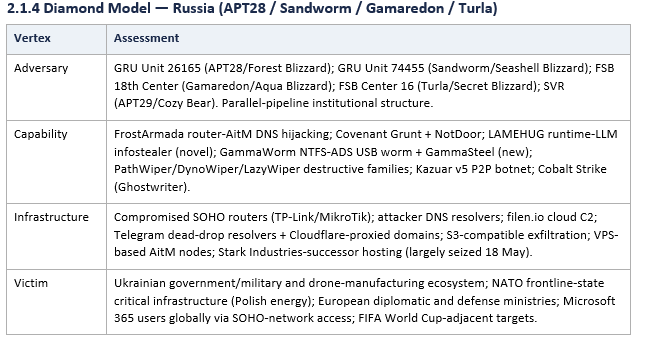
Russia’s cyber posture in this window is defined by a broadening of the APT28 operational surface, a generational evolution in Gamaredon’s tooling, and an intensification of Sandworm’s kinetic-cyber convergence that, for the first time in the series, crossed a destructive threshold against NATO-member critical infrastructure. The GRU and FSB are operating in parallel-pipeline mode: APT28 (Unit 26165) runs concurrent router-AitM, webmail, spearphishing, and AI-assisted collection tracks; Sandworm (Unit 74455) handles destructive and infrastructure operations; Gamaredon (FSB 18th Center) provides high-volume Ukrainian access that Turla (FSB Center 16) inherits for deeper espionage. The strategic frame is one of institutional redundancy: no single disruption degrades the overall collection posture. The 5 June Iran-Russia nuclear-cooperation agreement adds fresh SVR/FSB counterintelligence collection requirements against Western diplomatic channels.
Domestically, Decree 1667 has matured into a dual-use instrument — GNSS jamming and mobile-internet shutdowns justified as drone countermeasures while advancing RuNet isolation, with 761 VPN apps removed and Telegram fully blocked. The FSB-approved whitelist mechanism (SORM-compliant infrastructure stays online during shutdowns) converges infrastructure security with mass-surveillance coercion.
2.1.2 Active Campaigns and Operations (Full Rolling Window)
APT28 / Forest Blizzard — Operation FrostArmada Phase 2: A joint NCSC/FBI/Microsoft advisory (~2 June) confirmed the reconstituted FrostArmada DNS-hijacking botnet following the April Operation Masquerade disruption. APT28 mass-scans SOHO router administrative interfaces, exploiting an unauthenticated TP-Link credential-extraction flaw and credential attacks against MikroTik devices, then reconfigures DHCP/DNS to attacker-controlled resolvers. Malicious resolvers selectively return fraudulent IPs for Microsoft 365 authentication domains — including defanged hosts such as autodiscover-s[.]outlook[.]com and outlook[.]office365[.]com — routing victims to adversary-in-the-middle nodes that harvest credentials, OAuth tokens, and session cookies in real time despite TLS. At its December 2025 peak, more than 18,000 unique IPs across 120+ countries communicated with attacker infrastructure, affecting 200+ organizations. Two compartmentalized clusters — a router-expansion team and a credential-interception team — enabled rapid scaling.
APT28 — CVE-2026-21509 / Covenant Grunt / NotDoor: Trellix documented a concurrent multi-stage campaign exploiting a Microsoft Office OLE security bypass to deliver PNG-steganographic loaders, in-memory Covenant Grunt implants staged via the filen.io cloud service, and the NotDoor Outlook backdoor. NotDoor silences Outlook macro-security warnings via registry modification and auto-forwards all received mail to attacker infrastructure while purging the sent copy — the stealthiest persistent email-access vector documented for APT28 this cycle. Targeting spans nine Eastern European nations including Poland, Slovenia, Turkey, Greece, the UAE, and Ukraine, weighted toward defense ministries, transport/logistics, and diplomatic entities.
⚠️ APT28 — LAMEHUG / PROMPTSTEAL (AI-assisted, novel): LAMEHUG remains operationally deployed — a Python infostealer that queries a live Hugging Face Qwen2.5-Coder-32B-Instruct model at runtime to generate Windows reconnaissance and collection commands fresh on each execution. It is the confirmed first-in-field nation-state malware using a live commercial LLM for runtime command generation, defeating signatures built around predefined payloads.
⚠️ Gamaredon / Aqua Blizzard — GammaWorm (new): Sekoia’s three-part “FSB Matryoshka” series (1–2 June) reconstructed Gamaredon’s January 2026 infection chain from 70+ artifacts, introducing a new worm tier, GammaWorm, that hides core logic in NTFS Alternate Data Streams (invisible to Explorer and most backup tools), propagates to USB drives and network shares via weaponized LNK files bearing Ukrainian-language names, and resolves command-and-control by parsing a Telegram channel page (defanged: hxxps://www.telegram[.]me/s/oberfarir) before pivoting to Cloudflare-proxied domains. A companion 71-module registry-staged stealer, GammaSteel, exfiltrates to S3-compatible storage. Sekoia assesses that complete wipe is the only reliable remediation.
Sandworm / Seashell Blizzard — wiper expansion and NATO-member impact: ESET’s Q4 2025–Q1 2026 report confirmed Sandworm deployed several new wipers in Ukraine and attributed (medium confidence) the December 2025 destruction at a Polish energy company to the group — the rare case of a Russia-aligned destructive attack affecting NATO-member critical infrastructure. The active toolchain now includes PathWiper, which overwrites the master boot record and master file table and is distributed at scale by hijacking the administrative privileges of a legitimate endpoint-management product. APT28/Sednit provides the espionage layer, targeting Ukrainian drone manufacturers and R&D organizations.
Kinetic-cyber synchronization: Russia’s 23–24 May package — 90 missiles (including the first combat use of the Oreshnik IRBM) plus 600 drones — was the largest missile strike of the war. Ukraine’s 3 June strikes on the St. Petersburg Oil Terminal (roughly 1,100 km from the border), Kronstadt Naval Base, and a Tambov weapons plant were accompanied by documented GNSS jamming across the St. Petersburg metropolitan area and mobile-internet shutdowns under Decree 1667 authority. Pro-Russian hacktivist NoName057(16) — credited with 3,700+ DDoS attacks against NATO targets — has, per a co-sealed NCSC/Europol advisory, moved beyond DDoS into OT targeting via exposed VNC and remote-access services.
APT29 / Cozy Bear and Turla / Secret Blizzard: No new major primary disclosures entered the record this window. APT29’s diplomatic-targeting posture (GRAPELOADER/WINELOADER, device-code-authentication watering holes) carries forward, with collection imperatives intensified by the 5 June Iran-Russia agreement. Turla continues deploying Kazuar v5 against diplomatic, defense, and research institutions; a shared WinRAR path-traversal flaw (CVE-2025-8088) is now confirmed exploited across Sandworm, Turla, and Gamaredon, and the new GammaWorm USB capability opens air-gap-adjacent access paths Turla can inherit.
Post-deadline exposure: The 3 June CISA KEV remediation deadline for two Microsoft Defender vulnerabilities (CVE-2026-41091 local privilege escalation to SYSTEM and CVE-2026-45498 real-time-protection denial of service) passed; federal civilian agencies were required to verify Defender versions, while non-federal organizations remain exposed. The combination provides the precise post-exploitation enabler for in-memory implant chains.
Operation Roundish persistence (carry-forward): The Sieve forwarding rules APT28 implanted in Ukrainian government mailboxes prior to public disclosure continue to operate independently of command-and-control availability and have not been confirmed remediated in open sources. Mailboxes at organizations that underwent Roundish compromise — including the State Migration Service, prosecutors, asset-recovery agencies, and law-enforcement bodies — continue to forward inbound mail to the GRU dead drop until each administrator manually audits and removes the filters. This illustrates the persistence characteristic of APT28’s parallel-pipeline model: disruption of an active command channel does not terminate collection that has been embedded in mail-platform logic.
Turla shared-exploit and access-handoff doctrine (expanded): Beyond the WinRAR commodity exploit, the institutional pattern of Secret Blizzard inheriting Gamaredon-compromised Ukrainian access for Kazuar v5 deployment remains operative and is now amplified by GammaWorm’s USB-propagation capability. Organizations discovering GammaWorm artifacts — the characteristic NTFS Alternate Data Stream names, the recurring scheduled-task labels, and the associated registry keys — should treat the environment as a candidate for parallel Kazuar Kernel-module presence. Kazuar v5 itself is a 12-to-18-month architectural investment that Russia will not abandon in response to the May public disclosure; behavioral indicators (inter-process-communication coordination, irregular encrypted exfiltration, staging-directory usage) are the operative detection vector rather than static signatures.
Runet isolation as a strategic-cyber variable: The maturation of Decree 1667 into routine mobile-internet shutdowns, the removal of 761 VPN applications, the full block of Telegram, and pending State Duma legislation granting the FSB absolute communications-shutdown authority together create a dual strategic effect. Domestically it advances RuNet’s separation from the global internet; for Western collection it represents a potential signals-intelligence windfall, because any FSB-ordered shutdown leaves only SORM-whitelisted infrastructure online, rendering surviving traffic trivially interceptable. The irony that GammaWorm relies on Telegram dead-drop resolvers — a service now inaccessible inside Russia — indicates the campaign is operated from outside Russian territory or via VPN-capable infrastructure.
GammaWorm technical reach and remediation burden: The GammaWorm tier is the most consequential single Russian tooling development of the window. By installing core logic into NTFS Alternate Data Streams that are invisible to standard directory enumeration and most backup solutions, maintaining three independent scheduled-task persistence mechanisms, and recursively replacing legitimate directories with malicious shortcuts that open the expected folder while silently executing, the worm defeats partial remediation — reliance on dead-drop resolvers allows constant download of fresh payloads, so cleaning attempts that miss a single fallback restore the malware. The dramatic increase in lateral reach into air-gap-adjacent environments — secure enclaves, isolated OT networks, and classified systems that prohibit direct internet access but permit USB usage — is the strategic concern, and it is compounded by the Gamaredon-to-Turla access-handoff doctrine that converts a high-volume Gamaredon foothold into a deeper FSB espionage opportunity.
Cybercrime-state convergence and code-signing supply: The Russian state’s tolerance of financially motivated ransomware groups remains unchanged, with these groups serving as a reserve coercive capability. Threat-forecasting in the window assessed a moderate-to-high probability of a replacement code-signing-as-a-service operation emerging within roughly two weeks of a May disruption of a prior signing service, reflecting the enduring value of signed-malware delivery for Russian post-exploitation chains. Separately, ESET’s attribution of Covenant and BeardShell implants against Ukrainian drone manufacturers to APT28/Sednit confirms a doctrinal division of labor in which the GRU’s espionage unit provides technical intelligence on Ukrainian UAV capabilities to kinetic planners while Sandworm handles disruption — a direct cyber-support relationship to Russia’s counter-drone operations.
Tactical indicators (IOCs), TTP narratives, and MITRE ATT&CK mappings for this reporting period are available on request as a separate technical addendum.
2.1.5 Assessment and 30–60 Day Outlook
We assess with HIGH CONFIDENCE that APT28 maintains a reconstituted large-scale DNS-hijacking credential-theft capability against Microsoft 365 users globally; that Gamaredon’s GammaWorm materially raises the remediation bar in air-gap-adjacent environments; and that Sandworm will continue deploying new destructive families against Ukrainian and NATO-adjacent infrastructure. We assess with MODERATE CONFIDENCE that the 5 June Iran-Russia agreement will intensify SVR collection against European diplomatic channels, and that NoName057(16)’s OT shift represents a developing physical-impact capability if GRU-directed. Over the next 30–60 days, the highest-probability developments are: an APT28 PRISMEX-successor loader emerging on alternative cloud storage as the retooling window closes; a FIFA World Cup intelligence-collection surge across all Russian groups from 11 June; and elevated Ghostwriter/Sandworm pre-positioning against NATO frontline sectors timed to the 7–8 July Ankara Summit. Sandworm is assessed likely to shift summer focus from energy toward logistics, transportation, and the drone supply chain.
2.2 China
2.2.1 Strategic Posture
China’s posture is governed by two simultaneous realities: an enforcement-forbearance window that the United States is maintaining through the 24 September reciprocal Xi summit, and a structural escalation in the disclosed scope of Chinese telecom intrusion following the 27 May Salt Typhoon declassification. Beijing’s strategic calculus is to consolidate collected access, rebuild on new infrastructure where evicted, and use a maturing counter-sanctions legal architecture to raise the political cost of any future Western designation. The persistent pre-positioning of Volt Typhoon in U.S. and allied operational technology, the seventh SD-WAN zero-day of 2026, and the formal assessment of nine Chinese APTs against the FIFA World Cup together indicate undeterred operational tempo coexisting with diplomatic restraint at the policy level.
China is simultaneously shaping the international-governance environment, having co-engineered the UNGA’s 24 May cybersecurity-governance framework and positioned to embed AI-safety agenda inclusion, cyber-sovereignty doctrine, and attribution-blocking norms at the July UN Global Mechanism plenary. The counter-sanctions framework — Decree No. 835’s Malicious Entity List, the MOFCOM blocking order, and the $1.18B Wingtech AFSL suit against Nexperia — has reached operational maturity, creating an irresolvable compliance trap designed to deter the Salt Typhoon sanctions the U.S. intelligence community has sought since December 2025.
2.2.2 Active Campaigns and Operations (Full Rolling Window)
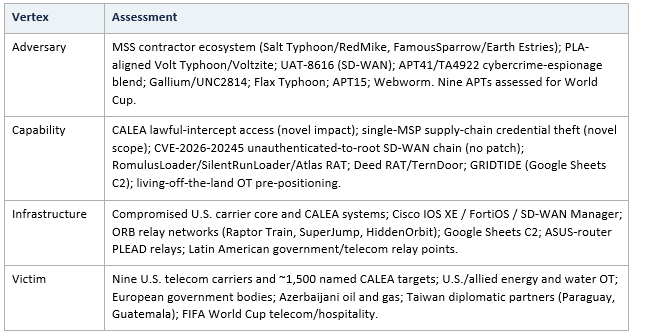
⚠️ Salt Typhoon — declassified scope and CALEA inversion: The 27 May CISA/NSA/FBI joint assessment confirmed nine carriers (Carrier Groups A–I) compromised for 8 to 18 months. Three carriers were breached through unpatched internet-facing network-management systems (Cisco IOS XE and Fortinet FortiOS, with patches available 60–180 days prior); six were breached through credential theft at a single managed-services provider maintaining infrastructure across all six simultaneously — the most efficient single-vector supply-chain attack on U.S. critical infrastructure on record. Lawful-intercept (CALEA) systems at four carriers were accessed for metadata and, in some cases, content on approximately 1,500 named individuals across government, defense, and policy circles; five additional carriers’ core networks enabled bulk metadata collection. A third intelligence category — mapping CALEA architecture for potential future disruption — was identified. Eviction completed March 2026 after a nine-month process requiring physical hardware replacement.
Institutional response: Eight carriers (AT&T, Charter, Comcast, Cox, Lumen, T-Mobile, Verizon, Zayo) formed the Communications Cybersecurity ISAC (C2 ISAC), operational June 2026 under a former CISA/FBI senior official, as an explicit private-sector response to federal enforcement forbearance. A bipartisan bill would mandate annual third-party audits, lawful-intercept network segmentation, and tamper-evident CALEA logging; the FCC has opened a carrier-cybersecurity proceeding. Salt Typhoon sanctions remain frozen; Sichuan Juxinhe remains the sole designated MSS contractor.
⚠️ Cisco SD-WAN — CVE-2026-20245 (seventh zero-day, unpatched): On 5 June Cisco disclosed a high-severity command-injection flaw in the Catalyst SD-WAN Manager CLI, reported by Mandiant and actively exploited, with no patch available. An authenticated attacker with netadmin privileges uploads a crafted file to execute commands as root; the flaw chains directly to the May CVE-2026-20182 identity-spoofing flaw to produce a full unauthenticated-to-root path on unpatched managers, enabling configuration changes pushed to all connected edge devices. The forensic indicator is unexpected tenant-configuration upload activity in the SD-WAN Manager script log. UAT-8616 (China-nexus, ORB-network TTPs) is the assessed probable actor given the chaining dependency, though Cisco has not formally attributed it.
Volt Typhoon / Voltzite — Stage 2 stabilization: No new technical disclosures, but the policy response sharpened: CISA’s CI Fortify messaging shifted toward mandatory framing with regulatory-penalty language, energy was reaffirmed as the priority sector, and a Carnegie Mellon assessment warned that the most serious near-term risk is digitally active control layers (battery-management systems, inverter firmware, grid-management platforms) rather than edge devices — noting undocumented communications hardware discovered in some Chinese-origin U.S. grid equipment, a physical hardware-collection layer beneath the network threat.
TA4922 (Silver Fox overlap) — European expansion: Proofpoint disclosed TA4922 — now generating more unique campaigns than any other tracked cybercrime actor in its data — expanding from East Asia to the UK, Germany, Italy, and South Africa, deploying the previously undocumented RomulusLoader (C-based, AnyDesk/SyncFuture sideloading), SilentRunLoader (Python Chrome-credential stealer), and Atlas RAT via HR-themed lures, and migrating victims from corporate email to LINE, WhatsApp, and Microsoft Teams to escape enterprise controls. Proofpoint flags the malware’s surveillance potential as resellable to espionage groups — placing TA4922 in the China-aligned cybercrime-espionage blended ecosystem.
FamousSparrow / Earth Estries — Azerbaijan three-wave campaign: Bitdefender and SOC Prime documented a December 2025–February 2026 intrusion of an Azerbaijani oil-and-gas target via ProxyShell/ProxyNotShell, deploying Deed RAT (masquerading as LogMeIn Hamachi) and attempting TernDoor, with persistence through three remediation cycles. Defanged C2 included virusblocker[.]it[.]com and sentinelonepro[.]com. The Deed RAT/TernDoor overlap with Salt Typhoon tooling suggests shared development within China’s contractor ecosystem.
China-nexus edge-botnet and Latin America: Gallium/UNC2814 compromised 53 organizations in 42 countries, deploying the GRIDTIDE backdoor with Google Sheets C2; Flax Typhoon presence was confirmed in Paraguayan government systems and APT15 in Guatemala’s Foreign Ministry — both Taiwan diplomatic partners. The Webworm EchoCreep/GraphWorm campaign against Belgian, Italian, Polish, Serbian, and Spanish government bodies continues, with 50+ targets from decrypted Discord C2 still unidentified.
FIFA World Cup posture: Recorded Future formally assessed nine Chinese APTs — Volt Typhoon, Salt Typhoon, BlackTech, APT31, Mustang Panda, APT41, Aquatic Panda, Storm-2077, and APT40 — as active in World Cup-adjacent targeting of telecommunications, airlines, hospitality, and event logistics, citing BlackTech’s roughly 12-month undetected compromise of a 2022 Qatar World Cup telecommunications provider as the operative precedent.
Mustang Panda and Webworm continuity: No new Mustang Panda (RedDelta/TA416) technical disclosure entered the record beyond the World Cup listing and continuing FDMTP campaign activity; the BookWorm-TONESHELL infrastructure linkage from the prior reporting window remains the authoritative characterization. The Webworm EchoCreep/GraphWorm campaign was formally documented by Red Sky Alliance on 1 June, confirming presence in government bodies across Belgium, Italy, Poland, Serbia, and Spain plus a South African university; ChainWorm and WormFrp proxy-infrastructure construction continues, consistent with the CISA covert-network doctrine advisory and indicating Webworm’s transition from target-specific espionage actor to persistent ORB-network provider. The 50-plus targets identified from 433 decrypted Discord command-and-control messages remain largely unattributed, and additional NATO-member government victims are assessed likely to surface as cross-indicator analysis completes.
Counter-sanctions enforcement architecture (expanded): China’s counter-sanctions ecosystem reached operational maturity in the window. The April Decree No. 835 established a Malicious Entity List enabling asset seizures, investment restrictions, entry bans, and fines against individuals at foreign firms who implement U.S. sanctions — nominally exposing compliance officers, export-control lawyers, and banking correspondents to Chinese countermeasures. The MOFCOM blocking order prohibiting compliance with U.S. sanctions on five Chinese petrochemical companies, paired with the U.S. secondary-sanctions warning, creates a deliberate compliance trap. New outbound-direct-investment regulations effective 1 July integrate technology-export licensing and data-transfer compliance into investment review and prohibit indirect technology transfer via overseas personnel placement — directly targeting a mechanism used in prosecuted semiconductor IP-theft cases. The cumulative effect raises the political cost of any future U.S. cyber-sanctions designation and is specifically calibrated to forestall Salt Typhoon sanctions.
H200 stalemate and Taiwan pressure: Post-summit reporting confirmed Beijing is blocking Chinese companies from purchasing U.S.-approved Nvidia H200 chips — roughly 750,000 licenses issued but stalled on the Chinese side as Beijing prioritizes domestic Huawei Ascend development. A bilateral AI-safety dialogue remains aspirational with no framework or timeline. The Trump administration’s pending decision on roughly $14B in Taiwan arms sales is the primary near-term variable; deferral past 24 September to preserve the summit is assessed as likely and would be read by PLA cyber planners as confirmation of U.S. Taiwan ambiguity. Chinese cyber pre-positioning in critical infrastructure is assessed “in the red” by external analysts, consistent with the Volt Typhoon posture.
CALEA inversion — strategic significance: The most important analytic reframing of the period is that Salt Typhoon is not a data breach in the conventional sense. As the declassified assessment makes explicit, the actor did not steal customer records; it positioned itself inside the infrastructure that carries American communications and used that position for persistent intelligence collection, including the ability to query lawful-intercept systems against targets of its choosing. The third intelligence category — mapping the architecture and capabilities of intercept systems for potential future disruption of U.S. law-enforcement surveillance — means that even after eviction, the Ministry of State Security may hold a comprehensive architectural map enabling future targeted disruption. The nine-month eviction and the physical hardware replacement required at multiple carriers confirm a deep infrastructure compromise requiring structural remediation at the physical layer, not a software cleanup.
SD-WAN exposure chain in detail: The seventh SD-WAN zero-day of 2026 is significant less for its individual severity than for what it represents — a sustained, undeterred exploitation campaign against a single product line across the entire reporting year. Because CVE-2026-20245 chains to the May identity-spoofing flaw whose federal patch deadline expired weeks ago, any organization that did not remediate the earlier flaw now faces a complete unauthenticated-to-root path with no workaround available for the new flaw across all deployment types, including the government FedRAMP tier. The forensic signal is tenant-configuration upload activity in the manager’s script log, and the disclosure five days before the reporting date — on the eve of the September-summit horizon — underscores that operational tempo, not diplomatic deference, governs Chinese behavior during forbearance.
Voltzite hardware-layer concern: The Carnegie Mellon assessment that undocumented communications hardware has been discovered in some Chinese-origin equipment deployed in U.S. grid infrastructure introduces a physical hardware-collection layer beneath the network-based threat. Combined with Chinese military doctrine identifying energy, telecommunications, transportation, and financial infrastructure as priority cyber and electromagnetic attack targets in a Taiwan contingency, and confirmed Volt Typhoon pre-positioning in energy networks, the hardware finding indicates an active, ongoing intelligence program in the U.S. energy supply chain that operates independently of network-based access and is correspondingly harder to evict.
Tactical indicators (IOCs), TTP narratives, and MITRE ATT&CK mappings for this reporting period are available on request as a separate technical addendum.
2.2.4 Diamond Model — China
2.2.5 Assessment and 30–60 Day Outlook
We assess with HIGH CONFIDENCE that the Salt Typhoon declassification is the most consequential disclosure of the period and that CVE-2026-20245 requires treating any unpatched SD-WAN Manager as an open unauthenticated-to-root exposure. We assess with MODERATE CONFIDENCE that China-nexus APTs will exploit the FIFA World Cup as an opportunistic collection platform, that China will advance its norms agenda at the July UN Global Mechanism plenary, and that the counter-sanctions legal framework has passed the deterrence threshold against future U.S. designations. We assess with LOW CONFIDENCE that meaningful Chinese operational restraint occurs before 24 September — the completed eviction suggests collected access has already been exploited, shifting the imperative toward rebuilding rather than restraining. Over the next 30–60 days: a Cisco patch for CVE-2026-20245 on no announced timeline; C2 ISAC operations beginning with limited public impact; continued TA4922 European expansion; intensified World Cup targeting through the tournament; and possible Salt Typhoon rebuild on new infrastructure, plausibly again via managed-services providers given proven efficiency.
2.3 North Korea
2.3.1 Strategic Posture
North Korea’s cyber posture is dominated by financially motivated crypto theft executed with the discipline of a state revenue program, complemented by espionage (Kimsuky, Andariel, ScarCruft) and the IT-worker fraud apparatus. The window produced the highest concentration of legally, operationally, and technically significant DPRK developments since the February 2025 Bybit heist. Two structural features define the strategic picture: an industrialized laundering capability that washed roughly $220M in six weeks, and a maturing legal frontier — the KelpDAO $71M proceeding and the parallel Gerstein Harrow terrorism-creditor litigation — that will set DeFi-recovery precedent for DPRK-attributable assets. Pyongyang’s 2026 year-to-date crypto theft stands at roughly $577M–$620M, approximately 55% of total industry losses, against an all-time total exceeding $6.75B.
The espionage track shows continued capability modernization: Kimsuky now fields at least five malware families and multiple tunneling methods simultaneously, Andariel has reemerged against nuclear and liquid-hydrogen infrastructure aligned with ballistic and nuclear acquisition priorities, and ScarCruft maintains a multi-platform supply-chain surveillance capability against the Yanbian Korean diaspora. The legislative environment (the CLARITY Act on the Senate calendar, the 2 June AI Executive Order’s enforcement prioritization) is tightening but has not yet produced new enforcement against DPRK in the window.
2.3.2 Active Campaigns and Operations (Full Rolling Window)
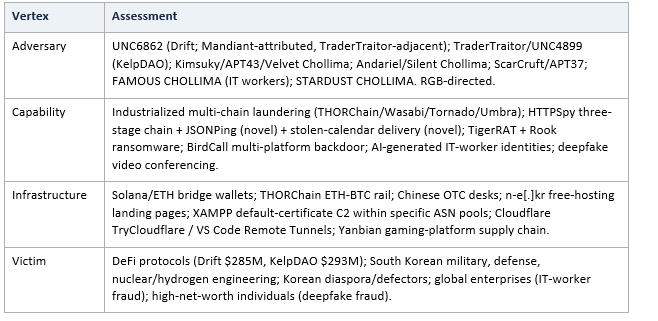
⚠️ Drift Protocol — UNC6862 attribution and Day-65 dormancy: On 3 June Mandiant conclusively attributed the roughly $285–295M April 1 Drift exploit to UNC6862, a previously undesignated North Korean group assessed to overlap with the broader TraderTraitor cluster — the first formal forensic-grade attribution of the theft. The stolen ETH remained fully dormant at Day 65, exceeding the Bybit laundering-initiation timeline by 60+ days and approaching the Radiant Capital precedent. The primary attacker address (defanged Solana wallet HkGz4KmoZ7Zmk7HN6ndJ31UJ1qZ2qgwQxgVqQwovpZES) showed zero movement. With THORChain’s restart imminent, this is the single highest-priority on-chain monitoring trigger in the DPRK space.
THORChain — ADR-028 and the V12 dispute: Node operators passed ADR-028 on 27 May, authorizing a staged restart via Protocol-Owned Liquidity with no RUNE dilution and the attacker’s bond slashed; v3.18.1 deployed and v3.19.0 entered stagenet testing. Separately, security firm V12 publicly accused THORChain of silently patching a critical loss-of-funds vulnerability disclosed in late April — weeks before the May exploit — without credit or compensation, after retiring its bug-bounty program citing a flood of AI-generated low-quality submissions. V12 has signaled intent to release exploit code, creating downstream risk for protocols sharing the tss-lib fork.
KelpDAO — $71M proceeding and completed laundering: The 5 June hearing before Judge Margaret Garnett (SDNY) is the anticipated ruling date. The Arbitrum DAO’s court-authorized binding governance vote to transfer 30,765.667 ETH to an Aave LLC-controlled address has been initiated, with the Gerstein Harrow terrorism-creditor restraining notice traveling with the assets; no final ruling vacating that notice was confirmed as of filing. Aave’s post-mortem confirms full rsETH backing restored. Separately, the attacker laundered roughly $220M of unfrozen proceeds within six weeks — the fastest large-scale DPRK laundering on record — via THORChain (~$175M ETH-to-BTC pre-halt), Wasabi CoinJoin, Tornado Cash, and Umbra, leaving roughly $1.7M traceable.
⚠️ Kimsuky — HTTPSpy three-stage chain and JSONPing (novel): ENKI Whitehat documented (27/29 May) a March–April 2026 campaign against South Korean military and corporate targets featuring two novel techniques. In one wave, attackers compromised a service member’s account, extracted a real Webex meeting schedule, and built a counterfeit meeting page distributing malware to all scheduled attendees — the first documented use of a stolen calendar entry as a delivery vehicle. The novel JSONPing technique embeds JSONP queries to a malware-deployed local server to verify live infection before serving the next stage, bypassing sandbox detonation and hiding inside ordinary cross-origin traffic. HTTPSpy was refactored from a single binary into a three-stage installer/loader/core chain. Kaspersky’s parallel findings confirm five simultaneous Kimsuky families (HelloDoor/Rust, HttpMalice, HTTPSpy, HappyDoor, AppleSeed).
⚠️ Andariel — reemergence against nuclear/hydrogen infrastructure: ESET confirmed Andariel’s reemergence in attacks on a South Korean engineering firm producing liquid-hydrogen handling and nuclear-power equipment, deploying TigerRAT and attempting Rook ransomware — technologies directly applicable to rocket-propellant production and nuclear acquisition. The ROK NIS annual report separately documented Andariel infiltrating critical infrastructure via an IT-maintenance firm, seizing 20+ servers and stealing blueprints, confirming the supply-chain-pivot playbook (previously a Lazarus signature) as an Andariel TTP.
ScarCruft / APT37 and IT-worker apparatus: ESET confirmed ScarCruft’s multi-platform BirdCall supply-chain compromise of a Yanbian gaming platform (seven Android versions) targeting the Korean diaspora and defector community. The FAMOUS CHOLLIMA IT-worker operation continued at scale — 45 operations identified in March 2026 alone, with doubled use of AI-generated identities — though no new U.S. prosecutions occurred in the window; an HRW report (5 June) documented DPRK forced labor reaching EU supply chains including European Parliament cafeterias via Chinese seafood-processing intermediaries.
Laundering economics and the broader DeFi landscape: The KelpDAO completion confirms an industrialized laundering posture. The THORChain halt of mid-May did not materially delay it, because roughly $175M in ETH had already routed through the protocol in a 36-hour window before shutdown, with Chinese OTC desks completing the fiat conversion. PeckShield’s tally of 14 cross-chain and bridge-related exploits in 2026 totaling $340.7M is structurally dominated by the two DPRK April exploits. CertiK places DPRK 2026 theft at roughly $620M of an industry-wide $1.1B — about 55% — against an all-time total exceeding $6.75B, with the 2026 pace tracking toward $700–800M annually. Two early-June DeFi exploits (Gnosis Pay and a roughly $2.5M TesseraDAO token-mint exploit routed through Tornado Cash) were not attributed to DPRK.
Legal-frontier significance: The Gerstein Harrow terrorism-creditor strategy is now confirmed as structural rather than case-specific, pursued in parallel against the KelpDAO ETH, DPRK fund flows via a separate DAO/custodian, and roughly $344M in Iranian-attributed Tether USDT. A ruling for the creditors at any level would create binding SDNY precedent incentivizing preemptive restraining notices within hours of any future DPRK-attributed on-chain theft — a development that would reshape DeFi incident response. Even a ruling for DeFi users would not foreclose future assertions of the same theory. Separately, no UN Panel of Experts replacement has been established since Russia’s 2024 veto, leaving DPRK sanctions monitoring without a dedicated investigative body.
Policy and enforcement context: The CLARITY Act’s placement on the Senate Legislative Calendar (1 June) completes five of nine steps toward enactment, with the 60-vote cloture threshold the structural obstacle; its DPRK-relevant provisions (a DPRK AI working group, real-time intelligence sharing, a transaction hold, a DeFi-analytics mandate, and a mixer assessment) remain intact. The 2 June AI Executive Order directs prioritized enforcement against AI-enabled unauthorized computer access — analytically framing Kimsuky’s LLM-assisted development and FAMOUS CHOLLIMA’s AI-generated identities as AI-criminal use cases. The State Department’s standing $10M Rewards for Justice bounty covering Lazarus, Kimsuky, BlueNoroff, and Andariel remains an underutilized enforcement incentive. OFAC issued no DPRK designations in 25-plus days, leaving a UNC6862 designation plausible following the Mandiant attribution.
UNC6862 attribution — analytic weight: Mandiant’s designation of UNC6862 as a distinct, forensically attributed group with operational telemetry recovered during the review elevates the Drift case from the operational pattern-matching that TRM Labs, Elliptic, and Chainalysis had previously offered to forensic-grade attribution. The group is not previously documented in the open-source record, and its relationship to the established TraderTraitor, PRESSURE CHOLLIMA, or GOLDEN CHOLLIMA clusters is not yet publicly characterized; Mandiant’s note that it has direct ties to other state-sponsored actors involved in similar platform attacks suggests overlap with the broader TraderTraitor cluster rather than an entirely novel actor. The attribution increases confidence that laundering will route through THORChain post-restart, Chinese OTC intermediaries, and privacy protocols, and it strengthens the case for a future OFAC designation.
Kimsuky tradecraft maturation: The March–April campaign’s two novel techniques each erode a long-standing defensive assumption. The stolen-meeting-schedule delivery means a legitimate calendar invitation is no longer, on its own, a clean delivery indicator — a lateral social-engineering escalation that weaponizes trusted internal scheduling. JSONPing, the first documented real-time infection-verification technique of its kind, serves payloads only to confirmed-infected hosts, defeating sandbox detonation and email-gateway analysis while hiding inside ordinary cross-origin web traffic; because the technique is architecturally portable to any web-staged delivery chain, it is assessed likely to propagate across DPRK and potentially other programs. The persistent reuse of a default web-server certificate within a specific autonomous-system pool remains a reliable clustering signal even as the malware families evolve.
STARDUST CHOLLIMA and exchange-breach baseline: No new primary disclosures of STARDUST CHOLLIMA deepfake video-conferencing operations entered the window, though the Singapore deepfake fraud case (roughly $3.8M) remains the most recent confirmed disclosure and demonstrates that synthetic video-conferencing fraud has escaped the enterprise and crypto sectors to target individual high-net-worth individuals. A South Korea country assessment confirmed Lazarus involvement in six of nine major South Korean exchange breaches since 2017, with combined confirmed thefts exceeding $120M and a late-2025 domestic-exchange attack of roughly $30M still under investigation — underscoring the continuity of the financial-theft mission alongside the espionage and IT-worker tracks.
Tactical indicators (IOCs), TTP narratives, and MITRE ATT&CK mappings for this reporting period are available on request as a separate technical addendum.
2.3.4 Diamond Model — North Korea
2.3.5 Assessment and 30–60 Day Outlook
We assess with HIGH CONFIDENCE that UNC6862 conducted the Drift exploit and that the dormant ETH will begin moving within days to roughly two weeks of THORChain trading resumption; that Kimsuky’s campaign expansion represents the completion of a multi-year capability modernization; and that Andariel’s nuclear/hydrogen targeting is directly aligned with Pyongyang’s acquisition priorities. We assess with MODERATE CONFIDENCE that the KelpDAO $71M will ultimately return to DeFi user recovery rather than terrorism creditors, while noting the Gerstein Harrow precedent-seeking strategy is structural and will recur. We assess with LOW CONFIDENCE that the CLARITY Act receives a full Senate floor vote before the August recess. Over the next 30–60 days, the priority watch items are: activation of the Drift laundering window on THORChain restart; the KelpDAO ruling defining DeFi-recovery law; potential Kimsuky JSONPing expansion to EU/NATO targets; a possible UNC6862 OFAC designation following the Mandiant attribution; and a possible V12 exploit-code release affecting tss-lib-derived protocols.
2.4 Iran
2.4.1 Strategic Posture
Iran’s posture is shaped by the collapse of the nuclear MOU, a fracturing ceasefire, and the partial restoration of internet connectivity at Day 88 that returns its APT apparatus to full operational tempo. The strategic configuration — a perpetually near-signed deal punctuated by IRGC kinetic strikes — is the most cyber-permissive environment of the conflict: diplomatic cover suppresses U.S. retaliation while pre-positioned MOIS/IRGC implants on U.S. bank, airport, and defense-supplier networks remain authorized for activation within hours. The window’s defining trend is a qualitative capability advance: the IRGC-affiliated Nimbus Manticore (UNC1549/Screening Serpens) emerged as the most active Iranian APT, fielding the AI-assisted MiniFast backdoor via search-engine poisoning, while MUDDYWATER’s AI-authored CHAR backdoor confirms AI-assisted development across at least two Iranian programs.
Iran has also broadened beyond cyber: the Handala umbrella now spans physical-proxy recruitment and surveillance, the LA Metro breach was attributed to MOIS, and the Persian Gulf Strait Authority institutionalized a Bitcoin/crypto toll rail for Hormuz transit. OFAC’s escalating “Economic Fury” campaign — designating the PGSA and four crypto exchanges representing 78% of Iran’s $9.9B annual volume — directly targets IRGC-affiliated ransomware financial rails. The IAEA’s declared “loss of continuity of knowledge” over Iran’s 60% HEU stockpile compounds the strategic uncertainty.
2.4.2 Active Campaigns and Operations (Full Rolling Window)
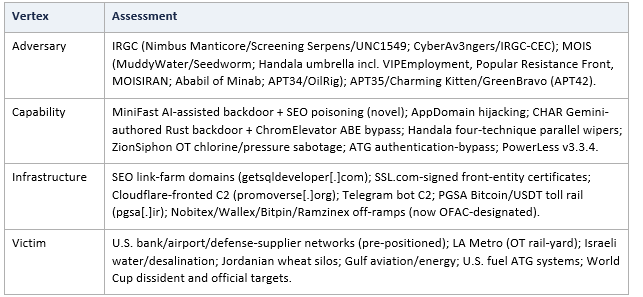
⚠️ Nimbus Manticore / Screening Serpens / UNC1549 — MiniFast and SEO poisoning (novel): Check Point and Unit 42 independently documented a three-wave February–April 2026 campaign that accelerated through active kinetic operations. Wave 1 (February) used airline-impersonation lures against aviation and software firms in Saudi Arabia and Australia, introducing AppDomain hijacking to disable .NET security before application start. Wave 2 (March) delivered a trojanized Zoom installer and the new MiniFast 64-bit backdoor — 17 commands, Chrome-146 traffic masquerade, signed with valid SSL.com certificates issued to named front entities. Wave 3 (April) replaced spear-phishing with search-engine poisoning: the defanged domain getsqldeveloper[.]com was pushed to the top of Bing/DuckDuckGo results so that database developers seeking Oracle SQL Developer downloaded MiniFast instead — the first confirmed Iranian APT use of SEO manipulation as a primary delivery vector. Check Point assessed four code-level indicators of AI-assisted development in MiniFast.
⚠️ MUDDYWATER / Seedworm — Operation Olalampo and AI-authored CHAR: Group-IB documented three malware families against MENA targets — the GhostFetch downloader (defanged C2 promoverse[.]org, real IP 209[.]74[.]87[.]67), the upgraded HTTP_VIP standalone backdoor, and the CHAR Rust backdoor with Telegram bot C2. Google Threat Intelligence confirmed MuddyWater used Google Gemini to write CHAR, evidenced by emoji-laden debug strings characteristic of AI-generated code. A parallel Symantec disclosure added ChromElevator (a Chrome App-Bound-Encryption bypass embedded in DLL-sideloading chains, defanged DLL IP 157.20.182[.]49) and clarified the Ababil of Minab MOIS connection — linking the March 2026 LA Metro breach (700GB exfiltrated, OT rail-yard control accessed) to MOIS via Black Shadow infrastructure overlap.
Handala / MOIS — multi-domain expansion: Recorded Future and OffSeq confirmed (2 June) that MOIS expanded the Handala brand into VIPEmployment (global proxy recruitment for espionage and sabotage via cryptocurrency), the Handala Popular Resistance Front (physical attacks inside Israel), and MOISIRAN (surveillance) — evolving a cyber-wiper persona into a multi-domain coercion platform. Kaspersky documented Handala’s four simultaneous wiper techniques (custom MBR-overwriting wiper via Group Policy logon scripts, an AI-commented PowerShell wiper, VeraCrypt abuse, and manual VM deletion), with months of dwell before the destructive phase.
OT/ICS targeting: An eight-agency U.S. advisory (4 June) confirmed ongoing malicious activity against Automatic Tank Gauge systems via authentication bypass on internet-facing interfaces — an Iran-suspected, attribution-neutral campaign that continues regardless of MOU status. Darktrace disclosed ZionSiphon, the first publicly named Iran-attributed OT malware with confirmed chlorine and pressure-control sabotage capabilities targeting Israeli water and desalination systems. Jordan’s National Cybersecurity Center thwarted an Iran-attributed attack on national wheat-silo temperature controls — a new food-security OT targeting category.
APT34/OilRig and APT35/Charming Kitten: No new standalone APT34 disclosure, but pre-positioned access continues, with ESET noting unattributed Israel-targeting clusters (Rusty Boots, MoKhargosh) deploying bootkit-style wipers consistent with MOIS tradecraft. Recorded Future identified GreenBravo (APT42) with a possible remit to lead World Cup operations — espionage targeting of regime opponents, dissidents, and U.S. officials — with carry-forward BellaCPP and PowerLess v3.3.4 infrastructure active.
Sanctions and finance: OFAC designated the Persian Gulf Strait Authority (27 May, Bitcoin/USDT Hormuz toll rail), an eight-individual procurement network stealing U.S. network-security and encryption tools for Iran’s Ministry of Defense (29 May), and four crypto exchanges — Nobitex, Wallex, Bitpin, Ramzinex (2 June) — with Treasury explicitly linking Nobitex to IRGC-affiliated ransomware wallets, the first official confirmation of the ransomware-IRGC financial pipeline.
Hormuz toll rail and economic-warfare institutionalization: The Persian Gulf Strait Authority, founded 5 May and designated 27 May, institutionalized a Hormuz transit toll — roughly $1 per barrel, up to $2M per tanker, payable in Bitcoin, Chinese yuan via correspondent banking, or USDT — with a companion Bitcoin-based maritime-insurance scheme creating a self-contained sanctions-resistant ecosystem. OFAC’s follow-on clarification that any payment to the PGSA via any modality is sanctionable, paired with the exchange designations that remove 78% of Iran’s domestic crypto on-ramp capacity, targets the toll’s collection infrastructure. The physical undersea-cable threat remains assessed as low-feasibility for covert cutting but moderate via intimidation of repair vessels; the PGSA’s institutionalization converts an ad hoc signal into a standing economic-warfare posture.
IAEA safeguards collapse: The IAEA’s first Iran report since February, circulated 4 June, states the Agency cannot provide information on the size, composition, or whereabouts of Iran’s enriched-uranium stockpile or confirm whether enrichment-related activity has been suspended — a formal “loss of continuity of knowledge.” The last confirmed inventory (pre-strike) was 440.9 kg at up to 60% enrichment, assessed by the Director General as sufficient for as many as ten weapons if weaponized. The verification gap is directly actionable for Iran’s nuclear shadow program and reframes Iranian cyber operations against IAEA member states’ nuclear communications as potentially driven by undeclared-program intelligence needs rather than solely diplomatic leverage.
Congressional and connectivity variables: The House’s 3 June War Powers Resolution (215–208, with four Republican defections) is the first successful House passage in four attempts during the conflict; though lacking practical legal effect against a determined executive, it signals Republican fracturing that Tehran may read as a ceiling on U.S. coercive capacity, reducing incentives to moderate cyber operations. The Day-88 partial internet restoration — executed by the vice president over the judiciary’s same-day suspension of the responsible presidential body — reveals the executive-versus-SNSC/IRGC institutional struggle, and is assessed as deliberately timed to the ceasefire framework, meaning it can be re-restricted within 24–72 hours if negotiations collapse.
Nimbus Manticore campaign mechanics in detail: The three-wave structure is itself analytically significant because it demonstrates an Iranian APT iterating its delivery model under operational pressure. Wave 1’s airline-impersonation lures against aviation and software firms introduced AppDomain hijacking — manipulating .NET application initialization to disable security mechanisms before the application starts — as a replacement for the DLL-sideloading the group previously favored. Wave 2’s trojanized Zoom installer carried the new MiniFast backdoor, signed with valid certificates issued to named front entities and masquerading its traffic as a current Chrome browser version over JSON-over-HTTPS. Wave 3’s pivot from spear-phishing to search-engine poisoning — elevating a malicious download domain to the top of search results so that developers seeking a legitimate database tool retrieve the implant — is the first confirmed Iranian APT use of the technique and represents a shift from targeted to opportunistic-but-precise delivery. Unit 42’s parallel disclosure of six new RAT variants grouped into two families, with targeting that includes a U.S. oil-and-gas firm and shows no sign of slowing, corroborates the assessment that this is the dominant offensive actor of the window.
MuddyWater Operation Olalampo and the AI-development trend: Group-IB’s extraction of the CHAR Rust backdoor’s Telegram bot name from malware logs gave visibility into hands-on-keyboard activity, including the operator testing the implant on their own machine before deployment. The independent confirmation that CHAR was written with Google Gemini — evidenced by emoji-laden debug strings characteristic of AI-generated code — places the AI-assisted development trend across at minimum two Iranian programs alongside the IRGC’s MiniFast indicators, mirroring the cross-program normalization observed in Russian and North Korean tooling. The HTTP_VIP variant’s upgrade from downloader to standalone backdoor, and the addition of a Chrome App-Bound-Encryption bypass to the sideloading kit, indicate steady capability accretion rather than a single leap.
ICS/OT and hacktivist ecosystem: The window’s OT picture spans an eight-agency advisory on ongoing ATG targeting, the first publicly named Iran-attributed OT malware with chlorine and pressure-control sabotage capabilities against Israeli desalination, a thwarted attack on Jordanian wheat-silo temperature controls representing a new food-security targeting category, and the MOIS-attributed LA Metro breach with rail-yard control access. The Iran-aligned hacktivist ecosystem — coordinated through an Electronic Operations Room of the Islamic Resistance Axis encompassing several DDoS and defacement personas — remains active but with DDoS and defacement as its operational ceiling; no destructive operations by these groups were confirmed in the window, and a brief hijacking of a U.S. official’s social-media account with pro-Iran propaganda was consistent with but not formally attributed to MOIS information operations.
Tactical indicators (IOCs), TTP narratives, and MITRE ATT&CK mappings for this reporting period are available on request as a separate technical addendum.
2.4.4 Diamond Model — Iran
2.4.5 Assessment and 30–60 Day Outlook
We assess with HIGH CONFIDENCE that Nimbus Manticore is the most operationally active and technically advancing Iranian APT of the window; that the Day-88 partial internet restoration returns Iranian groups to full conventional connectivity for command-and-control of pre-positioned access; and that the OFAC exchange designations materially degrade IRGC-affiliated ransomware financial rails over a 30–90 day horizon. We assess with MODERATE CONFIDENCE that the 1–2 June Kuwait strikes were IRGC coercive signaling rather than command failure, that Handala’s physical-domain expansion is a deliberate doctrine shift requiring force-protection coordination, and that the IAEA’s loss of continuity of knowledge creates an unverifiable breakout window. We assess with LOW CONFIDENCE that an MOU is signed in the June 5–19 window. Over the next 30–60 days the priority watch items are: World Cup targeting by Handala, CyberAv3ngers, and GreenBravo from 11 June; ZionSiphon sabotage confirmation against Israeli water systems; Iranian operators migrating to P2P/OTC rails following the exchange designations; and any expansion of MiniFast SEO-poisoning campaigns to additional sectors.
Section 3 — Cross-Nation Convergence
3.1 New This Period
Six cross-cutting developments shaped the window. The supply-chain crisis deepened with the 1 June Mini Shai-Hulud “Miasma” wave compromising 32 packages in the Red Hat npm namespace via a single employee GitHub account — generating valid SLSA provenance while injecting a 4.29MB obfuscated credential stealer — atop TeamPCP’s 12 May open-sourcing of the complete worm toolchain, which has rendered attribution structurally unreliable. The Anthropic/NSA Mythos deployment became operational (4 June FT report), and the Trump AI Executive Order was signed (2 June), bifurcating a voluntary civilian review framework from a fully operational military AI-cyber track. An eight-agency U.S. ATG advisory (4 June) confirmed sustained, likely state-sponsored targeting of civilian fuel infrastructure. Recorded Future’s FIFA World Cup assessment formally named nine Chinese APTs plus Russian and Iranian groups as tournament threats. And NATO Ankara Summit preparation accelerated, with the agenda explicitly elevating AI-supported threats.
Major breaches and the ransomware ecosystem: The window’s incident tempo reinforced the supply-chain and security-tooling theme. RansomHouse claimed access to a portion of Trellix’s source-code repository (Mandiant-assisted IR), structurally similar to the Checkmarx development-toolchain compromise whose blast radius Mandiant’s 4 June update constrained to GitHub and development credentials rather than customer production. ShinyHunters exfiltrated 500,000-plus Salesforce records from Cushman & Wakefield via vishing; Everest published 108GB of Liberty Mutual policyholder data via a third-party vendor; and Qilin claimed Sysco, the world’s largest food distributor. Microsoft’s technical dissection of The Gentlemen (tracked as Storm-2697) documented a self-propagating Go encryptor attempting 21 parallel lateral-movement techniques per host with a five-stage evidence-destruction sequence, and confirmed a BreachForums affiliate-recruitment partnership signaling a Q2/Q3 expansion. BlackFog logged 95 publicly disclosed ransomware attacks in May across 17 countries, healthcare leading at roughly 30%.
Vulnerability and patch landscape: The 29 May Exchange Server CVE-2026-42897 federal deadline passed with no permanent patch, leaving the Emergency Mitigation Service as the operative control pending the 10 June Patch Tuesday; the 3 June Defender deadline was met through engine-update propagation. New KEV additions included a critical Exim use-after-free (CVE-2026-45185, “Dead.Letter,” discovered by an automated bug-hunter), an Oracle WebLogic deserialization flaw, a GitHub Enterprise Server RCE, and the ScadaBR ICS missing-authentication flaw (CVE-2026-8602) that allows unauthenticated injection of arbitrary SCADA sensor readings — the same unauthenticated-HTTP-write logic as the ATG campaign. The Verizon 2026 DBIR’s finding that vulnerability exploitation overtook stolen credentials as the leading initial-access vector frames this surface as the new center of gravity.
Enforcement and arrests beyond sanctions: Scattered Spider member Tyler Buchanan pleaded guilty (24 May) to wire-fraud conspiracy and aggravated identity theft, the third major Scattered Spider accountability action of 2026; Dutch FIOD investigators arrested two operators and seized 800 servers of a Stark Industries-successor bulletproof-hosting network under sanctions law — the first criminal prosecution of hosting operators knowingly providing infrastructure for Russian state-sponsored operations; Canadian authorities arrested the alleged operator of the Kimwolf IoT botnet; and the DOJ Scam Center Strike Force announced seven arrests in Thailand. The pattern shows sustained progress against cybercriminal infrastructure even as state-sponsored enforcement remains constrained by the China-forbearance posture.
3.2 Adversary Coordination Evidence
Direct operational coordination among Russia, China, Iran, and North Korea remains limited and largely transactional rather than integrated. The strongest evidence is financial-infrastructure sharing: North Korea’s laundering routes through THORChain and Chinese OTC desks that also service Russian and Iranian sanctions-evasion needs. The 5 June Iran-Russia nuclear-cooperation agreement deepens an intelligence-sharing axis (FSB Center 16/Turla and SVR collection on Western monitoring of Iranian nuclear activity), and the 20 May Beijing China-Russia summit reaffirmed aligned multilateral-governance positioning. A shared WinRAR path-traversal exploit (CVE-2025-8088) is now confirmed across Russian GRU/FSB units and China-nexus actors, indicating a common initial-access commodity rather than coordinated tasking. The more consequential convergence is doctrinal mimicry — AI-assisted malware and supply-chain compromise propagating across programs by emulation, not command.
3.3 Russia-Iran-China Satellite ISR and Intelligence Sharing
The window did not surface new primary disclosures of operational satellite-ISR data sharing among the three states, but the structural drivers intensified. The Russia-Iran nuclear-cooperation agreement and continued Bushehr fuel arrangements sustain a bilateral channel; Russia’s GNSS-jamming operations around St. Petersburg demonstrate electronic-warfare capability that, combined with Iranian and Chinese interest in counter-ISR, forms a latent cooperation surface. China’s flagged undocumented communications hardware in U.S. grid equipment and its ORB-network expansion provide a collection layer of strategic interest to all three. This briefing assesses the ISR-sharing relationship as opportunistic and bilateral rather than a trilateral integrated capability.
The more durable convergence is in the diplomatic-cover domain: the 20 May Beijing China-Russia summit produced no cyber-accountability alignment but reaffirmed joint support for the UN Global Cybersecurity Mechanism, the Hanoi Convention, and the UN AI Panel, with both sides opposing the “weaponization of AI” in framing that implicitly targets U.S. AI-enabled offensive disclosures. This positions Beijing and Moscow to use multilateral processes as instruments to forestall binding accountability norms while each pursues independent operational programs. The Iran-Russia axis adds a fourth dimension through the 5 June nuclear-cooperation agreement, which generates fresh Western collection requirements and a corresponding elevation of Russian counterintelligence posture against the services monitoring it.
3.4 Western Defensive Posture (CISA / Five Eyes / NATO)
The U.S. posture is the bifurcation described in Section 1.3: enforcement forbearance toward China through 24 September alongside accelerating institutional mobilization — the C2 ISAC, the eight-agency ATG advisory, CI Fortify’s shift toward mandatory framing, CIRCIA town halls (15–18 June) advancing 72-hour incident and 24-hour ransomware-payment reporting, and the AI EO’s directive for CISA binding operational directives by 2 July. Five Eyes signaling sharpened with the GCHQ/NCSC Director’s 27 May warning. NATO is in pre-summit hardening, with Ankara’s infrastructure upgrade and an AI-threat agenda, movement toward IP4 invitations and Japan’s DIANA accession, and the joint NCSC/Europol acknowledgment of hacktivist OT expansion. The EU advanced its regulatory triad (CRA/NIS2/CSA2, with the ENISA Single Reporting Platform mandatory from 11 September) and the UK its Cyber Security and Resilience Bill.
3.5 OFAC / Sanctions / Indictments Activity
Enforcement diverged sharply by adversary. Against Iran, OFAC’s “Economic Fury” campaign designated the PGSA (27 May), a U.S.-tool procurement network (29 May), and four crypto exchanges representing 78% of Iran’s volume (2 June). Against Russia, the UK sanctioned 18 A7-crypto-network entities and enacted a uranium-import ban, the EU’s 20th package banned cybersecurity services to Russian entities (the first such measure), and the Netherlands criminally prosecuted two operators of an 800-server Stark Industries-successor hosting network under sanctions law — a novel enforcement pathway. Against China, no new cyber sanctions were issued; Salt Typhoon designations remain frozen amid forbearance, and Beijing’s counter-sanctions architecture (Decree No. 835, MOFCOM blocking order, Wingtech AFSL suit) actively raises the cost of future designations. Against North Korea, no new OFAC designations occurred in 25+ days, though a UNC6862 designation is assessed as plausible following the Mandiant attribution. Criminal accountability advanced with the Scattered Spider guilty plea of Tyler Buchanan (24 May) and the Kimwolf-botnet arrest in Canada.
3.6 Iran MOU Outcome / Ceasefire Status
The MOU is assessed as dead. The 21 May Khamenei rejection of uranium transfer, the 1 June Trump edits demanding HEU destruction (which Iran denied any draft contained), the 1–2 June IRGC strikes on Kuwait International Airport with reciprocal CENTCOM strikes on Qeshm Island, and the 3 June House War Powers Resolution (215–208) together render a durable agreement improbable within the outlook window. The strategic consequence is sustained: the perpetual near-deal posture maximizes IRGC cyber operational tempo by providing diplomatic cover while denying a termination trigger, and the eight-agency ATG advisory confirms U.S. agencies treat Iranian cyber harassment as an ongoing, unresolved campaign rather than a pre-deal wind-down. Kazakhstan has emerged as a potential neutral HEU custodian, but the Iranian parliament has rejected third-country transfer.
Open threads carried into the next window include the continuing Ghostwriter/FrostyNeighbor campaign against Ukrainian, Polish, and Lithuanian organizations via geofenced loader and Cobalt Strike delivery; the unresolved Webworm victim list; and the Microsoft termination of an Israeli military-intelligence unit’s Azure access over mass-surveillance terms-of-service violations, which highlights state-sponsored surveillance as an emerging cloud-provider governance challenge distinct from the four primary adversary programs. India’s composite OT/ICS threat was rated critical amid simultaneous Pakistani, Chinese, North Korean, and Iranian campaigns, with the June layered DoS-plus-intrusion against the national secondary-education examination portal adding the education sector to the target set.
3.7 UN Global Mechanism Pre-positioning
The UNGA’s 24 May framework resolution established a UN Cybercrime and Digital Security Council, a Global Cyber Incident Response Mechanism, and non-binding Principles for Responsible State Behavior intended to evolve into a convention — architecture China is positioned to shape at the 20–24 July first substantive plenary. China’s strategy is to embed AI-safety agenda inclusion, reinforce cyber-sovereignty doctrine limiting international-humanitarian-law applicability, and block attribution-based state accountability; Russia and China have already removed proxy-accountability language from the OEWG consensus report. U.S. disengagement from multilateral cyber processes creates a favorable environment for embedding sovereignty-based, attribution-blocking norms that protect state APT programs from accountability. We assess China likely succeeds on AI-agenda inclusion and on blocking binding accountability language, with the cyber-sovereignty framing contested by a European counter-coalition.
3.8 AI / Emerging Threat Vectors
AI is now accelerating both offense and defense simultaneously. On offense, nation-state AI-assisted malware spans Russia (LAMEHUG runtime LLM command generation), Iran (MiniFast and Gemini-authored CHAR), and North Korea (LLM-accelerated development, AI-generated IT-worker identities), and the Verizon 2026 DBIR documents the median malicious actor leveraging AI across 15 distinct attack techniques — primarily scaling known methods rather than inventing new categories. On defense, the U.S. operationalized Anthropic’s Claude Mythos on classified NSA networks, struck AI-deployment agreements with eight companies for high-side military use, and Google launched its AI Threat Defense platform. The governance gap is the central tension: the AI EO’s civilian review framework is voluntary and narrowed to 30 days while the military deployment track runs without civilian-oversight visibility, and the “covered frontier model” designation sits with the NSA Director under a classified process. The DBIR’s finding that vulnerability exploitation has overtaken stolen credentials as the leading initial-access vector for the first time in 19 years — alongside third-party breaches reaching 48% of incidents — confirms that the AI-accelerated attack surface has shifted decisively toward exploitation and supply chain.
Section 4 — Appendices
4.1 Confidence Definitions (ICD 203 Reference)
This product applies the analytic confidence standard of Intelligence Community Directive 203. Confidence reflects the quality and quantity of source information, the strength of corroboration, and the rigor of analytic logic — it is distinct from the estimative likelihood expressed in probabilistic language.
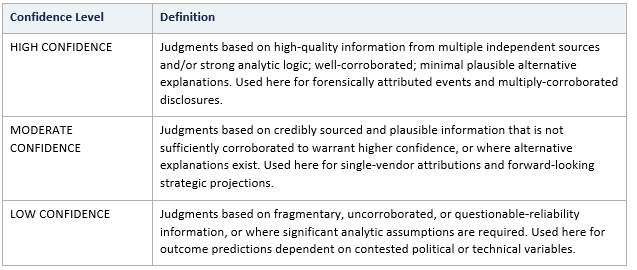
End of briefing. Reporting period 22 April – 05 June 2026 (45 days rolling). Next scheduled update: 12 June 2026. Classification: UNCLASSIFIED // OSINT — TLP:WHITE.