
Executive Summary — Bottom Line Up Front (BLUF)
The seventh weekly update in the rolling 45-day assessment is the convergence/inflection week. Four major trigger events that were tracked across prior briefings as future risks have now resolved — and all four resolved in directions that materially expand operational space for the four monitored adversaries while constraining Western diplomatic and bureaucratic levers for response. The Trump-Xi Beijing state visit (13–15 May) concluded as a stalemate summit with zero cyber deliverables, an explicit Taiwan warning from Xi, Nvidia H200 chip export approvals for approximately ten Chinese firms, and a Trump indication he is contemplating lifting sanctions on Chinese buyers of Iranian oil. CISA Binding Operational Directive 22-01’s deadline for FCEB agencies to remediate CVE-2026-32202 elapsed on 12 May with no public compliance report; analyst estimates place 30–40 percent of affected systems unpatched at deadline, and APT28 exploitation of the underlying NTLM coercion capability has been continuous since December 2025 (a five-month window). Iran’s negotiated framework — the 14-point MOU first reported by Axios on 6 May — remains unsigned. President Trump declared the ceasefire “on life support” on 12 May. Iran’s Foreign Minister Araghchi confirmed on 15 May that talks are in deadlock over enriched uranium disposition and that Iran is simultaneously discussing a Russian-proposed uranium relocation arrangement, opening a parallel diplomatic track that further reduces U.S. leverage. The Drift Protocol stolen-ETH activation window peaks at T-1 (16 May), with all $285 million in ETH fully dormant for 44 days as of 0500 UTC on 15 May.
Three independent cyber-significant events overlaid on these diplomatic and policy resolutions further define this reporting period. First, an unattributed attacker drained approximately $10.7 million from THORChain’s Asgard vaults across Bitcoin, Ethereum, BNB Smart Chain, and Base simultaneously on 15 May; THORChain executed an emergency global halt. THORChain is assessed as the single most critical cross-chain laundering rail for DPRK-linked crypto proceeds — processing the majority of ETH from both the $1.46 billion Bybit theft and the $292 million KelpDAO exploit. The halt arriving on the same day as the Drift Protocol laundering peak creates a structural bottleneck against DPRK conversion of stolen Drift ETH, potentially forcing a pivot to Railgun, Umbra, or Chinese OTC intermediary rails. Second, Google Threat Intelligence Group documented the first confirmed case of a threat actor deploying an AI-generated zero-day exploit in an active operation — a Python script targeting a two-factor-authentication bypass in an open-source web administration tool whose characteristics (extensive docstrings, structured formatting, educational inline comments) were distinctive of large-language-model-generated code; PRC-nexus actor UNC2814 was separately documented using “persona-driven jailbreaking” to extract vulnerability research from commercial AI models as a standard operational workflow. Third, Dragos documented the first confirmed AI-assisted operational-technology attack — against a Monterrey, Mexico municipal water utility — in which an adversary used a commercial AI model to autonomously navigate SCADA segmentation boundaries. The Five Eyes joint guidance on agentic AI security (CISA, NSA, ASD/ACSC, CCCS, NCSC-NZ, NCSC-UK), published 1 May, addresses precisely this threat vector and is now in post-publication implementation.
On the nation-state campaign side, the most operationally significant new disclosure of the reporting window is Symantec’s 13 May confirmation that Seedworm (MuddyWater / MOIS) has, in Q1 2026, achieved the broadest geographic targeting footprint on record — at least nine organizations across four continents, including a South Korean electronics manufacturer, a Middle East international airport, Latin American financial services, and Southeast Asian industrial manufacturers — using a novel technique that weaponizes signed endpoint-security tooling: DLL sideloading via the trojanized SentinelOne binary sentinelmemoryscanner.exe. This is the first confirmed use of a signed SentinelOne binary as a malicious DLL loader by an Iranian APT and represents a qualitative defense-evasion capability advancement against EDR-centric defensive architectures. In parallel, Hunt.io exposed (5–7 May) an Iranian-nexus operation against twelve Omani government ministries — including the Royal Oman Police, Ministry of Finance, Ministry of Justice, Tax Authority, and Office of Public Prosecution — exfiltrating more than 26,000 citizen records and SAM/SYSTEM registry hives. Oman is the primary mediation channel between Iran and the United States; the operation constitutes strategic intelligence collection directly against the deal-making process.
Key Judgments (ICD 203 Confidence Labels)
• KJ-1 (HIGH CONFIDENCE): The Trump-Xi Beijing summit (13–15 May 2026) produced zero binding cyber accountability for PRC operations and zero analog to the 2015 Obama-Xi cyber non-espionage framework. Salt Typhoon, Volt Typhoon, and Shadow-Earth-053 prepositioning will continue unimpeded by diplomatic pressure through at least the 24 September reciprocal White House summit — a four-month minimum extended cyber enforcement forbearance window.
• KJ-2 (HIGH CONFIDENCE): The CVE-2026-32202 federal patching deadline (12 May) elapsed with no public CISA compliance report and an estimated 30–40 percent of affected FCEB systems unpatched at deadline. APT28 (GRU Unit 26165) exploitation of the underlying NTLM coercion capability has been continuous since December 2025; non-FCEB populations (defense industrial base, NATO logistics, EU government) remain actively exposed with no binding deadline. Post-deadline credential harvesting against unpatched systems is assessed as ongoing.
• KJ-3 (HIGH CONFIDENCE): Sandworm (GRU Unit 74455 / APT44) has established a persistent OT/ICS targeting posture in NATO member industrial sectors with a demonstrated post-detection escalation doctrine. Nozomi Networks telemetry (May 13) documents 29 confirmed Sandworm events across 10 industrial organizations in seven countries; one compromised host targeted 405 internal systems and average pre-detection warning windows were 43 days. The Poland ABW disclosure (May 8) of five 2025 water-treatment ICS breaches with explicit APT28/APT29 attribution confirms a coordinated Russian hybrid warfare campaign against NATO frontline critical infrastructure.
KJ-4 (HIGH CONFIDENCE): Gamaredon (FSB 18th Center) is conducting sustained CVE-2025-8088 (WinRAR) spearphishing operations against Ukrainian state institutions, with GammaDrop and GammaLoad as newly documented malware families. Twelve-plus waves observed September 2025 • through 8 May 2026, including ARJ-archive masquerade waves on 5, 7, and 8 May. The campaign uses Cloudflare Workers for C2, fast-flux DDNS, and persistent NTFS alternate-data-stream abuse.
• KJ-5 (HIGH CONFIDENCE): CL-STA-1132 exploitation of CVE-2026-0300 (Palo Alto Networks PAN-OS, CVSS 9.3) represents the highest-priority new operational threat in this reporting period. EarthWorm tooling overlap with Volt Typhoon, APT41, and UAT-8337 — combined with SAML-flood-triggered failover exploitation, systematic Linux log destruction, and Active Directory enumeration via firewall service account credentials — indicates Tier 1 Chinese state nexus capability. CISA’s four-day KEV deadline (9 May, expired) was one of the fastest KEV-to-deadline windows on record.
• KJ-6 (HIGH CONFIDENCE): The Iran MOU has entered structural stalemate. Trump’s “life support” declaration (12 May), Iran’s chief negotiator’s “must accept our proposal or face consequences” posture (12 May), Foreign Minister Araghchi’s 15 May confirmation of deadlock plus parallel Russian uranium-relocation track, and the 14 May hardline congressional letters (52 Senators, 177 Representatives) demanding full nuclear dismantlement are collectively irreconcilable within the current negotiating window. IRGC cyber operational authorization is fully retained.
• KJ-7 (HIGH CONFIDENCE): Seedworm (MOIS / MuddyWater) has weaponized signed SentinelOne endpoint-security software (sentinelmemoryscanner.exe) for DLL sideloading — the first confirmed Iranian APT use of trusted EDR binaries to defeat allowlisting and process-trust defenses. The Q1 2026 global campaign documented by Symantec (13 May) crosses four continents and includes new sector expansion into South Korean electronics, Southeast Asian industrial manufacturing, and Latin American financial services.
• KJ-8 (HIGH CONFIDENCE): CrowdStrike’s 14 May Financial Services Threat Landscape Report represents the most authoritative public documentation of DPRK AI-industrialized identity fraud to date. FAMOUS CHOLLIMA (UNC1069 / Contagious Interview) doubled operational scale using AI-generated identities; STARDUST CHOLLIMA (Sapphire Sleet) tripled tempo via AI-generated recruiter personas and synthetic video conferencing environments. AI removes the primary social-engineering bottleneck — credible human-persona construction — and enables exponential scaling without proportional human resource investment.
• KJ-9 (HIGH CONFIDENCE): The convergence week (12–16 May) resolved with maximum strategic ambiguity rather than clarity across all four monitored trigger events — analytically the most dangerous configuration. Adversaries are operating without effective deterrent consequence while Western defensive posture is fragmented (CISA director vacancy at 9+ months, $707M FY27 budget cut request pending, election-security program effectively eliminated, post-deadline FCEB exposure to NTLM coercion).
• KJ-10 (MODERATE CONFIDENCE): The THORChain Asgard vault exploit (15 May) is most likely an opportunistic third-party operation; DPRK attribution is not confirmed and operational signaling against the DPRK rail is plausible but unevidenced. The halt nonetheless creates a near-term structural bottleneck against DPRK Drift Protocol ETH conversion if movement initiates during the T-1 peak window. Analysts should monitor Railgun, Umbra, and direct OTC intermediary rails for substitution.
• KJ-11 (MODERATE CONFIDENCE): The first confirmed AI-generated zero-day exploit (GTIG, May 2026) and the first confirmed AI-assisted OT attack (Dragos / Monterrey water utility, April 2026 disclosure window) mark the operational threshold-crossing from AI as an experimental adversary capability to AI as an integrated component of nation-state attack chains. CrowdStrike’s 2026 Global Threat Report documents an 89 percent increase in AI-enabled adversary activity; the trajectory is now confirmed across Russia, China, DPRK, and Iran.
• KJ-12 (MODERATE CONFIDENCE): Salt Typhoon’s Azerbaijan oil-and-gas pivot (December 2025 – February 2026, disclosed 14 May) signals a deliberate Chinese geographic and sector expansion aligned with the Hormuz-driven European energy corridor reconfiguration. Combined with FBI’s February confirmation that Salt Typhoon activity remains ongoing across 80+ countries and the absence of summit-level attribution, the operational tempo of PRC strategic-intelligence collection is unconstrained.
Section 1 — Strategic Landscape
1.1 Reporting Period Triggers and Inflection Points
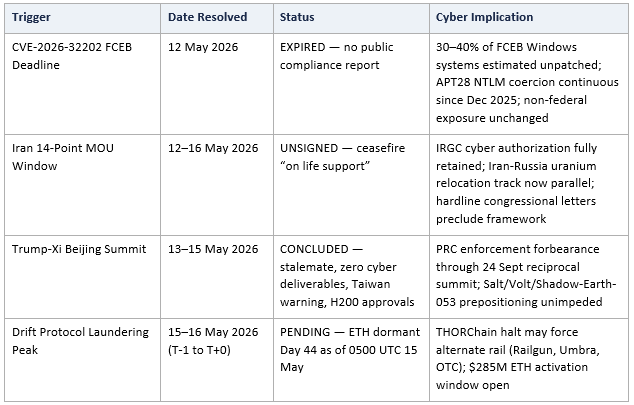
The 31 March – 15 May 2026 reporting period closes with four trigger events tracked across the prior six weekly briefings now resolved. The resolutions, in chronological order:
1.1.1 Trump-Xi Summit Outcome — Cyber Posture Summary
President Trump arrived in Beijing on 13 May evening for the first U.S. presidential state visit to China since 2017. The two-day summit covered trade, the Iran-Hormuz conflict, Taiwan, AI and semiconductors, and rare earths. Trump described the summit as “historic” and called it the “G2,” while Xi framed a three-year “constructive, strategic, and stable” framework. The White House readout omitted both Taiwan and cybersecurity; the joint framing contained zero cyber-specific language. No analog to the 2015 Obama-Xi cyber non-espionage agreement emerged. The U.S. raised AI distillation per the 23 April OSTP “industrial-scale” memo by White House OSTP director Michael Kratsios; Beijing rejected the characterization that Chinese labs are “extracting” U.S. AI capabilities. No bilateral mechanism to address AI distillation was agreed.
On the technology side, the U.S. Commerce Department approved approximately ten Chinese firms (Alibaba, Tencent, ByteDance, JD.com, Lenovo, Foxconn among them) to purchase Nvidia H200 chips concurrent with the summit — capped at 75,000 chips per buyer, requiring 25 percent U.S. revenue share, transit through U.S. territory, and buyer certification of non-military use. No deliveries have occurred. On Taiwan, Trump and Xi discussed the $14 billion arms package; Trump acknowledged Xi “would like us not to” proceed, and no public agreement was reached. On Iran, Xi called for swift resolution and offered to facilitate U.S.-Iran peace talks; Trump declined. Both agreed the Strait of Hormuz “must remain open.” Trump indicated he is “contemplating lifting sanctions on Chinese firms that acquire Iranian oil” — a direct concession on the China-Iran oil corridor that would benefit PRC “teapot” refineries currently in OFAC’s secondary sanctions crosshairs. No announcement of that relief had been made as of 15 May. The Xi-Trump reciprocal summit at the White House is scheduled for 24 September 2026, extending the cyber enforcement forbearance horizon by at least four months.
1.1.2 CVE-2026-32202 Deadline Outcome and Residual Exposure
The CISA BOD 22-01 mandatory deadline for FCEB agencies to apply the 14 April Patch Tuesday update addressing CVE-2026-32202 (Windows Shell zero-click NTLM hash coercion) elapsed on 12 May. No public statements from CISA or the Office of Management and Budget have confirmed overall FCEB compliance rates in open-source reporting as of 15 May. Patch saturation for federal agencies is assessed with moderate confidence to be high given the explicit KEV addition (28 April) and the 14-day remediation window, but historical KEV compliance baselines combined with three structural factors lower confidence in completeness: Microsoft’s initial 14 April “not exploited” classification that removed urgency signals for two weeks; the absence of CISA’s proposed three-day remediation policy from formal adoption; and the CISA leadership vacuum (Acting Director Andersen, no permanent director, $707 million FY27 budget cut request) limiting compliance enforcement capacity. For non-federal organizations — defense industrial base, NATO logistics, EU government — no binding deadline applies and the exposure is materially larger.
A Kiteworks analysis published 13 May 2026 confirmed that APT28 has been exploiting the underlying NTLM coercion capability continuously since December 2025 — well before the 14 April patch and before the 27 April corrective advisory. The structural relationship between CVE-2026-32202 and its predecessor CVE-2026-21510 makes attribution of post-deadline exploitation to APT28 with high confidence. No specific confirmed post-12 May breach has been disclosed in open sources as of this reporting date; the typical 30–90 day lag between intrusion and public breach confirmation makes an absence of current reporting unreliable as evidence of non-exploitation. APT28 is assessed with high confidence to be sustaining exploitation against NATO defense industrial base, logistics, and EU government targets through at least June 2026. Hashes harvested before 12 May do not expire when the patch is applied; pass-the-hash lateral movement remains available regardless of subsequent remediation.
1.1.3 Iran MOU Status — Negotiations on “Life Support”
The Iran 14-point MOU framework first reported by Axios on 6 May remains unsigned as of 15 May. Trump declared the ceasefire “on life support” on 12 May after Iran’s latest counter-response was assessed as inadequate, with the White House citing the removal of Iran’s commitment to transfer highly enriched uranium out of the country. On the same day Iran’s chief negotiator warned the United States must accept Iran’s proposal “or face consequences.” On 14 May, 52 Senate Republicans and 177 House Republicans wrote to President Trump demanding the full dismantlement of Iran’s nuclear program — a hardline floor that effectively precludes the existing MOU framework. On 15 May, Iran’s Foreign Minister Abbas Araghchi confirmed that talks are in deadlock over enriched uranium disposition, expressed doubts about U.S. “seriousness,” and disclosed that Iran is simultaneously in discussions with Russia over a Russian-proposed uranium relocation arrangement. Trump indicated willingness to discuss a 20-year halt on Iranian enrichment “if Iran’s assurance is genuine,” but no signed instrument and no date for resumed talks have been announced. Prediction-market odds of a U.S.-Iran nuclear deal before end of 2026 stood at approximately 54 percent on 13 May.
The cyber consequence is the sustained near-deal/no-deal oscillation: enough diplomatic momentum to avoid resumed U.S. strikes, but no actual deal that would terminate IRGC operational authorization. Combined with the Trump-Xi summit’s divided U.S. attention, this represents the maximum sustained gray-zone incentive for IRGC operational tempo. We assess with high confidence that Iranian cyber actors are now operating under a “use-it-or-lose-it” strategic framework where continued restraint yields no diplomatic dividend.
1.1.4 Drift Protocol Laundering Peak — T-1 Status
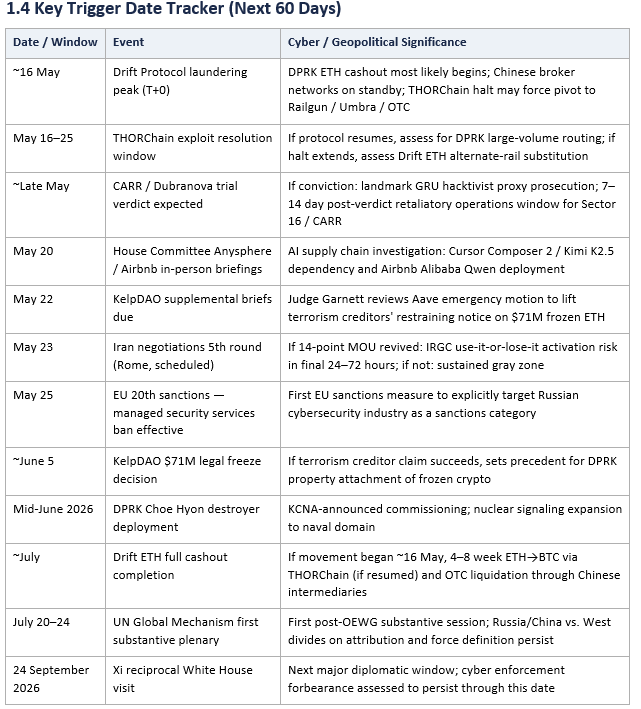
The Drift Protocol $285 million ETH theft occurred on 1 April 2026; the 45-day activation threshold derived from the Radiant Capital (October 2024) and Bybit (February 2025) post-theft dormancy patterns attributed to TraderTraitor / Citrine Sleet places the peak laundering activation window at approximately 16 May (T-1 as of this brief). As of 0500 UTC on 15 May 2026, all stolen ETH remains fully dormant on-chain (Day 44 of dormancy). The Drift recovery pool is funded at approximately $3.8 million USDT seed; the Tether commitment of up to $127.5 million has not yet been funded. Stolen-fund recovery is at $0; Mandiant forensic investigation is ongoing; the Drift relaunch target remains Q2 2026 before July per DL News. The THORChain halt arriving on the same day as the peak window introduces an exogenous variable — if the DPRK actor attempts to route Drift ETH through THORChain during the halt window, transactions will fail, potentially extending dormancy. Analysts are advised that absence of movement through 17 May is not operationally meaningful; extended dormancy is within the documented pattern range (60–120 days per Radiant Capital). Any movement before 1 June should trigger immediate escalation.
1.2 Cross-Adversary Convergence (Russia-Iran-China-NK)
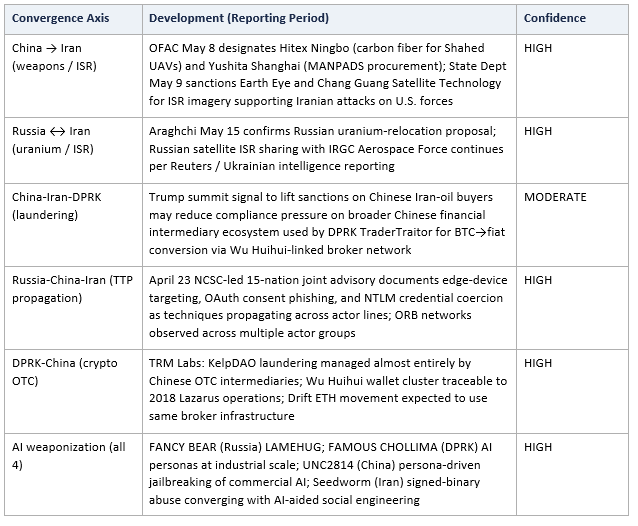
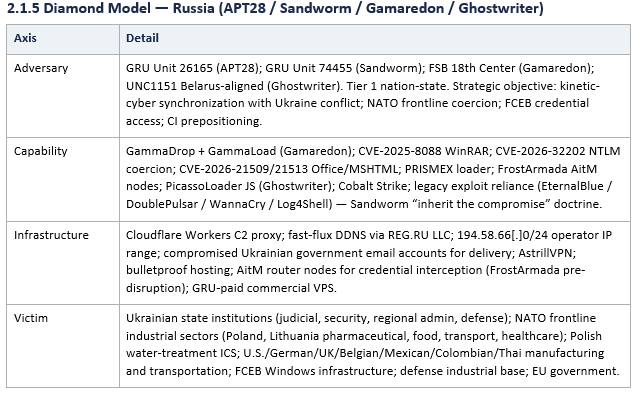
The four monitored adversaries continue to occupy distinct strategic lanes — Russia (kinetic-cyber synchronization in Ukraine, NATO frontline pressure), China (strategic-intelligence prepositioning, AI distillation, Taiwan-Hormuz axis), DPRK (revenue generation through crypto theft and IT-worker fraud), Iran (regime preservation through cognitive warfare, ICS/OT preparation, intelligence collection against negotiation infrastructure) — but the boundary between their tradecraft has eroded materially during the reporting period.
1.3 Western Defensive Posture Status
1.3.1 CISA — Leadership and Operational Status
CISA enters its second acting-director cycle since January 2025 with no end in sight. Plankey’s nomination was formally withdrawn on 28 April; no replacement nominee has been announced. Confirmation following any future nomination would require a minimum three-to-four-month Senate calendar, meaning CISA will almost certainly not have a confirmed director before Q4 2026. Acting Director Nick Andersen remains in place. The $707 million FY27 budget cut request remains pending congressional action. CISA’s cybersecurity-division reorganization announced February 2026 is mid-implementation, narrowing mission focus to OT security, national cyber defense, and partner intelligence delivery at the expense of election security programs and broader critical-infrastructure partnership activities. The election-security program is effectively eliminated with eight months to the November 2026 midterms, creating a structural vulnerability previously assessed at high confidence. CISA launched its CI Fortify strategic guidance framework on 5 May, citing the April 2026 NSA/FBI advisory on Russian GRU router exploitation and the Polish ABW ICS disclosures as motivating factors; CI Fortify directs critical-infrastructure operators across all 16 U.S. sectors to prepare for weeks-to-months of isolated operations during geopolitical conflict — framing the threat environment as an active conflict posture rather than an incremental threat.
1.3.2 Five Eyes — Agentic AI and ORB Network Advisories
The 1 May Five Eyes joint guidance on Careful Adoption of Agentic AI Services (CISA, NSA, ASD/ACSC, CCCS, NCSC-NZ, NCSC-UK) — the first coordinated Five Eyes regulatory statement on agentic AI — entered its post-publication implementation phase during this reporting period. Dragos’s documented April 2026 case of an AI-assisted OT attack against the Monterrey, Mexico municipal water utility (adversary used a commercial AI model to autonomously navigate SCADA segmentation) confirms the threat vector the guidance addresses is no longer theoretical. The 23 April NCSC-led 15-nation joint advisory on China-linked Operational Relay Box (ORB) networks — published on Day 2 of CYBERUK 2026 — is the most operationally significant Five Eyes publication of the reporting window for defenders. The advisory’s key finding is that IOC extinction (indicators disappearing as fast as they are discovered) now requires “adaptive, intelligence-driven” defense rather than signature-based approaches. NCSC CEO keynote at CYBERUK (22 April) explicitly named China, Iran, and Russia as the three primary national-security cyber threats in unambiguous language — China as a “peer competitor in cyberspace,” Iran using cyber to suppress British nationals on UK soil, and Russia “taking the cyber lessons it has learnt in a theatre of war... beyond the battlefield.”
Section 2 — Nation-State Threat Analysis
Section 2 profiles the four primary nation-state threat actors covered by this briefing. Each subsection follows a consistent structure: strategic posture, active campaigns and operations across the full rolling 45-day window, tactics/techniques/procedures with novel-flag annotations, consolidated indicators of compromise, Diamond Model analysis, MITRE ATT&CK mapping, and 30–60 day outlook with ICD 203 confidence labels. May 15 lead findings are highlighted in each strategic posture summary; full 45-day rolling context (March 31 – May 15) is preserved in active campaigns.
2.1 Russia
2.1.1 Strategic Posture
Russia continues to occupy the most kinetically-integrated cyber posture of the four monitored adversaries, with operational tempo aligned to Moscow government working hours (Nozomi telemetry shows peak Wednesday ~14:00 Moscow time across 29 Sandworm events) and target selection synchronized with the Ukraine conflict and NATO frontline pressure campaign. The May 8–15 window is defined by three convergent disclosures: (1) the Polish ABW’s 8 May publication of its first public threat report since 2014, attributing five 2025 water-treatment ICS breaches to APT28 and APT29 and a December 2025 combined-heat-and-power plant attack to Sandworm; (2) Nozomi Networks’ 13 May publication of telemetry-based analysis documenting 29 confirmed Sandworm events across 10 industrial organizations in seven countries and a defining post-detection escalation doctrine; and (3) HarfangLab’s 13 May TRR260501 comprehensive technical analysis of Gamaredon’s GammaDrop / GammaLoad campaign exploiting CVE-2025-8088 (WinRAR directory traversal) in 12+ waves of spearphishing against Ukrainian state institutions since September 2025, active through at least 8 May 2026. The 12 May CISA BOD 22-01 deadline for FCEB agencies to remediate CVE-2026-32202 — a vulnerability with confirmed APT28 exploitation continuous since December 2025 — elapsed without a public compliance report. Russia’s reporting-window cyber posture is best summarized as sustained operational tempo with no diplomatic deference: the Trump-Xi summit’s focus on China created a permissive U.S.-attention window, and the EU’s 20th sanctions package (adopted 23 April, phased effective May–June) explicitly targets the Russian managed-security-services industry as a sanctions category for the first time.
The Belarus-aligned, Russian-directed Ghostwriter (UNC1151) group escalated its Ukraine government-targeting with a new PicassoLoader JavaScript variant and Cobalt Strike chain documented by The Hacker News on 14 May; victimology extends to Poland and Lithuania industrial, healthcare, logistics, and government sectors. APT44 / Sandworm’s documented operational doctrine has shifted to treat OT/ICS escalation as a post-detection response rather than an objective requiring undisturbed pre-positioning — a structural departure from typical APT tradecraft (which emphasizes stealth) indicating GRU confidence that current EU/NATO defensive capabilities cannot contain Sandworm at speed. The 43-day average pre-Sandworm warning period documented by Nozomi means defenders have advance indicators they are frequently failing to act on.
2.1.2 Active Campaigns and Operations (Full Rolling Window)
The following subsections enumerate the active Russia-attributed campaigns observed across the 31 March – 15 May 2026 reporting window, ordered by operational significance.
Gamaredon (UAC-0010 / Aqua Blizzard / Primitive Bear / Shuckworm) — GammaDrop / GammaLoad Twelve-Wave CVE-2025-8088 Campaign
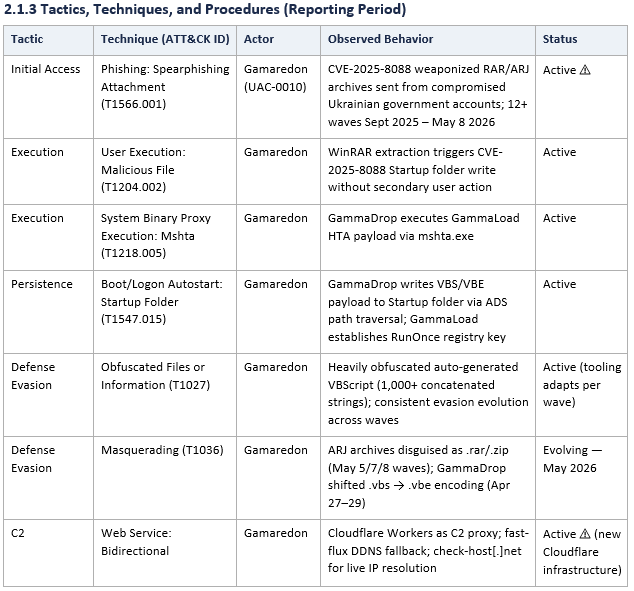
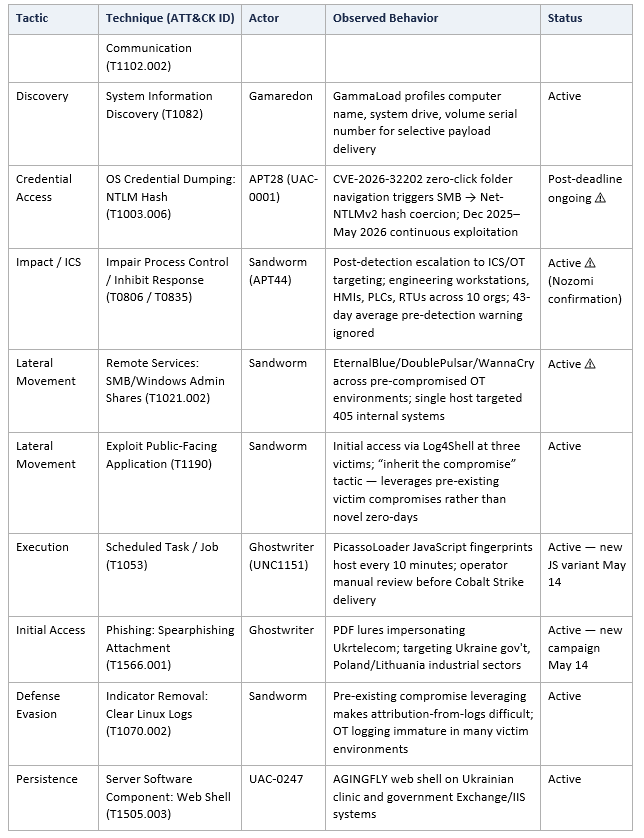
Gamaredon (assessed as FSB 18th Center of Information Security) has conducted at least twelve waves of spearphishing against Ukrainian state institutions from September 2025 through 8 May 2026, exploiting CVE-2025-8088 (RARLAB WinRAR ≤7.13 directory traversal). HarfangLab’s Cyber Threat Research Team published comprehensive technical analysis under report TRR260501 on 13 May 2026, documenting two newly tracked Gamaredon malware variants confirmed active through the current reporting window. GammaDrop is a first-stage VBScript downloader written as a persistent auto-generating VBScript dropped to %APPDATA%\Microsoft\Windows\Start Menu\Programs\Startup\ via CVE-2025-8088’s NTFS alternate data stream path traversal; the script is heavily obfuscated, auto-generated per victim, and functions as a downloader for GammaLoad while establishing Cloudflare Worker C2 contact. GammaLoad is a second-stage HTA/VBScript C2 beacon that profiles the infected host (computer name, system drive, volume serial number) and awaits operator-directed selective payload delivery; it uses Cloudflare Workers as primary C2 proxy with fast-flux DDNS fallback C2s registered via REG.RU LLC and establishes persistence via HKCU\SOFTWARE\Microsoft\Windows\CurrentVersion\RunOnce.
Initial access is achieved via CVE-2025-8088: weaponized RAR archives containing a decoy PDF (ADS-embedded) and the GammaDrop VBS payload written silently to the Startup folder without user execution when the archive is extracted. Emails are sent from compromised Ukrainian government accounts (Odessa Oblast official accounts observed) or spoofed via attacker-controlled relays from the 194.58.66[.]0/24 subnet, bypassing SPF/DKIM/DMARC where policies are absent or set to quarantine. Recent waves include ARJ-archive masquerade waves on 5, 7, and 8 May 2026 (ARJ archives disguised with .rar/.zip extensions delivering GammaLoad HTA files) and a 27–29 April encoding shift from .vbs to .vbe indicating active evasion adaptation. Confirmed targets include Ukrainian state institutions — security services, courts, prosecutors, regional administrations, military prosecution, National Anti-Corruption Bureau (NABU), CourtID, and Defense Forces — with regional targeting focused on entities in Luhansk, Lviv, Chernivtsi, Odesa, Sumy, Kirovohrad, Zaporizhzhia, and Khmelnytskyi oblasts. The campaign’s continued operation through 8–15 May despite the publicly disclosed CVE-2025-8088 exploitation confirms that Ukrainian organizations are not patching WinRAR at an operationally sufficient rate.
Sandworm (APT44 / Seashell Blizzard / Voodoo Bear) — Nozomi Industrial Telemetry: OT/ICS Multi-Country Manufacturing and Transportation Targeting
Sandworm is the GRU Unit 74455 cyber-physical operations element. Nozomi Networks published on 13 May 2026 a telemetry-based analysis of Sandworm operations in industrial environments documenting 29 confirmed Sandworm events across 10 industrial customers in seven countries (United States, Germany, United Kingdom, Belgium, Mexico, Colombia, Thailand) over six months (July 2025 – January 2026). The report’s defining behavioral finding is an escalation-after-detection posture: every infected organization experienced Sandworm increasing activity after defenders became aware of the intrusion — expanding lateral movement, increasing alert volume (one infection triggered a 12-fold volume increase), deploying additional malware, and deliberately pivoting toward OT/ICS assets (engineering workstations, HMIs, PLCs, RTUs at Purdue Levels 1–2). Rather than deploying novel zero-days, Sandworm exploited pre-existing compromises in victim environments using EternalBlue, DoublePulsar, WannaCry, Log4Shell, Cobalt Strike, and Metasploit — an “inherit the compromise” tactic that reduces operational signature and leverages organizational remediation failures.
Lateral-movement scale documented in the report: 17 infected machines collectively targeted 923 unique internal systems; one compromised host alone targeted 405 internal systems; 632 machines began generating new alert types after contact. OT targeting specifics: 286 engineering workstations targeted at one victim; 95 HMIs targeted at another; 52 field controllers / RTUs / PLCs / IEDs targeted at a third victim. Every Sandworm-infected system generated serious warning indicators between 20 and 155 days before confirmed Sandworm activity (average 43-day warning window) that went unremediated. The Nozomi report directly correlates with the Polish ABW disclosure (below), confirming Sandworm’s sustained expansion of OT targeting to NATO member manufacturing and transportation sectors across multiple continents. The escalation-after-detection doctrine represents a structural departure from typical APT tradecraft and indicates GRU confidence that current EU/NATO defensive capabilities cannot contain Sandworm at speed.
CVE-2026-32202 — APT28 Post-Deadline Residual Exploitation
CVE-2026-32202 is a zero-click NTLM hash coercion vulnerability in the Windows Shell affecting Windows 10/11 and Server platforms. The vulnerability requires only folder navigation by the victim — explorer.exe’s automatic .LNK metadata parsing triggers an outbound SMB connection that coerces Net-NTLMv2 authentication from the victim’s account. Akamai’s incomplete-patch analysis confirms the vulnerability is structurally a predecessor-related issue with CVE-2026-21510. The 14 April Patch Tuesday update addresses the vulnerability; a corrected advisory was issued 27 April. CISA added CVE-2026-32202 to KEV on 28 April with a 12 May FCEB deadline (BOD 22-01). Microsoft confirmed active exploitation on 27 April. Attribution: Kiteworks’s 13 May analysis confirmed APT28 had been exploiting the underlying NTLM coercion capability continuously since December 2025 — well before the April patch and before the corrective advisory. The structural relationship to CVE-2026-21510 makes attribution to APT28 with high confidence.
Post-deadline assessment: no public statements from CISA or OMB have confirmed FCEB compliance rates in open-source reporting as of 15 May. Estimated 30–40 percent of affected FCEB systems remain unpatched at deadline based on historical KEV compliance baselines combined with Microsoft’s initial “not exploited” classification (which removed urgency signals for two weeks) and the CISA leadership vacuum. Non-federal organizations — defense industrial base, NATO logistics, EU government — remain actively exposed with no binding deadline. We assess with high confidence that exploitation continues against unpatched non-FCEB populations. Pre-deadline intensification against NATO logistics, defense-sector, and EU-government unpatched targets is assessed as likely based on APT28’s established pattern. Trend Micro’s 12 May threat-encyclopedia update (document 26-020) documents continued exploitation telemetry consistent with the APT28 methodology.
Ghostwriter (UNC1151 / Belarus-Aligned, Russian-Directed) — PicassoLoader JavaScript / Cobalt Strike Ukraine-Poland-Lithuania Campaign
Ghostwriter / UNC1151 (Belarus-aligned, Russian-directed information operations and cyberattack group) launched a fresh campaign active since March 2026 documented in detail on 14 May 2026. The campaign targets Ukrainian governmental organizations, military, and defense sector entities via spear-phishing PDFs impersonating Ukrtelecom. The PDF contains malicious links that deploy a JavaScript version of PicassoLoader — an updated variant of the group’s previously documented .NET/PowerShell loader. The technical chain: spear-phishing PDF attachment impersonating Ukrtelecom → malicious embedded link → JavaScript PicassoLoader deploys → host profiling/fingerprinting (every 10 minutes, transmitted to attacker C2) → operators manually review fingerprint data → selective delivery of third-stage JavaScript Cobalt Strike Beacon dropper. Victimology: Ukraine primary (government, military, defense sector); Poland and Lithuania broader (industrial, manufacturing, healthcare/pharma, logistics, government). The inclusion of industrial and manufacturing sectors in NATO frontline states is consistent with Ghostwriter’s hybrid warfare mandate of intelligence collection combined with infrastructure preparation. Kaspersky reporting in this window also documented that pro-Ukraine hacktivist group BO Team / Black Owl may be cooperating with Head Mare (PhantomCore) in retaliation attacks on Russian organizations, deploying BrockenDoor and ZeronetKit.
Poland ABW Disclosure — Five Water-Treatment Plant ICS Breaches (2025, Published 8 May)
Poland’s Internal Security Agency (ABW) published its first public annual threat assessment since 2014, formally documenting a sustained campaign targeting Polish critical infrastructure in 2025. The report’s release in this window represents a significant escalation in Polish national attribution posture. Documented breaches: five Polish water-treatment facilities compromised in 2025 — Jabłonna Lacka, Szczytno, Małdyty, Tolkmicko, and Sierakowo. In several facilities attackers gained access to ICS managing pumps, filters, and chemical dosing, obtaining the capability to modify operational parameters in real time. ABW attributed the campaign to “hacktivist groups that are often personas used by foreign governments, particularly Russian intelligence services,” explicitly naming APT28 and APT29 as operating against Polish targets, alongside UNC1151. The December 2025 attack on a Polish combined heat/power plant — attributed by ESET to Sandworm, affecting near-500,000 customers’ heat supply — was cross-referenced in the report as part of the same escalating pattern. ABW documented between 20 and 50 cyberattacks per day against Polish targets; Polish cybersecurity investment of €1 billion was referenced as a response. The ABW’s public posture shift after 12 years of silence represents a significant political signal of increased attribution willingness aligned with the NATO July summit.
APT28 / Star Blizzard — iOS / iCloud Targeting (DarkSword / GhostBlade)
Star Blizzard’s iOS/iCloud targeting campaign with DarkSword and GhostBlade implants (carry-forward from prior reporting windows) remains active per April 2026 telemetry. The campaign targets policy researchers, NGOs, and journalists with credential-phishing and OAuth-token harvesting via Apple-branded lures. No new specific deployment detail was published in the 8–15 May window, but Star Blizzard infrastructure rotation patterns suggest continuing operations.
Sector 16 / Revenskii Plea (April 30) — Status Update
Andrei Revenskii’s guilty plea on 30 April 2026 to global oil-and-gas ICS infrastructure attack conspiracy charges remains the latest U.S. federal cybercrime action against a named Russian APT-aligned individual. Sentencing is pending. The Victoria Dubranova CARR trial commenced 7 April 2026; based on typical five-to-eight-week federal jury trial durations for computer-crime conspiracy cases, a verdict may be reached within the next 14–21 days (i.e., by early June 2026). No new Sector 16 arrests confirmed in this reporting window. We assess with low confidence that Sector 16 remaining members or CARR may conduct a demonstrative ICS intrusion in the Revenskii sentencing window (expected June–July 2026); past Russian proxy patterns suggest retaliatory hacktivist activity within 7–21 days of adverse judicial events.
EU 20th Sanctions Package — Cyber Provisions (Adopted 23 April, Phased Effective May–June 2026)
The EU’s 20th Russia sanctions package, adopted 23 April 2026, included cyber-relevant provisions entering force during this reporting window: 14 May 2026 — transaction ban on 20 additional Russian banks took effect, including institutions assessed as financing GRU and FSB cyber operations; 25 May 2026 (upcoming) — expanded ban on professional services to Russian state-linked entities, explicitly including managed security services, penetration testing, incident response, and security audits. This represents the first EU sanctions measure to explicitly target the Russian cybersecurity industry as a sanctions category. Total designations: 37 individuals and 80 entities added in the package (largest expansion in two years). On 13 May the EU separately extended the application of travel bans and asset freezes under Decision 2019/797 — the EU’s principal cyber-attack sanctions regime — through 18 May 2027, with new FIMI designations targeting Russia’s hybrid threat infrastructure (total listings 69 individuals and 19 entities under the cyber regime).
PRISMEX / FrostArmada — Follow-On Status
PRISMEX: No new confirmed PRISMEX deployment or infrastructure migration has been detected in open sources in this reporting window. The Trend Micro 12 May threat-encyclopedia update (26-020) may contain updated PRISMEX/APT28 telemetry. The 30–60 day post-disclosure modification window (April 8 Trend Micro disclosure) expires between 8 May and 7 June, placing the current window squarely within the period during which APT28 would be expected to have modified PRISMEX tooling. Analysts should flag any APT28-attributed loader traffic to cloud storage providers other than Filen.io (e.g., Koofr, Icedrive, Internxt) as a potential PRISMEX variant signal. FrostArmada: no confirmed AitM router infrastructure re-establishment detected. The 7 April Operation Masquerade disruption removed the primary AitM node infrastructure; APT28’s documented pattern of rebuilding router-based espionage infrastructure within 30–90 days after disruption (per historical precedent: GRU router botnet rebuilt within 60 days after 2024 FBI operation) suggests potential reconstitution is underway but not yet operationally confirmed.
UAC-0247 / AGINGFLY / SILENTLOOP — Ukrainian Clinic and Government Campaign
CERT-UA documented UAC-0247 expansion from clinical to government targets across Ukraine during March–April 2026, deploying AGINGFLY and SILENTLOOP custom backdoors. The campaign continued through this reporting period without significant evolution. Targets: Ukrainian healthcare facilities, regional administrations, and CERT-UA-coordinated incident response infrastructure. The campaign’s persistence indicates GRU subordinate operational continuity beyond the higher-profile Gamaredon and Sandworm activity.
2.1.7 Assessment and 30–60 Day Outlook
We assess with HIGH CONFIDENCE that Gamaredon’s CVE-2025-8088 campaign is active and ongoing as of 8–15 May 2026 with no evidence of operational disruption. The HarfangLab comprehensive IOC disclosure and the most recent wave dates (5, 7, 8 May 2026) confirm sustained high-tempo spearphishing operations against Ukrainian state institutions. The campaign’s continuous 8-month activity, evolution from .vbs to .vbe payload encoding, and adaptation to ARJ archives in recent waves demonstrate a sophisticated operational pipeline with active developer support.
We assess with HIGH CONFIDENCE that Sandworm has established a persistent OT/ICS targeting posture in NATO member industrial sectors with demonstrated willingness to escalate after detection. Nozomi’s telemetry from 29 confirmed events in seven countries (including Germany, UK, Belgium, and the U.S.) confirms Sandworm’s operational doctrine has shifted to treat OT/ICS escalation as a post-detection response rather than an objective requiring undisturbed pre-positioning. The 43-day average pre-Sandworm warning period means defenders have advance indicators they are frequently failing to act on.
We assess with HIGH CONFIDENCE that Russian actors conducted physically consequential ICS intrusions against Polish critical infrastructure in 2025, with Polish ABW attribution confirming APT28 and APT29. The five Polish water-treatment plant ICS breaches documented by ABW represent confirmed Russian state-directed operations even under the ABW’s cautious “hacktivist proxy” framing. The ABW’s explicit naming of APT28 and APT29 — combined with Sandworm’s documented December 2025 Polish energy-grid attack — confirms a sustained Russian hybrid warfare campaign against Polish critical infrastructure as a coercive tool against a NATO frontline state.
We assess with HIGH CONFIDENCE that CVE-2026-32202 exploitation against non-federal targets is ongoing. APT28 continues to exploit the NTLM coercion vector against organizations that have not applied the 14 April Patch Tuesday update. The FCEB deadline creates only a partial reduction in attack surface; defense industrial base, EU government entities, and NATO logistics contractors remain actively exposed.
We assess with MODERATE CONFIDENCE that PRISMEX tooling is undergoing modification or being replaced based on APT28’s documented 30–60 day tool-modification cycle following Trend Micro’s 8 April disclosure. The absence of new confirmed PRISMEX variants as of 15 May is consistent with an ongoing retooling period rather than operational retirement.
We assess with MODERATE CONFIDENCE that the Trump-Xi summit’s focus on AI competition and China-linked cyber operations reduced short-term U.S. political bandwidth for Russian cyber attribution responses, creating a permissive window during 13–15 May. Historical patterns show Russian actors typically increase operational tempo during periods of U.S. diplomatic-political preoccupation with other threat actors.
We assess with MODERATE CONFIDENCE that Ghostwriter’s Cobalt Strike campaign against Poland and Lithuania represents deliberate pre-positioning in NATO frontline industrial and logistics sectors. Expanded targeting of Polish industrial, healthcare, and logistics organizations — beyond the Ukrainian government focus — reflects GRU tasking to establish persistent access in sectors critical to NATO logistics support for Ukraine.
We assess with LOW CONFIDENCE that FrostArmada router infrastructure is being reconstituted following Operation Masquerade and that a Sector 16 or CARR retaliatory ICS operation may be imminent in the Revenskii sentencing window.
30–60 Day Outlook (15 May – 15 July 2026):
• Gamaredon campaign continuation and potential technique evolution. HarfangLab’s 13 May public disclosure has exposed Gamaredon’s GammaDrop/GammaLoad infrastructure, YARA detection rules, and operator IP ranges. Expect domain infrastructure rotation, new Cloudflare Worker registrations, and potential payload delivery format changes within 7–14 days of disclosure.
• Sandworm OT/ICS escalation against European manufacturing and energy sectors. Organizations currently in the 43-day pre-detection window may soon experience active ICS-targeted escalation. NATO member manufacturing, transportation, and energy sectors should conduct focused threat hunts for EternalBlue, DoublePulsar, and Log4Shell indicators in OT-adjacent systems.
• CVE-2026-32202 residual exploitation against defense industrial base and EU government. APT28 expected to sustain exploitation against NATO defense industrial base, logistics, and EU government targets as alternative high-value post-FCEB-deadline targets. Patch compliance verification urgent through June 2026.
• PRISMEX variant or successor deployment. The 30–60 day post-disclosure window (from 8 April) expires by 7 June; new APT28 loader activity using alternative cloud storage providers, revised steganographic encoding, or new initial-access vectors (OneNote, Teams-based lures) should be expected.
• CARR / Dubranova verdict and post-verdict escalation risk. Conviction is the more likely outcome. GRU-directed proxy groups have historically conducted demonstrative DDoS or intrusion campaigns within 7–14 days of adverse U.S. federal court decisions affecting Russian state-linked actors.
• Ghostwriter intelligence collection ahead of NATO July summit. Cobalt Strike persistence in Polish/Lithuanian pharma, food, transport, and healthcare sectors — if not remediated — provides GRU with the option for disruptive operations timed to the summit.
• EU 20th sanctions package — 25 May effective date for the managed-security-services ban. First EU sanctions targeting Russian cybersecurity industry as a category; expect immediate sanctions-evasion network reconfiguration.
2.2 China
2.2.1 Strategic Posture (Trump-Xi Summit Outcome)
China’s cyber posture for the May 8–15 reporting window is defined by the Trump-Xi Beijing summit (13–15 May) and a months-long state-sponsored campaign exploiting CVE-2026-0300 in Palo Alto Networks PAN-OS. The summit concluded with warm optics but negligible substantive cyber deliverables: the White House readout emphasized “enhanced economic cooperation” and market access; the joint framing conspicuously omitted Taiwan and contained zero cyber-specific language. Xi warned Trump that mishandling Taiwan “could lead to conflict,” and both sides agreed to a framework of “constructive strategic stability” — but no analog to the 2015 Obama-Xi cyber non-espionage agreement emerged. Cyber enforcement forbearance continues into its sixth month and will extend at minimum through the 24 September reciprocal White House summit.
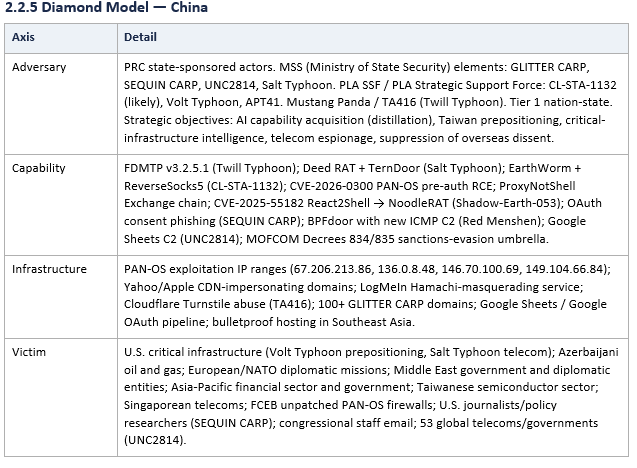
The most operationally significant new disclosure of the reporting window is Unit 42’s 6–7 May attribution of CVE-2026-0300 (CVSS 9.3) exploitation to a state-sponsored cluster designated CL-STA-1132. Post-exploitation tooling — EarthWorm and ReverseSocks5 — overlaps with Volt Typhoon, APT41, and UAT-8337, providing an infrastructure-overlap signal pointing toward Chinese state nexus. Twill Typhoon (Mustang Panda / TA416) deployed an updated FDMTP v3.2.5.1 modular RAT across the Asia-Pacific and Japan region; Salt Typhoon (Earth Estries) pivoted to Azerbaijani oil-and-gas targeting via ProxyNotShell exploitation. The U.S. Commerce Department approved approximately ten Chinese firms to purchase Nvidia H200 chips concurrent with the summit (Alibaba, Tencent, ByteDance, JD.com, Lenovo, Foxconn among them) under stringent security conditions; no deliveries have occurred. China’s State Council issued MOFCOM Decrees No. 834 and No. 835 with immediate effect 2 May 2026, invoking blocking-rule authority for the first time to prohibit entities from complying with U.S. sanctions on five named Chinese companies — a significant escalation of China’s counter-sanctions architecture.
2.2.2 Active Campaigns and Operations (Full Rolling Window)
CL-STA-1132 — CVE-2026-0300 PAN-OS Zero-Day Exploitation (Unit 42 / Palo Alto, May 6–7)
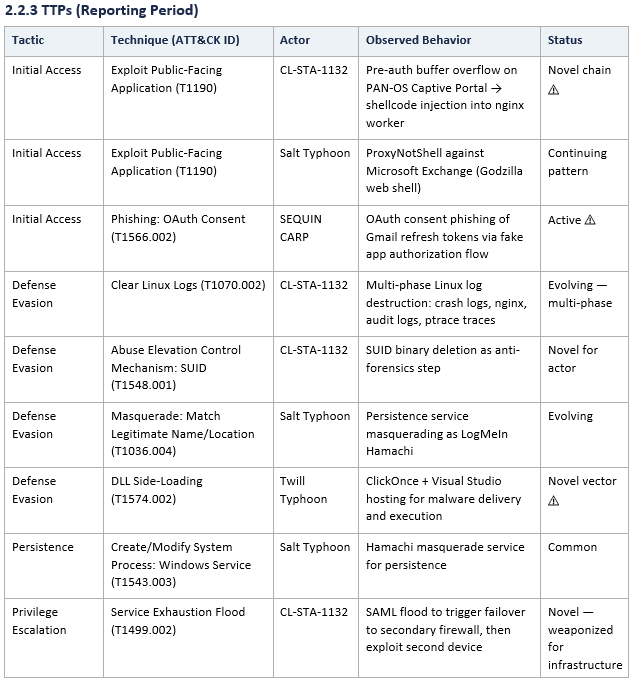
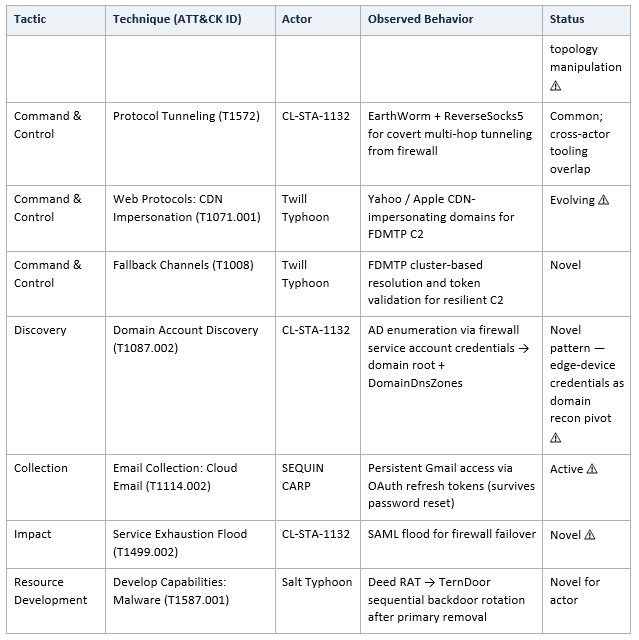
CVE-2026-0300 is a pre-authentication buffer overflow in the Palo Alto Networks PAN-OS User-ID Authentication Portal (CVSS 9.3) affecting PA-Series and VM-Series firewalls. Unit 42 disclosed the exploitation on 6–7 May 2026, attributing it to a cluster designated CL-STA-1132. Timeline of exploitation: 9 April — unsuccessful initial exploitation attempts against an internet-exposed PAN-OS captive portal; 16 April — successful shellcode injection into Nginx worker process with log cleanup immediately initiated (crash kernel messages, nginx entries, core dump files deleted); 20 April — deployment of open-source tunneling tools EarthWorm and ReverseSocks5 with root privileges, Active Directory enumeration via firewall service account credentials targeting domain root and DomainDnsZones, deletion of ptrace injection evidence and SUID escalation binary; 29 April — SAML flood against the first compromised device forced a second firewall to become active and inherit internet-facing traffic, with immediate RCE achieved on the second device and EarthWorm/ReverseSocks5 deployed.
CL-STA-1132 demonstrates extreme operational discipline: open-source tooling only (minimizing signature detection), intermittent interactive sessions spanning weeks, aggressive evidence destruction, and identity trust abuse over traditional network pivoting. EarthWorm specifically has been previously observed in Volt Typhoon, APT41, UAT-8337, and CL-STA-0046 campaigns — providing an infrastructure overlap signal pointing toward Chinese state nexus. Palo Alto declined to formally attribute to a specific nation but characterized the actor as “likely state-sponsored.” Patches were released 13 May (priority versions) and 28 May (remaining). CISA added CVE-2026-0300 to KEV on 7 May with a 9 May FCEB deadline — one of the fastest KEV-to-deadline windows on record, a four-day forced emergency patching order.
Twill Typhoon (Mustang Panda / TA416) — FDMTP v3.2.5.1 Modular RAT in APJ Espionage (Darktrace, May 14)
Darktrace published a full technical analysis on 14 May 2026 of a Twill Typhoon campaign active September 2025 through at least April 2026, targeting entities across the Asia-Pacific and Japan region. The campaign represents the most detailed public documentation of the actor’s updated toolset since late 2024. FDMTP v3.2.5.1 is a modular .NET-based RAT framework communicated over custom TCP using the Duplex Message Transport Protocol (DMTP), with cluster-based resolution, token validation, and a persistent message loop for remote tasking. The malware supports system fingerprinting, command execution, Windows task manipulation, registry persistence management, process manipulation, and remote file/command retrieval. Delivery is via DLL sideloading through the legitimate Windows ClickOnce engine and Visual Studio hosting. Infected hosts make C2 requests to domains impersonating Yahoo and Apple CDN infrastructure, blending into normal enterprise traffic baselines.
In April 2026 a system within a financial organization’s network was confirmed compromised — a sector expansion beyond the prior government/military focus. Darktrace assesses with moderate confidence that the campaign aligns with Mustang Panda / TA416 / Twill Typhoon tradecraft. The actor is also tracked by Proofpoint (TA416), CrowdStrike (Camaro Dragon), and Trend Micro (Earth Preta). Proofpoint additionally documented this actor targeting European diplomatic missions to the EU and NATO through April 2026, including Middle East intelligence collection linked to the U.S.-Israel-Iran conflict.
Salt Typhoon (Earth Estries / GhostEmperor / UNC2286) — Azerbaijan Energy Sector Pivot
Bitdefender documented (published 14 May) a Salt Typhoon intrusion against an Azerbaijani oil-and-gas company between December 2025 and February 2026 — a geographic pivot that security analysts attribute to Azerbaijan’s emergence as a critical European energy corridor following Russia’s Ukraine gas transit expiration and the Strait of Hormuz disruptions. TTPs: initial access via ProxyNotShell exploit chain against Microsoft Exchange servers; web shell deployment (Godzilla class) for initial foothold; Deed RAT deployed via updated DLL sideloading technique with persistence via a service masquerading as LogMeIn Hamachi; RDP lateral movement from initial host to second server; Impacket for third host compromise; following malware removal from one host, re-access via persisted first-stage foothold and deployment of TernDoor backdoor (linked to Salt Typhoon by Cisco Talos); late February 2026 attempted redeployment of Deed RAT via same execution chain — demonstrating persistent access even after partial remediation. Bitdefender characterized the campaign as “not isolated” but a “sustained and adaptive operation” consistent with Salt Typhoon’s documented pattern of returning to previously accessed networks. The FBI confirmed in February 2026 that Salt Typhoon activity is “still very much ongoing” across more than 80 countries.
Twill Typhoon / TA416 — European Government and Middle East Espionage (Proofpoint)
Proofpoint documented TA416 running multiple waves of web bug and malware delivery campaigns against diplomatic missions to the EU and NATO across European countries. The actor rotated its infection chain repeatedly: Cloudflare Turnstile abuse, OAuth redirect abuse, and C# project file delivery — demonstrating rapid tooling evolution to evade corporate email security. In the context of the U.S.-Israel-Iran war, TA416 pivoted to targeting Middle Eastern government and diplomatic entities for regional intelligence collection — aligning TA416 targeting to both the summit preparation and the Iran conflict that dominated the Trump-Xi agenda.
GLITTER CARP / SEQUIN CARP — OAuth Consent Phishing (Citizen Lab / ICIJ)
Citizen Lab and ICIJ (5 May) documented China-aligned phishing actors GLITTER CARP and SEQUIN CARP targeting journalists, diaspora communities, and Taiwan semiconductor sector. SEQUIN CARP’s defining TTP is obtaining persistent Gmail refresh tokens via the legitimate Google OAuth 2.0 flow — any U.S.-based journalist, policy analyst, or think-tank researcher who authorized SEQUIN CARP’s fake app before the summit may still be providing real-time visibility into summit deliberations during 13–15 May. Modern Diplomacy (10 May) reported China’s counter-response to U.S. intelligence operations has included “increased Chinese intelligence attempts to infiltrate US government email systems, including targeting US congressional staff.” GLITTER CARP’s 100+ domain list is available in the Citizen Lab report appendix; no new GLITTER/SEQUIN infrastructure has been publicly documented since 5 May, but the OAuth-token persistence model means active access continues without re-phishing.
Shadow-Earth-053 / UNC6595 — React Server Components Exploitation (CVE-2025-55182)
Shadow-Earth-053 (also tracked as UNC6595) is the actor cluster responsible for exploitation of CVE-2025-55182 (React Server Components / RSC “Flight” protocol RCE). The campaign deploys NoodleRAT for Linux post-exploitation. Multi-vendor convergence: TrendMicro and Google Threat Intelligence Group share indicators across allied services. Carry-forward through the May 8–15 window; additional NATO country victims may be disclosed as allied services complete analysis of shared TrendAI/GTIG indicators.
Storm-1175 — Medusa Ransomware via ConnectWise ScreenConnect and SimpleHelp
Storm-1175 (Microsoft tracking) deploys Medusa ransomware following exploitation of CVE-2024-1708 / CVE-2024-1709 (ConnectWise ScreenConnect path traversal → RCE, CVSS 10.0) and CVE-2024-57726 / CVE-2024-57728 (SimpleHelp admin escalation + path traversal RCE). The 12 May 2026 FCEB deadline for CVE-2024-1708 elapsed; the 8 May SimpleHelp deadline elapsed. Healthcare, education, and financial services remain highest-risk sectors. Microsoft and The Hacker News attribute Storm-1175 to a China-nexus criminal-state hybrid actor.
Cisco Catalyst SD-WAN Manager Mass Exploitation (CVE-2026-20127 / CVE-2026-20128)
Cisco Catalyst SD-WAN Manager (Critical CVSS) is under mass exploitation with 400+ IPs observed conducting authentication bypass + privilege escalation chains for full WAN fabric access. Attribution to UAT-8616 (Cisco Talos) is possible. Prior KEV deadline period (April–May 2026); organizations should treat any SD-WAN Manager exposure as a presumed-compromised pathway pending remediation verification.
BPFdoor / Red Menshen Telecom Sleeper Cells (Rapid7, March 26)
Rapid7 documented BPFdoor sleeper cells in global telecom infrastructure attributed to Red Menshen, with new variants and ICMP C2 signaling. Retroactive threat hunting using Rapid7’s open-source detection script is recommended for all global telecom operators; additional victim notifications expected through June–July 2026.
UNC3886 — Singapore Telecoms (Operation CYBER GUARDIAN, February 2026)
Singapore’s Cyber Security Agency (CSA) and IDA announced Operation CYBER GUARDIAN on 9 February 2026: all four major Singapore telcos attacked, zero-day used to bypass perimeter firewall. Carry-forward context for the reporting window.
UNC2814 — Google Sheets C2 Across 53 Telecoms / Governments in 42 Countries (CSO Online / GTIG / Mandiant, February 25–26)
UNC2814 / GRIDTIDE used Google Sheets as a C2 channel to spy on 53 telecoms and governments in 42 countries. This actor is separately documented in May 2026 by Hive Security/GTIG as using “persona-driven jailbreaking” to extract vulnerability research from commercial AI models — see Section 3.8 for the first confirmed AI-generated zero-day exploit.
UNC6201 — Dell RecoverPoint Zero-Day (CVE-2026-22769)
Mandiant/GTIG documented UNC6201 zero-day exploitation of Dell RecoverPoint (CVE-2026-22769, CVSS 10.0) since mid-2024 with GRIMBOLT C# backdoor. Disclosed 18 February 2026.
Xu Zewei Federal Proceedings (Houston)
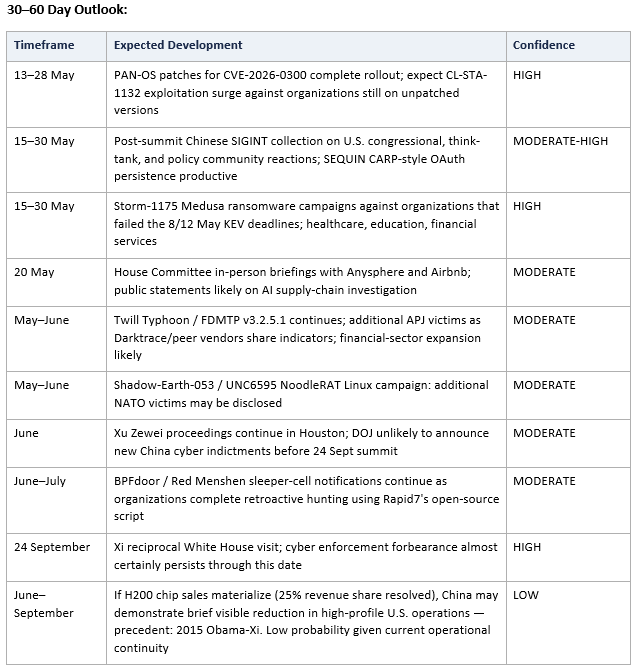
Federal proceedings against Xu Zewei continue in Houston; co-conspirator Zhang Yu remains at large. DOJ unlikely to announce new China cyber indictments before the 24 September summit. We assess with moderate confidence that DOJ may escalate to Red Notice or additional indictments if summit fails to produce cyber discussions — Trump-Xi summit produced no cyber discussions, raising probability of Q3 2026 indictment escalation.
2.2.7 Assessment and 30–60 Day Outlook (Post-Summit Forbearance Through Sept 24)
Overall threat level: ELEVATED — qualitative increase in edge-device exploitation risk; summit produced no cyber stabilization.
We assess with HIGH CONFIDENCE that CL-STA-1132’s exploitation of CVE-2026-0300 in PAN-OS represents the highest-priority new operational threat in this reporting period. The actor’s use of EarthWorm — a tool overlapping with Volt Typhoon, APT41, and UAT-8337 — combined with SAML flood-triggered failover exploitation and systematic log destruction, indicates a Tier 1 adversary with pre-planned playbooks for network edge-device compromise. Any organization with internet-exposed PAN-OS Captive Portals that has not applied the 13 May patches is at immediate risk of persistent, forensically difficult-to-detect root-level compromise.
We assess with HIGH CONFIDENCE that the Trump-Xi summit produced no cyber-relevant commitments. The White House readout omitted both Taiwan and cybersecurity; China rejected the U.S. AI distillation characterization; no analog to the 2015 Obama-Xi framework was discussed publicly. Cyber enforcement forbearance will extend at minimum through the 24 September reciprocal summit. Chinese APT operational tempo showed no pre-summit reduction.
We assess with HIGH CONFIDENCE that Salt Typhoon’s Azerbaijan energy-sector pivot signals a deliberate targeting expansion aligned with the Hormuz-driven European energy crisis. Any critical-energy infrastructure with Microsoft Exchange exposure should treat this as a direct threat indicator, particularly in European NATO member states relying on Azerbaijani gas.
We assess with MODERATE CONFIDENCE that Twill Typhoon’s FDMTP v3.2.5.1 deployment against the Asia-Pacific and Japan region, now documented against financial-sector targets, represents a sector expansion beyond government/military. The CDN-impersonation C2 (Yahoo/Apple services) is specifically designed to defeat enterprise proxy and network-monitoring baselines.
We assess with MODERATE CONFIDENCE that the House AI supply-chain investigation (Anysphere / Airbnb) will produce limited near-term policy outcomes despite the 13 May deadline passing during the summit. With Trump having approved H200 chip sales to Chinese firms concurrently, the political environment for punitive action against U.S. companies using Chinese AI models is unfavorable through the September summit window.
We assess with MODERATE CONFIDENCE that China-Iran satellite and cyber cooperation has crossed from passive intelligence-sharing to active kinetic support — the documented use of a Chinese commercial satellite for Iranian precision strikes is a strategic escalation with implications for U.S. targeting policy in the Hormuz theater. MSS involvement in Iranian cyber capability development also means that vulnerabilities exploited by Iranian groups should be assessed for potential PRC intelligence access to the same tradecraft.
We assess with LOW CONFIDENCE that the Nvidia H200 chip approvals will be fully executed as announced (75,000 chips per company, 25 percent revenue share, transit-through-U.S. requirement). The conditions have stalled the program since November 2025 and remain technically and politically unresolved.
We assess with LOW CONFIDENCE that CL-STA-1132 is exclusively a Chinese state actor. The EarthWorm infrastructure overlap with multiple Chinese APT clusters is strongly suggestive, and the operational patterns are consistent with PLA SSF or MSS Tier 1 operations. However, Unit 42 has not made a formal nation-state attribution, and we apply low confidence to the specific attribution absent additional corroborating indicators.
2.3 North Korea
2.3.1 Strategic Posture
North Korea’s cyber posture for the 8–15 May reporting window is defined by the convergence of the Drift Protocol $285 million ETH laundering peak window (T-1 / 16 May) with the unexpected exploitation and emergency halt of THORChain — the single most critical cross-chain laundering rail for DPRK-linked crypto proceeds — on 15 May, in the same 24-hour window. Stolen Drift ETH remains fully dormant as of 0500 UTC on 15 May (Day 44 of dormancy), consistent with the 45-day TraderTraitor activation pattern. CrowdStrike’s 2026 Financial Services Threat Landscape Report, published 14 May (the day of the Trump-Xi summit), represents the most authoritative public documentation of DPRK AI-industrialized identity fraud to date: FAMOUS CHOLLIMA (UNC1069 / Contagious Interview) doubled operational scale using AI-generated identities; STARDUST CHOLLIMA (Sapphire Sleet) tripled tempo via AI-generated recruiter personas and synthetic video conferencing environments. The Trump-Xi summit included a confirmed bilateral discussion of North Korea, but no diplomatic outcome was disclosed — Trump confirmed aboard Air Force One on 15 May he discussed North Korea with Xi; the White House readout made no mention of the topic. The Diplomat assessed the absence of substantive Korean Peninsula discussion as removing near-term incentives for DPRK operational restraint. KCNA announced 7 May that DPRK will deploy the Choe Hyon nuclear-capable destroyer (5,000-ton class) in mid-June 2026 following extended navigation trials observed by Kim Jong Un on 6 May — an extension of nuclear signaling to the naval domain.
Two additional reporting-period legal developments shape the picture. On 7 May, Matthew Isaac Knoot (Nashville, TN) and Erick Ntekereze Prince (New York) were sentenced to 18 months in federal prison each for operating laptop farms enabling DPRK IT workers — the seventh and eighth U.S.-based laptop farmers sentenced in 2026 under the DPRK RevGen Domestic Enabler Initiative. On 14 May, U.S. District Judge Margaret Garnett delayed ruling on Aave’s emergency motion to fully unfreeze $71 million in frozen KelpDAO-recovered ETH, ordering supplemental briefs by 22 May with review around 5 June; the underlying KelpDAO rsETH burn (117,132 rsETH on Arbitrum) was completed on 12 May, with withdrawals resuming within 24 hours.
2.3.2 Active Campaigns and Operations (Full Rolling Window)
Drift Protocol Laundering Peak Tracker (T-1, ~16 May)
The Drift Protocol $285 million ETH theft on 1 April 2026 (attributed to TraderTraitor / Citrine Sleet — DPRK subgroup) has reached its laundering peak activation window. The 45-day analytical threshold is derived from the Radiant Capital (October 2024) and Bybit (February 2025) post-theft dormancy patterns. As of 0500 UTC on 15 May 2026 (Day 44), all stolen ETH remains fully dormant on-chain. Drift recovery pool is funded at approximately $3.8 million USDT seed; Tether’s commitment of up to $127.5 million has not been funded. Stolen-fund recovery is at $0. Mandiant forensic investigation continues. Drift relaunch target remains Q2 2026 (before July per DL News). Monitoring priority IOCs (elevated status): Drift attacker primary Solana address HkGz4KmoZ7Zmk7HN6ndJ31UJ1qZ2qgwQxgVqQwovpZES; multiple ETH bridge destination wallets tracked via TRM Beacon / Chainalysis KYT; THORChain native pools (ETH→BTC conversion) monitored for large volume once protocol resumes.
The 45-day activation threshold is an analytical construct derived from TraderTraitor / Citrine Sleet patterns. The Drift theft actor is assessed as a distinct (but related) DPRK subgroup by TRM Labs; their specific dormancy behavior may diverge from the TraderTraitor playbook. The THORChain halt introduces an exogenous variable — if the DPRK actor attempts to route Drift ETH through THORChain during the halt window, the transaction will fail, potentially extending dormancy. Absence of movement through 17 May is not operationally meaningful; extended dormancy is within the documented pattern range (60–120 days per Radiant Capital). Any movement before 1 June should trigger immediate escalation to CISA/FBI/Mandiant notification chain.
THORChain Asgard Vault Exploit (15 May, ~$10.7M Multi-Chain)
An unattributed attacker drained more than $10.7 million from THORChain’s Asgard vaults across Bitcoin, Ethereum, BNB Smart Chain, and Base simultaneously on 15 May 2026. ZachXBT and PeckShield identified two primary theft addresses: bc1ql4u94klk265lnfur2ujk9p6uh52f2a8jhf6f37 (BTC) and 0x82fc0d5150f3548027e971ec04c065f3c93154eb (ETH). THORChain executed an emergency global halt, pausing all trading operations. No confirmed DPRK attribution as of this publication. DPRK operational relevance: THORChain is the primary cross-chain laundering rail used by DPRK in its two largest 2026 heists — KelpDAO (~$175M ETH converted to BTC through THORChain per TRM Labs) and Bybit (hundreds of millions of stolen ETH routed through THORChain per TRM Labs). The timing — same day as the Drift Protocol laundering peak window — creates a potential laundering bottleneck. Whether the exploit is opportunistic (unrelated third party) or DPRK-linked (attempting to obscure infrastructure access or test the system) is unknown.
Critical watch items: if THORChain remains halted into 16–17 May and Drift ETH begins moving, analysts should monitor for alternative routing — Railgun (privacy protocol), Umbra (stealth address protocol), direct OTC desk transfers to Chinese intermediaries, and Tornado Cash residual activity. Drift’s own recovery plan specifically flagged Umbra as a monitoring priority. We assess with moderate confidence that the THORChain exploit is most likely an opportunistic third-party operation; DPRK attribution is plausible but unevidenced.
KelpDAO Recovery — rsETH Burn and Legal Freeze (May 6–14)
The 18 April KelpDAO rsETH bridge exploit ($292M) entered final recovery phase during this reporting window. On 6 May the exploiter’s eight Aave V3 positions were liquidated across Ethereum and Arbitrum — a prerequisite for the rsETH burn step. On 9 May Judge Margaret Garnett issued a partial order allowing the $71M in frozen ETH to transfer to an Aave-controlled wallet while preserving terrorism judgment creditors’ legal claims; Gerstein Harrow LLP (representing plaintiffs with $877M in unpaid North Korea terrorism judgments) filed the original restraining notice 1 May arguing the frozen ETH qualifies as DPRK property. On 12 May Aave and KelpDAO burned the exploiter’s 117,132 rsETH on Arbitrum, commencing the two-week refill plan for the LayerZero OFT adapter (117,132 rsETH, ~$278M); KelpDAO confirmed mainnet rsETH remains fully backed. On 13 May KelpDAO announced withdrawal resumption “within 24 hours”; Stani Kulechov (Aave co-founder) confirmed ETH withdrawals would normalize. Security hardening implemented: 4-attestor verification + 64-block confirmation requirement for bridge transactions; migration to Chainlink CCIP announced. On 14 May Judge Garnett delayed ruling on Aave’s emergency motion to fully unfreeze the $71M ETH, finding the filing did not sufficiently demonstrate immediate harm from the restraining notice; supplemental briefs due 22 May, next review approximately 5 June.
LayerZero protocol response: LayerZero publicly admitted (9 May) it made a mistake approving a 1/1 DVN configuration for high-value transactions and committed to migrating all default pathways to 5/5 verifiers (minimum 3/3 where DVN availability is limited). Solv Protocol announced migration of $700M+ in tokenized BTC infrastructure away from LayerZero in response to the KelpDAO exploit. The structural rsETH recovery is largely complete on the technical side; the $71M legal disposition will be determined by 5 June at the earliest. The Gerstein Harrow terrorism creditor claim (under the Anti-Terrorism Act) introduces novel legal risk for DeFi protocols processing assets with DPRK attribution.
CrowdStrike 2026 Financial Services Threat Landscape Report — DPRK AI Industrialization (May 14)
CrowdStrike Counter Adversary Operations released its 2026 Financial Services Threat Landscape Report on 14 May — the most comprehensive public intelligence assessment of DPRK cyber operations in the current period — documenting several significant operational evolutions. FAMOUS CHOLLIMA (UNC1069 / Contagious Interview) doubled operational scale using AI-generated identities to infiltrate cryptocurrency exchanges, fintech platforms, and consumer banks. This confirms the analytical assessment from the PromptMink campaign (ReversingLabs, 28 April) and the SEAL report (8 April) that AI is now an integral part of DPRK’s at-scale social engineering and infiltration pipeline, not merely an experimental capability. Hands-on-keyboard intrusions against financial institutions spiked 43 percent globally and 48 percent in North America over two years. STARDUST CHOLLIMA (Sapphire Sleet) tripled its operational tempo, deploying AI-generated recruiter personas and synthetic video conferencing environments targeting fintechs across North America, Europe, and Asia. GOLDEN CHOLLIMA (BlueNoroff) used recruitment-themed lures to divert cryptocurrency funds and access cloud environments at fintechs in Southeast Asia and Canada. PRESSURE CHOLLIMA (TraderTraitor / Lazarus Group) conducted the largest financial theft ever reported: $1.46B in cryptocurrency in 2025 via trojanized software supply chain compromise (Bybit / Safe{Wallet}).
The 14 May CrowdStrike report represents a formal institutional confirmation — from the world’s largest endpoint security vendor — that DPRK’s AI-weaponized identity and social engineering operations have reached industrial scale. We assess with high confidence (CrowdStrike May 14, Microsoft March 11, SEAL April 8) that DPRK-nexus actors have operationalized AI at industrial scale across two distinct threat axes: AI-generated recruiter/HR personas (STARDUST CHOLLIMA) with synthetic video conferencing environments and AI-generated workforce identities (FAMOUS CHOLLIMA) for DPRK IT workers with synthetic U.S.-person identities (ID documents, work history, GitHub profiles, LinkedIn profiles). These capabilities represent a qualitative shift: AI removes the primary operational bottleneck in DPRK social engineering — the cost and time required to build credible human personas — and enables exponential scaling without proportional human resource investment.
Sapphire Sleet macOS — Zoom SDK Update.scpt AppleScript Chain
Microsoft Threat Intelligence’s 16 April disclosure remains active through this reporting period. Sapphire Sleet (STARDUST CHOLLIMA) targets macOS users with a compiled AppleScript lure named Zoom SDK Update.scpt. The chain: user-initiated execution opens in Script Editor, initiates a curl chain with stage-specific user-agent tracking (mac-cur1 through mac-cur5, plus audio and beacon UAs); systemupdate.app credential-harvesting fake update captures macOS keychain seeds, crypto wallet data; softwareupdate.app decoy update stage reinforces legitimate update illusion after credential harvest. Target list includes browser extensions for Phantom, Sui, TronLink, Coinbase, OKX, Solflare, Rabby, Backpack wallets, and Bitwarden IndexedDB. Direct TCC database manipulation grants osascript AppleEvent permissions to Finder without user consent prompt. LaunchDaemon persistence for multi-stage payload; survives reboot. Novel: user-initiated execution bypasses Gatekeeper/TCC/quarantine enforcement; first confirmed Sapphire Sleet use of TCC database direct manipulation; first documented wallet extension targeting list of this scope.
Contagious Interview / UNC1069 — Axios Supply Chain Follow-On and Package Campaign Continuity
No new public disclosures of Contagious Interview / UNC1069 supply-chain campaigns were published in the 8–15 May window specifically. Carry-forward assessments: the Axios supply chain (March 31 – April disclosure, 135+ organizations) — Mandiant/GTIG estimated full scope assessment will take months. No confirmed downstream crypto theft attributed to Axios access as of 15 May. The 135+ compromised organizations — including OpenAI — remain under monitoring. UNC1069’s historical monetization timeline for supply-chain access (6–18 months post-compromise) means downstream exploitation risk extends into Q3/Q4 2026. The PromptMink npm campaign (300+ package versions across 60+ unique packages identified by ReversingLabs 28 April) continues to operate across npm, PyPI, Go, Rust, and PHP ecosystems. The Socket research team identified 1,700+ malicious packages linked to Contagious Interview since January 2025 (8 April disclosure). SEAL has blocked 164 UNC1069-linked domains impersonating Teams/Zoom (6 February – 7 April window per April 8 report). We assess with moderate confidence that UNC1069’s downstream exploitation of Axios supply-chain access will produce at least one attributable crypto theft or espionage action in the May–July 2026 window, consistent with UNC1069’s historical monetization timeline.
ScarCruft (APT37) BirdCall — Supply Chain Android APKs
ESET disclosure carry-forward: ScarCruft BirdCall supply-chain campaign distributing Android APKs via the trojanized mono.dll downloader hosted on sqgame[.]net (and xiazai.sqgame.com[.]cn). 12 Zoho WorkDrive accounts serve as C2 infrastructure. Novel behavioral OPSEC: audio capture is time-gated (7–10 PM) to align with target awake hours. Carry-forward; APKs may still be available on sqgame[.]net; expected pivot to OneDrive, Box, or Google Drive C2.
BlueNoroff AI Deepfake Zoom — Web3 Executive Spearphishing
Arctic Wolf / Cybersecurity Dive disclosure (27 April) of BlueNoroff Web3 executive spearphishing campaign using fake Zoom typosquat domain uu03webzoom[.]us. 80+ registered typosquat domains; 164 blocked by SEAL. The campaign is consistent with GOLDEN CHOLLIMA’s recruitment-themed lure pattern documented in the CrowdStrike 14 May report.
Mach-O Man (BlueNoroff macOS) — ClickFix via Teams Typosquat
Bitso / ANY.RUN documentation: BlueNoroff Mach-O Man macOS implant delivered via ClickFix lure on update-teams[.]live (Teams typosquat). ClickFix injection technique now active across Windows, macOS, and Linux per Sapphire Sleet/BlueNoroff cross-platform tooling.
IT Worker Enforcement — Knoot and Prince Sentenced (May 7)
DOJ announced 6 May the sentencing of Matthew Isaac Knoot (Nashville, TN) and Erick Ntekereze Prince (New York) to 18 months in federal prison each for operating laptop farms enabling DPRK IT workers — the seventh and eighth U.S.-based laptop farmers sentenced in 2026 under the DPRK RevGen Domestic Enabler Initiative. Knoot operated from Nashville residences (July 2022 – August 2023), received company laptops under stolen identity “Andrew M.,” installed remote desktop software, enabled North Korean IT workers operating from China. Victim companies paid $250,000+; caused $500,000+ in remediation costs. Prince operated through Taggcar Inc. (June 2020 – August 2024), enabled at least three DPRK IT workers. Victim companies paid $943,000+; caused $1M+ in remediation costs. Ordered to forfeit $89,000. Combined impact: nearly 70 U.S. victim companies; $1.2M+ in DPRK revenue generated. CrowdStrike (14 May) identified 45 distinct DPRK IT worker operations in Q1 2026 alone — the sentencing pace (8 U.S. nationals in 5 months) represents a sustained enforcement tempo but addresses only the domestic enabler layer, not the overseas IT worker network itself.
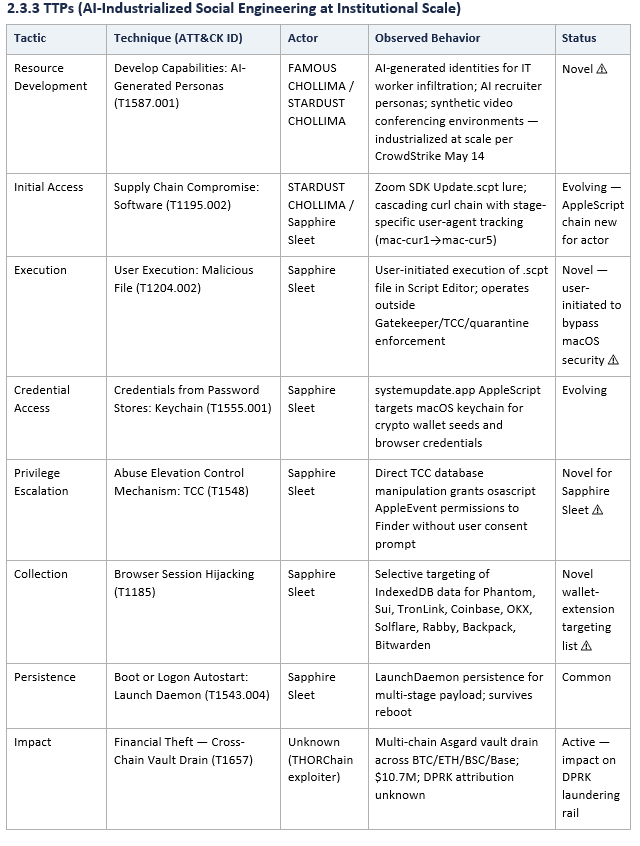
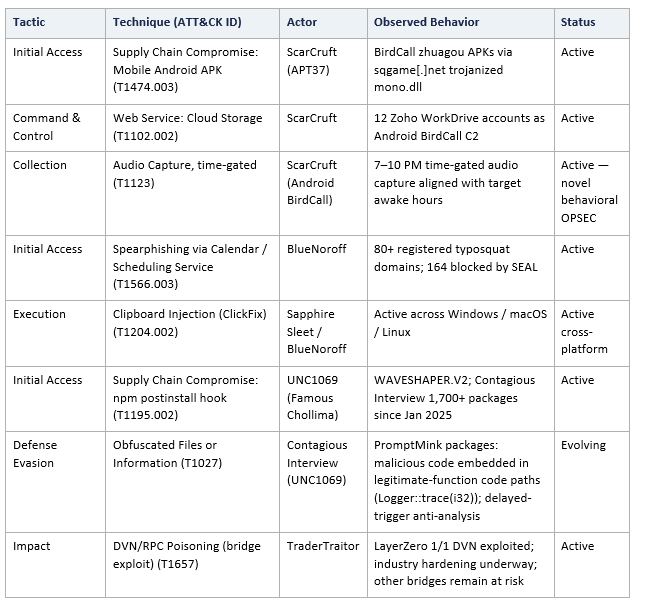
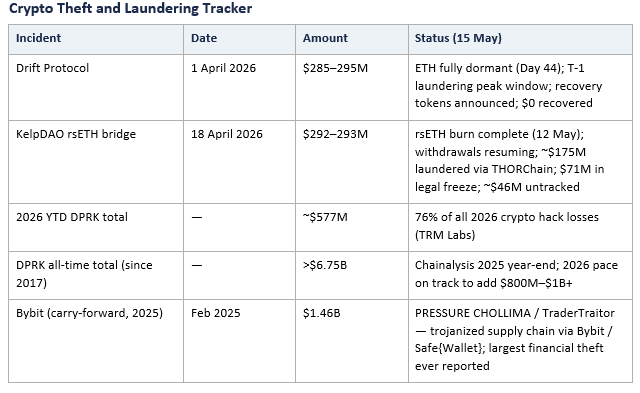
THORChain disruption — implications for DPRK laundering. THORChain processed “the vast majority” of proceeds from both the Bybit and KelpDAO heists per TRM Labs. Its halt on 15 May — the peak Drift laundering window — creates a structural disruption to the primary DPRK ETH→BTC conversion rail. Analysts should monitor: (1) Railgun activity (privacy protocol, Ethereum) — DPRK has used Railgun as an alternative ETH mixer; any surge in Railgun inflows from Drift-linked wallet clusters would be a significant indicator; (2) Umbra stealth-address activity (flagged explicitly in Drift’s recovery plan); (3) direct OTC desk transfers — Chinese intermediary OTC liquidation, consistent with the KelpDAO laundering playbook per TRM Labs (“the ongoing laundering phase is handled almost entirely by Chinese intermediaries”); (4) THORChain resume — if the protocol resumes operations quickly, expect immediate DPRK routing attempts. KelpDAO laundering final status: the ~$175M in ETH converted to BTC through THORChain via Chinese OTC intermediaries continues to be tracked but is largely assessed as dissipated through the laundering pipeline. The $71M in frozen ETH on Arbitrum remains in an Aave-controlled wallet pending the 5 June court review. Global Ledger and Arkham Intelligence previously confirmed BTC laundering wallet linkage to the Bybit heist — establishing TraderTraitor infrastructure continuity.
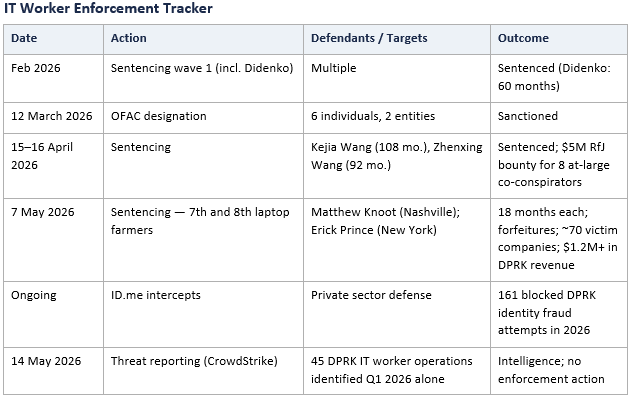
Cumulative 2026 pace: 8 U.S. nationals convicted or sentenced; multiple DOJ indictments; OFAC designations. CrowdStrike assessed FAMOUS CHOLLIMA (which overlaps with the IT worker scheme) doubled operations in 2026 using AI-generated identities — the enforcement cadence, while sustained, is not keeping pace with the expansion of the underlying operation. DOJ statement (Assistant AG John Eisenberg, 7 May): “These sentences hold accountable U.S. nationals who enabled North Korea’s illicit efforts to infiltrate U.S. networks and profit on the back of U.S. companies.”
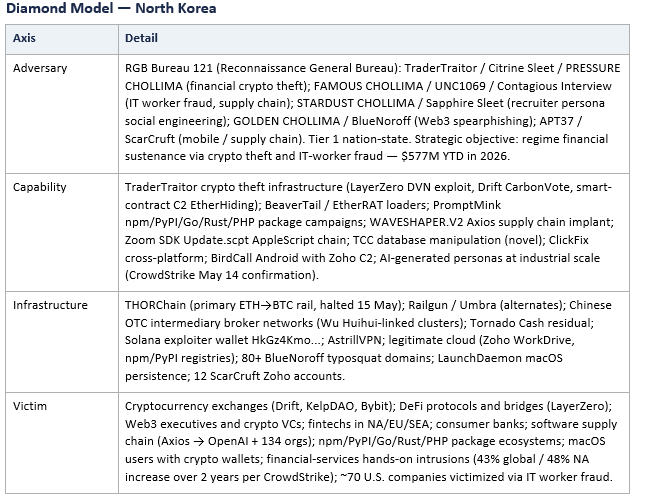
2.3.9 Assessment and 30–60 Day Outlook
We assess with HIGH CONFIDENCE that the period 8–15 May 2026 is defined by two converging risk factors: the imminent activation of the Drift Protocol laundering pipeline (T-1, 16 May peak window) and the unexpected disruption of THORChain on the same day. These two events create the highest-stakes monitoring window in the 2026 DPRK crypto cycle. Whether the THORChain exploit is connected to the pending Drift ETH movement — as a probe, a cover operation, or simply a coincidental third-party attack — is analytically unknown and should be treated as a high-priority intelligence question.
We assess with HIGH CONFIDENCE that CrowdStrike’s 14 May Financial Services Threat Landscape Report represents the most significant new intelligence disclosure of this reporting period. The formal documentation of AI-industrialized DPRK identity fraud — FAMOUS CHOLLIMA doubling operations, STARDUST CHOLLIMA tripling tempo — elevates the AI-assisted supply chain and social engineering threat from an emerging concern to a confirmed, ongoing, operational reality at scale.
We assess with HIGH CONFIDENCE that the KelpDAO recovery (rsETH burn 12 May; withdrawal resumption 13 May) represents a significant DeFi ecosystem milestone, demonstrating that Layer 2 governance can coordinate a technically complex, multi-party recovery from a state-sponsored exploit. The $71M legal freeze complicates full recovery, and the Gerstein Harrow terrorism creditor claim introduces novel legal risk for DeFi protocols processing assets with DPRK attribution.
We assess with MODERATE CONFIDENCE that the Trump-Xi summit produced no actionable diplomatic outcome on North Korea. Trump’s Air Force One confirmation that he discussed North Korea with Xi, combined with the absence of specifics from either White House or Chinese state media, is consistent with a perfunctory exchange rather than a substantive diplomatic initiative. The Korean Peninsula’s low profile at the summit removes near-term incentives for DPRK operational restraint; Pyongyang is more likely to escalate signaling (naval warship deployment mid-June, potential missile tests) in response to diplomatic marginalization.
We assess with LOW-TO-MODERATE CONFIDENCE that Drift Protocol stolen ETH will begin moving in the 16 May – 15 June window. The THORChain halt introduces an exogenous variable that may delay laundering initiation. The responsible actor’s demonstrated patience (44 days dormant) suggests they will not attempt to route funds through a compromised protocol.
We assess with MODERATE CONFIDENCE that UNC1069’s downstream exploitation of Axios supply-chain access (135+ organizations, including OpenAI) will produce at least one attributable crypto theft or espionage action in the May–July 2026 window, consistent with UNC1069’s historical monetization timeline.
Intelligence Gaps:
• No public attribution has been made for the THORChain 15 May exploit — DPRK involvement, while operationally resonant, is not confirmed.
• No public disclosure of Drift ETH movement has occurred as of this brief’s preparation; T-1 monitoring has not yet observed activation.
• The full Axios supply-chain downstream exploitation picture remains publicly unknown — Mandiant assessment of 135+ organizations is ongoing.
• The Trump-Xi North Korea discussion content remains undisclosed.
• No new Kimsuky, APT43, or Andariel campaign disclosures were published 8–15 May.
• The THORChain exploiter’s identity and relationship to known DPRK infrastructure is unknown.
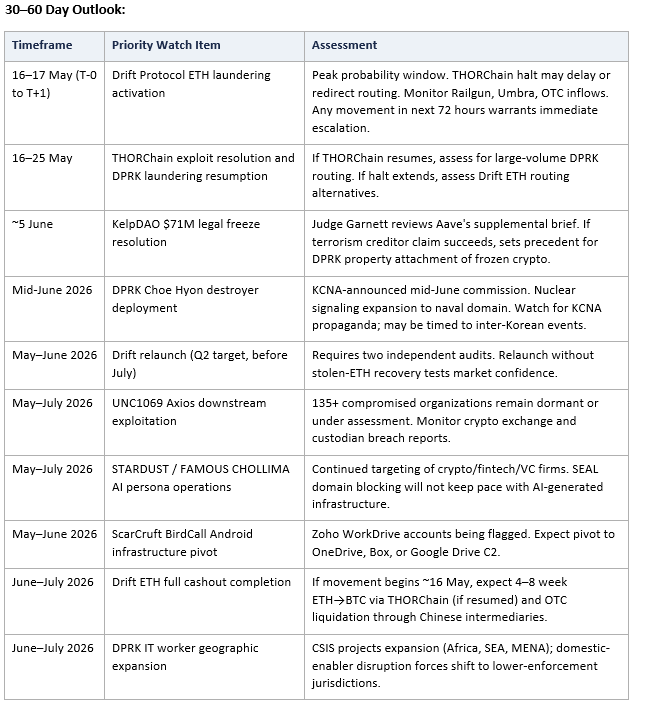
2.4 Iran
2.4.1 Strategic Posture (MOU Unsigned; Ceasefire “on Life Support”)
Iran’s cyber posture for the 8–15 May reporting window is shaped by the failure of the 14-point MOU to close, Trump’s 12 May declaration that the ceasefire is “on life support,” the 14 May hardline congressional letters from 52 Senators and 177 Representatives demanding full nuclear dismantlement, and Foreign Minister Araghchi’s 15 May confirmation of deadlock plus parallel Russian uranium-relocation discussions. The cyber operational consequence is that the IRGC retains full operational authorization. Iran has now experienced the full pressure cycle — kinetic strikes, economic sanctions, naval blockade, international isolation — and the deal track has not produced a signed instrument. We assess with high confidence that Iranian cyber actors are now operating under a “use-it-or-lose-it” strategic framework where continued restraint yields no diplomatic dividend. The concurrent Iran-Russia discussions on uranium relocation signal Iran is actively building alternative diplomatic off-ramps outside the U.S. negotiation track, which further reduces U.S. leverage and removes Iranian incentives to moderate cyber posture. Trump’s China visit coinciding with Hormuz deadlock increases the probability Iran times a significant cyber provocation to exploit Washington’s divided attention.
Three reporting-period campaigns define the threat picture. First, Symantec’s 13 May confirmation that Seedworm (MuddyWater / MOIS) breached at least nine organizations across four continents in Q1 2026 using a novel technique that weaponizes signed SentinelOne endpoint-security software for DLL sideloading. Second, Hunt.io’s 5–7 May disclosure of an Iranian-nexus operation against twelve Omani government ministries (including the Royal Oman Police, Ministry of Finance, Ministry of Justice, Tax Authority, and Office of Public Prosecution), exfiltrating more than 26,000 citizen records and SAM/SYSTEM registry hives — a strategic intelligence operation against the nuclear-mediation intermediary. Third, Handala’s sustained information operations against U.S. military personnel families (Marines doxing campaign continuation, Asia Times coverage 14 May) and the National Cyber Directorate-confirmed Iranian mass SMS cognitive warfare campaign against Israeli civilians (12 May). On the internal-posture side, Iran’s internet blackout reached Day 77+ (1,848+ hours) on 15 May; President Pezeshkian established the Specialized Headquarters for Organizing and Guiding Iran’s Cyberspace under VP Aref on 14 May, centralizing control of the tiered “Internet Pro” architecture.
2.4.2 Handala / Tactical Posture
Handala’s operational posture in the 8–15 May window is characterized by sustained information operations rather than new destructive events. The group is leveraging the 27–28 April Marines doxing action — which generated continuous media coverage through 14 May — as an extended psychological operation requiring minimal new technical action. Operations summary:
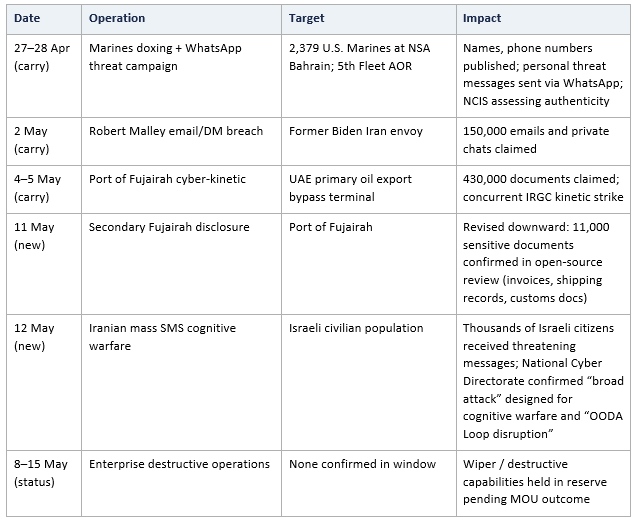
The revised Fujairah document figure (11,000 vs. 430,000 claimed) in independent reporting is consistent with Handala’s well-documented pattern of inflating exfiltration claims. The 12 May Israeli civilian SMS campaign represents a parallel MOIS operation — distinct from Handala’s traditional enterprise-targeting profile — executed by the same operational infrastructure to maximize cognitive pressure during the deal-deadlock period. We assess with MODERATE CONFIDENCE that Handala’s absence of new enterprise destructive actions in this window reflects a deliberate MOIS decision to hold wiper/destructive capabilities in reserve pending outcome of MOU negotiations. The precedent (Stryker wiper on 11 March, Fujairah cyber-kinetic 4–5 May) indicates destructive operations are authorized for specific political moments, not as ambient tempo. Flashpoint reporting notes Handala claims persistent access to Microsoft Entra, VMware vSphere, and IBM FlashSystem environments across multiple targets — if accurate, destructive activation is operationally ready and authorization is the limiting factor.
2.4.3 Active Campaigns and Operations (Full Rolling Window)
Seedworm / MuddyWater Global Campaign Expansion (Symantec, 13 May)
Symantec researchers disclosed on 13 May 2026 that Seedworm / MuddyWater (MOIS) breached at least nine organizations across four continents in Q1 2026, with intrusions beginning as early as February 2026. This is a delta disclosure relative to the March 2026 Symantec report covering U.S. targets; the May report adds new victim geographies and sectors. Victims include a South Korean major electronics manufacturer (February 2026), an international airport in the Middle East, industrial and electronics manufacturers in Southeast Asia, a financial-services provider in Latin America, educational institutions in multiple countries, and government agencies (sector/country undisclosed). New technical TTPs documented 13 May: DLL sideloading via signed Fortemedia binary (fmapp.exe) — loads malicious DLL while masquerading as legitimate audio-management software; DLL sideloading via signed SentinelOne binary (sentinelmemoryscanner.exe) — exploiting trusted endpoint-security software as cover for malicious DLL loading, a highly dangerous technique that actively weaponizes EDR tools against defenders; node.exe-based implant chain with PowerShell scripts for reconnaissance, screenshot capture, SAM hive theft, privilege escalation, and SOCKS5 reverse-proxy tunneling; Rclone + Wasabi Technologies cloud storage for exfiltration (previously documented in March Symantec report).
Industrial Cyber published a follow-up analysis (11 May) confirming the Rapid7 Darkcomp/Chaos campaign involved a second C2 domain — moonzonet[.]com — linked to MuddyWater in early 2026 targeting Israeli and Western organizations. The exfiltration path via Rclone to Wasabi cloud storage is now confirmed as a consistent Seedworm tradecraft element across at least two disclosed campaigns in this period.
Iranian-Nexus Operation Against Oman Government (Hunt.io, 5–7 May)
An exposed command-and-control server (RouterHosting VPS, UAE IP 172.86.76[.]127) revealed an active Iranian-nexus espionage campaign targeting 12 Omani government ministries. The server contained the full operational toolkit, session logs, and exfiltrated data in an open directory. Targets include the Ministry of Justice and Legal Affairs (mjla.gov[.]om — primary confirmed target, active access through 10 April 2026), Royal Oman Police, Tax Authority, Civil Aviation Authority, Ministry of Finance, and Office of Public Prosecution. Data exfiltrated: 26,000+ citizen records; judicial case data; committee decisions; SAM and SYSTEM registry hives (credential extraction). Techniques used: ProxyShell Exchange exploitation (CVE-2021-34473 / CVE-2021-34523 / CVE-2021-31207); DotNetNuke vulnerability exploitation; custom Python scripts for Exchange/SQL/Oracle system targeting; GodPotato Windows privilege escalation tool; 12 custom exploit scripts for Omani government entities.
Attribution: tactical overlaps with MOIS-linked groups APT34 and MuddyWater; infrastructure connected to spoofed Iranian diaspora media and censorship circumvention tools. Strategic significance: Oman is Iran’s primary nuclear negotiation mediation channel. Compromising Omani government judicial and immigration systems provides intelligence on Iranian diaspora movements, sanctions enforcement, and the internal communication architecture supporting the deal track. This operation is assessed as MOIS strategic intelligence preparation, not opportunistic access.
MuddyWater Darkcomp / Chaos False-Flag Ransomware (Rapid7, 6 May)
Rapid7’s 6 May comprehensive technical analysis documented MuddyWater deploying Chaos ransomware as a false-flag decoy. The campaign uses Microsoft Teams external-access screen-sharing for credential harvesting, followed by Darkcomp (Game.exe) RAT deployment with port 443 C2 to uploadfiler[.]com and Stagecomp (ms_upd.exe) downloader to moonzonet[.]com. Code-signing certificate fingerprints: “Donald Gay” (cross-campaign continuity fingerprint across Stagecomp, Darkcomp, Fakeset, Operation Olalampo) and “Amy Cherne” (companion certificate used on Dindoor backdoor and Fakeset). The 11 May Industrial Cyber follow-on confirms the Microsoft Teams external-access vector remains active.
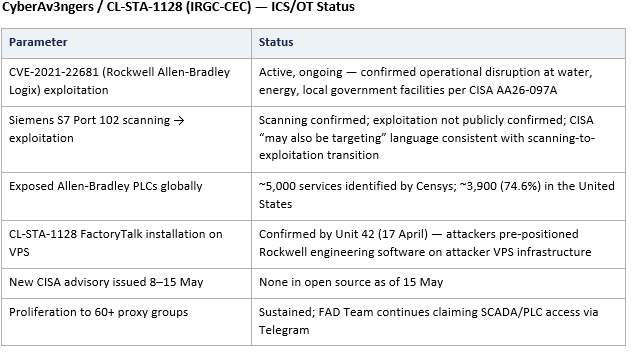
Siemens S7 Assessment (Updated): The 14 May summary of AA26-097A explicitly flags Port 102 inclusion in the IOC set as a deliberate signal. CISA’s language — “may also be targeting” — is its standard pre-exploitation warning formulation, consistent with scanning-to-exploitation transition. We assess with MODERATE CONFIDENCE that at least one unreported Siemens S7 exploitation event has occurred, consistent with the pattern established with Rockwell devices (scanning confirmed weeks before exploitation public disclosure). The 30-day exploitation confirmation window from the 8 May brief has elapsed without public confirmation, but absence of disclosure is not evidence of absence. CIRCIA 72-hour reporting rule implementation (May 2026) means future incidents will surface more rapidly than historical baselines.
APT35 / Charming Kitten — Carry-Forward
No new APT35-attributed campaign disclosures published in the 8–15 May window. Carry-forward: continued spearphishing of researchers, NGOs, and journalists associated with Iran policy and Iranian-American communities. APT35’s pattern of social-media impersonation and OAuth consent phishing remains operationally relevant given the SEQUIN CARP / Chinese-actor convergence on this tradecraft.
OilRig / APT34 — Carry-Forward
APT34 / OilRig operational continuity through the reporting window includes the Oman government breach attribution overlap. No standalone APT34 campaign disclosures published in the 8–15 May window beyond the Oman context. The Hunt.io disclosure of MOIS-linked operations using APT34-overlapping tradecraft (ProxyShell + GodPotato + 12 custom Omani-government exploit scripts) is the most operationally significant APT34-adjacent intelligence development of the period.
Imperial Kitten / Tortoiseshell — Carry-Forward
No new Imperial Kitten campaign disclosures published in the 8–15 May window. Carry-forward context: defense industrial base, transportation, and logistics targeting consistent with broader MOIS strategic intelligence priorities. The Seedworm Q1 2026 global campaign (Symantec 13 May) overlaps targeting categories with Imperial Kitten’s historical TTPs.
Agrius / Marshtreader — IoT / Camera RCE Chain (Carry-Forward)
Agrius continues to exploit the legacy Hikvision RCE chain (CVE-2017-7921 / CVE-2021-36260 / CVE-2023-6895) and the Dahua auth bypass (CVE-2021-33044) for BDA/ISR strike targeting against Gulf and Israeli targets. No new disclosures in the 8–15 May window.
2.4.4 ICS/OT Targeting Update
Water, energy, and hospital sector events in the 8–15 May window: no new confirmed U.S. critical infrastructure disruption events in open source beyond the AA26-097A baseline. CIRCIA 72-hour reporting rule implementation (May 2026) means future incidents will surface more rapidly than historical baselines. The Dragos BAUXITE assessment that Iranian adversaries are “actively mapping control loops and understanding how to manipulate physical processes” is consistent with S7 protocol-level learning. The April 7–8 FBI/CISA/NSA/EPA/DOE joint advisory on 3,900+ internet-exposed Rockwell PLCs targeting U.S. water, energy, and government systems remains active with no resolution or takedown. Space sector attack tempo continues: Via Satellite confirmed an “upsurge of attacks from Iran” targeting satellite communications, PNT systems, and space infrastructure since the conflict’s onset. More than 700 flights in Gulf air corridors experienced GPS spoofing by March 2026, alongside 1,100+ maritime vessels reporting GPS interference in a 24-hour period in the Strait of Hormuz region.
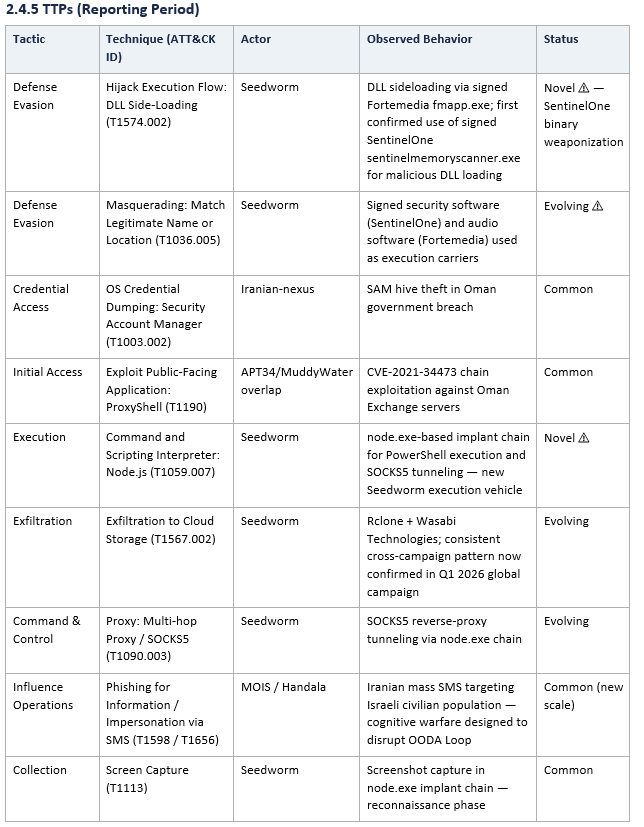
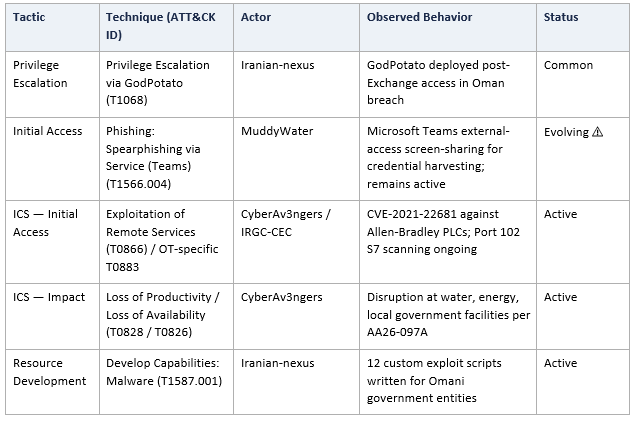

Architecture Development (14 May): The establishment of the Specialized Headquarters for Organizing Iran’s Cyberspace under VP Aref is the most significant domestic internet governance development of the period. This centralizes control of the “Barracks Internet” transition under a single political authority, streamlining the National Information Network whitelist governance and “Internet Pro” tiered access administration. The appointment of Aref (a political moderate) as head of this body signals the regime is managing the optics of permanent internet restriction while institutionalizing it structurally. APT Restoration Trigger (Updated): The creation of a formal cyberspace governance headquarters suggests the “Barracks Internet” architecture is closer to operational deployment than previously assessed. When implemented, selected APT operators and MOIS personnel will likely receive Internet Pro or higher-tier access, enabling resumed high-tempo operations without general internet restoration. The APT operational surge trigger should now be updated to monitor Internet Pro tier expansion to MOIS/IRGC personnel networks — not merely general public connectivity metrics.
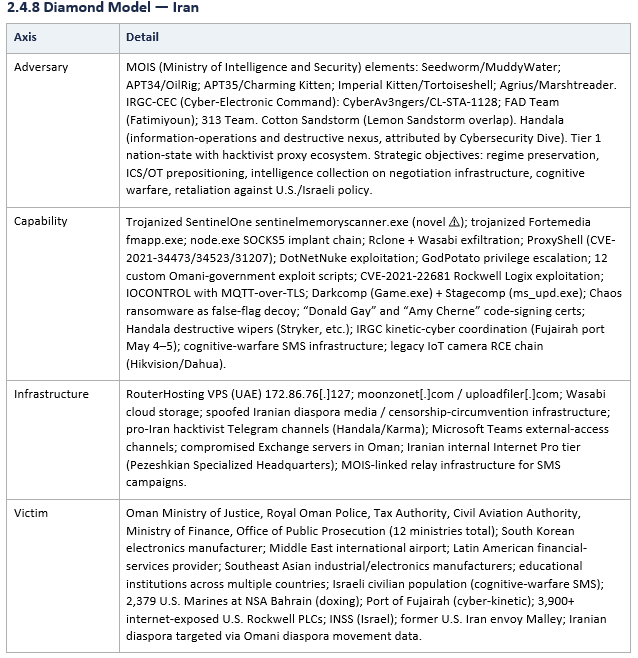
2.4.10 Assessment and 30–60 Day Outlook
We assess with HIGH CONFIDENCE that the Iran MOU negotiations have entered a structural stalemate as of 15 May 2026. Trump’s “life support” declaration (12 May), Iran’s FM expressing doubts about U.S. “seriousness” (15 May), the Iran-Russia uranium relocation track emerging as a parallel diplomatic channel, and the fundamental gap between U.S. demands (facility dismantlement, 12–20 year enrichment moratorium) and Iranian red lines (no dismantlement, 5-year maximum) are collectively irreconcilable within the current negotiating window.
We assess with HIGH CONFIDENCE that MuddyWater / Seedworm (MOIS) has achieved the broadest geographic targeting footprint on record. The 13 May Symantec disclosure confirms operations across four continents during Q1 2026 with victims in South Korea, Southeast Asia, Latin America, and multiple countries beyond the traditional MENA focus. The SentinelOne binary sideloading technique represents a qualitative capability advancement in defense evasion.
We assess with HIGH CONFIDENCE that the Iranian-nexus operation against Oman’s government ministries constitutes strategic intelligence collection against the Iran-U.S. deal-making process. Oman is the primary mediation channel; compromising its judicial, law enforcement, and financial-ministry infrastructure provides insight into Iranian diaspora networks, sanctions enforcement mechanisms, and government communications relevant to the negotiation architecture.
We assess with MODERATE CONFIDENCE that the deadlock in MOU negotiations has now crossed the threshold for a “use-it-or-lose-it” IRGC cyber authorization window. Historical precedent (Stryker wiper during active negotiations, Fujairah cyber-kinetic during ceasefire) demonstrates Iran does not maintain full cyber restraint during diplomatic periods. With the deal track visibly failing and Trump distracted by the China summit, a Handala destructive operation or CyberAv3ngers escalation against U.S. critical infrastructure is plausible within the next 7–14 days.
We assess with MODERATE CONFIDENCE that Siemens S7 exploitation has occurred at one or more facilities not yet disclosed. The Port 102 scanning confirmation in April, the Nozomi Networks explicit calling-out of S7 IOC inclusion in AA26-097A, and the 30+ day elapsed window since confirmed Rockwell exploitation without S7 public confirmation follows the same temporal pattern as prior Rockwell exploitation lag.
We assess with MODERATE CONFIDENCE that the Russia-Iran diplomatic track (uranium to Russia) may simultaneously enable cyber intelligence sharing. Russia’s insertion into the enriched uranium relocation discussion provides a new mechanism for the Iran-Russia intelligence cooperation relationship.
We assess with LOW CONFIDENCE that an MOU will be signed before the end of May 2026 and that Handala wiper capabilities will be employed against U.S. financial or energy infrastructure within 30 days.
Intelligence Gaps (15 May):
• Scope and authenticity of Port of Fujairah document dump — 11,000 (commercial sources) vs. 430,000 (Handala claim); UAE has not confirmed breach
• Current status of Darkcomp C2 domains (uploadfiler[.]com, moonzonet[.]com) — active or sinkholed/taken down
• Identity of Darkcomp intrusion victim organization (Rapid7 has not disclosed)
• Whether Seedworm’s South Korean electronics manufacturer victim disclosure intersects with defense supply chain
• Extent of Siemens S7 exploitation at non-disclosed U.S. OT facilities
• Status of U.S. Cyber Command offensive operations concurrent with Iran negotiations
• Whether “Internet Pro” tier access has been extended to MOIS/IRGC operational units within Iran
• Russia’s full terms in the uranium relocation proposal and U.S. response
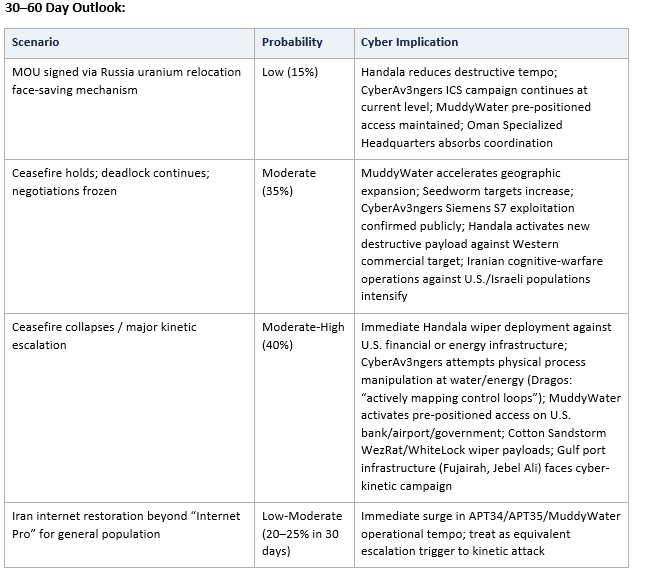
Key Monitoring Indicators (Next Week):
• Trump-Xi summit follow-through — does any back-channel deliver Iran pressure?
• Iran response to Russia uranium relocation proposal — acceptance would be breakthrough
• Handala / Karma Telegram: new data release timing or target announcement
• CISA advisory tracker — new AA26 advisory = Siemens S7 exploitation confirmed
• NetBlocks Iran connectivity metrics AND “Internet Pro” expansion announcements
• Oman Ministry of Justice breach response — UAE/Oman government disclosure
• MuddyWater follow-on victims from 13 May Symantec disclosure — sector/country spread
Section 3 — Cross-Nation Convergence
Section 3 documents the cross-adversary coordination patterns observed during the 31 March – 15 May 2026 reporting period. The four monitored adversaries continue to occupy distinct strategic lanes, but the boundary between their tradecraft has eroded materially: edge-device targeting, OAuth consent phishing, NTLM credential coercion, and AI-augmented social engineering are now propagating across actor lines.
3.1 Adversary Coordination Evidence (Russia-Iran-China-NK)
The reporting period produced several discrete coordination signals across the four-actor matrix. The most diplomatically and operationally significant is the China-Iran ISR-and-weapons axis surfaced by OFAC and State Department designations during the same week Trump traveled to Beijing. The most operationally significant for U.S. defenders is the Russia-Iran uranium-relocation diplomatic track confirmed by Iran’s Foreign Minister on 15 May, which introduces a new parallel mechanism for Russia-Iran intelligence cooperation.
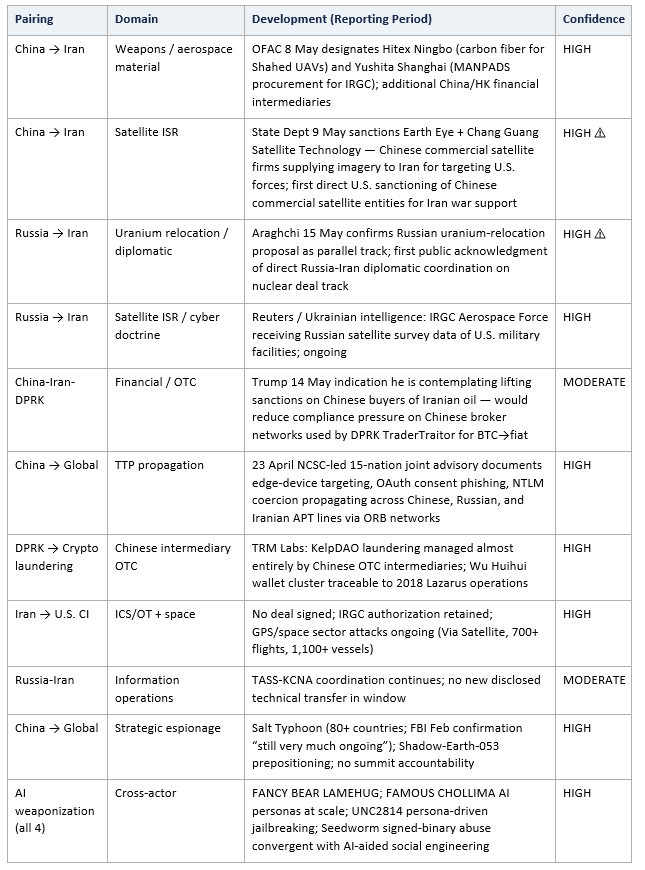
3.2 Russia-Iran-China Satellite ISR Sharing
The May 8–9 enforcement actions constitute the sharpest documented China-Iran-axis enforcement of the entire Economic Fury campaign. OFAC’s 8 May Economic Fury Wave 6 designated 10 individuals and entities in China, Hong Kong, Belarus, Dubai, and Iran for IRGC drone and ballistic-missile procurement; specifically named were Yushita Shanghai (MANPADS procurement for IRGC), Hitex Ningbo (aerospace-grade carbon fiber for Shahed UAVs/IRGC), HK Hesin, AE International, Mustad Ltd (Hong Kong financial intermediaries), Armory Alliance LLC (Belarus arms procurement), Elite Energy FZCO (Dubai financial facilitator), Li Genping (Chinese national), and Maleki and Tolibov (Belarus-based). On 9 May the State Department sanctioned 11 entities and 3 individuals in China, Iran, Belarus, and UAE for supplying satellite imagery used to target U.S. forces — specifically naming Chinese companies, with Secretary Rubio addressing the designations publicly. Western media had previously reported that Iran used Earth Eye’s TEE-01B reconnaissance satellite (acquired 2024) for targeting U.S. military assets; the 8–9 May designations constitute the official U.S. government confirmation.
This is the first direct U.S. sanctioning of Chinese commercial satellite entities for Iran war support — a significant escalation in the Russia-Iran-China ISR coordination picture. The cumulative significance is that OFAC and State have now — in the same week Trump was in Beijing — sanctioned Chinese entities for (1) weapons procurement for Iran’s IRGC, (2) supplying aerospace-grade materials for Shahed drone production, and (3) providing satellite imagery for targeting U.S. forces. These actions contradict the summit’s “constructive, stable” framing in operational terms.
On 11 May OFAC separately targeted 3 IRGC officials and 9 companies (Hong Kong / UAE / Oman) for IRGC oil sales to China — IRGC Shahid Purja’fari oil HQ personnel; Golden Globe Turkey; 4 Hong Kong companies; 4 UAE companies. The State Department announced an additional $15M reward for IRGC financial mechanism disruption (Iran International, May 11). On 12–14 May additional designations on individuals/entities in China and Iran for ballistic-missile program support were announced. The China-Iran-DPRK satellite/ISR triangulation creates a direct intelligence-collection capability against U.S. military operations in the Hormuz theater — Chinese ISR support to Iran’s strike operations effectively means PRC satellite collection is being used to target U.S. military forces.
3.3 Western Defensive Posture (CISA / Five Eyes / NATO)
3.3.1 CISA — Operational Status
CISA enters its second acting-director cycle since January 2025 with no end in sight. Plankey’s nomination was formally withdrawn 28 April; no replacement nominee has been announced. Confirmation following any future nomination would require a minimum 3–4 month Senate calendar — CISA will almost certainly not have a confirmed director before Q4 2026. The $707M FY27 budget cut request remains pending congressional action. CISA’s cybersecurity-division reorganization announced February 2026 is mid-implementation, narrowing mission focus to OT security, national cyber defense, and partner intelligence delivery at the expense of election security programs and broader critical-infrastructure partnership activities. The election security program is effectively eliminated with 8 months to the November 2026 midterms — a structural vulnerability previously assessed at high confidence. CISA’s proposed three-day remediation policy for actively exploited critical vulnerabilities has not been formally announced; the CVE-2026-32202 situation (CVSS 4.3 triggering a 14-day window despite active zero-day exploitation) is the precise scenario this policy would address.
CI Fortify (launched 5 May) is the most significant operational CISA initiative of the reporting window. The strategic guidance framework directs critical-infrastructure operators across all 16 U.S. sectors to prepare for weeks-to-months of isolated operations during geopolitical conflict — framing the threat environment as an active conflict posture rather than an incremental threat. CI Fortify explicitly cites the April 2026 NSA/FBI advisory on Russian GRU router exploitation and the Polish ABW ICS disclosures as motivating factors. The initiative explicitly cites the Russian threat by name — a public attributive posture notably more direct than previous CISA critical-infrastructure guidance.
3.3.2 Five Eyes — Agentic AI Guidance and ORB Network Advisory
The 1 May Five Eyes joint guidance on Careful Adoption of Agentic AI Services (CISA, NSA, ASD/ACSC, CCCS, NCSC-NZ, NCSC-UK) entered post-publication implementation during this reporting period — the first coordinated Five Eyes regulatory statement on agentic AI. Dragos’s documented April 2026 AI-assisted OT attack against the Monterrey, Mexico municipal water utility (adversary used a commercial AI model to autonomously navigate SCADA segmentation) confirms the threat vector the guidance addresses is no longer theoretical. The 23 April NCSC-led 15-nation joint advisory on China-linked ORB networks — published on Day 2 of CYBERUK 2026 — is the most operationally significant Five Eyes publication of the reporting window for defenders. Key finding: IOC extinction (indicators disappear as fast as they are discovered) now requires “adaptive, intelligence-driven” defense rather than signature-based approaches.
NCSC CEO keynote at CYBERUK (22 April) explicitly named China, Iran, and Russia as the three primary national-security cyber threats in unambiguous language — China as a “peer competitor in cyberspace,” Iran using cyber to suppress British nationals on UK soil, and Russia “taking the cyber lessons it has learnt in a theatre of war... beyond the battlefield.” No new NATO collective cyber response was announced in the 8–15 May window specifically tied to summit developments. Locked Shields 2026 results have not been publicly released (classified exercise).
Three Economic Fury waves in eight days through 11 May represent the sharpest sustained China-Iran nexus enforcement of the campaign. The 8 May China-satellite-intelligence designation is the sharpest single action: it crosses from sanctioning commercial dual-use goods or financial facilitation to direct intelligence provision for kinetic attacks on U.S. military assets. Cumulative effect is a contradictory dual-track between the Trump-Xi summit’s “constructive, stable” framing and the operational sanctions reality on the ground.
3.5 Trump-Xi Summit Outcome Analysis (May 14–15)
Status: Concluded. “Stalemate summit.” No cyber deliverables. Taiwan warning. Nvidia H200 deal greenlit. Boeing 200-jet purchase announced.
Framework: Trump characterized the summit as producing “fantastic trade deals” and said the two sides “settled a lot of different problems,” with no specifics. Analysts at Eurasia Group called it a summit that “will ultimately not hold significant weight” because the “fundamental dynamics of the relationship remain unchanged.” The Chinese readout described Xi and Trump agreeing their relationship is “the most consequential bilateral relationship in the world,” framing it in a three-year “constructive, strategic, and stable” framework — a diplomatic tone-setter with no enforcement mechanism.
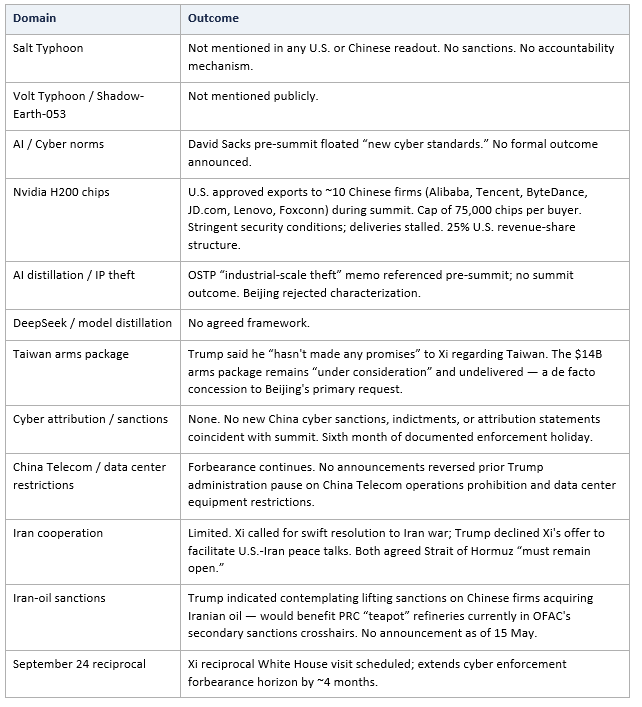
Cyber Posture Assessment: We assess with HIGH CONFIDENCE that the summit produced no binding cyber accountability for PRC operations. The H200 chip deal structurally improves China’s AI frontier capability. Shadow-Earth-053, Salt Typhoon, and Volt Typhoon prepositioning operations face no new diplomatic deterrent. The three-year framework is incompatible with a subsequent U.S. decision to impose Salt Typhoon sanctions in the near term. Taiwan arms package delay — even framed as “under consideration” — partially satisfies Beijing’s core demand. The pre-summit NYT reporting confirmed a White House directive to officials to “steer clear of needless confrontations with China” — a frame that validated the prior assessment that Salt Typhoon accountability would be subordinated to trade objectives. The departure delegation’s cyber hygiene protocol — officials and executives required to use burner phones and stripped laptops — itself reflects the intelligence community’s continued view of Beijing as a hostile collection environment.
3.6 Iran MOU Negotiation Outcome
Status: No deal signed. Negotiations on “life support” as of 11 May. Hardline Congressional pressure on 14 May. Ceasefire technically intact but strained. New sanctions imposed 12 May.
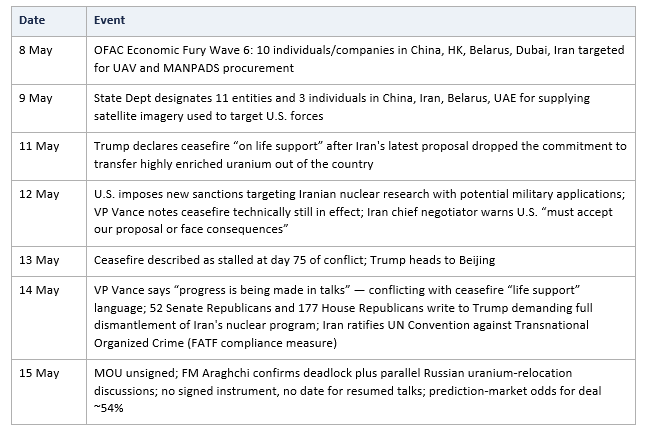
Cyber Consequences: The negotiation collapse back into “life support” is the operationally most significant development for Iranian cyber posture. The IRGC retains full operational authorization. The April 7–8 FBI/CISA/NSA/EPA/DOE joint advisory on 3,900+ internet-exposed Rockwell PLCs remains in full effect. Iranian attacks on the space sector (confirmed upsurge by Via Satellite) continue. The “use-it-or-lose-it” acceleration risk identified in the May 8 briefing did not materialize as a deal-closure scenario — but the sustained near-deal/no-deal oscillation actually represents the maximum sustained gray-zone incentive for IRGC operational tempo: enough diplomatic momentum to avoid resumed U.S. strikes, but no actual deal that would terminate operational authorization. Iran’s 14 May ratification of the UN Convention against Transnational Organized Crime is analytically notable: it represents a FATF compliance gesture aimed at sanctions relief signaling without making nuclear concessions — a diplomatic hedge.
3.7 UN Global Mechanism
The new UN Global Mechanism on ICT Security (successor to the OEWG) held its organizational session in March 2026. The first substantive plenary session is scheduled 20–24 July 2026. The mechanism’s “old divides” — Russia and China vs. Western states on verification, attribution, and force definitions — persist structurally and are not addressed by the summit’s “constructive, stable” framing. The UN Global Mechanism’s July 2026 first substantive session will occur against a backdrop where AI is already operationally integrated into nation-state attack chains — and no international norm specifically addresses AI-enabled cyberattacks. The 2015 GGE’s 11 norms remain the high-water mark; the new mechanism’s old state divides are incompatible with rapid AI-specific norm development.
3.8 AI / Emerging Threat Vectors
3.8.1 First Confirmed AI-Generated Zero-Day Exploit (GTIG, May 2026)
Google Threat Intelligence Group (GTIG), in a report published May 2026, documented the first confirmed case of a threat actor deploying an AI-generated zero-day exploit in an active operation — a Python script targeting a two-factor-authentication bypass vulnerability in an open-source web administration tool. The exploit’s characteristics (extensive docstrings, structured formatting, educational inline comments) were distinctive of LLM-generated code. PRC-nexus actor UNC2814 was documented using “persona-driven jailbreaking” — elaborate researcher personas to extract vulnerability research from commercial AI models — as a standard operational workflow. The disclosure is the operational threshold-crossing from AI as an experimental adversary capability to AI as an integrated component of nation-state attack chains. The combination of UNC2814’s documented Google Sheets C2 channel (CSO Online / GTIG / Mandiant 25–26 February 2026 — used to spy on 53 telecoms and governments in 42 countries) with the persona-driven jailbreaking workflow gives this PRC actor a full chain: AI-extracted vulnerability research → AI-assisted exploit generation → established C2 infrastructure for deployment at scale.
3.8.2 First Confirmed AI-Assisted OT Attack (Dragos / Monterrey Water Utility)
Dragos documented the first confirmed AI-assisted OT attack on a municipal water utility (Monterrey, Mexico, April 2026 disclosure window), where an adversary used a commercial AI model to autonomously navigate SCADA segmentation boundaries. The attack represents the threat vector the Five Eyes agentic AI guidance (1 May) explicitly addresses and serves as operational evidence that agentic AI is active in adversary attack chains targeting critical infrastructure, not merely a future risk. The combination of (a) AI autonomously navigating SCADA segmentation, (b) IRGC-CEC documented “actively mapping control loops” posture per Dragos BAUXITE, and (c) the proliferation of Iranian ICS exploitation tooling to 60+ proxy groups defines a new ceiling for nation-state OT capability.
3.8.3 CrowdStrike AI-Industrialized DPRK Social Engineering (May 14)
CrowdStrike’s 14 May Financial Services Threat Landscape Report represents the most authoritative public documentation of DPRK AI-industrialized identity fraud to date. FAMOUS CHOLLIMA (UNC1069 / Contagious Interview) doubled operational scale using AI-generated identities; STARDUST CHOLLIMA (Sapphire Sleet) tripled tempo via AI-generated recruiter personas and synthetic video conferencing environments. The CrowdStrike 2026 Global Threat Report confirmed an 89 percent increase in AI-enabled adversary activity. FANCY BEAR deployed LLM-enabled malware (LAMEHUG) for automated reconnaissance and document collection; FAMOUS CHOLLIMA used AI-generated personas for insider operations at scale. DPRK’s $577M Drift hack involved months of AI-augmented social engineering including physical proxy meetings — assessed as the current ceiling of nation-state AI social engineering. The same playbook adapts directly to defense procurement, financial sector, and critical-infrastructure vendor targeting.
3.8.4 AI Governance Gap
The UN Global Mechanism’s July 2026 first substantive session will occur against a backdrop where AI is operationally integrated into nation-state attack chains. The Trump delegation to Beijing was explicitly required to use burner phones and stripped laptops — a physical security measure reflecting the intelligence community’s assessment of China as a surveillance environment that can exploit AI-augmented SIGINT collection. At the policy level, the OSTP “industrial-scale” AI distillation memo (Kratsios, 23 April) was raised at the Trump-Xi summit; Beijing rejected the characterization. No bilateral mechanism to address AI distillation was agreed. The House AI supply-chain investigation (Anysphere / Airbnb) deadline (13 May) passed during the summit’s first day with no public congressional statements confirming receipt or adequacy of responses.
Section 4 — Defensive Recommendations
Section 4 translates the threat picture in Sections 2 and 3 into prioritized detection engineering, NIST CSF 2.0 alignment, D3FEND countermeasures, and sector-specific guidance. Recommendations are sequenced by analyst-assessed priority for the 15 May runtime: signed-binary DLL sideloading (Seedworm SentinelOne), Drift Protocol wallet-cluster monitoring (T-1), CVE-2026-32202 post-deadline credential hunting, CVE-2026-0300 PAN-OS exploitation, Gamaredon WinRAR CVE-2025-8088 detection, OAuth consent phishing (SEQUIN CARP), and Microsoft Teams external-access hardening (MuddyWater Darkcomp).
4.1 Priority Detection Engineering
4.1.1 DLL Sideloading via Signed SentinelOne Binary (Seedworm) — NOVEL ⚠
Highest-priority new detection for the 15 May runtime. Seedworm’s first confirmed use of signed SentinelOne sentinelmemoryscanner.exe as a malicious DLL loader (Symantec, 13 May) actively weaponizes trusted EDR tooling against defenders. Process-trust and signature-based allowlists assume signed endpoint security software is benign; Seedworm exploits exactly that assumption.
SIGMA rule (high priority):
title: Suspicious DLL Load by SentinelOne sentinelmemoryscanner.exe
id: 7a8c2d4f-may15-2026-seedworm-sentinelone-dll
status: experimental
description: Detects DLL load by sentinelmemoryscanner.exe from non-standard SentinelOne installation directory or with unsigned/unexpected DLL
logsource: { category: image_load, product: windows }
detection: selection: { Image|endswith: ‘\\sentinelmemoryscanner.exe’ }; filter: { ImageLoaded|startswith: ‘C:\\Program Files\\SentinelOne\\’ }; condition: selection and not filter
level: high
KQL (Microsoft Defender / Sentinel):
DeviceImageLoadEvents | where InitiatingProcessFileName =~ “sentinelmemoryscanner.exe” | where not(FolderPath startswith “C:\\Program Files\\SentinelOne\\”) or FileName !endswith “.dll” | extend DllSigner = tostring(InitiatingProcessVersionInfoCompanyName) | where DllSigner != “SentinelOne, Inc.” | project Timestamp, DeviceName, FolderPath, FileName, InitiatingProcessAccountName, ProcessCommandLine
Detection notes: monitor for sentinelmemoryscanner.exe loading DLLs outside the standard installation path; alert on node.exe process spawning from sentinelmemoryscanner.exe context (Seedworm pivot pattern); flag SOCKS5 reverse-proxy initialization from any SentinelOne process. Identical detection logic applies to Fortemedia fmapp.exe (also abused).
4.1.2 Drift Protocol Wallet Cluster Monitoring (T-1) — CRITICAL
Elevated to maximum sensitivity for next 72 hours. Primary monitoring asset: Solana wallet HkGz4KmoZ7Zmk7HN6ndJ31UJ1qZ2qgwQxgVqQwovpZES (44 days dormant as of 15 May). Additional monitoring per TRM Beacon / Chainalysis KYT clusters.
• Alert on any outbound transaction from primary or cluster-linked addresses
• Monitor THORChain ETH→BTC native pool for large-volume DPRK-pattern transactions once protocol resumes
• Monitor Railgun inflows from Drift-linked clusters (privacy protocol substitution)
• Monitor Umbra stealth-address activity (Drift recovery plan flag)
• Monitor Tornado Cash residual activity
• Coordinate with TRM Beacon Network (30+ exchanges / protocols on alert)
• Retroactive re-screening of all April 2026 exchange inflows recommended
4.1.3 CVE-2026-32202 Post-Deadline Credential Hunting — HIGH
Detection: outbound SMB connections (port 445) from explorer.exe or svchost.exe processes to external IP addresses; unexpected Net-NTLMv2 authentication events in SIEM telemetry; Cobalt Strike or NTLM relay tooling (Responder, ntlmrelayx) in process telemetry.
KQL — outbound SMB from explorer.exe to external IP:
DeviceNetworkEvents | where InitiatingProcessFileName in~ (”explorer.exe”, “svchost.exe”) | where RemotePort == 445 | where ipv4_is_private(RemoteIP) == false | project Timestamp, DeviceName, InitiatingProcessFileName, RemoteIP, RemotePort, InitiatingProcessAccountName
KQL — Net-NTLMv2 anomaly detection:
SecurityEvent | where EventID == 4624 and LogonType == 3 and AuthenticationPackageName == “NTLM” | summarize Count=count() by Account, IpAddress, bin(TimeGenerated, 1h) | where Count > 50 | order by Count desc
Immediate actions post-deadline: (1) Apply 14 April KB update if not yet done; (2) Rotate all domain credentials active on unpatched systems during the exposure window (28 April – patch date); (3) Block outbound SMB (port 445) at perimeter; (4) Hunt for NTLM relay activity in logs from 28 April forward.
4.1.4 CVE-2026-0300 PAN-OS Exploitation Detection — CRITICAL
Apply 13 May / 28 May patches immediately. Detection: PAN-OS firewall logs for crash kernel messages followed by selective log deletion (anti-forensic indicator); nginx worker process anomalies; outbound connections from PA-Series devices to attacker-staging IPs (67.206.213.86, 136.0.8.48, 146.70.100.69, 149.104.66.84) on ports 8000 and 443; SAML flood patterns triggering HA failover; AD enumeration from firewall service account credentials.
YARA — EarthWorm tunneling binary signature:
rule EarthWorm_CL_STA_1132 { meta: actor = “CL-STA-1132 / Chinese state-sponsored”; sha256 = “e11f69b49b6f2e829454371c31ebf86893f82a042dae3f2faf63dcd84f97a584”; strings: $s1 = “earthworm” nocase; $s2 = “-s socks” nocase; $s3 = “-d 0.0.0.0” nocase; condition: uint16(0) == 0x457f and 2 of them }
4.1.5 Gamaredon CVE-2025-8088 WinRAR Detection — HIGH
Detection: monitor for .rar/.arj archives delivered via email from Ukrainian government domain senders; flag WinRAR extraction resulting in file writes to %APPDATA%\Microsoft\Windows\Start Menu\Programs\Startup\; alert on .vbs or .vbe files in Startup folder; monitor Cloudflare Workers (*.workers.dev) for anomalous resolution from Ukrainian endpoints; flag check-host[.]net resolution lookups.
YARA — Gamaredon GammaDrop:
rule Gamaredon_GammaDrop { meta: actor = “Gamaredon / UAC-0010 / FSB 18th Center”; reference = “HarfangLab TRR260501”; strings: $vbs1 = “CreateObject” nocase; $vbs2 = “WScript.Shell” nocase; $cloudflare = “.workers.dev” nocase; $reg = “CurrentVersion\\RunOnce” nocase; condition: filesize < 200KB and 3 of them }
4.1.6 OAuth Consent Phishing (SEQUIN CARP) — HIGH
Detection: monthly audit of third-party OAuth app grants with mail.google.com scope; revoke any OAuth apps with mail.google.com scope not explicitly authorized by IT; alert on persistent refresh-token usage from anomalous geographic locations.
KQL — Google Workspace audit:
AuditLogs | where ActivityDisplayName == “Consent to application” | extend Scope = tostring(parse_json(AdditionalDetails)[0].value) | where Scope contains “mail.google.com” | summarize by InitiatedBy_user_userPrincipalName, AppDisplayName, Scope, TimeGenerated
4.1.7 MuddyWater Microsoft Teams External-Access Hardening — CRITICAL
Defensive controls: restrict Teams external access at tenant level; prohibit screen-sharing with external unvetted domains; require MFA for cross-tenant guest invitations; alert on Teams external-domain screen-share events. Process detection: flag node.exe processes spawned from unusual parent processes (Outlook, Teams); flag Rclone process connecting to *.wasabisys.com — block at egress.
4.1.8 Sandworm OT/ICS Detection — HIGH
Hunt for EternalBlue, DoublePulsar, Log4Shell, WannaCry indicators in OT-adjacent IT systems; monitor for legacy exploit chain activity at Purdue Levels 2–3; alert on increased internal alert volume (12-fold-increase pattern observed in Nozomi data); flag SMB connections originating from engineering workstations to non-standard destinations. Sandworm “inherit the compromise” doctrine: treat any unresolved 20–155-day-old high-severity alert as a potential Sandworm pre-positioning indicator.
Classification: UNCLASSIFIED // OSINT // TLP:WHITE