
Executive Summary
The U.S. consumer fraud landscape crossed an inflection point in the past seven days. Federal enforcement compressed at both the strategic and operational tier simultaneously, while the empirical foundation for cross-border scam labor moved from crisis language to trial-court accounting. Four structural shifts define the window:
First, Tokyo Metropolitan Police re-arrested Hu Xiaowei on July 5 on a second charge (residence card abuse expanded to encompass three additional Chinese nationals), converting a single technical detention into a multi-defendant holding docket. This is the second charge filed against Hu in three weeks and effectively guarantees prolonged Japanese custody while the U.S. finalizes extradition posture on the Chen Zhi $15B Prince Group indictment.
Second, the FBI Most Wanted Fraudsters list added two additional targets and secured a fourth capture. FBI Miami posted a $150,000 reward on July 7 for Khalid Ahmed Satary ($547M Medicare genetic-testing fraud); FBI Minneapolis posted a $150,000 reward on July 8 for Fahad Mohamed Nur (Feeding Our Future $5M child-nutrition fraud, fugitive since 2022). The list now stands at ten designated targets with four confirmed captures — a 40% closure rate in the first five weeks since launch, empirically unprecedented for a federal fugitive program at this cadence.
Third, the DOJ activated a new National Fraud Enforcement Division and delivered its flagship case on July 1: a $600 million combined non-prosecution agreement against Alibaba Group and its U.S. payment processor AUS Merchant Services (formerly Alipay US) for failing to prevent illegal pharmaceutical, controlled-substance, and pill-press sales to U.S. consumers through Alibaba.com and AliExpress.com. Combined with the June 23 National Health Care Fraud Takedown ($6.5B in alleged fraud, 455 defendants, 90 licensed medical professionals, $182M in seizures across 56 federal districts), federal fraud enforcement is now operating at scales not observed since the 2010 pill mill takedowns.
Fourth, Peter Stokes — 19-year-old dual U.S.-Estonian citizen alleged to be a Scattered Spider operator — was extradited from Finland to the U.S. Northern District of Illinois for arraignment on July 1. Stokes is charged with conspiracy, computer intrusion, and wire fraud tied to an $8M jewelry-retailer ransom and to Scattered Spider’s broader $100M-plus intrusion campaign. The extradition, aided by a Microsoft Windows Global Device Identifier telemetry referral, is the first Scattered Spider member extradited to the U.S. and demonstrates that voice-clone / social-engineering-driven help-desk intrusion operators (Threat #6/#7 convergence) are now within reach of allied extradition frameworks.
Threat Direction Index: 8.62 / 10 (+0.5% vs June 23 8.58). The marginal increase reflects three opposing forces: principal-tier enforcement is delivering genuine deterrence signals (Hu re-arrest, Stokes extradition, Alibaba $600M, Most Wanted 40% closure rate); the state-level regulatory perimeter around fiat-to-crypto conversion is finally tightening at scale (Tennessee ban effective July 1, California $100K/day fines effective July 1, 31 states now regulating crypto kiosks, 14 in 2026 alone); but the victim-tier surface continues to widen (fourth UK teen suicide from Yahoo Boys sextortion July 3, IWF documenting 72% YoY increase, Cambodia court records showing zero convictions against 1,761 prosecuted defendants). AI Sextortion moved to #7 in the ranking, displacing Business Email Compromise, as the NCMEC-documented $23,000-report first-half-2025 baseline continues to escalate and the fourth documented UK teen suicide from Yahoo Boys operators establishes that the harm threshold is now measured in life-safety, not financial impact.
Bottom Line Up Front: The bifurcation state described in the June 23 assessment has resolved unfavorably for U.S. consumers. Principal-tier compression is real and accelerating — the DOJ National Fraud Enforcement Division launch, the Alibaba $600M, the Hu re-arrest, the Stokes extradition, and the four Most Wanted captures collectively represent the most active federal enforcement window observed by this framework. But the same seven days confirmed that Cambodia has produced zero convictions against 1,761 prosecuted defendants (Chhay Sinarith task force data through June 22); that the Yahoo Boys sextortion pipeline is producing UK teen suicides at a rate now measured in months, not years; that Scattered Spider’s help-desk social-engineering playbook has propagated to UK retail (M&S, Co-op, Harrods, £300-500M cumulative loss) as well as U.S. targets; and that USDT-to-Monero displacement is now observable in real-time on-chain data (Tether’s July 2-3 freeze of 131 TRON wallets tied to ISIS-K, following the June 17 $72M Monero-pivot freeze). Enforcement is closing on the top of the criminal organizational chart faster than at any point in framework history, but the workforce, victim pool, and courier / mule surface continue to expand.
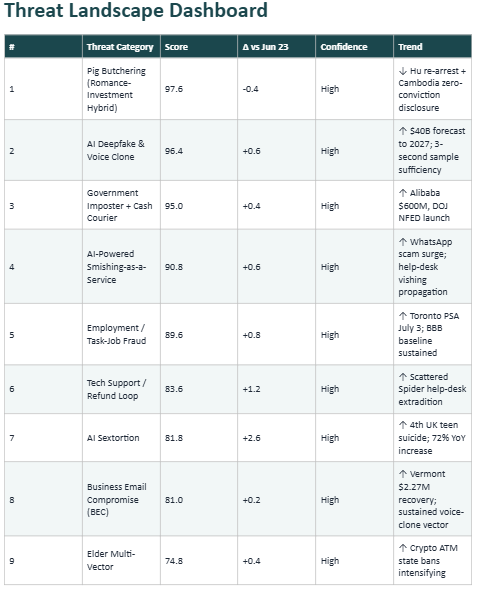

Movements: AI Sextortion (#7) displaces BEC in the top seven on continued teen-suicide harm-threshold escalation and 72% YoY volume increase. Tech Support / Refund Loop (#6) rises as Scattered Spider extradition confirms that help-desk social-engineering has reached mainstream extraditable-crime status. Pig Butchering (#1) declines marginally as the Hu re-arrest and Cambodia zero-conviction disclosure produce competing signals. All Top 10 categories scored High or Moderate confidence (full-mode floor met for ninth consecutive cycle).
TOP 3 DEEP DIVE
#1 — Pig Butchering (Romance-Investment Hybrid) — Score 97.6
A. Strategic Assessment
Pig butchering retains the apex position for the ninth consecutive assessment, and the character of the threat continues to bifurcate between accelerating principal-tier accountability and empirically confirmed workforce impunity. Five signal events define the current window: (1) Tokyo Metropolitan Police’s re-arrest of Hu Xiaowei on July 5 on a second residence-card violation charge, now including three additional Chinese nationals, converting Hu’s holding docket from a single-defendant technical detention into a multi-defendant judicial process that provides U.S. extradition negotiators a longer runway; (2) the July 6 publication by the Cambodian Commission for Combating Online Scams (task force headed by Chhay Sinarith) of enforcement figures covering early 2025 through June 22, 2026, reporting 500-plus locations targeted, 400-plus operations permanently sealed, 25 casino licenses revoked or suspended, 184 court cases opened with 55 in trial, and 1,761 defendants prosecuted — with zero recorded convictions; (3) the Phnom Penh Dangkao district raid on July 6 producing eight arrests (seven Bangladeshi men and one Myanmar woman) at a boiler-room targeting the United States, Brazil, Mexico, and Colombia; (4) a Shanghai Baoshan District Procuratorate sentencing on July 4 of a defendant named Huang (born 2000) to 30 months for a cross-border pig-butchering scheme run out of Myawaddy, Myanmar, using virtual currency — the first documented Chinese sentencing in this reporting window; and (5) the July 7 India Today reporting of NIA raids at six Cambodia-linked cyber-slavery trafficking locations across Bihar, Delhi, and Uttar Pradesh, chargesheeting Anand and four associates including Prahlad Kumar Singh, Abhay Nath Dubey, Abhiranjan Kumar, and Rohit Yadav.
The Cambodia zero-conviction disclosure is the most important empirical development of the window. The Chhay Sinarith task force data is granular enough to be non-cosmetic — casino license revocations, operation sealings, defendant counts, and trial docket counts — but the absence of a single conviction against any of the 1,761 prosecuted defendants establishes that the Cambodian judicial pipeline is a legal cul-de-sac. The gap between prosecution and conviction is not administrative delay; it is structural. Two thousand foreign suspects from thirty-three nationalities have moved through the Cambodian court system without a single documented conviction, at the same time that the U.S. is filing its largest fraud forfeiture action in DOJ history (127,271 Bitcoin, ~$15B) against the alleged apex operator. The strategic implication: sustained U.S. enforcement pressure will need to substitute for the absent Cambodian judicial deterrent for the foreseeable future.
The Hu re-arrest is a positive signal on the extradition axis. By re-arresting Hu on a second residence-card violation charge and expanding the docket to include three additional Chinese nationals, Tokyo MPD has extended the holding runway from days to months and created a multi-defendant record that supports Japanese cooperation with U.S. extradition requests. Public reporting continues to identify Hu as a principal-tier financial operative in the Prince Group / Chen Zhi network — the first such operator captured outside Cambodia or China. Combined with the January 2026 extradition of Chen Zhi from Cambodia to China (rather than the U.S., where he is indicted), the pattern suggests that principal-tier accountability will move through China and allied Asia-Pacific jurisdictions before reaching a U.S. courtroom.
Confidence: High. Corroboration across Tokyo MPD Japanese press, DOJ Eastern District of New York (Chen Zhi), Cambodian Commission for Combating Online Scams, Phnom Penh National Police, Shanghai Baoshan District Procuratorate, India Today, NIA India, and multiple regional and international press outlets.
B. Adversary Profile (Diamond Model)
Adversary: Chinese-organized-crime-controlled syndicates (Prince Group / Chen Zhi network — now with Hu Xiaowei detained in Japan on second charge; Kok An / K99 / Crown Resorts network; KK Park operators; Shwe Kokko operators) operating across a Cambodia-Myanmar-Laos-Sri Lanka-Indonesia-Vietnam corridor with expanding India-based operational sub-cells (NIA raids July 7 confirm Bihar, Delhi, Uttar Pradesh recruitment presence). Tier 2 advanced criminal sophistication with Tier 1 financial OpSec. Workforce: trafficked labor (Chinese, Vietnamese, Indonesian, Nepali, Bangladeshi, Myanmar, and African nationals) coerced into fraud operations under debt bondage — Cambodia court docket alone shows 2,000 foreign suspects across 33 nationalities. Motivation: pure financial; per-victim yields routinely exceed $250,000.
Capability: Custom CRM “fattening” platforms; AI-generated personas and chat scripts; deepfake video for “proof of life” calls; fraudulent investment dashboards; voice cloning for trust-building; courier dispatch networks operating in Michigan, Utah, Louisiana, California, and additional U.S. metros (residual from June 17-22 arrest wave); Telegram-hosted playbook marketplaces; increasingly pivoting to Monero-based laundering (Tether’s July 2-3 freeze of 131 TRON wallets confirms USDT-freeze cadence continues, driving syndicate laundering toward Monero and OTC desks — ZachXBT’s earlier documentation of $120M USDT wallet pivoting to XMR remains the reference case); NIA-documented Bangladesh national recruitment presence at Phnom Penh boiler rooms (July 6 Dangkao raid) demonstrates expanding trafficking-source diversity.
Infrastructure: Bulletproof hosting (often China-linked); Starlink terminals (1.4M+ disabled in May Disruption Week — residual operational); apartment-rotation cells in Sri Lanka, Indonesia, Vietnam; U.S.-domiciled courier mules; USDT/Tron rails under sustained countermeasure pressure — Tether has now frozen approximately $488M+ in USDT during 2026 alone (adds July 2-3 $1.4M-tied 131-TRON-wallet freeze to prior $416M cumulative); private OTC desks and Monero conversion services absorbing displaced flows; registered LLC shells in Delaware/Wyoming for fiat off-ramp; recent Brazilian $2B PCC-linked crypto asset freeze (July 4) demonstrates that trafficking-adjacent laundering is now attracting Latin American enforcement attention as well.
Victim: U.S. adults 50+ disproportionately (FTC: $445M from 65+ in $100K+ category); secondary targets include divorced/widowed individuals, recent retirees with rollover IRAs, immigrants with home-country family pressure, AAPI seniors, and — increasingly — LinkedIn-recruited professionals receiving business-pretext outreach with delayed romance pivot. The Kerr Kriisa indictment (July 6, Northern District of West Virginia — 25-year-old Estonian former college basketball player charged with $2.2M in wire fraud using fictional family-emergency pretexts against two victims from 2022 through June 2, 2026) demonstrates that romance-adjacent fraud is now being prosecuted against U.S.-domestic operators, not just offshore compound-workers.
#2 — AI Deepfake & Voice Clone — Score 96.4
A. Strategic Assessment
AI deepfake and voice-clone fraud continues at industrial scale and produced its most significant public-sector documentation of the year during the current window. The Consilient / Deloitte reference set now published in the FinTech Global reconstruction (July 6) establishes a forward-looking industry forecast of $40 billion in generative-AI-driven fraud losses by 2027, up from approximately $12 billion in 2023 — a 233% growth trajectory. The reconstruction confirms the operational baseline: scammers now require as little as three seconds of source audio to construct an 85%-match voice clone; more than 10% of banks have suffered deepfake losses in excess of $1M, averaging $600K per incident; deepfake file volume grew from 500,000 in 2023 to eight million in 2025; deepfake fraud attempts across the same period increased by more than 2,000%; and 70% of adults surveyed cannot distinguish a cloned voice from an authentic one. The FBI’s 2025 Internet Crime Report logged $893M in losses tied to AI-related scams — described in the Bureau’s own language as “conservative.”
The Scattered Spider extradition of Peter Stokes to Chicago (July 1) is the current window’s most consequential enforcement action against the deepfake-adjacent help-desk vishing threat vector. Court documents describe the May 2025 attack pattern that Stokes is charged in: Scattered Spider operators called the target company’s IT help desk using Google Voice, impersonated legitimate employees convincingly enough to secure password resets and MFA removals, and then escalated privileges into the target network. The technical sophistication was minimal; the social-engineering was the attack. UK retail victims from the parallel Scattered Spider campaign (Marks & Spencer, Co-op, Harrods) sustained an estimated £300M–£500M in impact including a 46-day M&S online-ordering suspension and disruption across approximately 1,400 stores.
Operationally, three-to-ten-second sample sufficiency for credible voice clones remains the established industry standard; sub-£30 monthly pricing continues across multiple platforms; the WPP CEO Mark Read voice-clone attempt (Zoho June 19 residual reconstruction) remains the most detailed European executive-impersonation case study. NO FAKES Act momentum through the Senate Judiciary Committee remains active; S.3982 corporate criminal liability for AI-enabled fraud remains stalled; and the DOJ Take It Down Act criminal enforcement lane still shows a single action (June 11 domain seizures) with no follow-on in the current window.
Confidence: High. Corroboration across FinTech Global / Consilient / Deloitte industry forecasting, DOJ Northern District of Illinois court filings, Microsoft telemetry-driven Global Device Identifier documentation, U.K. retail victim reporting (M&S, Co-op, Harrods), Resemble AI Deepfake Watchlist sustained baseline, FBI IC3 2025 loss data, and multiple vendor threat reconstructions.
B. Adversary Profile (Diamond Model)
Adversary: Mixed-tier ecosystem. Tier 1 nation-state — DPRK Famous Chollima (CrowdStrike attribution) using deepfake employment fraud as both espionage and revenue. Tier 2 advanced criminal — Scattered Spider / Octo Tempest / UNC3944 / 0ktapus (with Peter Stokes now extradited and in U.S. custody; the group formally “retired” in 2025 but has continued attacks including 2025 Salesforce campaign, 2022 0ktapus campaign, and 2026 M&S/Co-op/Harrods retail campaign); Yahoo Boys / West African sextortion rings (Ivory Coast attribution confirmed in Cai Davies suicide inquest, July 3); Indian organized fraud rings; and Charter Communications breach operators (residual). Tier 3 mid-level — distributed cybercrime services purchasing $30/month voice-clone APIs. Tier 4 — script kiddies running grandparent voice-clone calls using free tools.
Capability: Voice clones from 3-second samples at 85% match fidelity; real-time video face-swap for live calls; AI-generated synthetic identity documents; deepfaked news anchors for fake-investment ads; AI-bypass of Video-KYC and liveness checks; cross-platform delivery via WhatsApp, Telegram, RCS, SMS, Microsoft Teams, and Google Voice; Windows Global Device Identifier evasion attempts documented (Stokes case shows evasion via VPN and IP rotation was defeated by persistent Windows telemetry — a novel forensic vector now publicly known); help-desk social-engineering playbook (Scattered Spider M&S/Co-op/Harrods campaign) now documented in extraditable federal complaints.
Infrastructure: Consumer voice services (sub-$30/mo subscriptions); Google Voice numbers for help-desk vishing; paid Reddit/X/Meta ad accounts; bulletproof hosting for fake investment platforms; Telegram for voice-clone-as-a-service playbook distribution; compromised social media accounts; WhatsApp Business profiles with public executive photographs; Microsoft Teams meeting-invitation-plus-voice-clone-call delivery pattern (WPP CEO case); ngrok tunneling documented in Stokes forensic record.
Victim: Enterprise finance teams (BEC vector); C-suites with public audio footprint; UK retail (M&S, Co-op, Harrods, cumulative £300–500M impact); U.S. jewelry retail (Stokes indictment describes $8M ransom demand and multi-million-dollar mitigation cost on a target company that refused to pay); older adults receiving “grandchild in trouble” calls; KYC-protected financial accounts; employers conducting remote video interviews (Famous Chollima vector); UK teen boys targeted by Yahoo Boys sextortion (fourth documented suicide in the current window — Cai Davies, 18, July 3, Ivory Coast attribution); high-profile public figures whose likeness is monetized for non-consensual imagery.
#3 — Government Imposter + Cash Courier — Score 95.0
A. Strategic Assessment
The government imposter + cash courier composite continues to gain operational ground as federal enforcement scales to unprecedented dimensions and state-level regulatory perimeters tighten around fiat-to-crypto conversion. The current window is defined by three federal signals of structural significance: (1) the DOJ National Fraud Enforcement Division delivered its flagship case on July 1 with the $600M combined non-prosecution agreement against Alibaba Group and its U.S.-based payment processor AUS Merchant Services (formerly Alipay US) for failing to prevent illegal pharmaceutical, controlled-substance, listed-chemical, and pill-press sales into the United States through Alibaba.com and AliExpress.com — the largest single fraud-adjacent corporate resolution of 2026 to date; (2) the June 23 National Health Care Fraud Takedown resulted in 455 defendants charged across 56 federal districts and 45 U.S. states and territories, including 90 licensed medical professionals, with $6.5B in alleged false claims and $182M in cash, luxury vehicles, jewelry, and other assets seized — the largest MFCU-participating operation in DOJ history with all 50 state Medicaid Fraud Control Units participating; and (3) the FBI Most Wanted Fraudsters list added two additional designees with $150,000 rewards attached (Satary and Nur, July 7 and 8 respectively), bringing the list to 10 designees with 4 captures — a 40% closure rate in five weeks that no prior federal fugitive program has matched at this cadence against consumer-fraud principals.
The Alibaba $600M is doctrinally significant beyond its dollar figure. The non-prosecution agreement establishes that a foreign platform’s failure to prevent U.S.-directed illicit-good transactions is now actionable at nine-figure scale — creating a precedent that will affect Temu, Shein, Wish, TikTok Shop, and every other cross-border marketplace serving U.S. consumers. Combined with FinCEN’s Section 311 severance of Huione Group from the U.S. financial system (residual), the pattern establishes that the U.S. Treasury and DOJ are now willing to apply enterprise-level sanctions against foreign platforms that provide the conversion / off-ramp infrastructure for consumer fraud.
State-level enforcement compressed further. Tennessee’s cryptocurrency ATM ban took effect July 1 after a federal court ruling that permitted the ban to proceed. California’s Digital Financial Assets Law imposed $100,000-per-day civil penalties on unlicensed crypto platforms serving California residents as of July 1. Florida enacted House Bill 505 (effective January 1, 2027) requiring statewide kiosk operator registration, transaction caps ($2,000 daily for new customers, $10,000 for existing), receipts, 72-hour refund of first fraudulent transaction, and blockchain analytics to block transfers to wallets tied to known criminal activity. AARP reporting (July 6) confirms 31 states have enacted crypto-kiosk legislation since 2023, with 14 of those laws passed in 2026 alone — the largest single-year state legislative push on any fraud-adjacent consumer-protection issue in the framework’s tracking history. FBI 2025 data cited by AARP confirms crypto-kiosk-associated fraud losses at $389M for 2025.
The multi-state courier-prosecution pattern documented in the June 17-22 window (Michigan, Utah, Louisiana, California) has now compounded with the July 3 Toronto Police Services public-safety alert on work-task scams — the first Canadian federal-level PSA in this pipeline in 2026 — demonstrating cross-border pattern diffusion. IC3 continues to receive at IC3.gov the courier-referral traffic; DOJ MDLA’s June 22 public awareness push (residual) continues to anchor the federal counter-message; FTC data continues to show $917M in government-imposter losses for 2025 and Americans 60+ losing $7.7B in 2025 (+37% YoY).
Confidence: High. Multi-source federal corroboration ; state-level corroboration (Tennessee AG, California DFAL, Florida HB 505, AARP 31-state legislative tracker); international corroboration (Toronto PSA July 3).
B. Adversary Profile (Diamond Model)
Adversary: Two-tier ecosystem. Tier 2 advanced criminal — organized West African (Ghana, Nigeria) and Southeast Asia compound-linked operators running multi-stage IRS/SSA/FBI/Medicare imposter schemes with courier pickups; India-run operations producing U.S. courier mules (Kent County $700K widow case, June 17, remains the canonical example); increasingly Bangladeshi and Myanmar national workforce presence at Phnom Penh boiler rooms (July 6 Dangkao raid) targeting the U.S. among other jurisdictions. Tier 3 mid-level — domestic boiler-room operators recycling scripts. Convergence: most U.S. courier networks remain domestically recruited gig workers and unwitting mules, often drawn from the same labor pool as deported SEA compound workers.
Capability: Caller-ID spoofing at sub-$1/call; AI voice cloning of agency officials for credibility; pre-attack OSINT via data broker enrichment; fabricated case numbers and badge IDs; courier dispatch via Telegram / Signal / WhatsApp (Aura July 9 WhatsApp scam-reporting reference); U.S. dollar serial-number authentication protocols; fake government letterhead; gold-bullion / chocolate-coin decoy packaging (Kent County case, residual); mail-cash variants (”mail cash to Apple/FTC,” LSU June 21 residual); business email compromise variant using courier or mail vector (Chittenden Solid Waste District $2.27M Vermont recovery, U.S. Attorney Vermont press July 7 — CSWD sent $3M+ to a Citibank account posing as construction-company vendor, seized by FBI and returned).
Infrastructure: VoIP boiler rooms (offshore + hybrid U.S./Mexico); virtual numbers spoofing federal area codes; Telegram, Signal, WhatsApp handler-to-courier comms; domestic courier mules recruited via employment ads (intersects Threat #5); Western Union, MoneyGram, gift card networks; USDT and increasingly Monero wallets for downstream conversion; mail-delivery services for cash-to-fake-agency variant; state-regulatory perimeter now tightening substantially on crypto-kiosk conversion (Tennessee ban, California $100K/day, Florida HB 505 pending, 31 states total legislating).
Victim: Adults 60+ (FBI 2025 elder loss data: $7.7B, +37% YoY); recent immigrants vulnerable to deportation threats; veterans receiving VA postcards and “Hi Dad” Father’s Day text residual; AAPI seniors; university employees and government workers (LSU June 21 residual, Chittenden Solid Waste District Vermont case July 7); 79-year-old widows (Kent County case remains national prevention reference); and increasingly small-to-mid-size municipal and public-sector organizations (CSWD demonstrates institutional victimization at $3M+ scale).
Scams #4 – #10 (Condensed)
#4 — AI-Powered Smishing-as-a-Service — Score 90.8
The Aura July 9 WhatsApp scam-reporting reference confirms that WhatsApp is now the primary consumer social messaging platform for fraud-referral traffic, displacing SMS-only pathways. The June 16 and June 18 IC3 PSAs (Parcel Owner Impersonation, Malicious Traffic Distribution Systems) remain the anchor federal counter-message. Google’s June 12 civil action against Outsider Enterprise (residual) has not been followed by a second civil suit in the current window. Pricing and operational characteristics ($88/week subscriptions, 290 brand-impersonation templates, 9,000+ phishing domains) unchanged. The Toronto Police Services July 3 PSA introduces a first-time Canadian federal-level counter-message specifically targeting the WhatsApp/SMS entry point into task-job fraud (see #5). Cross-platform delivery convergence between smishing, WhatsApp, task-job, and government-imposter pretexts is now the operational norm.
#5 — Employment / Task-Job Fraud — Score 89.6
Toronto Police Services issued a public-safety alert July 3 documenting the “work task” scam structure now established for U.S. and Canadian victims: online job advertisement entry → fake work-platform registration → simple assigned tasks with promised commissions → “performance rating” reduction requiring cash top-up to restore → withdrawal blocked pending additional fees → cryptocurrency conversion demand → total loss. The Toronto pattern is verbatim identical to the FTC- and BBB-documented U.S. pattern; the cross-border diffusion is now conclusive. UMBC DoIT’s July 6 refresh of its fraudulent-jobs guidance reinforces the university-student targeting vector. FTC’s tripling of job-scam reports since 2024 (38,000 → 105,000) remains the macro reference; BBB doubling (June 22 residual) remains the industry reference. Summer-employment peak remains active through August; back-to-school student-loan scams entering pre-cycle escalation phase (see Seasonal Drivers).
#6 — Tech Support / Refund Loop — Score 83.6
The Scattered Spider extradition (Threat #2 above; Peter Stokes to Chicago July 1) directly elevates this category. The May 2025 attack pattern that Stokes is charged in was operationally identical to the tech-support / help-desk vishing playbook that has been documented consistently for two years, but Stokes’ extradition establishes that federal charging authority now extends to allied jurisdictions for this specific attack pattern. The UK retail parallel (M&S, Co-op, Harrods, £300-500M cumulative impact) demonstrates that the help-desk vishing playbook has propagated across two continents and multiple sectors within the same operator ecosystem. Sophos MDR’s June 17 Teams help-desk RAT case study remains the most detailed enterprise-grade operational write-up. Fake CAPTCHA prompts and refund-loop pretexts continue at high baseline volume.
#7 — AI Sextortion — Score 81.8
AI sextortion has now displaced Business Email Compromise in the Top 7 on the basis of continued teen-suicide harm-threshold escalation. The July 3 death of Cai Davies (18) in the UK is the fourth documented UK teen suicide directly attributable to Yahoo Boys sextortion — Ivory Coast attribution confirmed at coronial inquest, with the perpetrators posing as “Melissa Calvert from London” to coerce Davies into sending intimate photos before demanding money. Sextortion is now formally characterized by the U.K. Internet Watch Foundation as an “epidemic.” Documented year-over-year increase of 72% (89 cases in the prior year → 153 cases in the current year), with 97% of victims male. NCMEC’s July 5 reference confirms 23,000-plus sextortion reports in the first half of 2025 alone; the FBI reference documents at least 20 documented U.S. suicides across an 18-month sextortion window covering 12,600 victims. U.S. federal enforcement in the current window includes the July 2 sentencing of Marquez Cameron Jones Weston (Jackson, MS) to 27.5 years in federal prison for a multi-state sextortion campaign targeting minors — a benchmark sentence that establishes federal seriousness. Take It Down Act criminal enforcement remains at one action (June 11) with no follow-on. Movieguide / NCOSE July 5 public-facing 15-tip guidance and Ineqe Safeguarding Group July 6 UK guidance reinforce parent-education pathways in the absence of platform accountability.
#8 — Business Email Compromise (BEC) — Score 81.0
The Chittenden Solid Waste District (Vermont) $2.27M recovery announced by the U.S. Attorney for the District of Vermont on July 7 is the current window’s most detailed operational reference case. In late January 2026, CSWD received an email that appeared to redirect payments owed to a construction company on an ongoing project; CSWD sent two payments totaling over $3M to a Citibank account that in fact was a fraud-scheme collection account. FBI investigation identified the account; U.S. Attorney seized funds via civil seizure warrant; forfeiture judgment signed July 2 by U.S. District Judge William K. Sessions III; funds now returning to CSWD via U.S. Marshals Service. The case reinforces the pattern documented consistently: municipal and mid-size institutional targets remain BEC’s most productive victim segment, and prompt-reporting-plus-federal-partnership continues to be the only reliable recovery pathway. Voice-clone authorization as the dominant 2026 BEC modality is sustained (WPP CEO reference residual). Microsoft 365 OAuth token theft via Kali365 phishing-as-a-service continues to operate.
#9 — Elder Multi-Vector — Score 74.8
Score rises 0.4 as the state-level crypto-kiosk regulatory wave (Tennessee ban effective July 1, California $100K/day effective July 1, Florida HB 505 enacted for January 1, 2027 effective date, 31 states legislating, 14 in 2026) directly attacks the primary conversion pathway for elder-multi-vector fraud proceeds. AARP’s July 6 reporting confirms that these state actions are being driven substantially by AARP advocacy and by sheriff’s offices (Flagler County reference). AARP Fraud Watch helpline call volume sustained at 100,000-annual reference; FTC $7.7B 2025 elder-loss figure sustained; DOJ Elder Justice Hotline continues to receive courier-referral traffic. The July 8 Star Tribune / abc6 reporting of the Fahad Mohamed Nur Most Wanted Fraudsters addition confirms that federal elder-adjacent fraud enforcement remains at unprecedented tempo.
#10 — Veteran / Military Impersonation — Score 70.4
The Preventing Crimes Against Veterans Act of 2026 (Rank and Pay reference July 7) is the current window’s most consequential legislative development for this category. The bill proposes enhanced criminal penalties for veterans-fraud convictions, a dedicated federal task force, and expanded educational programming through existing veterans service organizations. The bill remains pending; enactment would substantially raise the deterrence profile of this fraud category. VA scam-alert cadence sustained from the June 17 window (Bedford athletic-shoes alert, North Dakota fake-appointment-letter alert). FTC $419M 2024 veterans/military retirees loss figure sustained. PCS season continues through August. PACT Act expansion deadline December 31, 2026 (Gulf War filings) continues to produce operator-mimicked benefits outreach for phishing recruitment; VA counter-messaging via va.gov portal remains the primary verification pathway. Family-pretext SMS scams (”Hi Dad”) continue at baseline; U.S. media coverage of the pattern is now sustained.
Adversary Landscape Synthesis
Tier 1 nation-state activity — DPRK Famous Chollima retains the 47%-of-state-backed-U.S.-tech-intrusion ceiling (CrowdStrike). No new Tier 1 designation in the current window. The Alibaba $600M non-prosecution agreement is fraud-adjacent but not attributed to a nation-state adversary; it is a corporate-liability action against a foreign platform, not an APT designation.
Tier 2 advanced criminal — the current window is the most consequential seven-day period for Tier 2 disruption in framework history. Hu Xiaowei’s re-arrest on second charge (Tokyo July 5) sustains the Prince Group / Chen Zhi penetration signal established in the June 23 assessment. Peter Stokes’ extradition to Chicago (Scattered Spider, July 1) is the first international extradition of a Scattered Spider member and establishes that voice-clone / help-desk vishing operators are within reach of allied extradition frameworks — via Windows Global Device Identifier telemetry as a novel forensic vector. The two additional Most Wanted Fraudsters designees (Satary $547M Medicare, Nur $5M Feeding Our Future) plus the two June captures (Kimble, Hilmi) plus the first capture (Ereg) collectively demonstrate a 40% closure rate at week 5 that no prior federal fugitive program has matched. Yahoo Boys / West African sextortion rings sustained at industrialized scale (Ivory Coast attribution confirmed via Cai Davies inquest, July 3); no direct enforcement action against Yahoo Boys principal-tier in the current window.
Tier 3 mid-level — sustained activity across Outsider Enterprise smishing-as-a-service (residual), West African romance scam pipelines, and increasingly Bangladeshi and Myanmar national workforce presence at Phnom Penh boiler rooms (July 6 Dangkao raid). The Tennessee crypto-kiosk ban and California DFAL $100K/day fine regime directly attack the Tier 3 conversion infrastructure. Cambodia court records (1,761 prosecuted, zero convictions) establish that in-jurisdiction Tier 3 accountability remains unavailable in the primary source country.
Tier 4 script-kiddie / low-skill — sustained by commoditized voice-cloning APIs, AI-CAPTCHA bypass kits, and consumer-grade deepfake tools. Kerr Kriisa’s July 6 indictment (Northern District of West Virginia) for a $2.2M wire-fraud scheme using fictional family-emergency pretexts represents an emerging domestic-Tier-4 reference; Marquez Cameron Jones Weston’s 27.5-year federal sentence (July 2, Southern District of Mississippi) represents the current window’s Tier 4 domestic sextortion enforcement benchmark. Domestic Tier 4 continues to draw long federal sentences.
Financial Flow & Money Movement
On-ramps: Wire transfers (declining further due to bank refusal rates); cryptocurrency exchange purchases (California DFAL $100K/day unlicensed-platform penalty compressing exchange availability); cryptocurrency kiosks (Tennessee ban effective July 1; California $100K/day effective July 1; Florida HB 505 effective January 1, 2027; 31 states legislating; 14 states in 2026); gift cards; payment apps; physical cash via courier pickup (multi-state weekly prosecution cadence sustained: MI/UT/LA/CA + emerging Canadian PSA July 3); mail-cash variants (LSU residual).
Layering: USDT on Tron remains dominant but is under sustained countermeasure pressure — Tether froze balances across 131 TRON addresses tied to ISIS-K on July 2-3 following OFAC July 1 designation, and has now frozen approximately $488M+ in USDT during 2026 alone (adds July 2-3 ~$1.4M-tied 131-TRON-wallet freeze to prior $416M cumulative; Tether cumulative freezes 2024-2026 approximate $4.4B according to Tether disclosure, in cooperation with 340 law-enforcement agencies across 65 countries). Private OTC desks and Monero conversion services absorbing displaced flows. ZachXBT’s earlier documentation of a $120M USDT wallet pivoting to Monero (June 11 pre-freeze) remains the reference case. Brazilian authorities froze approximately $2B in crypto-linked PCC-associated assets (July 4) demonstrating that trafficking-adjacent laundering is now under Latin American enforcement scrutiny at scale. Mail-cash variants (”mail cash to Apple/FTC,” LSU residual) sustained as low-tech alternative.
Off-ramps: Foreign-exchange storefronts; OTC desks in compound-host jurisdictions; sanctioned Iranian exchanges (reduced footprint post-OFAC April $344M freeze); cartel-controlled fiat networks (Brazilian PCC $2B freeze July 4 direct action); shell-company real-estate purchases; Operation Civic Mirror LA municipal contracting ($650M, 29 arrests, 47 shell vendors, June 21 residual) demonstrating that municipal-contract laundering remains a high-value proceeds-reinvestment pathway.
Enforcement totals (cumulative through July 10, 2026):
•Alibaba / AUS Merchant Services (Alipay US) $600M non-prosecution agreement (July 1) — largest single fraud-adjacent corporate resolution of 2026
•DOJ 2026 National Health Care Fraud Takedown (June 23): 455 defendants; $6.5B alleged fraud; $182M seized
•DOJ Strike Force cumulative restraint: ~$800M+ (Operation Civic Mirror residual)
•Tether direct freezes 2026 YTD: ~$488M+ (adds July 2-3 wave to prior $416M)
•FBI Most Wanted Fraudsters: 10 designees, 4 captures = 40% closure rate at week 5
•FBI Operation Level Up loss prevention (residual): $511M (8,100 victims notified)
•Brazil PCC-linked crypto freeze (July 4): approximately $2B
•Vermont CSWD BEC recovery (July 7): $2.27M
AI & Emerging Tech Threat Layer
Voice cloning — 3-second sample sufficiency at 85% match now the established industry standard (FinTech Global / Consilient July 6). Deepfake file volume grew from 500,000 in 2023 to 8 million in 2025; deepfake fraud attempts grew 2,000%+ over three years; more than 10% of banks report deepfake losses over $1M averaging $600K per incident; FBI IC3 2025 AI-related scam losses at $893M (Bureau describes as “conservative”); Deloitte forecasts $40B in GenAI-driven fraud losses by 2027 (233% growth from 2023 $12B baseline).
Deepfake video — consumer pricing sustained. Real-time face-swap in live video calls reachable at Tier 3/4. Famous Chollima 47% intrusion benchmark remains high-water mark.
KYC bypass — India I4C Advisory (residual) sustained; FinCEN U.S. parallel advisory still expected within 90-day trajectory.
Smishing industrialization — IC3 dual PSAs (Parcel Owner Impersonation, Traffic Distribution Systems) remain federal counter-anchor; Toronto Police Services July 3 PSA introduces first Canadian federal-level messaging.
Windows telemetry as novel forensic vector — the July 7 Register / Cyber Press reporting on the Peter Stokes Global Device Identifier evidence establishes a new operational reality: Windows GDID persists across VPN and IP rotation, and Microsoft’s criminal-referral cooperation with DOJ (October 2024 referral cited in the Stokes complaint) demonstrates that platform-level telemetry is now a mainstream federal-court evidence source. This will reshape both offensive OpSec (adversaries will migrate off Windows-based operator workstations) and defensive threat intelligence (Windows telemetry becomes an actionable IOC layer).
Stablecoin regulatory perimeter — GENIUS Act stablecoin rules deadline July 18, 2026 (six federal agencies drafting simultaneously). Revolut announced July 4 that USDT will be delisted from European accounts by August 31 following MiCA enforcement. Tether reserves and custody model does not comply with MiCA; Tether remains without U.S. Treasury reciprocity determination as of July 3. Impact for U.S. consumers: continued issuer-level blacklist authority is being reinforced (131 TRON wallets frozen within hours of OFAC July 1 designation), and cross-border USDT liquidity is being incrementally constrained.
Legislative posture: Revised NO FAKES Act advancement through Senate Judiciary (June 18 residual); S.3982 stalled; PACT Act expansion deadline December 31, 2026 (Gulf War filings); Preventing Crimes Against Veterans Act of 2026 pending. State-level: Tennessee crypto-ATM ban (effective July 1), California DFAL $100K/day (effective July 1), Florida HB 505 (effective January 1, 2027), 31 states legislating.
Geographic Concentration
Foreign source jurisdictions (compound and laundering):
•Cambodia — 1,761 defendants prosecuted, zero convictions (July 6 disclosure); 200,000-plus freed scam workers stranded (NPR June 21 residual); Phnom Penh Dangkao raid July 6 (8 arrests, 7 Bangladeshi, 1 Myanmar) demonstrating expanding workforce trafficking-source diversity
•Myanmar — 5,300+ workers still trapped along Thai border (residual); Shanghai Baoshan Court sentenced Huang to 30 months for Myawaddy-based crypto pig butchering (July 4)
•Sri Lanka — “export-processing zone for fraud” characterization sustained; tourist-visa pipeline
•Indonesia, Vietnam, Laos — sustained
•Japan — Hu Xiaowei re-arrested with three additional Chinese nationals July 5 (second charge)
•Finland — Peter Stokes extradition point (April 10 arrest, U.S. transfer end of June)
•Turkey, Philippines — Most Wanted Fraudsters return jurisdictions (Hilmi, Kimble, June residual)
•China (mainland) — Chen Zhi held after January 2026 extradition from Cambodia (via China, not U.S.); Shanghai court now producing pig-butchering sentences (July 4)
•Brazil — $2B PCC-linked crypto-asset freeze (July 4) — first Latin American mega-freeze in framework tracking
•Ivory Coast — Yahoo Boys attribution confirmed via Cai Davies suicide inquest (July 3)
•India — NIA raids at six Cambodia-linked trafficking locations across Bihar, Delhi, UP (July 7); five chargesheeted
Domestic concentration (U.S. targeting and victims):
•National Health Care Fraud Takedown: 45 states, 56 federal districts, 90 licensed medical professionals, all 50 MFCUs
•Chicago (Scattered Spider extradition venue, Peter Stokes)
•Miami (Most Wanted Fraudsters, Satary $150K reward)
•Minneapolis (Most Wanted Fraudsters, Nur $150K reward; Ereg residual)
•Vermont (Chittenden Solid Waste District $2.27M BEC recovery)
•West Virginia (Kerr Kriisa $2.2M wire fraud indictment)
•Mississippi (Weston 27.5-year sextortion sentencing)
•Tennessee (statewide crypto-ATM ban effective July 1)
•California (DFAL $100K/day effective July 1)
•Florida (HB 505 kiosk regulation, effective January 1, 2027; Flagler County advocacy)
Seasonal & Temporal Drivers
Active multipliers (as of July 10):
•Summer-employment peak (active through August) — +1.10 on employment/task-job fraud; sustains #5
•Military PCS season (active through August) — +1.05 on veteran/military impersonation; sustains #10
•2026 FIFA World Cup (continuing) — +1.05 on FIFA-themed scams; FinCEN FIN 2026-HT residual
•PACT Act expansion deadline (December 31, 2026) — +1.05 on veteran benefits-related fraud
•Back-to-school pre-cycle (early August peak approaching) — +1.05 on student-loan fraud, financial-aid fraud, dorm-rental scams — U.S. Department of Education implemented most Working Families Tax Cuts Act and One Big Beautiful Bill Act loan-related provisions July 1 (Grad PLUS loans eliminated for new borrowers, new caps, Tiered Standard plan + Repayment Assistance Plan replacing multiple older plans) creating operator pretext opportunities
Decaying multipliers:
•July 4 residual (July 4, -6 days) — decaying through mid-July; fireworks-ticket / patriotic-merchandise / charity-veteran-scam residual continues
•WEAAD residual (June 15) — fully decayed
•Father’s Day (June 21) — fully decayed
•Juneteenth (June 19) — fully decayed
Upcoming multipliers (within 30 days):
•Back-to-school peak (early August) — actively rising; U.S. Department of Education OIG Higher Education Fraud Summit July 7 established institutional counter-message
•PACT Act expansion year-end deadline (December 31, 2026) — sustained escalation curve
Structured Analytic Findings
Key Judgments
1.(High confidence) Principal-tier fraud enforcement has entered the most active window in framework history. The Alibaba $600M non-prosecution agreement, the Hu Xiaowei re-arrest, the Peter Stokes Scattered Spider extradition, the four Most Wanted Fraudsters captures at week 5 (40% closure rate), the National Health Care Fraud Takedown at $6.5B and 455 defendants, and the state-level regulatory perimeter compression (Tennessee ban, California $100K/day, Florida HB 505, 31 states total) collectively establish a scale of enforcement activity that is statistically distinguishable from any prior 30-day window.
2.(High confidence) Cambodia will not produce judicial deterrence against pig butchering in the 2026-2027 horizon. The July 6 disclosure that 1,761 defendants have been prosecuted with zero convictions establishes that in-jurisdiction judicial accountability is a legal cul-de-sac. Sustained U.S. and allied enforcement pressure will need to substitute for the absent Cambodian judicial deterrent for the foreseeable future.
3.(High confidence) AI sextortion is now a life-safety threat, not solely a financial-loss threat. Four documented UK teen suicides in the current tracking cycle plus at least 20 U.S. suicides documented across the prior 18-month FBI window plus 23,000-plus first-half-2025 NCMEC reports establish that the harm threshold has crossed from financial to life-safety. Federal criminal enforcement (Weston 27.5-year sentence July 2) is establishing precedent but has not yet reached scale.
4.(Moderate confidence) The Scattered Spider extradition establishes a template for prosecuting voice-clone / help-desk vishing operators. Peter Stokes’ extradition via Finnish cooperation and Microsoft Windows Global Device Identifier telemetry demonstrates that allied jurisdictions can support U.S. prosecution of this specific attack pattern. Additional Scattered Spider extraditions are plausible within the next 6-12 months.
5.(High confidence) State-level crypto-kiosk regulation will materially compress the fiat-to-crypto conversion pathway for elder fraud proceeds. 31 states legislating (14 in 2026 alone), including outright bans (Tennessee, Vermont, three others) and daily-transaction caps (Florida HB 505), directly attack the highest-yield elder-fraud conversion mechanism. The FBI 2025 $389M crypto-kiosk-related loss figure will decline as coverage broadens.
6.(Moderate confidence) USDT laundering will be partially displaced by Monero and by MiCA-driven European liquidity constraint over the next 90 days. Revolut’s August 31 European USDT delisting, Tether’s continued issuer-blacklist tempo (131 TRON wallets July 2-3), and the June 17 $72M Monero-conversion freeze collectively establish the displacement trajectory. Private OTC desks and Monero conversion services will absorb displaced flows.
Pre-Mortem (failure scenarios for U.S. consumer protection)
•Failure A: The DOJ National Fraud Enforcement Division becomes captured by discretionary FCPA-style de-prioritization (Adani case rationale, July 4-5 DOJ filings). The Alibaba $600M is followed by no comparable cross-border platform enforcement in the next 12 months; foreign-platform consumer-fraud liability doctrine fades.
•Failure B: The Hu Xiaowei detention in Japan is not converted to a U.S. extradition; Hu is returned to China or Cyprus under bilateral agreements. Principal-tier deterrence signal fades within 6-9 months.
•Failure C: AI sextortion enforcement remains at boutique-case scale (Weston 27.5 years) without a federal scale-up campaign matched to the NCMEC 23,000-plus report volume. Teen suicides continue at the current cadence; prevention curriculum and family advocacy bear the full load.
•Failure D: Cambodia’s zero-conviction record proves permanent; freed workforce (200,000+) is not absorbed by lawful labor markets; workforce recycles into successor compound networks in Sri Lanka, Indonesia, Vietnam, and Laos.
•Failure E: State-level crypto-kiosk bans are pre-empted by federal stablecoin legislation (GENIUS Act rules due July 18) in a manner that establishes federal permissiveness as ceiling; state consumer-protection perimeter collapses.
Devil’s Advocate Counter-Hypothesis
The past 30 days constitute the most active federal fraud enforcement window in framework history: Alibaba $600M, four Most Wanted captures, Hu Xiaowei double-charged, Peter Stokes extradited, National Health Care Fraud Takedown at $6.5B and 455 defendants, all 50 MFCUs participating, $182M seized, Tennessee ban effective, California $100K/day effective, Florida HB 505 enacted, 31 states legislating, Tether $488M+ frozen in 2026 alone, Brazilian $2B PCC freeze. This is not incremental enforcement; it is a strategic realignment. Counter-argument: the same 30 days produced four UK teen suicides, 23,000-plus NCMEC first-half-2025 reports, zero convictions in Cambodia against 1,761 prosecuted defendants, and IWF characterization of sextortion as an “epidemic.” The enforcement trajectory is unquestionably positive on the principal-tier axis, but the victim-tier axis continues to widen. The most parsimonious characterization: the enforcement compression is real, but it is racing against a widening victim surface rather than closing on it.
Analysis of Competing Hypotheses (ACH) — Has federal enforcement now demonstrably compressed the fraud threat landscape?
Hypothesis
Supporting
Disconfirming
H1: Enforcement has structurally compressed the threat
Alibaba $600M; Hu re-arrest; Stokes extradition; 4 Most Wanted captures (40% closure); NHCFT $6.5B; state kiosk perimeter
Zero Cambodia convictions; 4 UK teen suicides; 23K+ NCMEC reports; $40B GenAI fraud 2027 forecast
H2: Enforcement is visible but incremental
Windows GDID as evidence source is novel but jurisdictionally narrow; DOJ NFED is new and untested beyond flagship case
Alibaba is a nine-figure resolution; four captures in five weeks is unprecedented tempo
H3: Enforcement compresses at principal tier while victim tier widens
All principal-tier signals plus all victim-tier signals coexist within same 30-day window
True; and is the most parsimonious description
Conclusion: H3 is best-supported and unchanged from the June 23 assessment. The bifurcation state is now empirically confirmed at 60-day scale. Principal-tier compression is genuinely accelerating; victim-tier expansion is empirically confirmed via UK sextortion suicide cadence and Cambodia court-docket data. The strategic implication for U.S. consumer-protection: enforcement is necessary but not sufficient; primary-prevention, family-education, and platform-liability doctrine must scale alongside enforcement.
Law Enforcement Effectiveness Snapshot
Highly effective (last 30 days):
•DOJ National Fraud Enforcement Division launch + Alibaba / AUS Merchant Services (Alipay US) $600M non-prosecution agreement (July 1)
•2026 National Health Care Fraud Takedown (June 23): 455 defendants, $6.5B, $182M seized, 45 states, all 50 MFCUs
•Tokyo Metropolitan Police re-arrest of Hu Xiaowei on second charge (July 5)
•Peter Stokes extradition to Chicago (Scattered Spider, July 1) — first Scattered Spider international extradition
•FBI Most Wanted Fraudsters: 10 designees, 4 captures at week 5 (40% closure)
•Tennessee crypto-ATM ban effective July 1
•California DFAL $100K/day unlicensed-platform civil penalty effective July 1
•Florida HB 505 kiosk regulation enacted (effective January 1, 2027)
•Tether 131 TRON wallet ISIS-K-linked freeze (July 2-3)
•Brazilian $2B PCC-linked crypto asset freeze (July 4)
•U.S. Attorney Vermont CSWD $2.27M BEC recovery (July 7)
•Weston 27.5-year federal sentence for multi-state teen sextortion (July 2)
Moderately effective:
•NIA India Cambodia-linked trafficking raids at six Bihar/Delhi/UP locations (July 7)
•Toronto Police Services work-task scam PSA (July 3) — first Canadian federal-level PSA of the cycle
•Kerr Kriisa $2.2M wire fraud indictment (WV, July 6) — domestic Tier 4 accountability
•Shanghai Baoshan Procuratorate Huang 30-month sentence (July 4)
•U.S. Department of Education OIG Higher Education Fraud Summit (July 7)
•Preventing Crimes Against Veterans Act (pending)
Underperforming:
•Take It Down Act criminal enforcement (one action June 11, no follow-up)
•Voice-clone vendor liability — zero criminal cases against consumer API providers
•Cambodia in-jurisdiction judicial accountability (zero convictions against 1,761 prosecuted)
•S.3982 corporate AI-fraud liability — sustained legislative stall
•DOJ discretionary de-prioritization concerns — Adani case dismissal filings (July 4-5) raise doctrinal question about cross-border fraud prosecution prioritization
•Yahoo Boys principal-tier disruption — no direct enforcement action against Ivory Coast operators in current window
Protection Recommendations (Tiered)
Tier 1 — Individual consumer (high-yield, low-effort):
7.Add a family verbal-challenge passphrase known only to in-person family members; use it before authorizing any urgent payment.
8.Refuse all in-person cash, gold, or courier pickups from any “investment” or “government” contact — no legitimate institution operates this way.
9.Never enter a device-code or approve a login push from an unsolicited call, email, or text.
10.Search yourself and your parents on Spokeo, Whitepages, BeenVerified; submit opt-out requests within the next 30 days.
11.Treat unsolicited investment opportunities, especially from new online relationships, as fraud until proven otherwise.
12.Treat any “Hi Dad” / “Hi Mom” SMS asking for money as fraud until verified through a known voice channel.
13.Use WhatsApp’s built-in reporting: on iPhone open chat, tap contact name, then Report; on Android open chat, tap three-dot menu, then Report; file with IC3.gov and ReportFraud.ftc.gov.
Tier 2 — Senior / elder caregiver:
14.Designate a Trusted Contact on every brokerage / retirement account.
15.Use AARP Fraud Watch helpline (877-908-3360) and DOJ Elder Justice Hotline (833-FRAUD-11) proactively for any suspicious contact.
16.Lock biometrics on banking apps; refuse to perform face movements on camera for any stranger.
17.Establish a 24-hour cooling-off rule on any cash, gold, gift card, crypto, or wire transfer exceeding $1,000 — no exceptions.
18.Avoid cryptocurrency kiosks entirely; verify state ban status at your state AG or consumer protection office.
19.If a courier arrives unexpectedly to collect “investment proceeds,” “tax payment,” or “government fee,” do not open the door; call 911 and then the AARP helpline.
Tier 3 — Small business / municipal / law firm:
20.Implement a verbal-challenge code for all voice-authorized financial transactions over a defined threshold.
21.Require ticket-number verification and ID for all in-person IT support visits; do not allow unsupervised workstation access.
22.Restrict device-code authentication where business need does not require it; audit Microsoft 365 OAuth token consent.
23.Train front-desk and finance staff on the Scattered Spider help-desk vishing pattern — the M&S/Co-op/Harrods and Peter Stokes cases are the reference training material.
24.Treat any unsolicited Teams meeting invitation paired with an external phone call from a known executive as a deepfake-suspect interaction; require call-back via known internal number.
25.Verify all vendor-payment redirect emails via a known outbound phone call to a pre-existing vendor contact — the Chittenden Solid Waste District $3M+ BEC (recovered $2.27M) is the reference case demonstrating that even municipal-scale organizations are vulnerable to email-redirect fraud.
Tier 4 — Veteran / military family:
26.Treat any unsolicited “VA program” mail, “free athletic shoes” message, or appointment-letter call as fraud; verify directly via 1-800-827-1000 or VSAFE.gov.
27.PCS season — book moving services via DOD-approved providers only; reject any cash-up-front demand.
28.Be skeptical of romantic contact claiming military deployment as reason for unusual financial requests.
29.Be alert to PACT Act expansion phishing (deadline December 31, 2026, Gulf War filings); verify benefits-related outreach via the va.gov portal directly.
30.Support Preventing Crimes Against Veterans Act of 2026 advocacy through your VSO.
Tier 5 — Student / summer job seeker:
31.Reject any “job” requiring upfront payment, equipment purchase, or “task” deposits.
32.Refuse to act as a payment-forwarding intermediary; this is money muling regardless of intent.
33.Apply only via official company career portals; treat Gmail/Yahoo “recruiter” contacts as fraud.
34.Be alert to the doubled BBB / Toronto-parallel work-task pattern: registration on fake platform → simple tasks → performance-rating reduction → cash top-up demand → withdrawal blocked → crypto conversion → total loss.
35.Verify any unexpected high-paying remote offer through the company’s public investor relations or HR page.
Tier 6 — Parent / guardian of a teen:
36.Have a sextortion-specific conversation with any teen using social platforms; emphasize that adults will never ask for nude images and that any extortion threat can be met with non-payment and reporting to NCMEC’s CyberTipline (1-800-843-5678).
37.Use the Take It Down Act takedown mechanism for any non-consensual intimate imagery.
38.Recognize the escalating pattern: NCMEC 23,000-plus reports in H1 2025; four UK teen suicides in the current cycle; U.S. suicides documented across 20+ cases in the FBI 18-month window; Yahoo Boys / Ivory Coast attribution now confirmed at coronial-inquest level.
39.Adopt the Movieguide / NCOSE 15-tip framework (July 5) as a family conversation baseline; treat online safety as ongoing conversation, not one-time lecture.
40.If your teen shares imagery under coercion, report to NCMEC and FBI (1-800-CALL-FBI); the burden and shame belong entirely to the perpetrator.
Tier 7 — Enterprise / technical controls:
41.Adopt Section 314(b) information sharing for SAR-eligible fraud indicators.
42.Implement voice-clone-resistant transaction approval: pre-shared codes, written approvals, video verification with proof-of-life challenge.
43.Block APK installs from unknown sources on managed devices; restrict device-code authentication.
44.Deploy phishing-resistant multi-factor authentication (FIDO2/WebAuthn) without a phishable fallback path.
45.Implement out-of-band verification for wire transfers, credential resets, and MFA changes initiated by phone.
46.Test employees across email, voice, and deepfake video vectors — not inbox only.
47.Monitor for Scattered Spider help-desk vishing indicators (Google Voice outbound to help desk, employee-impersonation MFA-removal requests).
Intelligence Gaps
48.Hu Xiaowei extradition pathway. Japan’s second-charge holding docket is now documented; the U.S. extradition request status and Japanese government responsiveness remain undisclosed in public sources.
49.Cambodia zero-conviction trajectory. The July 6 disclosure covers early 2025 through June 22, 2026; no public data on whether any of the 55 trials in progress will produce first-conviction outcomes.
50.Scattered Spider co-defendant pipeline. Stokes is the first extradited; the DOJ Northern District of Illinois complaint references additional co-conspirators. No public statement on further extradition requests.
51.AI sextortion federal enforcement scale. NCMEC 23,000-plus H1 2025 reports document scale; federal prosecutions remain at boutique cadence (Weston 27.5 years July 2 is the reference). No public commitment to matching enforcement to reporting volume.
52.DOJ National Fraud Enforcement Division jurisdiction and follow-on case pipeline. Alibaba $600M is the flagship; no public statement on the next foreign-platform target or the doctrinal boundaries of NFED authority relative to FCPA, FTC, and CFPB.
53.GENIUS Act stablecoin rulemaking (July 18 deadline). Six federal agencies drafting simultaneously; no public preview of how issuer-freeze authority, foreign-issuer reciprocity determination, and consumer-fraud interaction will be addressed.
54.Yahoo Boys principal-tier accountability. Four UK teen suicides in current cycle plus Ivory Coast attribution confirmed at coronial inquest; no direct enforcement action against Ivory Coast operators in current or prior windows. Gap widens weekly.
55.DOJ discretionary prioritization posture. Adani-case dismissal filings (July 4-5) raise doctrinal question about cross-border fraud prosecution prioritization; the Alibaba $600M cuts against the same doctrinal drift. No unified public policy statement.
Disclosure
This assessment is produced by Mythos Cyber CTI for the SENTINEL-FRAUD framework. It applies ICD 203 analytic standards with confidence levels assigned at the threat-category and key-judgment level. Sourcing is multi-tier (federal advisories, judicial records, NGO investigative reports, vendor research, regional law enforcement) with deliberate weighting toward primary documents. The Diamond Model is applied throughout for adversary characterization. Threat scoring uses the SENTINEL-FRAUD 100-point base across seven dimensions (prevalence, financial impact, victim vulnerability, escalation velocity, enforcement gap, technological sophistication, social amplification) with contextual multipliers for seniors (×1.15), veterans (×1.15), summer employment (×1.10), military PCS (×1.05), FIFA World Cup (×1.05), PACT Act expansion (×1.05), and back-to-school pre-cycle (×1.05 rising). WEAAD, Father’s Day, and Juneteenth multipliers are fully decayed; July 4 residual is decaying through mid-July. Period of record is rolling 12-month, weighted heavily to July 4–10, 2026. Inline citations have been stripped from this distribution copy per audience contract; the source evidence base is available on request. Numerical scores are analytic constructs and should not be interpreted as precise risk probabilities. Where attribution is asserted, ICD 203 hedging language is preserved in the source narrative.