Modus Operandi: The Dangerous Storm-1175
Storm-1175, StormEncryptor, and What the Compromise of a Management Plane Actually Costs

BOTTOM LINE UP FRONT
Storm-1175 has replaced the ransomware it deploys and changed almost nothing else. That is the finding that matters. Between 31 July and 2 August 2026 the group exploited an authentication bypass in N-able N-central — a remote monitoring and management platform that administers endpoints on behalf of managed service providers and enterprise IT teams — and on the same calendar day the vulnerability was disclosed, it deployed a new proprietary encryptor called StormEncryptor. The patch window was zero. No change advisory board convenes fast enough to matter against that timeline.
The encryptor is new; the intrusion is not. Every stage between initial access and impact matches tradecraft Microsoft documented in April 2026: masqueraded Cloudflare tunnels for persistence, commodity scanners for discovery, Mimikatz and NTDS.dit for credentials, PsExec and PDQ Deployer for movement, Defender exclusions for evasion, and Bandizip plus Rclone for exfiltration before anything is encrypted. The correct mental model is a stable operator workflow with a swappable impact-stage component, and it argues for defensive investment in the middle of the intrusion rather than at its edges.
Three cautions govern how this assessment should be read. First, Microsoft assesses CVE-2026-18577 as the likely access vector but has not confirmed it, and N-able has not attributed its own intrusion to Storm-1175 — the two accounts correspond strongly but have not been formally joined. Second, StormEncryptor is publicly uncharacterized: no reverse engineering exists, and its encryption algorithm, key management, and recovery prospects are unknown. Nothing should be inferred from Medusa. Third, a substantial fraction of the granular tradecraft now circulating in secondary reporting on this campaign is single-source and low-reliability, and at least two widely repeated claims are simply false. Section 12 corrects them.
Patching N-central closes the vulnerability. It does not evict an actor who is already inside — and this one was observed creating accounts and resetting passwords specifically to survive remediation.
KEY INTELLIGENCE JUDGMENTS
Likelihood expressions describe the probability that the judgment is correct. The parenthetical confidence level describes the strength of the underlying evidence and reasoning — the two are independent, and a high-likelihood judgment resting on a single source is reported as such.
KJ-1. Storm-1175’s durable capability is a hands-on-keyboard intrusion workflow, not a malware family. The operator playbook has remained substantially stable across more than sixteen vulnerabilities and two distinct ransomware families since 2023, while the payload, the access vector, and the delivery product have all rotated freely. (high confidence)
KJ-2. StormEncryptor is an operational ransomware payload in Storm-1175’s hands as of 2 August 2026, and it is a genuinely distinct family from Medusa rather than a rebrand — the file extension, note name, and detection signature all differ. (high confidence)
KJ-3. CVE-2026-18577 was likely the initial access vector in the StormEncryptor campaign, but this remains an assessment rather than confirmed attribution. Microsoft characterized the vulnerability as likely involved; N-able independently documented matching exploitation and post-exploitation behavior without naming the actor. (moderate to high confidence)
KJ-4. Storm-1175 is very unlikely to be state-directed. The financially motivated characterization is well supported across primary reporting; the China-based geographic assessment rests on Microsoft’s August public statements rather than on published technical evidence, and should be reported with that caveat. (high confidence on motivation; moderate confidence on geography; low confidence in any state nexus)
KJ-5. The move to a proprietary encryptor was almost certainly driven by economics and operational security rather than by technical deficiency in Medusa. Public evidence cannot, however, distinguish in-house development from purchase, private partnership, or another affiliate arrangement. (moderate confidence on motive; low confidence on provenance)
KJ-6. Storm-1175 will very likely continue to weaponize newly disclosed vulnerabilities in management, file-transfer, mail, and remote-access platforms within 24 to 72 hours of disclosure, and is likely to retain some pre-disclosure exploit access. (high confidence on tempo; low confidence on exploit sourcing)
KJ-7. Defensive leverage against this actor sits predominantly in credential-access and defense-degradation telemetry rather than at the perimeter. In a sub-24-hour intrusion, the credential-theft stage is realistically the last point at which containment prevents encryption. (moderate to high confidence)
KJ-8. Organizations whose endpoints are administered by a third-party MSP face material residual exposure independent of their own patch state, because the trust relationship rather than the software version is the exposed surface. A single compromised partner account was observed reaching nine downstream managed organizations. (moderate to high confidence)
KJ-9. A material fraction of the granular campaign detail circulating in secondary reporting is single-source, uncorroborated, or demonstrably false. Consumers of open-source reporting on this campaign should expect contamination and grade accordingly. (high confidence)
EXECUTIVE SUMMARY
On 2 August 2026, Microsoft Threat Intelligence observed the intrusion set it tracks as Storm-1175 deploying a proprietary ransomware payload it had not used before. The malware, named StormEncryptor, is a C++ Windows binary that appends the .encrypted extension to the files it processes and drops a ransom note called !!!README_FIRST!!!.txt in every directory it scans, giving the victim three days to make contact before stolen data is published. It was the group’s first observed activity since April, and it marked a departure from Medusa — the ransomware-as-a-service platform Storm-1175 had used repeatedly for roughly three years.
The payload is the least interesting part of the story, and treating it as the headline misreads the threat. Storm-1175 is not a malware developer of note. Its comparative advantage is exploitation tempo against internet-facing infrastructure and a well-rehearsed post-exploitation workflow assembled almost entirely from legitimate administrative tooling. Microsoft has observed the group exploiting more than sixteen vulnerabilities since 2023, primarily N-days weaponized inside the window between public disclosure and patch adoption, with at least three confirmed cases of exploitation roughly a week before the vulnerability was public at all. In its fastest intrusions the group has progressed from initial access to exfiltration and encryption within a single day; five to six days is more typical.
The current campaign centers on CVE-2026-18577, an authentication bypass in N-able N-central. The vulnerability has an instructive origin: it is an incomplete-patch regression of CVE-2026-18556, where the original remediation closed one path to the authenticated state and left a second channel reaching the same state open. N-able assigned the residual defect a new identifier and shipped an emergency hotfix on 2 August — the same day the actor began deploying StormEncryptor. A second hotfix followed on 6 August, addressing a related attack path and superseding the first. CISA added the vulnerability to the Known Exploited Vulnerabilities catalog on 3 August with a three-day remediation deadline.
What makes an RMM console a category of target rather than merely a server is that it is a control plane. A compromised N-central instance confers administrative reach over every endpoint it manages, and in a managed service provider context those endpoints belong to organizations that were never themselves exploited. Huntress independently confirmed exploitation and reported that one compromised partner account reached nine downstream managed organizations. The same firm reported that more than half of the N-central servers it could observe across its partner base remained unpatched at the time of publication — a patch-lag figure that, set against a zero-day patch window, describes the shape of the problem more accurately than any severity score.
Three qualifications constrain the assessment and should travel with any republication of it. The link between the N-able intrusion and Storm-1175 specifically is strong but formally unclosed: Microsoft assessed CVE-2026-18577 as the likely vector without confirming it, and N-able documented the intrusion without naming the actor. StormEncryptor itself is publicly uncharacterized — there is no reverse engineering, no identified cryptographic weakness, no decryptor, and no basis for inferring its design from Medusa’s well-documented AES-256 implementation. And the open-source reporting on this campaign is measurably contaminated: two widely repeated claims are false, and several of the most operationally specific indicators in circulation trace to a single low-reliability outlet.
For defenders the practical conclusion is narrow and actionable. Patch to build 2026.3.1.10 or later, treat any instance that remained exposed as potentially compromised regardless of what an indicator scan returns, and hunt the credential-access and defense-degradation stages where this actor is loudest. Perimeter remediation is necessary and insufficient. It always was; the compression of the patch window has simply made that unavoidable to notice.
3. ACTOR PROFILE AND THE ATTRIBUTION PROBLEM
Storm-1175 is Microsoft’s designation for a financially motivated actor conducting human-operated ransomware intrusions, tracked since at least 2023. The “Storm” prefix is routinely misread and worth stating precisely: in Microsoft’s taxonomy it denotes a cluster that is emerging or incompletely attributed, not one assessed as state-sponsored. Microsoft’s own characterization emphasizes cybercrime throughout.
The geographic assessment requires more care than most reporting has given it. Microsoft publicly characterized the group as China-based in its August 2026 disclosure, and that characterization has propagated widely. Microsoft’s April 2026 technical profile — the substantive primary source for the group’s tradecraft — does not itself establish geography. Available analysis indicates the China assessment reflects operational infrastructure and behavioral indicators rather than a confirmed nexus to the People’s Liberation Army or the Ministry of State Security. This desk therefore reports the geography at moderate confidence and the financial motivation at high confidence, and treats any inference of state direction from the combination of geography and zero-day access as unsupported. Zero-day capability is available for purchase; it is not a nationality test.
The naming picture is genuinely tangled, and flattening it does readers a disservice. Symantec uses “Spearwing” for the Medusa operator and developer — the platform — while Microsoft’s Storm-1175 is an affiliate that deployed that platform’s payload. Other research maps Medusa’s core to CrowdStrike’s FROZEN SPIDER and assesses a Russian or wider CIS nexus for it, citing Russian-language forum activity and Cyrillic tooling. The commonly repeated equivalence “Storm-1175, also known as Spearwing” therefore collapses a China-assessed affiliate into a CIS-assessed platform brand. It is likely a conflation propagated through secondary trackers, and this assessment does not adopt it.
On the affiliate relationship itself: Microsoft repeatedly observed Storm-1175 deploying Medusa, and Medusa is documented by the FBI and CISA as operating an affiliate model, which makes the affiliate characterization well founded at the level of behavior. No contractual or forum record establishing formal affiliate status is public. The distinction rarely matters operationally but does matter when assessing what the break from Medusa signifies.
Victimology concentrates on healthcare, education, financial services, and professional services, with geographic focus on the United States, United Kingdom, and Australia. These are sectors combining acute downtime sensitivity, regulated data, and — in the mid-market segment where the group appears most active — security maturity that lags the value of what they hold. The targeting looks driven by exposure and ability to pay rather than by intelligence value, which is consistent with the financial-motivation assessment throughout.
4. CAMPAIGN CHRONOLOGY
The disclosure and remediation sequence rewards close reading, because the compression is the story. N-able’s own managed detection and response capability identified anomalous activity in customer environments on 31 July. Active exploitation was confirmed on 1 August, and initial guidance issued. On 2 August the vendor released its first emergency hotfix, build 2026.3.1.7; CVE-2026-18577 was disclosed publicly; and Microsoft observed Storm-1175 beginning to deploy StormEncryptor. Disclosure and ransomware deployment fell on the same calendar day.
CISA added CVE-2026-18577 to the Known Exploited Vulnerabilities catalog on 3 August with a 6 August remediation due date, and added the parent vulnerability CVE-2026-18556 on 5 August. On 6 August N-able shipped a second emergency hotfix, build 2026.3.1.10. The framing here deserves precision: N-able describes Hotfix 2 as addressing a related attack path and adding hardening measures that build on and supersede Hotfix 1, rather than as an admission that the first fix failed. Whether that distinction survives scrutiny is a matter of interpretation; what is not in dispute is that a vulnerability originating as an incomplete patch required two emergency releases in five days. Microsoft publicly attributed the StormEncryptor campaign on or about 7 August, and N-able published a consolidated customer advisory with indicators on 10 August.
One dating artifact is worth flagging for anyone citing the vendor material directly: N-able’s consolidated advisory is titled and dated to 10 August but published at a URL bearing an August 6 slug. Cite the content, not the path.
For vulnerability management purposes the generalizable lesson is that a regression CVE in an authentication path should raise, not lower, the assumed probability that the follow-on fix is also incomplete. The pattern recurs in this actor’s own target set: CVE-2026-1731 in BeyondTrust Remote Support and Privileged Remote Access is a variant of CVE-2024-12356 reachable through the same WebSocket-exposed component, and the SmarterMail zero-day the group exploited in 2026 reportedly resembled a previously disclosed flaw in the same product. Attackers increasingly treat a vendor’s first patch as a lead to be decompiled rather than a wall. Patch verification — independent validation that a fix closes the vulnerability class and not merely the reported instance — has become a first-order control rather than an assurance nicety.
5. THE ACCESS VECTOR: ANATOMY OF CVE-2026-18577
The parent vulnerability, CVE-2026-18556, was an authentication bypass reachable through an alternate access path, affecting N-central through version 2026.1 and fixed in 2026.2. It carries CVSS 3.1 base score 7.4. The remediation closed one route to the authenticated state; a second channel reaching the same state remained open. N-able assigned the residual defect the identifier CVE-2026-18577 and classified it CWE-288 — authentication bypass using an alternate path or channel.
Scoring differs by source and framework, which is worth getting right in any document that will be quoted. NIST scored CVE-2026-18577 at CVSS 3.1 base 8.1 High, with the vector AV:N/AC:H/PR:N/UI:N/S:U/C:H/I:H/A:H. N-able, as the CNA, scored it under CVSS 4.0 at 8.2 High. Both figures are correct within their frameworks and neither is wrong; reporting that presents one as a correction of the other is mistaken. The high attack-complexity metric in the CVSS 3.1 vector sits somewhat awkwardly against the observed reality of same-day mass exploitation and independent vendor characterizations describing the flaw as trivial to exploit — a reminder that complexity metrics describe theoretical difficulty for a naive attacker, not operational difficulty for one holding working exploit code.
Exploitation is unauthenticated, remote, and network-reachable. N-able’s investigation found the exploited condition permitted remote administrative access without authentication. Both cloud-hosted and self-hosted deployments were affected; cloud instances were mitigated by the vendor automatically, leaving self-hosted operators to remediate manually — which is precisely the population where patch lag concentrates. No public proof-of-concept had been released as of this assessment. Horizon3 reverse-engineered both vulnerabilities to build detection into its own tooling and has not published exploitation detail, which constrains network-layer signature development and correspondingly raises the value of post-exploitation detection coverage.
One authentication bypass substitutes for an entire lateral movement campaign. That is the whole reason the management plane is a target class and not just another server.
From the console, the actor did not need to import tooling to reach endpoints. N-central’s legitimate Take Control feature provides interactive access to managed devices, and it was used for exactly that. This is living off the victim’s management platform — the highest form of the living-off-the-land principle, in which the capability abused is not an operating system binary but the customer’s own administrative product, operating exactly as designed.
6. MODUS OPERANDI
The sections that follow describe the intrusion methodology stage by stage, drawing on Microsoft’s actor-specific reporting for tradecraft and on N-able’s independent account for current-campaign specifics. Where the two diverge, the divergence is stated rather than reconciled. Where a claim rests on the wider Medusa ecosystem rather than on Storm-1175 specifically, it is labeled, because generic ecosystem behavior imported into actor-specific hunting is a reliable source of false positives.
6.1 Initial access and exploitation tempo
Storm-1175 is oriented almost single-mindedly toward exploitation of public-facing applications. Microsoft’s catalog spans Microsoft Exchange, PaperCut, Ivanti Connect Secure and Policy Secure, ConnectWise ScreenConnect, JetBrains TeamCity, SimpleHelp, CrushFTP, GoAnywhere MFT, SmarterMail, BeyondTrust, and SAP NetWeaver, together with Oracle WebLogic instances in incidents where the specific vulnerability could not be determined. The 2023 Exchange activity is characteristic of the group’s chaining discipline: initial exposure through Outlook Web App PowerShell followed by remote code execution, the pattern published as OWASSRF.
The group should not be reduced to a zero-day operator. Microsoft states explicitly that it primarily uses N-days, exploited during the window between disclosure and patch adoption, and notes at least three zero-day cases alongside them. SAP NetWeaver CVE-2025-31324 was weaponized one day after its 24 April 2025 disclosure. GoAnywhere MFT CVE-2025-10035 and SmarterMail CVE-2026-23760 were both exploited approximately a week before public disclosure. Microsoft assesses that the zero-day activity could reflect either improved internal exploit development or access to resources such as exploit brokers, and the available evidence does not distinguish between them.
Two caveats on the CVE portfolio are worth carrying. Several identifiers circulating in secondary reporting as Storm-1175 attributions — notably Mirth Connect and Fortinet FortiClient EMS — appear in trade press citing Microsoft but are not present in Microsoft’s published April profile, and should be graded lower accordingly. And CVE-2026-23760 in SmarterMail was exploited by more than one actor; attributing it exclusively to Storm-1175 overstates the record.
For defensive planning the distinction between N-day and zero-day matters less than the consequence they share: for the product classes in this actor’s established target set, patch availability cannot be assumed to precede exploitation. That argues for a materially shorter remediation SLA on management, file-transfer, mail, and remote-access infrastructure than on the general estate, with compensating controls applied on disclosure rather than on patch availability.
6.2 Foothold and persistence
Historically Microsoft observes a web shell or remote-access payload following exploitation, then creation of a new local user placed in the administrators group. The account creation is unsophisticated, uses built-in net commands, and is trivially detectable — and its persistence in the playbook across three years suggests it continues to work more often than it should.
The technique most distinctive to the current campaign is tunnel masquerading. The actor registers a Windows service named Cloudflared and deploys the legitimate cloudflared binary under a system-process filename in a non-standard location, establishing an outbound-only encrypted Cloudflare Tunnel. Its evasive value is layered rather than clever: the binary is legitimately signed, so signature detection has nothing to fire on; the filename impersonates a genuine Windows process, so casual process review passes over it; the traffic terminates on Cloudflare edge infrastructure, which cannot be reputation-blocked without collateral damage to legitimate enterprise traffic; and because the channel is outbound, the entire inbound firewall posture most organizations treat as their network control is simply irrelevant.
There is a naming conflict in the source material that should not be papered over. Microsoft’s April profile describes the cloudflared binary renamed to conhost.exe. N-able’s August advisory lists a suspicious svchost.exe in a user’s Documents directory. These may be the same technique with different filenames across intrusions, or they may not be the same activity at all. Detection should target the behavioral invariant rather than either string: a process bearing a Windows-native name executing from a user profile, Documents, or temporary directory, correlated with a service installation that has no corresponding change record.
A crucial point about Cloudflare Tunnel in infrastructure modeling: it is a legitimate service abused as a covert channel, not attacker-owned infrastructure. Treating tunnel endpoints as actor infrastructure will generate both false positives and misleading attribution graphs.
N-able documented an additional persistence path with direct operational consequence: attackers created new accounts and reset existing account passwords to retain access after the platform itself was remediated. The vendor’s guidance follows from this and deserves to be quoted in substance — applying the hotfix closes the vulnerability but does not remove an attacker already present, and environments that patched late should assume possible compromise and investigate broadly regardless of whether an indicator scan returns clean.
No StormEncryptor-specific persistence mechanism — autorun key, scheduled task, service name, or mutex — has been publicly documented. Medusa did implement ransomware-level persistence through a Run-key value, but carrying that behavior forward to a different payload would be unsupported. Campaign persistence in this intrusion set is achieved through accounts, RMM tooling, and tunnels, not through the encryptor.
6.3 Discovery
Reconnaissance uses commodity network scanners. Advanced IP Scanner has been reported in current StormEncryptor incidents; the wider Medusa ecosystem has also used SoftPerfect Network Scanner and probed common management, database, and remote-access ports. The tooling is free, widely used by legitimate administrators, and generates no unusual binaries — which means detection here depends on context and baseline rather than on the presence of a file.
6.4 Credential access
Credential harvesting is the most thoroughly developed phase of the intrusion and the phase where defensive intervention is most likely to succeed. The techniques are applied in layers rather than as alternatives, which is characteristic of an operator who expects some of them to fail.
— LSASS memory dumping. Mimikatz extracts plaintext credentials and NTLM hashes; Impacket facilitates the same collection; and Task Manager has been used as a living-off-the-land dumping mechanism requiring no attacker tooling on disk.
— WDigest downgrade. The UseLogonCredential registry value is modified to re-enable WDigest plaintext credential caching — deliberately reintroducing an exposure Microsoft disabled by default more than a decade ago. It requires local administrator rights and is among the strongest single indicators of hands-on-keyboard credential theft available to a defender.
— Directory and host credential stores. Following the PsExec pivot to a domain controller, the actor accesses NTDS.dit for the full directory database and reads the SAM hive.
— Backup credential recovery. Scripts recover stored passwords from Veeam backup software, and those credentials are used to reach additional hosts.
The Veeam step is the one most worth designing controls around, because it inverts the function of the recovery estate. Backup infrastructure is precisely what an organization needs intact to recover without paying, and credentials stored there frequently carry broad privilege. Any environment where backup service accounts hold wide domain rights, or where repositories are reachable using credentials recoverable from the backup platform itself, has structurally pre-authorized the destruction of its own recovery path.
6.5 Lateral movement and execution
Movement depends on RDP, and where RDP is unavailable the actor manufactures it — using administrative privilege to modify Windows Firewall policy to permit Remote Desktop, then tunneling RDP through the Cloudflare channel. This defeats the network-level restriction rather than working around it, which is worth noting for any organization treating an RDP prohibition as an enforced control rather than a configuration.
The remainder of the toolkit is conventional and legitimate: PowerShell and other living-off-the-land binaries, PsExec for the domain controller pivot, Impacket for SMB and WMI execution, and PDQ Deployer for silent software distribution. PDQ Deployer warrants specific attention because it serves double duty — first for lateral movement, then as the primary delivery vehicle for the ransomware itself, with Group Policy as an observed alternative. An actor that controls a software deployment platform does not move laterally in any meaningful sense. It publishes.
6.6 Defense degradation
Defense evasion in this playbook is not stealth in the conventional sense. It is the exercise of legitimate administrative authority to switch controls off, which the actor can do because by this stage it holds highly privileged credentials. Microsoft Defender Antivirus settings are modified to prevent the payload being blocked, and encoded PowerShell adds the C: drive root to the exclusion path — suppressing scanning across an entire volume in a single action.
The wider Medusa ecosystem has additionally used obfuscated and base64-encoded PowerShell, command-history deletion, signed and vulnerable drivers to terminate endpoint protection, certutil, and Ligolo. These are ecosystem behaviors rather than confirmed Storm-1175 tradecraft, and actor-specific observations should be prioritized over generic ecosystem history when building hunts.
6.7 Collection and exfiltration
Bandizip, a legitimate archiving utility, collects and stages target files; Rclone moves them to actor-controlled cloud storage. Critically, this occurs before encryption, which has a direct consequence for incident scoping that is frequently missed: interrupting the encryptor does not establish that confidentiality impact has been prevented. An organization that detects the intrusion at the impact stage and reasons backward from a discrete exfiltration event will underestimate exposure. The defensible working assumption is that everything reachable by the compromised credentials, for the full duration of the intrusion, has left the environment.
6.8 Impact: what StormEncryptor is, and what is simply unknown
The publicly confirmed properties of StormEncryptor are narrow, and the honest presentation of this section is mostly negative space. Confirmed: it is a C++ Windows binary; it appends the .encrypted extension; it drops !!!README_FIRST!!!.txt in every scanned directory; the note gives three days before publication of stolen data and directs the victim to a dark web contact point; delivery is via PDQ Deployer with Group Policy as an alternative; and Microsoft Defender detects the reported sample as Ransom:Win64/StormEncryptor.
Not established by any public source reviewed: the encryption algorithm, the key generation scheme, key wrapping, cipher mode, any file-size or intermittent-encryption strategy, the file-type or directory exclusion list, service and process termination behavior, shadow-copy deletion, mutex names, embedded configuration or command-and-control, network-share traversal at the malware level, packer or compiler artifacts, self-deletion, the existence of ESXi or Linux variants, ransom amounts, cryptocurrency addresses, a dedicated leak-site hostname, or any identified cryptographic weakness or decryptor.
That list matters more than it looks. It means no assessment of recovery prospects without the actor’s key is currently possible, and it means the most valuable outstanding collection requirement in this entire campaign is a single competent reverse engineering effort against a sample whose hash is already public.
The temptation to fill the gap from Medusa should be resisted explicitly. Medusa is well documented: the FBI and CISA established AES-256 encryption, the .medusa extension, a !!!READ_ME_MEDUSA!!!.txt note, shadow-copy deletion via vssadmin, termination of security, backup, and database services, and Run-key persistence under the MDSLK value. Every one of those is a property of a different payload. Inheriting them into StormEncryptor would produce a profile that reads authoritative and is unsupported — and given that inherited detail tends to propagate faster than its caveats, doing so would actively degrade the community’s picture of the threat.
The same discipline applies to extortion mechanics. Medusa operated a mature negotiation model that the FBI documented in detail: contact required within 48 hours through Tor-based live chat or Tox, telephone and email follow-up for non-responsive victims, a Tor leak site with countdown timers and payment links, stolen data advertised for sale, an additional countdown day available for ten thousand dollars in cryptocurrency, and at least one documented case in which a second actor demanded further payment after the original ransom had been paid, indicating possible triple extortion. That history establishes that Storm-1175 has operated inside an aggressive extortion ecosystem. It does not establish StormEncryptor’s negotiation policy. Only the three-day engagement window and the data-publication threat are attributable with confidence.
One structural question remains open and is analytically interesting: whether Storm-1175 has stood up its own leak infrastructure or continues to rely on Medusa’s. Continued use of the former platform’s leak site while deploying a proprietary encryptor would suggest an incomplete transition or a negotiated arrangement rather than a clean break. No public source reviewed settles it.
7. WHY LEAVE MEDUSA
No actor communications, forum posts, or leak-site statements explaining the shift have been located, so the reasoning here is inferential and is offered at moderate confidence. The circumstantial case is nonetheless coherent.
Medusa has been under sustained law enforcement and research pressure. The joint FBI, CISA, and MS-ISAC advisory published 12 March 2025 documented more than 300 victims across critical infrastructure sectors as of February 2025; Symantec’s separate leak-site tracking put the figure near 400, with ransom demands ranging from roughly one hundred thousand to fifteen million dollars. A platform that well documented offers an affiliate steadily diminishing returns: its infrastructure is mapped, its negotiation patterns are published, its detection coverage is mature, and its brand invites law enforcement attention that burns collectively across every affiliate using it.
Against that backdrop a proprietary encryptor delivers four concrete advantages. It eliminates the affiliate revenue split. It removes dependence on tooling whose analysis is already in defender hands. It severs shared infrastructure that is exposed collectively when any affiliate is compromised. And it separates the operator from a brand under active investigation. What it does not require is any technical dissatisfaction with the previous payload — and the four-month gap between the group’s April dormancy and its August reappearance is plausibly consistent with a development or procurement cycle.
This is not an isolated decision, which strengthens the read. Industry reporting through 2026 identifies affiliates going independent as a defining structural trend in the ransomware economy: affiliate groups have split from platforms over payment disputes and stood up their own operations with more favorable splits, and established families have rewritten their encryptors outright in new languages. Law enforcement pressure on the ecosystem’s connective tissue has intensified in parallel — the FBI seized the RAMP forum in late January 2026, displacing a large affiliate-recruitment community into private channels. In that environment, an affiliate with a proven intrusion workflow and reliable access has diminishing reason to rent an impact stage from anyone.
What the public evidence cannot distinguish is provenance. In-house development, outright purchase, private partnership with a developer, and participation in a newer affiliate arrangement all remain consistent with what is known. Reporting that asserts Storm-1175 built StormEncryptor is overreaching.
8. STRATEGIC SIGNIFICANCE
Three features of this campaign make it worth more attention than its currently disclosed victim count would suggest.
The first is the collapse of the patch window. Disclosure and ransomware deployment occurred on the same calendar day. Any remediation process that depends on a scheduled change window, a testing cycle, or a weekly maintenance slot was structurally too slow before it began. This is the operational reality that severity scores and remediation SLAs are poorly designed to express, and it argues for a small, explicitly enumerated set of asset classes held to an emergency standard rather than for accelerating everything.
The second is the management-plane target class. This campaign sits in a clear lineage: the July 2021 Kaseya VSA compromise, in which exploitation of the platform reached roughly sixty direct customers and, by the vendor’s own estimate, between eight hundred and fifteen hundred downstream businesses against a seventy-million-dollar universal decryptor demand; and the 2024 ConnectWise ScreenConnect campaigns, which Storm-1175 itself participated in. The pattern is consistent — compromise one management plane and inherit administrative reach into every tenant beneath it. Huntress’s observation of a single compromised partner account touching nine downstream organizations is the same phenomenon at smaller scale, and the more instructive figure precisely because it is unremarkable.
The third is that this fits a measurable macro shift rather than being an anomaly. Verizon’s 2026 Data Breach Investigations Report, drawing on more than twenty-two thousand breaches, found vulnerability exploitation had reached thirty-one percent of initial access — up from twenty percent the prior year, a fifty-five percent year-over-year increase — overtaking credential abuse, which fell to thirteen percent, as the leading initial access vector for the first time. Storm-1175 is not an outlier exploiting a gap in the industry’s defenses; it is an unusually fast practitioner of what has become the mainstream approach.
One economic note completes the picture. Coveware’s Q4 2025 reporting found the overall ransom payment rate at twenty percent, with exfiltration-only extortion falling to an all-time low of nineteen percent in the third quarter before recovering to roughly a quarter of cases. Data-theft-only coercion is losing its leverage. That pressure points back toward encryption as the mechanism that still reliably forces a decision — which is a reasonable frame for why an actor in 2026 would invest in owning its encryptor rather than abandoning encryption for pure extortion.
9. DETECTION AND HARDENING PRIORITIES
The following are ordered by expected return against this specific actor rather than by general best practice. The first three address perimeter reality; the remainder address the detectable interior of the intrusion, which is where the realistic opportunity lies.
— Remediate N-central to build 2026.3.1.10 or later. This is the current minimum vendor remediation level and supersedes Hotfix 1. Enforce MFA, disable the in-product support account where it is not required, and audit all users and access. Where the platform is operated by a third-party MSP, obtain written confirmation of build version and exposure review rather than a general assurance of compliance.
— Assume compromise for any instance that remained exposed. A clean indicator scan is not exoneration — the vendor says so explicitly. Hunt for attacker-created accounts and unexplained password resets on the console, review Take Control session history, and scope the investigation to managed endpoints rather than to the server alone.
— Remove management consoles from unrestricted internet exposure. Place them behind a VPN, reverse proxy, WAF, or identity-aware boundary. An authentication bypass is substantially less useful against a console that cannot be reached without prior authentication at an independent layer.
— Alert on service creation paired with a masqueraded binary path. Windows Event IDs 7045 and 4697 give the service-installation signal; the fidelity comes from correlation with an executable bearing a system-process name (conhost.exe, svchost.exe) running from a user profile, Documents, or temporary directory. Monitor for the Cloudflared service name where the tool is not sanctioned, and for DNS resolution of Cloudflare tunnel domains from servers with no business reason to reach them.
— Instrument the credential-access signature set as a containment trigger. UseLogonCredential set to 1, LSASS process access by non-security tooling, NTDS.dit access outside a known backup window, and SAM hive reads collectively represent the strongest intervention point in the chain. Deploy Credential Guard — default-enabled on current Windows 11 — to blunt LSASS theft at the source.
— Treat antivirus exclusion changes as incidents. Any exclusion added at drive root should be handled as a compromise indicator until disproven. Enable Defender tamper protection tenant-wide and set DisableLocalAdminMerge so that a compromised local administrator cannot create exclusions at all — this control directly defeats the observed technique and is frequently overlooked.
— Enable the relevant attack surface reduction rules in block mode. Block credential stealing from LSASS; block process creations originating from PsExec and WMI commands; block web shell creation for servers; block execution of potentially obfuscated scripts; block use of copied or impersonated system tools; and enable advanced ransomware protection. Audit mode has no protective value against an actor operating on a sub-24-hour timeline.
— Constrain and monitor RDP enablement. Watch for fDenyTSConnections changes, firewall rule additions covering TCP 3389, and remote WMI enablement. Where policy prohibits RDP, verify the prohibition is enforced somewhere a local administrator cannot reach it.
— Detect exfiltration tooling behaviorally rather than by name. Rclone is identifiable by sustained outbound volume to consumer or object storage from a host with no business reason to reach it, regardless of the filename it wears. Bandizip execution on a file server is a useful corroborating signal, as is any archiving activity at unusual scale immediately preceding encryption.
— Harden the backup estate as a credential target. Remove broad domain privilege from backup service accounts, isolate backup credential stores from general administrative reach, and ensure at least one recovery path is unreachable with any credential recoverable from the backup platform itself.
Publicly available detection content applicable to this tradecraft exists but is not payload-specific: community Sigma coverage for cloudflared tunnel execution and for DNS resolution of Cloudflare tunnel domains is directly relevant, and N-able published a downloadable custom service template for its own platform. No public YARA rule for StormEncryptor and no signature keyed to the specific binary were located, which is a direct consequence of the reverse-engineering gap described in section 6.8.
10. RESPONSE CONSIDERATIONS FOR A COMPROMISED MANAGEMENT PLANE
An incident involving an RMM console differs from a server compromise in scope rather than in kind, and the response should be scoped accordingly from the first hour. The blast radius is every endpoint the console administers, and the credential blast radius is every credential that console held or could reach.
Four considerations follow. Managed endpoints should be treated as potentially compromised rather than presumed clean, because Take Control provided a legitimate interactive path to each of them. Agent trust must be re-established rather than assumed, since the platform that vouches for agent identity was itself under attacker control. Credential rotation must cover console accounts, service accounts, and any downstream administrative credential the console could have reached, sequenced so that rotation does not itself destroy the telemetry needed to scope the intrusion. And for managed service providers specifically, downstream customer notification should be scoped on the assumption that any managed device was reachable, not on the narrower basis of which devices show confirmed activity — a distinction with contractual and regulatory consequences that are better addressed early than litigated later.
Because exfiltration precedes encryption in this playbook, confidentiality impact should be assessed independently of whether encryption occurred. An intrusion interrupted before the impact stage is a successful defensive outcome for availability and tells you nothing about data loss.
11. INTELLIGENCE GAPS AND COLLECTION REQUIREMENTS
The following are gaps, not assessments. None should be filled by inference, and several are stated here specifically because plausible-sounding inference is already circulating in their place.
— StormEncryptor cryptographic design. No public reverse engineering exists. Algorithm, key generation, key wrapping, cipher mode, and file-handling strategy are all unknown, which precludes any assessment of recovery without the actor’s key. This is the highest-value collection requirement in the campaign, and a sample hash is already public.
— Sample provenance and metadata. No directly retrievable public sandbox or multi-scanner report for the reported StormEncryptor hash was located through indexed search, so PE metadata, imported cryptographic libraries, strings, and mutexes could not be independently corroborated. The hash is retained at lower provenance than Microsoft’s directly published indicators.
— Development provenance. Whether StormEncryptor was built in-house, purchased, commissioned, or obtained through another affiliate arrangement is unknown and bears directly on the group’s assessed capability trajectory.
— Formal linkage between the N-able intrusion and Storm-1175. Temporal and procedural correspondence is strong; formal attribution joining the two has not been published. Treat as one intrusion set at moderate confidence, not as established fact.
— Nature of the Medusa separation, and current leak infrastructure. Whether the departure was voluntary, and whether Storm-1175 now operates its own leak site or still uses Medusa’s, are both unresolved.
— Zero-day sourcing. Internal development capability versus broker procurement remains undetermined; Microsoft leaves both open.
— Exploitation mechanics for CVE-2026-18577. No public proof-of-concept, request structure, or URI-level indicator exists, which limits network-layer detection of the exploitation attempt itself.
— Campaign scale and exposure. No victim count, ransom figure, or negotiation detail has been disclosed for the StormEncryptor campaign, and no current authoritative internet-exposure count for N-central instances was located. Absence of disclosed numbers is not evidence of limited scope.
— Authoritative technique mapping. No official MITRE ATT&CK group page exists for this actor; the mapping in section 14 is this desk’s work, informed by vendor evidence and by the ATT&CK mapping in the FBI and CISA Medusa advisory.
12. CORRECTIONS TO CIRCULATING REPORTING
Open-source reporting on this campaign is contaminated to a degree unusual even for a fast-moving ransomware story, and the contamination is spreading through aggregators that present derivative claims with the confidence of primary reporting. Three corrections are worth making explicitly, because each is being repeated in material that practitioners are likely to encounter.
— There was no FBI Medusa decryptor. The claim that the FBI released a Medusa decryptor in late 2024 or early 2025 is unsupported. The joint advisory references a “true decryptor” only inside an anecdote describing a triple-extortion incident, where the phrase refers to what a victim believed they had purchased from the actor. The FBI decryptor that did exist was for ALPHV/BlackCat, released in December 2023. Reporting that cites a Medusa decryptor as a driver for the StormEncryptor transition is building on a conflation — and while the underlying argument about law enforcement pressure survives without it, the specific claim should be dropped.
— CVE-2026-1731 is a real and current BeyondTrust vulnerability. Its 2026 identifier appearing alongside 2023-era activity looks anomalous and has been flagged in some quarters as an error. It is not. It is an OS command injection reachable through a WebSocket-exposed component in BeyondTrust Remote Support and Privileged Remote Access, disclosed in February 2026, added to the CISA KEV catalog shortly afterward, and a variant of the earlier CVE-2024-12356 affecting the same component. Microsoft’s inclusion of it is correct; the anomaly is presentational, arising from a chronological listing of a portfolio that spans four years.
— Several widely repeated indicators are single-source and low-reliability. A second StormEncryptor hash, hashes attributed to Advanced IP Scanner and to an openrdp.bat script, the specific script behavior and registry path associated with RDP enablement, an onion contact portal, and a named victim organization with a 27-day extortion timeline all trace to one outlet whose output shows the characteristics of AI-assisted derivative writing. The named organization is a real company; the ransomware attribution to it is not established by any tier-one source. These items are carried in the indicator table at tier four and should not be actioned, published, or cited as campaign facts without independent corroboration.
The broader point is methodological rather than about any single outlet. In a campaign where primary reporting is thin — a vendor advisory, a short social-media disclosure, and a four-month-old technical profile — the vacuum fills quickly with material that is fluent, specific, plausible, and unsourced. Specificity is not provenance. Any indicator that appears in exactly one place, particularly one carrying operational detail that no primary source claims, deserves the grade its provenance earns rather than the grade its confidence implies.
13. INDICATORS OF COMPROMISE
Indicators are tiered by provenance rather than presented as a single undifferentiated block, because mixing Microsoft’s actor-attributed telemetry with vendor campaign infrastructure and with uncorroborated secondary reporting would both inflate false positives and overstate attribution. Tier 1 is directly published by Microsoft and tied to identified Storm-1175 activity. Tier 2 is published by N-able as campaign-associated infrastructure — the temporal and procedural overlap with Storm-1175 is significant, but N-able has not attributed its intrusion set to the actor and a one-to-one mapping should not be assumed. Tier 3 is behavioral and carries substantially longer useful life than any hash. Tier 4 is single-source and should not be actioned without corroboration.
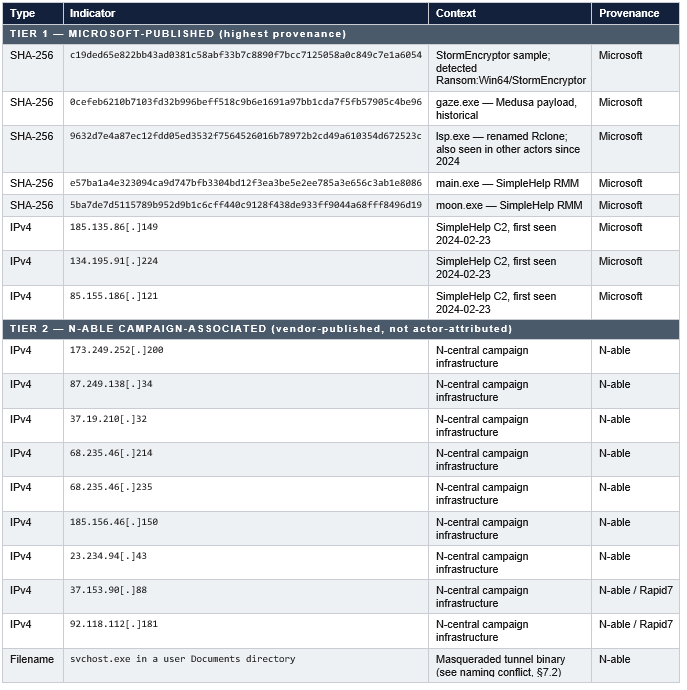
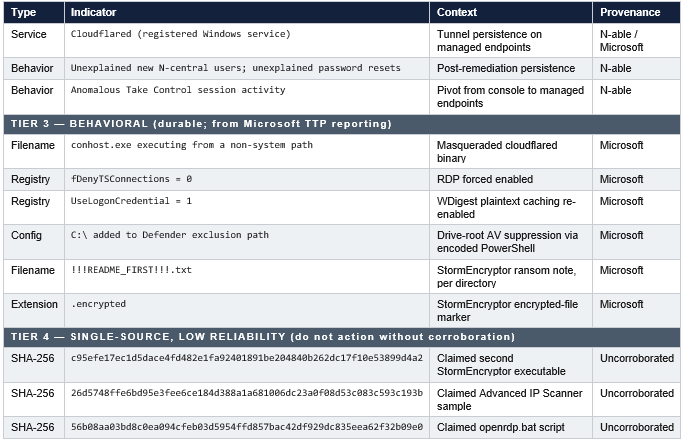
Two handling notes. Hash-based detection has limited durability against an actor that renames and recompiles freely, and Microsoft explicitly notes that the Rclone hash above has appeared in other actors’ intrusions since 2024 — treat it as tooling, not attribution. Cloudflare tunnel endpoints should not be blocked at the reputation layer or modeled as actor infrastructure; the service is legitimate and abused.
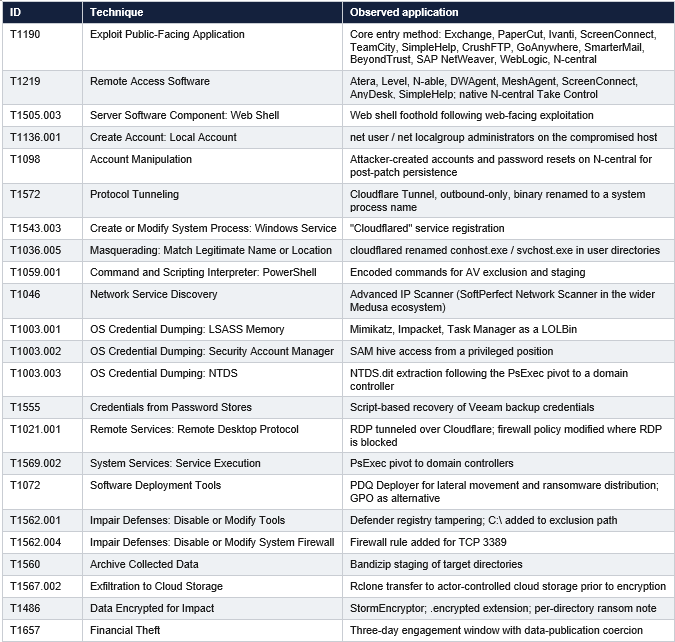
14. MITRE ATT&CK MAPPING
This mapping prioritizes Storm-1175-specific behavior as documented by Microsoft and N-able, supplemented where the wider Medusa ecosystem informs the technique. No official ATT&CK group page exists for this actor, so sub-technique assignments are this desk’s judgment against the vendor evidence rather than a vendor-published mapping. It is offered as a coverage reference for detection engineering rather than as a comprehensive behavioral profile.
15. SOURCING AND ANALYTIC METHODOLOGY
Source reliability below is graded on the Admiralty scale — A through F for source reliability, 1 through 6 for information credibility. Gradings are this desk’s assessment and are stated so that readers can discount accordingly rather than having to reconstruct provenance themselves.
— A1–A2 — Primary vendor and government reporting. Microsoft Security Blog (April 2026 technical profile) and Microsoft Threat Intelligence public disclosure (August 2026); N-able status advisories and consolidated customer advisory; NVD records for CVE-2026-18577 and CVE-2026-18556; CISA Known Exploited Vulnerabilities catalog; the FBI, CISA, and MS-ISAC joint Medusa advisory of 12 March 2025. Authoritative within their own telemetry and scope. Vendor advisories carry an inherent presentational interest, which is relevant when weighing the sufficiency of a first hotfix.
— B1–B2 — Named vendor technical analysis and incident response reporting. Horizon3, Rapid7, Huntress, Beazley, Arctic Wolf, Symantec Threat Hunter Team, SOC Prime. Independent confirmation of exploitation, downstream reach, patch-lag measurement, and vulnerability mechanics. Where these sources converge on the regression finding, this assessment treats it as verified.
— B2 — Established trade press. BleepingComputer, The Hacker News, Help Net Security, SecurityWeek, SecurityAffairs, Dark Reading. Generally reliable and useful for timeline corroboration, but largely derivative of vendor reporting; where a claim appears here and not in the primary source it purports to relay, it is graded lower.
— A2–B2 — Industry statistics and ecosystem reporting. Verizon Data Breach Investigations Report 2026; Coveware quarterly ransomware reporting; Group-IB annual ransomware analysis; Halcyon and Cloud Security Alliance research notes. Used for macro framing and attribution nuance rather than for campaign facts.
— E–F / 4–6 — Low-reliability aggregators and single-source outlets. Several outlets carrying granular campaign detail that no primary source claims. Identified in section 12; carried at tier four in the indicator table and not relied upon for any judgment in this assessment.
Analytic method. This assessment was produced by reconciling three independent bodies of material — a technical working draft, a primary-source verification pass, and a separately sourced assessment — against the underlying primary sources, and by preserving rather than resolving the disagreements between them where the evidence does not support resolution. Every claim carries the confidence its weakest supporting source permits. Observed activity is stated separately from inference throughout; the commercial and organizational reasoning in section 7 is explicitly inferential and labeled at moderate confidence. Where public reporting does not exist, this assessment says so rather than filling the gap, and section 11 exists precisely to make those absences legible.
Revision triggers. Publication of credible StormEncryptor reverse engineering; tier-one corroboration of any tier-four indicator; formal attribution joining the N-able intrusion to Storm-1175; a national CERT advisory naming the actor for this campaign; evidence of dedicated Storm-1175 leak infrastructure; or any law enforcement action against the group. Any of these should prompt reissue rather than amendment.
I know a hacking group using many of same tactics but not http://ransomware.My data is a month old.They are in USA.they just injected spam links.They are in Jupiter Florida. Devil’s Lair.