
Part 1 — Executive Summary
This assessment consolidates open-source cyber threat intelligence across four nation-state adversaries — Russia, the People’s Republic of China, the Democratic People’s Republic of Korea, and the Islamic Republic of Iran — along with cross-cutting convergence findings, geopolitical trigger analysis, and recommended defensive actions. The reporting period spans March 3 through April 17, 2026, incorporating a baseline research cycle and four weekly delta updates (March 27, April 3, April 10, and April 17). The dominant analytical frame for this briefing is the approaching expiration of the U.S.-Iran ceasefire on April 22, 2026 — now five days away — which compresses the escalation decision cycle for every actor examined in this report.
The ceasefire is a kinetic pause with no cyber provisions; expert consensus and historical precedent confirm that ceasefire periods produce cyber escalation, not de-escalation. Iranian proxy groups have explicitly declared the cyber war will continue irrespective of any military truce. At the same time, Russian intelligence services have broadened destructive operational technology targeting into Sweden (newly attributed this week), compromised 284 email accounts spanning Ukrainian prosecutors and NATO airbase military personnel, and continued a multi-year campaign to degrade Ukrainian healthcare. China has been caught in a dual-track posture — publicly denying weapons supply to Iran while U.S. intelligence identified imminent MANPADS and HQ-9B air-defense shipments and confirmed covert provision of a high-resolution optical spy satellite. North Korea has expanded its macOS credential-harvesting capability, opened a new Facebook-based social-engineering vector for RokRAT delivery, and received the largest individual U.S. sentences yet for its laptop-farm IT worker scheme.
Underneath these developments, the United States cyber-defense posture is degrading. The Cybersecurity and Infrastructure Security Agency (CISA) has lost roughly a third of its workforce over twelve months, three senior leaders have departed in 2026 alone, the director position remains unfilled, and the FY2027 budget proposal codifies a $707 million reduction that eliminates precisely the divisions needed to implement Executive Order 14390 by its May 5, 2026 first milestone. The net effect is a widening asymmetry between adversary capability growth and defender capacity retention at the moment convergence among Russia, China, Iran, and the DPRK is reaching a new evidentiary tier.
1.1 Key Judgments
The following twelve judgments represent the highest-confidence analytical conclusions derived from the research period. Each is supported by multiple corroborating sources documented in the Appendix Source Log. Confidence levels are HIGH unless otherwise noted.
• The U.S.-Iran ceasefire expires in five days (April 22, 2026). An in-principle two-week extension has been discussed but no formal announcement exists as of reporting; the White House states “no deal in place to extend it.” The interval between April 17 and April 22 represents the highest-probability window for a Stryker-class wiper event or identity-weaponization attack against a major U.S. financial institution or critical-infrastructure target, consistent with Nozomi Networks and SISA assessments.
• Fancy Bear (GRU Military Unit 26165) compromised at least 284 email accounts across Ukrainian prosecutors and investigators (170-plus, including the Asset Recovery and Management Agency and the Specialized Anti-Corruption Prosecutor’s Office), the Romanian Air Force (67 accounts covering NATO airbase personnel), the Hellenic National Defense General Staff (27 accounts), and additional entities in Bulgaria and Serbia. The intrusion, active from September 2024 through March 2026, was exposed via the adversary’s own OPSEC failure — an operational server left publicly accessible — and disclosed April 14–15.
• Sweden issued its first-ever government attribution of a destructive Russian cyber operation targeting operational technology: an early-2025 attempted attack on an unnamed Swedish thermal power plant, disclosed April 15. This formalizes the regional escalation trajectory from denial-of-service to destructive intent and extends the Poland DynoWiper (December 2025) and Norway dam-breach (April 2025) pattern to a third Northern European state.
• CERT-UA disclosed UAC-0247 targeting of Ukrainian clinical hospitals, emergency services, and municipal agencies with the AGINGFLY, SILENTLOOP, CHROMELEVATOR, ZAPIXDESK, and RAVENSHELL toolset, including a trojanized first-person-view drone operator software update delivered via Signal to defense-sector personnel — underscoring the cross-platform, cross-sector expansion of Russian-aligned cluster activity during the Easter ceasefire window.
• China is operating a dual-track strategy: President Trump publicly cited Xi Jinping’s assurance that Beijing will not supply weapons to Iran, while U.S. intelligence identified preparation of MANPADS and HQ-9B long-range surface-to-air missile shipments routed through third countries, and Global Defense Corp flagged deliberate backdoors in both BeiDou-3 and Huawei platforms on April 11. The May 14–15 Beijing summit delay extends the pre-summit intelligence collection window by roughly four weeks.
• Asia Times confirmed on April 16 that China covertly provided Iran with the TEE-01B optical reconnaissance satellite (0.52-meter panchromatic resolution, 14.8-kilometer swath) built by Earth Eye Co., along with access to Beijing-based Emposat ground stations. Documented Iranian imagery collection covers Prince Sultan Air Base (Saudi Arabia), Muwaffaq Salti Air Base (Jordan), U.S. Fifth Fleet facilities in Bahrain, and Erbil airport (Iraq), including pre- and post-strike imagery of the March 14 strike at Prince Sultan.
• Microsoft Threat Intelligence exposed (April 16) a Sapphire Sleet / APT38 macOS campaign in which fake LinkedIn recruiter profiles lure finance professionals to a fake Zoom support meeting that delivers a compiled AppleScript (Zoom SDK Update.scpt) hiding malicious logic below thousands of blank lines, deploys the icloudz backdoor via NSCreateObjectFileImageFromMemory memory loading, and exfiltrates cryptocurrency wallets, keychains, Telegram credentials, and Apple Notes via the Telegram Bot API. Apple issued XProtect signatures in response.
• APT37 / ScarCruft (disclosed April 13) opened a Facebook-to-RokRAT attack chain using two fake profiles with Pyongyang and Pyongsong locations, delivering a trojanized Wondershare PDFelement installer via Messenger and Telegram, pulling second-stage payloads from a compromised Japanese real-estate website (japanroom[.]com), and using Zoho WorkDrive as RokRAT command-and-control.
• DOJ sentenced two U.S. nationals on April 15–16 to 108 and 92 months in federal prison for running laptop farms that funneled over $5 million to North Korean weapons programs and enabled DPRK operatives to work at 100-plus U.S. companies, including a California defense contractor where ITAR-controlled data was accessed from January 19 through April 2, 2024. The State Department announced a $5 million reward for eight remaining co-conspirators.
• The Iranian PLC and industrial-control-system campaign confirmed in CISA advisory AA26-097A (April 7) is ongoing and has not paused following the ceasefire. Siemens S7 port scanning indicates a potential expansion beyond the Rockwell Automation Allen-Bradley baseline; more than 3,000 Rockwell devices remain internet-exposed per Nozomi Networks estimates.
• CISA structural collapse is accelerating. Three senior leaders (Costello, Stern, Hartsook) have departed in 2026, the director position remains vacant (Plankey unconfirmed; Gottumukkala departed amid scandal; Andersen now acting), effective staffing has dropped from approximately 3,700 to 2,700 (a 27 percent reduction), and the FY2027 budget proposal cuts $707 million while eliminating Stakeholder Engagement, International Coordination, Regional Operations, and the election-security program — precisely the divisions required to meet EO 14390’s May 5 review milestone.
• Russia-Iran-China satellite intelligence-sharing has been confirmed at a new depth. The April 17 JNS analysis states Russian and Chinese satellites are conducting dozens of detailed Middle East imagery surveys per week specifically to support Iranian targeting of U.S. forces and Israeli energy sites. Iran is now using Russian GLONASS for missile guidance in parallel with BeiDou, completing a multi-constellation navigation-assurance backbone for Iranian strike operations.
1.2 Threat Level Matrix
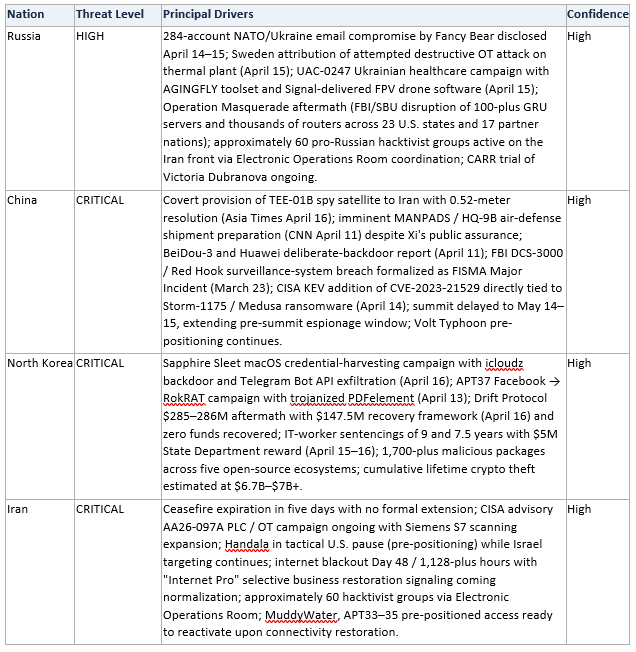
The following matrix summarizes current threat-level assessments by nation, the principal drivers of each assessment, and the confidence level supporting it. All assessments are based on open-source intelligence synthesized across 25 research inputs covering March 3 through April 17, 2026. Threat levels are relative to baseline adversary activity levels observed across the preceding twelve months.
1.3 Reporting Period Overview
The March 3 – April 17, 2026 period captures one of the most operationally compressed windows in recent cyber-threat history. The period opens in the aftermath of the February 28 U.S.-Israel strikes on Iranian nuclear and missile infrastructure (Operation Epic Fury), extends through the March 1 AWS Bahrain / UAE drone strikes that marked the first kinetic targeting of commercial cloud infrastructure, captures the Iranian internet blackout from its first days through Day 48, and closes with a fragile two-week ceasefire five days from expiration and a U.S. naval blockade of Iranian ports in its fifth day of enforcement.
Russia produced disclosures in every week of the window. The March 20 FBI/CISA Signal/WhatsApp advisory and the ANSSI campaign against French officials gave way to the April 7 Operation Masquerade takedown, which disabled roughly 100 GRU-controlled servers and recovered thousands of compromised TP-Link and MikroTik routers across 23 U.S. states and 17 partner nations. The April 8 Security Affairs disclosure of the PRISMEX framework — incorporating CVE-2026-21509 (Microsoft Office RTF) and CVE-2026-21513 (LNK), custom “Bit Plane Round Robin” steganography, and Filen.io cloud abuse — established APT28’s continued technical primacy. The April 14–15 Reuters disclosure of the 284-account prosecutor and NATO email breach, together with the April 15 Sweden attribution and the CERT-UA UAC-0247 advisory, defined the current reporting cycle.
China’s activity compresses around surveillance systems and Iran support. The FBI DCS-3000 “Red Hook” breach, declared a FISMA “Major Incident” on March 23 and fully analyzed by ComplexDiscovery on April 13, demonstrated MSS willingness to climb the intelligence collection chain from telecom carriers to the FBI’s own pen-register and trap-and-trace infrastructure. The April 6 Microsoft Storm-1175 / Medusa profile confirmed PRC-linked ransomware with a 24-hour access-to-encryption timeline and zero-day exploitation up to one week pre-disclosure; CVE-2023-21529 (Exchange) was added to the CISA KEV catalog on April 14 as a direct result. The April 16 Asia Times TEE-01B satellite analysis and the April 11 CNN report on imminent air-defense shipments to Iran established the operational linkage between Chinese intelligence-surveillance-reconnaissance capability and Iranian kinetic operations against U.S. forces.
North Korean activity was dense and multi-vector. The April 1 Drift Protocol hack drained $285–286 million in under twelve minutes using fictitious CarbonVote Token collateral, with Chainalysis, TRM Labs, and Elliptic confirming UNC4736 / Citrine Sleet / AppleJeus attribution. The April 16 recovery framework secured up to $147.5 million in Tether and partner support but recovered none of the stolen funds. The April 8 Socket disclosure of 1,700-plus malicious packages across npm, Go, Rust, PHP/Packagist, and Python marked the formal cross-ecosystem expansion of Contagious Interview / UNC1069. The April 13 APT37 Facebook-to-RokRAT campaign and the April 16 Sapphire Sleet macOS AppleScript chain introduced two new social-engineering vectors. The April 15–16 sentencing of Kejia Wang (108 months) and Zhenxing Wang (92 months) and the $5 million State Department bounty on eight remaining co-conspirators represented the most aggressive U.S. enforcement escalation against the DPRK IT-worker scheme to date.
Iran dominated the window. The February 28 Electronic Operations Room formation mobilized a coalition of approximately 60 hacktivist groups. Handala executed the March 11 Stryker Corporation wiper attack through Microsoft Intune abuse, affecting roughly 200,000 devices across 79 countries with 50 terabytes of claimed exfiltrated data. The March 27 compromise of FBI Director Kash Patel’s personal email preceded a $10 million State Department bounty. The April 1 Handala claim against St. Joseph County, Indiana and the April 7 six-agency advisory (FBI, CISA, NSA, EPA, DOE, Cyber Command) documenting ongoing Iranian PLC exploitation via CVE-2021-22681 against Rockwell Automation devices, with expansion indicators against Siemens S7, established the current ICS threat baseline. The April 7–8 ceasefire and April 13 naval blockade have not disrupted this campaign.
Convergence across the four actors reached a new evidentiary tier. The Ukrainian intelligence assessment of April 7 documented active Russia-Iran cyber coordination through shared Chelyabinsk-based ProfitServer infrastructure and joint Telegram-channel target publication. The TASS-KCNA information-war agreement signed March 28 was operationalized through April 16 Moscow Times reporting. BeiDou, GLONASS, and TEE-01B confirmations converged to validate the Atlantic Council’s “Axis of Evasion” framework. NATO Locked Shields 2026 executed its main national-teams exercise during the reporting period with no winner announced as of report date.
1.4 Analytical Confidence and Methodology
All assessments in this briefing are derived exclusively from open-source intelligence. Primary sources include U.S. government advisories (CISA, FBI, DOJ, EPA, Treasury OFAC, State Department Rewards for Justice, ODNI Annual Threat Assessment 2026); foreign-partner advisories (CERT-UA, NCSC-UK, ANSSI, BSI, SUPO and Traficom); vendor research (Microsoft Threat Intelligence, Mandiant / Google Threat Intelligence Group, Trend Micro, Check Point, Rapid7, Trellix, Unit 42 / Palo Alto Networks, Tenable, Recorded Future, Chainalysis, TRM Labs, Elliptic, Proofpoint, ESET, Kaspersky, Dragos, Nozomi Networks, Genians, Zscaler, SentinelOne, Symantec / Carbon Black, Huntress, Fortinet FortiGuard Labs, Bitdefender, Socket, Security Alliance / SEAL, Ctrl-Alt-Intel); journalistic reporting (Reuters, Bloomberg, CNN, CNBC, CBS, ABC, NYT, Al Jazeera, Kyiv Independent, United24, TechCrunch, The Register, The Hacker News, Cybersecurity Dive, The Record, BleepingComputer, CyberScoop, SC World, Krebs on Security); and policy and think-tank analysis (Atlantic Council, Brookings, Carnegie Endowment, CSIS, Chatham House, Defense News, FDD, Flashpoint, ISW, Critical Threats Project, IISS, JNS, PISM, RSIS, Shieldworkz, Steptoe, ComplexDiscovery).
Confidence levels follow the U.S. intelligence-community standard. HIGH confidence reflects multi-source corroboration including at least one primary-agency advisory or vendor-originated technical disclosure. MODERATE confidence reflects strong journalistic sourcing plus vendor confirmation but without primary-agency formal statement. LOW confidence reflects single-source or uncorroborated claims — for example, the BeiDou-3 backdoor allegation and the APT Iran 375 TB Lockheed Martin claim are both flagged as unconfirmed in their respective sections. Attribution is presented as reported; contested attributions such as TrendAI’s dissent on the 284-account email-breach Fancy Bear attribution are noted explicitly. No classified material was used in the preparation of this briefing.
Analytical limitations include: (1) the Iranian internet blackout suppresses visibility into coordinated high-bandwidth operations by domestic state APT cells, though external proxy coalition activity is unaffected; (2) the NATO Locked Shields 2026 main-exercise winner had not been announced by the April 17 runtime; (3) the CARR trial against Victoria Eduardovna Dubranova commenced April 7 but no verdict was publicly reported by the runtime; (4) the full downstream impact of the Axios npm supply-chain compromise remains under investigation with Mandiant’s scoping expected to take several months; and (5) specific NoName057(16) target lists for the April 10–17 window were not publicly disclosed in reviewed sources.
Part 2 — Nation-State Threat Assessments
This part examines each of the four priority nation-state adversaries in turn, following a consistent structure: strategic overview, key developments across the reporting period, tactics-techniques-procedures summary, indicators of compromise, and forward assessment. Developments are presented in analytical depth sufficient for defender prioritization rather than as event logs; the consolidated IOC reference for all four actors appears in Part 5.
2.1 Russia
2.1.1 Strategic Overview
Russian state-sponsored cyber activity during the March 3 – April 17, 2026 window is defined by four concurrent strategic objectives: (1) sustained intelligence collection against Ukrainian prosecutorial, law-enforcement, and defense entities as well as NATO-member militaries in Central and Eastern Europe; (2) destructive operational-technology targeting of Northern European critical infrastructure, now extending from Poland to Norway to Sweden; (3) coordinated cyber and information support to Iranian proxy groups as the Middle East conflict generates a second theatre for GRU-aligned hacktivist affiliates; and (4) domestic cyber-policy consolidation, including the April 1 FSB database-access statute and the Digital Development Ministry’s April 15 VPN-blocking benchmark. The April 7 Operation Masquerade disruption represents the most significant Western law-enforcement action against a Russian cyber operation in 2026 to date but does not change this strategic trajectory; the April 14–15 Reuters disclosure of the 284-account email compromise demonstrates that GRU intelligence collection against Ukrainian and NATO institutions was proceeding on parallel tracks throughout the Operation Masquerade window.
The principal active groups include APT28 / Fancy Bear (GRU Military Unit 26165), which operated FrostArmada / Operation Masquerade and is attributed to both the PRISMEX framework and the 284-account email compromise; APT29 / Midnight Blizzard / Cozy Bear (SVR), which continues Signal / WhatsApp targeting of current and former U.S. officials; Sandworm / APT44 (GRU Unit 74455), responsible for the December 2025 Poland DynoWiper attack against CHP plants and credibly implicated in the attempted Swedish thermal-plant attack disclosed April 15; Star Blizzard / Callisto (FSB-linked), which Microsoft and Google TIG have previously attributed to the global Signal-Support impersonation campaign; Turla / Secret Blizzard (FSB Center 16); Gamaredon / Shuckworm (FSB Crimea-based); Void Blizzard / LAUNDRY BEAR (newly identified 2025, tooling overlap with APT28); and the pro-Russian hacktivist proxy ecosystem — CyberArmyofRussia_Reborn (CARR / Z-Pentest), NoName057(16), DDoSia Project, KillNet, Z-Pentest Alliance, RansomHub-aligned affiliates — which has expanded operations onto the Iran front under Russia-Iran coordination frameworks.
Threat level is assessed HIGH. The combination of confirmed ongoing intelligence collection at NATO scale, the qualitative shift to attributed destructive OT targeting in a third European state, active targeting of Ukrainian healthcare through UAC-0247, and the pro-Russian hacktivist presence on the Iran front together justify this level. The threat level did not escalate to CRITICAL because no Russian actor has conducted a confirmed large-scale destructive attack on U.S. infrastructure during the reporting window; however, the PRISMEX framework’s zero-day gap (11 days between VirusTotal sample and Microsoft patch for CVE-2026-21513) and the demonstrated capability to compromise 284 accounts across five countries over 18 months place Russian APT capability at or above the baseline preceding the reporting period.
2.1.2 Key Developments
The following developments represent the most operationally consequential Russian cyber activity observed or newly disclosed during the reporting window. They are organized by disclosure date within the period, with the earliest items first and the April 17 deltas last.
Russian Intelligence Services Signal and WhatsApp Targeting (FBI/CISA PSA, March 20). The FBI and CISA issued a Private-Sector Advisory documenting widespread Russian Intelligence Services social-engineering against Signal and WhatsApp users. The campaign — attributed by Microsoft and Google TIG to Star Blizzard (UNC4221 / UAC-0185) and Seaborgium-adjacent clusters, with some operations attributed to UNC5792 (UAC-0195) — impersonates “Signal Support” to phish SMS verification codes, PINs, and QR-code click targets, enabling attacker-controlled linked devices or full account takeovers. Targets are current and former U.S. government officials, military personnel, political figures, and journalists. The campaign is global in scope with thousands of accounts compromised. Mechanism: no exploitation of application encryption — purely social engineering on the user.
APT28 BEARDSHELL / SLIMAGENT / COVENANT Long-Term Ukraine Espionage (ESET, late March). ESET disclosed a multi-year APT28 campaign against Ukrainian government and defense entities using BEARDSHELL (C# backdoor with dual-cloud redundancy across Microsoft Graph and an alternative cloud), SLIMAGENT (memory-resident loader), and the open-source COVENANT C2 framework customized with Grunt-stager modifications that later resurfaced in PRISMEX. Dual-cloud confirmation indicates APT28 has institutionalized redundant C2 pathways that survive single-cloud takedowns.
BadPaw / MeowMeow Campaign (ClearSky, March). ClearSky reported a Russian state-actor campaign delivering BadPaw (credential stealer) and MeowMeow (reverse shell) against Ukrainian organizations, using themed lures based on air-raid alerts and humanitarian-aid appeals.
DOJ Sentencing of Ilya Angelov (TA551 / Mario Kart, March). The Department of Justice sentenced Russian national Ilya Angelov for operating the TA551 botnet. The sentencing marks the second major Russian-criminal-actor sentencing of Q1 2026, following the Victoria Dubranova extradition and February 3 NoName057(16) trial.
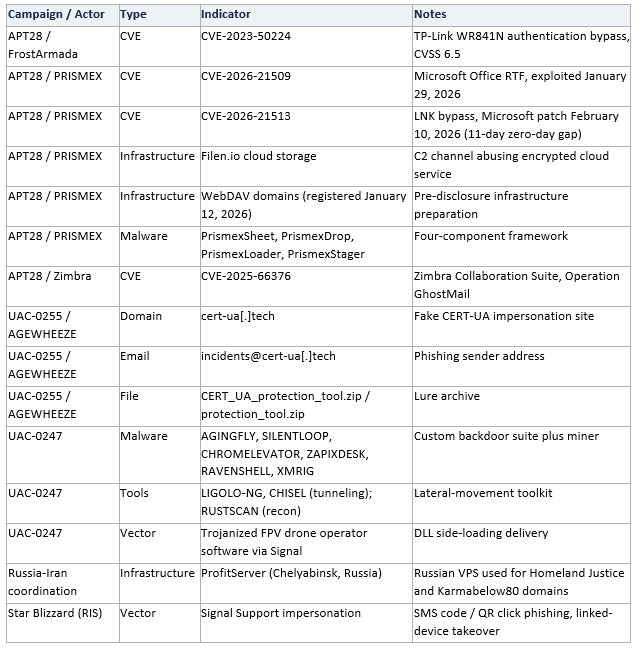
UAC-0255 AGEWHEEZE / CYBER SERP Campaign (CERT-UA, March 30). CERT-UA disclosed a campaign impersonating CERT-UA itself — using the fake domain cert-ua[.]tech and the email address incidents@cert-ua[.]tech, with a lure file titled “CERT_UA_protection_tool.zip” (or “protection_tool.zip”) — to deploy the AGEWHEEZE remote-access trojan. Active March 26–27 with disclosure on April 1–2; attribution is UAC-0255 / Cyber Serp cluster.
APT28 Zimbra CVE-2025-66376 / Operation GhostMail. APT28 exploited CVE-2025-66376 in Zimbra Collaboration Suite as part of Operation GhostMail, resulting in a CISA Known Exploited Vulnerabilities entry with a federal patch deadline prior to the reporting period’s end. The operation targeted diplomatic and government email infrastructure.
Rostelecom DDoS Attack (April 6). Pro-Ukrainian or unattributed actors conducted a distributed-denial-of-service attack against Rostelecom, Russia’s largest telecom provider. While not a Russian offensive operation, the event is notable as context for the Russia-Iran hacktivist coordination described below — Russian-aligned groups reciprocated with elevated DDoS against Western targets.
Operation Masquerade / FrostArmada Disruption (DOJ/FBI/NSA/NCSC-UK/SBU, April 7). The most significant Western law-enforcement action against Russian cyber operations in Q2 2026. FBI-led court-authorized operations under a District of Pennsylvania warrant — coordinated with NSA, NCSC-UK, DOJ, the Security Service of Ukraine (SBU), Polish counterintelligence, and 17 partner nations including Canada, Czech Republic, Denmark, Estonia, Finland, Germany, Italy, Latvia, Lithuania, Norway, Poland, Portugal, Romania, Slovakia, and Ukraine — disrupted a campaign (tracked by Lumen Black Lotus Labs as FrostArmada and by FBI as Operation Masquerade) that had reached a peak of 18,000-plus IP addresses across 120-plus countries in December 2025. APT28 / GRU Unit 26165 used DHCP and DNS hijacking via compromised TP-Link WR841N (CVE-2023-50224 authentication bypass, CVSS 6.5) and MikroTik routers to redirect victims to a GRU-controlled DNS resolver, conducting adversary-in-the-middle interception of Microsoft Outlook Web Access and other TLS sessions. The operation affected more than 200 organizations — ministries of foreign affairs, law enforcement, IT, telecom, and energy — across North Africa, Central America, Southeast Asia, and Europe. More than 5,000 consumer devices were confirmed compromised, with U.S. scope covering 23-plus states. FBI actions included court-authorized commands to collect evidence, reset DNS, and prevent re-exploitation. Black Lotus Labs’ Danny Adamitis stated that “the campaign has ceased” with a gradual decline in command-and-control communications following the April 7 action.
Ukraine-Side Operation Masquerade Cleanup (April 8–10). Distinct from the FBI U.S.-side remediation, the SBU announced jointly with the FBI, Polish counterintelligence, and EU law-enforcement partners that more than 100 GRU-controlled servers had been disabled and hundreds of compromised routers reclaimed within Ukraine. Nordic Defence Sector reported on April 10 that Finnish authorities (SUPO and Traficom) confirmed participation and issued a sustained warning that the Russian cyber threat “remains,” urging home-network hardening.
APT28 PRISMEX Framework Disclosure (Security Affairs / Trend Micro, April 8). Full technical disclosure of the PRISMEX campaign active since September 2025. PRISMEX comprises four components: PrismexSheet (malicious Excel files with decoy content including Ukrainian drone inventories and supplier price lists); PrismexDrop (native dropper with COM-hijacking persistence and scheduled-task explorer.exe restart); PrismexLoader (proxy DLL loader using custom “Bit Plane Round Robin” steganography to hide payloads in image bit planes, with in-memory .NET runtime loading); and PrismexStager (Covenant Grunt Stager variant using Filen.io cloud storage as C2, evading reputation-based filtering). The campaign exploits CVE-2026-21509 (Microsoft Office RTF, with WebDAV servers registered January 12, 2026 — two weeks before public CVE disclosure on January 26) and CVE-2026-21513 (LNK bypass, VirusTotal sample January 30, 2026, Microsoft patch February 10, 2026 — an 11-day zero-day gap after patch release). Targets include Ukrainian government and defense, drone units, logistics staff, emergency services, hydrometeorology, and transport, plus Central and Eastern European logistics hubs in Poland, Romania, and Slovakia. PRISMEX is assessed as a direct evolution of the MiniDoor / NotDoor ecosystem.
Russia-Iran Cyber Coordination Documentation (Reuters / Defense News, April 7). Ukrainian intelligence documented active operational coordination between Russian groups Z-Pentest Alliance, NoName057(16), and DDoSia Project with Iran’s Handala Hack team via Telegram channels. Russian groups published industrial-control-system credentials for Israeli critical-infrastructure facilities while Handala simultaneously published attack warnings against Israeli energy companies. Iranian groups Homeland Justice (UAC-0074) and Karmabelow80 used the Russian VPS provider ProfitServer (Chelyabinsk) to register operational domains. Ukrainian intelligence assessed that Iranian groups had adopted techniques “indicating they had obtained them from Russian military intelligence hackers.” Approximately 60 hacktivist groups are active on the Iran front as of early April 2026 per Unit 42 estimates, encompassing both pro-Russian and Iran-aligned collectives.
Easter Ceasefire Cyber Posture (April 11–12). A 32-hour Russian-Ukrainian Easter ceasefire produced 2,299 Ukrainian-documented violations. Long-range drone, missile, and guided-bomb use was reduced; small-drone and FPV attacks continued. No specific hacktivist operational surge or pause was tied to the ceasefire window in reviewed open-source reporting.
284-Account NATO and Ukraine Email Compromise Disclosed (Reuters exclusive, April 14–15). The most operationally significant Russian cyber disclosure of the window. Ctrl-Alt-Intel — a U.S. and U.K. threat-research collective — discovered an exposed operational server containing logs of successful hacking operations and thousands of stolen emails after Fancy Bear hackers left the server publicly accessible. Ctrl-Alt-Intel characterized the error: “The hackers just committed a significant operational error. They left their front door wide open.” Reuters authenticated the data in its review. At least 284 email accounts were compromised between September 2024 and March 2026, including: 170-plus accounts belonging to Ukrainian prosecutors and investigators (Asset Recovery and Management Agency including director Vasyl Maksymenko, Prosecutor’s Training Center in Kyiv with 44 employees including director Oleh Duka, Specialized Anti-Corruption Prosecutor’s Office, Specialized Office of Field Defense anti-corruption unit, Central Hospital in Kropyvnytskyi, Kropyvnytskyi city finance committee); 67 Romanian accounts including the Romanian Air Force and NATO airbase personnel plus a senior military official; 27 Greek accounts including the Hellenic National Defense General Staff and defense attaches in India and Bosnia; at least four Bulgarian accounts in Plovdiv province; and Serbian academics and military personnel. Attribution to Fancy Bear is contested: Ctrl-Alt-Intel attributes to Fancy Bear, ESET’s Matthieu Faou could not confirm, and TrendAI’s Feike Hacquebord contested attribution. Keir Giles of Chatham House assessed the campaign as targeting “Ukrainian law enforcement to stay ahead of investigators looking to expose Moscow’s operatives or to gather potentially damaging information about key officials in Kyiv.” SAPO spokesperson Olha Postolyuk stated on April 15 that “no signs of data theft have been detected” as of that date, verification ongoing.
Sweden Attributes Destructive Cyberattack on Thermal Plant (April 15). Swedish Civil Defense Minister Carl-Oskar Bohlin publicly attributed an early-2025 attempted destructive cyberattack against an unnamed Swedish thermal power plant to actors with “connections to Russian intelligence and security services” and pro-Russian groups, with no specific APT group named. The attack was blocked by a built-in protection mechanism; no disruption occurred. Minister Bohlin’s characterization — “Pro-Russian groups that once carried out denial-of-service attacks are now attempting destructive cyber attacks against organizations in Europe” — and his framing of the escalation as “riskier and more reckless behavior” mark the first Swedish government public attribution of a destructive attempted cyberattack to Russia-connected actors. Context: the December 29–30, 2025 Sandworm / ELECTRUM DynoWiper attack on Polish CHP plants and wind/solar installations (ESET medium confidence and Dragos moderate confidence attribution; publicly disclosed January 26, 2026) and the April 2025 pro-Russian hacktivist dam-breach attempt in Bremanger, Norway (attributed by Norwegian PST in August 2025) together establish the Poland-Norway-Sweden pattern. Sweden’s timing of the disclosure — April 15, one week after the ceasefire — reflects a deliberate policy choice to name and shame the escalation.
CERT-UA UAC-0247 Healthcare and Municipal Campaign (April 15). CERT-UA disclosed a March-April 2026 cluster designated UAC-0247 targeting Ukrainian clinical hospitals, emergency services, municipal bodies, and defense personnel connected to FPV drone operations. Toolset includes AGINGFLY (C#-based custom backdoor with command execution, file exfiltration, screenshot capture, keylogging, and dynamic retrieval and compilation of command logic from remote servers); SILENTLOOP (PowerShell persistence tool retrieving C2 addresses from Telegram channels); CHROMELEVATOR (browser-credential extractor); ZAPIXDESK (WhatsApp data-theft tool); RAVENSHELL (reverse-shell variants for encrypted C2); and XMRIG cryptocurrency miner embedded inside a modified WireGuard application. Lateral movement and post-exploitation uses LIGOLO-NG and CHISEL tunneling plus RUSTSCAN reconnaissance. Initial access occurs via phishing emails disguised as humanitarian-aid offers redirecting to fake or compromised websites with archive downloads containing malicious LNK shortcuts; LNK activates mshta.exe or PowerShell; decoy documents display to suppress suspicion; malicious executables deploy via scheduled tasks with code injection into legitimate processes such as RuntimeBroker.exe. The defense-sector vector is particularly significant: in March 2026 attackers distributed a trojanized FPV drone operator software update via the Signal messaging platform using DLL side-loading to install AGINGFLY. CERT-UA mitigation guidance emphasizes restricting execution of LNK, HTA, and JavaScript files and limiting use of native Windows binaries including mshta.exe and PowerShell.
CARR Trial Commenced (April 7). The trial of Victoria Eduardovna Dubranova (33, Ukrainian national; aliases Vika, Tory, SovaSonya) opened in the Central District of California federal court in Los Angeles. Dubranova faces CARR (Cyber Army of Russia Reborn / Z-Pentest) charges — conspiracy to damage protected computers and tamper with public water systems, damaging protected computers, access-device fraud, aggravated identity theft — with a statutory maximum of 27 years; a separate NoName057(16) trial on conspiracy charges (maximum 5 years) was held February 3, 2026. CARR was founded, funded, and directed by Russia’s GRU; Dubranova was extradited to the United States in 2025. OFAC sanctioned CARR members Pankratova and Degtyarenko in July 2024, and the State Department Rewards for Justice program offers up to $2 million for information on CARR associates. As of April 17 no verdict has been publicly announced. Federal complex-cyber trials typically run three to six weeks.
FSB Database Access Law (Effective April 1). A new Russian statute grants the FSB authority to obtain any organization’s databases without court order — corporate databases, telecom networks, financial communications, international contacts of scientists. In parallel, the Digital Development Ministry under Minister Shadayev met major Russian telecoms and platforms and requested VPN blocking by April 15 as a “benchmark” (ISW, April 2). The combined effect is to consolidate FSB domestic cyber-surveillance authority at the moment GRU external operations are under Western disruption pressure.
2.1.3 Tactics, Techniques, and Procedures
Russian APT activity during the period exhibits several evolving TTP patterns of operational significance. First, pre-disclosure infrastructure preparation: APT28 registered PRISMEX WebDAV servers on January 12, 2026 — two weeks before CVE-2026-21509’s public disclosure on January 26 — indicating either advance vulnerability knowledge or closely synchronized exploit development. Second, steganographic C2: PRISMEX’s custom “Bit Plane Round Robin” algorithm distributes payload data across image bit planes in a fashion not matched by commodity steganography tools, complicating static detection. Third, legitimate-cloud abuse: Filen.io (PRISMEX C2), Microsoft Graph and Zoho (APT28 secondary channels), Dropbear SSH on non-standard ports, and ProfitServer VPS (Iran-coordination infrastructure) all contribute to traffic that blends with normal enterprise patterns. Fourth, living-off-trusted-platforms: the Signal delivery of trojanized FPV drone software by UAC-0247 and the Star Blizzard Signal Support impersonation represent parallel exploitations of the high-trust messaging platforms used by the targeted populations (military operators and senior officials respectively).
At the supply-chain layer, APT28’s FrostArmada DHCP/DNS hijacking via consumer routers created an operational-relay infrastructure spanning 18,000-plus IPs at peak and enabled adversary-in-the-middle interception against more than 200 organizations. This represents a strategic capability shift from direct compromise of target networks to intermediate-network positioning on consumer-device infrastructure. The PRISMEX and UAC-0247 campaigns demonstrate that even with FrostArmada disrupted, APT28 retains full endpoint-compromise capability via direct social engineering. At the hacktivist layer, the Russia-Iran coordination pattern shows Russian groups publishing target credentials on Telegram for Iranian groups to operationalize — a division-of-labor pattern that maintains Russian plausible deniability while amplifying Iranian tactical capacity.
MITRE ATT&CK technique coverage observed in the period includes, at minimum: T1566 (Phishing) with sub-techniques across spearphishing attachment, link, and service; T1059 (Command and Scripting Interpreter) covering PowerShell, JavaScript, and AppleScript variants; T1053.005 (Scheduled Task); T1574.002 (DLL Side-Loading, UAC-0247 Signal campaign); T1071.001 and T1071.004 (Web Protocols, DNS); T1090.003 (Multi-Hop Proxy, FrostArmada ORB network); T1001.002 (Steganography, PRISMEX Bit Plane Round Robin); T1555 (Credentials from Password Stores, CHROMELEVATOR); T1567.002 (Exfiltration over Web Services, Filen.io); T1195.002 (Compromise Software Supply Chain, UAC-0247 FPV drone software); T1114 (Email Collection, 284-account campaign); T1189 (Drive-by Compromise, AGEWHEEZE CERT-UA impersonation).
2.1.4 Indicators of Compromise
The following indicators are consolidated from vendor and CERT-UA reporting during the reporting window. A complete consolidated IOC set across all four nations is provided in the Part 5 appendix.
2.1.5 Assessment and Outlook
The 30-day outlook for Russian cyber activity is defined by three variables. First, the CARR trial verdict, likely in late April or early May, will set precedent for prosecution of GRU-affiliated hacktivist collectives; a conviction will accelerate extradition pressure on remaining CARR and NoName057(16) associates but is unlikely to diminish operational tempo. Second, the Ukraine spring campaign continues in attritional mode — the anticipated 2026 offensive has not materialized per ISW — meaning APT28 and Sandworm are likely to maintain current collection and disruption targeting rather than transition to large-scale destructive operations. Third, the Sweden disclosure signals that additional European attribution announcements are possible; analysts should anticipate further named attribution from Finland, Denmark, or the Baltic states during the 30- to 60-day horizon given SUPO’s April 10 involvement in Operation Masquerade and the heightened policy appetite for public attribution.
Operationally, defenders should expect: (1) continued APT28 spearphishing against Ukrainian and NATO defense, prosecutorial, and diplomatic targets using PRISMEX-lineage tools with potential new CVE acquisition in the next 30 days; (2) continued Star Blizzard Signal and WhatsApp targeting of U.S. and U.K. officials; (3) Gamaredon tempo restoration against Ukrainian targets following any operational pause observed in the Easter ceasefire window; (4) Sandworm destructive-operation readiness against European OT should the Russia-Ukraine conflict escalate; and (5) pro-Russian hacktivist amplification around any Iranian ceasefire-related kinetic events through the Russia-Iran coordination frameworks documented April 7.
2.2 China
2.2.1 Strategic Overview
Chinese cyber activity during the reporting period operates at two interlocking levels. At the strategic-espionage level, the FBI DCS-3000 / Red Hook breach — declared a FISMA Major Incident on March 23 and fully analyzed publicly on April 13 — represents a qualitative escalation of Salt Typhoon-class targeting from telecom carriers to the FBI system that generates and manages surveillance orders. This is an upward move in the intelligence-collection chain with second-order implications for U.S. legal proceedings that rely on DCSNet-collected metadata. At the operational-support level, the April 16 Asia Times confirmation of the TEE-01B spy satellite transfer to Iran, the April 11 CNN report of MANPADS and HQ-9B preparation for Iranian shipment, the April 11 Global Defense Corp allegation of deliberate BeiDou-3 and Huawei backdoors, and the April 17 JNS documentation of Russian-Chinese satellite intelligence-surveillance-reconnaissance support establish that Beijing is actively sustaining the kinetic adversary of the United States with multi-domain intelligence and weapons support even while publicly brokering the April 7–8 ceasefire.
The principal active groups include Salt Typhoon (RedMike / GhostEmperor / UNC5807 / Operator Panda, MSS-linked), confirmed by the FBI in February 2026 as “still very much ongoing” with 200-plus companies impacted across 80-plus countries; Volt Typhoon (VOLTZITE / Insidious Taurus), assessed by IISS as pre-positioning for critical-infrastructure disruption in a military-crisis scenario; Silk Typhoon (Hafnium / Murky Panda / UNC5221 / UNC6201); APT41 / Wicked Panda / Brass Typhoon covering both espionage and financial operations; APT31 / Violet Typhoon; Mustang Panda / TA416 / Camaro Dragon / Earth Preta / Twill Typhoon, confirmed returning from a two-year hiatus to target EU / NATO diplomatic missions with archive-plus-renamed-MSBuild chains and expanded to Middle East targets post-strike; Red Menshen (Earth Bluecrow / DecisiveArchitect / Red Dev 18), deploying BPFdoor variant F with 26-instruction BPF filters and HTTPS-embedded triggers in Middle East and Asian telecoms; Flax Typhoon (AZURITE overlap), under EU sanctions via Integrity Technology Group designation; CL-STA-1087 Southeast Asia military cluster; TGR-STA-1030 Shadow Campaigns; UNC2814 telecom campaign distinct from Salt Typhoon; APT40 / Leviathan; and UAT-7290 edge-device specialists deploying SilentRaid, DriveSwitch, RushDrop, and Bulbature implants that convert compromised devices into shared operational-relay-box infrastructure.
Threat level is assessed CRITICAL. Drivers are: (1) the FBI DCS-3000 breach’s compromise of core U.S. federal surveillance infrastructure with pending legal-proceeding chain-of-custody exposure; (2) the covert provision of military-grade ISR (TEE-01B, BeiDou, Emposat) and the imminent-shipment air-defense pipeline directly enabling Iranian kinetic targeting of U.S. forces; (3) Storm-1175’s 24-hour access-to-encryption cycle with sub-one-week zero-day exploitation, now formalized in the CISA KEV catalog through CVE-2023-21529; (4) Volt Typhoon sustained infrastructure pre-positioning including reported acceleration during the January 2026 PLA leadership purge; (5) the May 14–15 summit delay extending the pre-summit intelligence collection window by roughly four weeks; and (6) continued sanctions forbearance since the December 2025 decision to halt Salt Typhoon sanctions to protect the trade truce.
2.2.2 Key Developments
FBI DCS-3000 / Red Hook Breach (March 23 Major-Incident Declaration, April 13 Analysis). FBI analysts flagged abnormal log activity on the Digital Collection System Network (DCSNet) on February 17, 2026. On March 23 DOJ classified the breach as a FISMA Major Incident — the highest available designation — triggering mandatory congressional notification by approximately March 30. Bloomberg first publicly reported the major-incident status on April 2. ComplexDiscovery published the fullest public accounting on April 13. DCSNet processes pen-register and trap-and-trace returns, including phone numbers called and received, websites visited, and personally identifiable information tied to active FBI counterterrorism, counterintelligence, and criminal investigation subjects. The data is unclassified but law-enforcement-sensitive. The attack vector exploited a commercial ISP whose systems connect to DCSNet, blending malicious activity with legitimate vendor traffic to bypass perimeter controls. Techniques are consistent with Salt Typhoon (MSS-linked); the FBI has not formally named the group. China denies involvement. Treasury sanctioned Sichuan Juxinhe Network Technology in January 2025 for Salt Typhoon ties. The April 13 analysis surfaced significant legal and forensic implications not previously widely covered: defense attorneys in pending criminal cases may file motions challenging chain-of-custody for surveillance evidence collected through DCSNet, citing Federal Rule of Evidence 901(a) authenticity requirements. The FBI and DOJ have not publicly addressed this exposure; congressional hearings had not been scheduled as of April 17.
TEE-01B Spy Satellite Provision to Iran (Asia Times, April 16). Iran covertly obtained a Chinese-made TEE-01B low-Earth-orbit optical spy satellite built by Earth Eye Co. Orbital parameters: 535–545 km altitude, panchromatic resolution 0.52–0.53 m, multispectral resolution 2.08–2.12 m, 14.8 km swath width. Iran obtained access to ground stations operated by Beijing-based Emposat, expanding its worldwide satellite-control reach. Documented March 2026 imagery targets include Prince Sultan Air Base (Saudi Arabia), Muwaffaq Salti Air Base (Jordan), U.S. Fifth Fleet headquarters area (Bahrain), and Erbil airport (Iraq), with pre- and post-strike imagery of the March 14 U.S. strike at Prince Sultan confirmed by Trump. The 2025 China Military Power Report provides official U.S. DoD acknowledgment that “as of August 2024, China-based commercial satellite companies participated in business with the IRGC,” establishing the commercial-to-military channel that TEE-01B now operationalizes.
Imminent MANPADS and HQ-9B Preparation (CNN, April 11). U.S. intelligence identified China preparing to deliver advanced air-defense systems to Iran “within the next few weeks,” routed through third-party countries for plausible deniability. Systems include MANPADS (shoulder-fired missiles posing asymmetric threats to low-flying aircraft) and possibly HQ-9B long-range surface-to-air missiles (broadly comparable to the Russian S-300). Chinese Ministry of National Defense denied the report. On April 13 Trump threatened 50 percent tariffs on any country supplying Iran with weapons — a threat aimed principally at China. SMIC and PLA-linked firms are alleged to have previously supplied missile-fuel precursors and semiconductor tools to Iran. The Trump administration imposed no new China sanctions during the reporting window despite the threat, consistent with the summit-protection posture.
BeiDou-3 and Huawei Backdoor Allegation (Global Defense Corp, April 11). Reporting alleges that China “purposely kept a backdoor in Huawei systems and the BeiDou-3 satellite constellation for navigation trap,” with the framing suggesting potential for selective denial or manipulation of BeiDou signals to Iran. This reporting was not independently verified by major outlets during the April 10–17 window and is flagged as unconfirmed; it is noted for monitoring rather than presented as established fact. If validated, the backdoor would function as strategic leverage permitting Beijing to withdraw navigation support during periods of diplomatic friction. Separately confirmed (Small Wars Journal, March 20): BeiDou provides Iran with sub-1-meter accuracy for ballistic-missile guidance, resistance to Western GPS jamming, and a short-message communication capability enabling post-launch redirection up to 2,000 km. Iranian missiles including the Fateh-110, Fath-360, Emad, and Ghadr series are assessed to use hybrid GNSS-inertial guidance incorporating BeiDou signals.
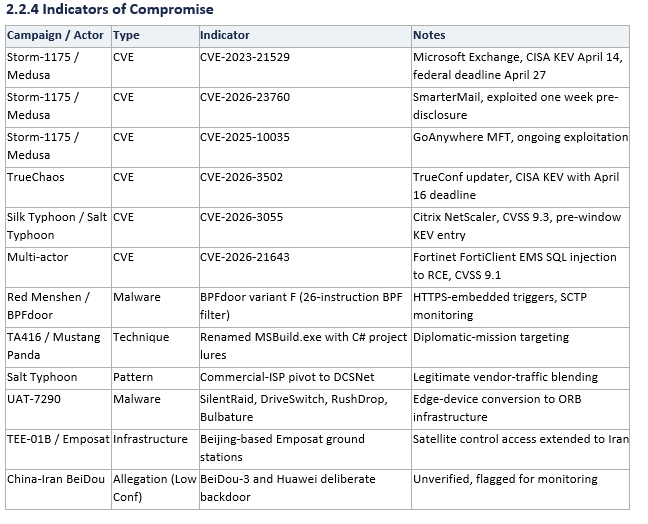
Storm-1175 / Medusa Ransomware Profile (Microsoft, April 6). Microsoft Threat Intelligence published a comprehensive profile of Storm-1175, a China-linked actor deploying Medusa ransomware with a 24-hour access-to-encryption timeline and zero-day exploitation up to one week pre-disclosure. Active CVEs include CVE-2026-23760 (SmarterMail, exploited the week before public disclosure) and CVE-2025-10035 (GoAnywhere MFT). CVE-2023-21529 (Microsoft Exchange Server, deserialization to remote code execution, CVSS 8.8) was added to the CISA Known Exploited Vulnerabilities catalog on April 14 directly as a result of Storm-1175 exploitation, with a federal patching deadline of April 27. Targets include healthcare, education, financial services, and professional services in the United States, United Kingdom, and Australia.
TA416 / Mustang Panda European and Middle East Campaign (Proofpoint, April 1–3). TA416 resumed operations against European Union and NATO diplomatic missions after a two-year hiatus. Infection chains from February 2026 through the reporting window use archives containing a renamed MSBuild.exe binary and malicious C# project files. Following the February 28 U.S.-Israel strikes on Iran, TA416 pivoted to target diplomatic and government entities in the Middle East, assessed as intelligence collection on the conflict. No new TA416 disclosures emerged during the April 10–17 window.
CISA KEV Batch (April 14). Six new CVEs were added with federal patching deadlines of April 16–27: CVE-2026-21643 (Fortinet FortiClient EMS SQL-injection to RCE, CVSS 9.1, indirect China link via Fortinet’s broad exploitation by PRC actors); CVE-2023-21529 (Microsoft Exchange, Storm-1175 direct link); CVE-2023-36424 (Windows CLFS Driver privilege escalation); CVE-2025-60710 (Windows Task Host privilege escalation); CVE-2020-9715 (Adobe Acrobat Reader RCE); and CVE-2012-1854 (Microsoft VBA RCE). The Storm-1175 linkage for CVE-2023-21529 is the principal operational signal in this batch. CVE-2026-3502 (TrueConf, China-linked Operation TrueChaos) was added earlier on April 2 with an April 16 deadline that fell within the reporting window.
Operation TrueChaos (Check Point, published pre-window). A China-nexus campaign compromising a single on-premises TrueConf server to simultaneously infect dozens of connected Southeast Asian government agencies via a trusted update channel. ShadowPad co-deployment at the same targets suggests coordination among multiple Chinese APT teams. The April 16 KEV deadline applied to affected federal systems.
Red Menshen / BPFdoor Telecom Implants (Rapid7 Labs / Security Affairs, March 27). BPFdoor variant F features a 26-instruction Berkeley Packet Filter, HTTPS-embedded triggers that disguise within legitimate HTTPS traffic, and Stream Control Transmission Protocol monitoring for telecom signaling. Targets are Middle Eastern and Asian telecom networks, with implants functioning as “digital sleeper cells” for long-term surveillance. Also tracked as Earth Bluecrow, DecisiveArchitect, and Red Dev 18. No new victims were publicly disclosed during April 10–17.
Trump-Xi Summit Delay to May 14–15 (Reuters April 6, Steptoe April 13). The summit originally planned for April was formally rescheduled to May 14–15 in Beijing due to the Iran conflict, creating a four-week runway during which Chinese intelligence services are expected to intensify collection against U.S. negotiators and policy deliberators on trade, Taiwan, Iran, and technology export controls. Trump stated on April 15 that Xi had assured him China would not supply weapons to Iran — a statement directly contradicted by the April 11 CNN intelligence report on MANPADS and HQ-9B preparation. The Atlantic Council assessment from October 2025 remains operationally relevant: “Spying was not front and center at the meeting between Xi and Trump. The US needs to up its game to counter Chinese espionage.” Salt Typhoon was not included in the U.S. National Security Strategy.
FlamingChina / NSCC Tianjin Breach CNN Coverage (April 10). The alleged FlamingChina breach of China’s National Supercomputing Center in Tianjin received CNN broadcast coverage on April 10, significantly elevating international awareness. Claimed data stolen: 10-plus petabytes across aerospace, military, bioinformatics, and fusion-simulation domains, with organizations including AVIC, COMAC, and the National University of Defense Technology reportedly affected. SentinelOne analyst Dakota Cary described sample data as “credible”; CNN could not independently authenticate the full dataset. Access method: compromised VPN domain with botnet-based exfiltration over months. No new verifications or Chinese government statements emerged during the April 10–17 window.
APT41 CI/CD Pipeline Supply Chain Attacks (pre-window, continued context). APT41 conducted supply-chain attacks against semiconductor manufacturers via compromised CI/CD pipelines, combining espionage and financial objectives per Brass Typhoon tracking. No new disclosures during the reporting window.
PLA Cyberspace Force South China Sea Deployment. The first confirmed PLA Cyberspace Force deployment was reported pre-window; no new deployment-specific disclosures emerged April 10–17.
EU Sanctions on Integrity Technology Group (Flax Typhoon) and Anxun Information Technology (i-Soon). EU sanctions imposed against the operator and infrastructure providers of Flax Typhoon and i-Soon — the latter the subject of the February 2024 leak that exposed MSS contractor relationships — remain in force. No new enforcement actions during the reporting window.
FCC Foreign-Made Consumer Router Ban. The FCC’s March 23 action banning all new foreign-made consumer routers, citing the Typhoon campaigns, continued implementation through the reporting window with no further federal actions.
UAT-7290 Edge-Device Telecom Campaign. UAT-7290 simultaneously targets U.S. and allied telecom providers via edge-device exploitation, deploying SilentRaid, DriveSwitch, RushDrop, and Bulbature implants. Compromised devices are converted into Operational Relay Box infrastructure shared with other PRC actors — a capability with direct operational-security implications for downstream tracing.
PLA Leadership Purge Impact (carry-forward). The January 2026 arrests of General Zhang Youxia (Central Military Commission Vice Chairman) and General Liu Zhenli (Joint Staff Chief) — the most significant PLA leadership decapitation in the modern era, with 101-plus senior officers purged since 2022 and 65 percent of the 2022 Central Committee military cohort removed — continue to produce structural effects. Some analysts observed a temporary lull in “high-initiative” PRC APT spear-phishing in late January (Shieldworkz). MSS-directed groups including Salt Typhoon appear operationally unaffected — MSS operations are Xi-directed rather than CMC-dependent. Volt Typhoon is assessed to have potentially accelerated infrastructure pre-positioning timelines during this period as a deterrent hedge against perceived PLA kinetic-readiness degradation.
2.2.3 Tactics, Techniques, and Procedures
Chinese APT TTPs during the period emphasize four patterns. First, legitimate-traffic blending: Salt Typhoon exploited a commercial ISP with connections to DCSNet to pivot into FBI surveillance infrastructure, while BPFdoor variant F embeds trigger patterns within legitimate HTTPS traffic. Second, zero-day cycle compression: Storm-1175’s 24-hour access-to-encryption timeline with sub-one-week zero-day exploitation (CVE-2026-23760 in SmarterMail exploited the week before disclosure) leaves defenders negligible patch windows. Third, operational-relay-box (ORB) infrastructure sharing: UAT-7290’s converted edge devices and the broader ORB ecosystem allow MSS-directed teams to attribute-obscure operations through shared proxy meshes. Fourth, ISR fusion with non-cyber intelligence platforms: the TEE-01B satellite, BeiDou and the alleged backdoor mechanism, Emposat ground stations, and Baidu AI / satellite data access collectively create a multi-modal intelligence fabric usable by Iran, the DPRK, or any aligned actor.
MITRE ATT&CK technique coverage includes, at minimum: T1190 (Exploit Public-Facing Application, CVE-2023-21529, CVE-2026-21643, CVE-2026-3502, CVE-2026-3055, CVE-2026-23760, CVE-2025-10035); T1199 (Trusted Relationship, DCS-3000 commercial-ISP pivot and TrueConf update channel); T1021.001 (Remote Desktop Protocol) and T1021.002 (SMB/Windows Admin Shares); T1105 (Ingress Tool Transfer); T1055 (Process Injection); T1572 (Protocol Tunneling, BPFdoor HTTPS embedding); T1071.001 (Web Protocols); T1090.004 (Domain Fronting); T1205 (Traffic Signaling, BPFdoor BPF filter); T1486 (Data Encrypted for Impact, Medusa ransomware); T1027 (Obfuscated Files or Information); T1218.007 (MSBuild proxy execution, TA416); T1195.002 (Supply Chain Compromise, TrueChaos and APT41 CI/CD).
2.2.5 Assessment and Outlook
The 30-day outlook for Chinese cyber activity is dominated by the May 14–15 Beijing summit. Expected developments include: (1) intensified pre-summit collection against U.S. trade, Taiwan, semiconductor export-control, and Iran-policy negotiators and congressional principals through Salt Typhoon and APT41 lineage groups; (2) continued Volt Typhoon infrastructure pre-positioning against U.S. energy, water, telecommunications, and Guam military infrastructure, likely accelerating further as the summit approaches; (3) sustained Storm-1175 operational tempo including probable exploitation of any late-April or early-May vendor disclosures given the one-week zero-day cycle; (4) possible additional FBI or federal-agency breach disclosures, as the DCS-3000 investigation expands scope; and (5) China’s continued dual-track Iran posture — public denial, private weapons and ISR pipeline — likely to intensify as the April 22 ceasefire expiration forces choice between maintaining supply or accepting the 50 percent tariff threat.
Defender priorities for the window include: (1) rapid patching of all CISA KEV April 14 entries with particular urgency on CVE-2023-21529 given Storm-1175’s 24-hour cycle; (2) threat hunting for BPFdoor variant F in telecom and edge-device environments with attention to SCTP traffic patterns; (3) audit of edge-device fleets for UAT-7290 implant indicators to break the ORB chain; (4) review of chain-of-custody and evidence-authentication procedures for any litigation relying on DCSNet-collected data; and (5) elevated scrutiny of legitimate cloud-service outbound traffic given the ORB-infrastructure and legitimate-service abuse patterns documented across Salt Typhoon, Storm-1175, and TA416.
2.3 North Korea
2.3.1 Strategic Overview
North Korean cyber activity during the reporting period operates across three highly differentiated mission tracks that the DomainTools Investigations team has characterized as a “deliberately fragmented” malware ecosystem — mission-driven, operationally resilient, and resistant to attribution. Kimsuky (Emerald Sleet / Velvet Chollima / APT43) pursues espionage; the Lazarus Group umbrella (Diamond Sleet / UNC2970 / Pompilus) with offshoots BlueNoroff / Sapphire Sleet (APT38 / Alluring Pisces) and Citrine Sleet (APT43 / Gleaming Pisces) pursues illicit revenue generation and sanctions evasion, now a central pillar of the apparatus; and Andariel (Onyx Sleet / Stonefly / APT45) handles ransomware and wiper deployment for strategic disruption and signaling. APT37 (ScarCruft / Reaper / Ruby Sleet / Ricochet Chollima) operates primarily in the espionage track. This fragmentation allows the regime to sustain operations across multiple objectives in parallel while obscuring connections between tracks that would otherwise expose the cumulative scale of the program.
Alongside the classical APT tracks, the DPRK IT Worker ecosystem — tracked variously as Jasper Sleet, Coral Sleet, Famous Chollima, Wagemole, and PurpleDelta — represents a strategic revenue-generation stream estimated to produce between $350 million and $800 million annually, with OFAC citing near-$800 million figures for 2024 alone. CSIS assesses the operation is expanding geographically through 2026 with increasing use of multimodal generative AI (voice, text, and video deepfakes) to sustain disguised employment. Flare intelligence notes DPRK has built a multinational recruitment pipeline drawing skilled developers from Iran, Syria, Lebanon, and Saudi Arabia, paid in cryptocurrency, coached through interviews, and placed into fabricated Western personas targeting U.S. defense contractors, cryptocurrency exchanges, and financial institutions.
Threat level is assessed CRITICAL. Drivers include: (1) the April 1 Drift Protocol hack’s $285–286 million drain, bringing cumulative DPRK lifetime crypto theft through Drift to $6.75 billion–$7 billion+; (2) the April 16 Sapphire Sleet macOS campaign introducing a new credential-harvesting capability against finance professionals; (3) the April 13 APT37 Facebook-to-RokRAT vector; (4) continued expansion of Contagious Interview / UNC1069 across five open-source package ecosystems with 1,700-plus malicious packages documented since January 2025; (5) the largest-ever individual U.S. laptop-farm sentences (9 and 7.5 years) and $5 million State Department bounty, reflecting the scale and persistence of the IT-worker infiltration program; and (6) confirmed coordination with Russian cyber groups including Lazarus-Medusa (February 2026) and Moonstone Sleet-Qilin (2025).
2.3.2 Key Developments
Drift Protocol $285–286 Million Hack and Aftermath (April 1 event; April 16 recovery framework). On April 1 attackers drained $285–286 million from Drift Protocol in approximately 12 minutes across 31 withdrawal transactions, most funds bridged from Solana to Ethereum within hours. Chainalysis documented at least 18 token types drained: USDC ($71.4 million), JLP ($159.3 million), cbBTC ($11.3 million), USDT ($5.6 million), and others. The attacker used a fictitious CarbonVote Token as phantom collateral after social-engineering Drift Security Council multisig signers into pre-signing transactions. The attacker swapped tokens to USDC, bridged via Circle CCTP, and converted to ETH on Ethereum through decentralized exchanges. Attribution: UNC4736 / Citrine Sleet / AppleJeus (medium-high confidence, per Mandiant / SEAL911) with on-chain links to the October 2024 Radiant Capital hack. On April 16 Drift Protocol published its recovery framework: Tether contribution of up to $127.5 million (USDT market-making support facility), $20 million from other partners for a total support package of up to $147.5 million, plus a $100 million revenue-linked credit facility. Outstanding user losses total $295 million. No funds have been confirmed recovered. A dedicated recovery token will be issued to each impacted user as a transferable claim on the recovery pool. An asset-recovery bounty program is in development with Arkham and Bybit.
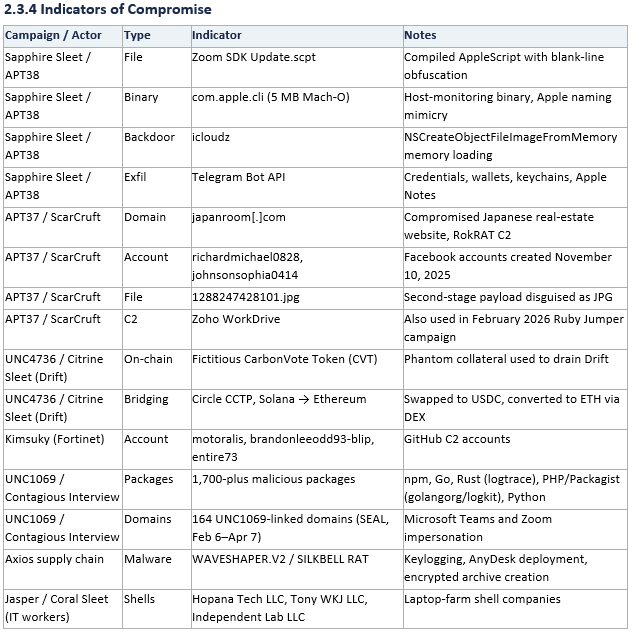
Sapphire Sleet (APT38) macOS Credential Harvesting Campaign (Microsoft, April 16). Active since at least 2020 and now expanded with a new macOS attack chain variant. Initial access uses fake recruiter profiles on LinkedIn and other social media platforms to contact finance professionals with phony job opportunities and scheduled technical interviews. A fake Zoom support meeting link prompts the target to download Zoom SDK Update.scpt, a compiled AppleScript that opens by default in macOS Script Editor. A large comment block of fake update instructions appears; thousands of blank lines hide the malicious logic below the visible area. Stage 1 launches the legitimate softwareupdate binary with an invalid parameter (visual trust signal doing nothing harmful). Stage 2-plus executes a malicious payload via curl to fetch an attacker-controlled AppleScript, which launches a cascading chain of curl commands with distinct user-agent strings for campaign tracking. Deployed components include a credential stealer delivered via osascript that drops systemupdate.app and displays a fake macOS password dialog before exfiltrating via the Telegram Bot API; a host-monitoring binary named com.apple.cli (5 MB Mach-O mimicking Apple naming conventions); and the icloudz backdoor, which uses the macOS NSCreateObjectFileImageFromMemory API to load payloads directly into memory. Evasion techniques include Apple-style naming (com.apple.cli, icloudz, systemupdate.app), blank-line obfuscation, fake native macOS password dialogs, TCC protection bypass, and memory-only payload loading. Exfiltrated data includes cryptocurrency wallets, browser history, keychains, Apple Notes, and Telegram login details. Apple responded with platform-level protections: Apple Safe Browsing blocks in Safari and XProtect signatures to detect and block Sapphire Sleet malware families.
APT37 / ScarCruft Facebook-to-RokRAT Campaign (Genians / Hacker News, April 13). Two fake Facebook accounts — richardmichael0828 and johnsonsophia0414, both created November 10, 2025, with locations set to Pyongyang and Pyongsong, North Korea — sent friend requests to targets. After establishing trust via Messenger, actors delivered a ZIP file via Telegram containing a trojanized version of Wondershare PDFelement plus four PDF decoy documents and installation instructions. Launching the tampered installer triggered embedded shellcode communicating with C2 server japanroom[.]com, a compromised legitimate website belonging to the Seoul arm of a Japanese real estate information service — a living-off-trusted-infrastructure technique. C2 served a second-stage payload disguised as a JPG image (1288247428101.jpg) that delivered the final RokRAT payload. RokRAT exfiltrated via Zoho WorkDrive as C2, also seen in the February 2026 Ruby Jumper campaign per Zscaler ThreatLabz. RokRAT capabilities include screenshot capture, remote command execution via cmd.exe, host information collection and system reconnaissance, detection evasion against Qihoo 360 Total Security, and malicious traffic disguise. The targeting pretext — encrypted military documents — indicates intelligence gathering against defense and government-adjacent individuals. RokRAT’s core functionality has remained stable across operations; APT37 focuses on evolving delivery, execution, and evasion chains rather than the payload itself.
IT Worker Sentencings (DOJ, April 15–16). Kejia Wang (a.k.a. Tony Wang), 42, of Edison, NJ, was sentenced to 108 months (9 years) federal prison for wire-fraud conspiracy, money-laundering conspiracy, and identity-theft conspiracy. Zhenxing Wang (a.k.a. Danny Wang), 39, of New Brunswick, NJ, was sentenced to 92 months (7.5 years) for wire-fraud conspiracy and money-laundering conspiracy. Both were ordered to serve three years supervised release. Total forfeiture was $600,000 (U.S. has received $400,000). Kejia Wang was ordered to pay $29,236.03 restitution. The scheme operated from approximately 2021 through October 2024 using laptop farms with KVM switches to allow North Korean operatives to appear as U.S.-based remote workers. Shell companies used were Hopana Tech LLC, Tony WKJ LLC, and Independent Lab LLC — no employees or operations; they received millions from victim companies. Kejia Wang traveled to Shenyang and Dandong, China in 2023 to coordinate with overseas actors including a former North Korean classmate. At least 80 U.S. identities were stolen; 100-plus U.S. companies were victimized including Fortune 500 firms and a California defense contractor whose ITAR-controlled data was accessed January 19 through April 2, 2024. The scheme generated over $5 million in illicit DPRK revenue; victim companies incurred $3 million-plus in damages. U.S. facilitators received approximately $700,000 combined. State Department Rewards for Justice announced a reward of up to $5 million for information on eight remaining defendants indicted in June 2025 — Xu Yongzhe, Huang Jingbin, Tong Yuze, Zhou Baoyu, Yuan Ziyou (Samuel Yuan), Zhou Zhenbang, Liu Menting, and Liu Enchia — plus suspected IT worker Song Min Kim (a.k.a. Chengmin Jin), all still at large.
Axios npm Supply Chain Aftermath and Contagious Interview Ecosystem Expansion (Socket / SEAL / Mandiant, March 30 through April 8). The compromise of Axios maintainer Jason Saayman’s account produced a downstream impact landscape still under active investigation. As of April 10, 135 devices across 12 organizations were confirmed compromised (Huntress data) with Mandiant and GTIG noting the downstream assessment “will likely take several months.” Socket’s April 8 research documented 1,700-plus malicious packages linked to Contagious Interview since January 2025, now spanning five open-source ecosystems: npm (primary), Go, Rust (logtrace), PHP / Packagist (golangorg/logkit), and Python. Loaders fetch platform-specific second-stage payloads with infostealer and RAT capabilities; the Windows variant includes a full post-compromise implant with keylogging, AnyDesk deployment, and encrypted archive creation. The Security Alliance (SEAL) published data on April 7–8 documenting 164 UNC1069-linked domains blocked between February 6 and April 7, 2026, impersonating Microsoft Teams and Zoom. SEAL’s operating-pattern analysis describes multi-week low-pressure social engineering across Telegram, LinkedIn, and Slack, impersonation of known contacts or credible brands, ClickFix-style fraudulent Zoom or Microsoft Teams meeting links, and deliberate non-acting following initial access — the implant is left dormant while the target reschedules the failed call and continues normal operations unaware of compromise. A TechCrunch update on April 10 identified a second Axios maintainer targeted by UNC1069 who refused to run a downloaded app and refused a curl command in Terminal, at which point the threat actors erased all conversations and went dark — demonstrating a practiced abort protocol when initial social engineering fails.
Fortinet FortiGuard Labs Kimsuky-Linked LNK and GitHub C2 Campaign (April 2). Fortinet disclosed DPRK-linked campaigns using LNK files with embedded encoded payloads and GitHub accounts as covert C2 infrastructure. Decoy PDF titles suggest targeting of Korean companies to expand surveillance operations. Metadata links — file names, sizes, modification dates — are consistent with Kimsuky / APT37 / Lazarus naming patterns including Hangul Document naming conventions. GitHub account infrastructure analysis: motoralis functions as primary operational hub with a surge in private repository contributions aligned with recent LNK-based phishing spikes; brandonleeodd93-blip was activated recently for redundancy; entire73 remains largely dormant. Multi-stage PowerShell execution; stolen data is assessed as potentially leveraged for follow-on attacks.
Bitcoin Depot Breach (April 9). Bitcoin Depot, one of the largest U.S. cryptocurrency ATM operators, disclosed a breach via SEC 8-K filing on April 6. ZachXBT determined the attack began March 20 — three days before the March 23 date in the SEC filing — meaning the company did not detect the breach for three days. Amount stolen: 50.9 BTC (approximately $3.6–3.7 million); ZachXBT found 54.45 BTC total, suggesting additional personal accounts impacted. Funds destination: 54 BTC flowed to KuCoin. No formal DPRK attribution established; noted as context given BlueNoroff’s documented targeting of cryptocurrency ATM and infrastructure companies. Monitor for further attribution and KuCoin compliance actions.
Lazarus Moonstone / Qilin Ransomware Coordination with Russian Groups (carry-forward). Moonstone Sleet used Qilin ransomware (Russian-linked) in 2025 attacks. Lazarus has been working with Medusa ransomware (Russian-linked) as of February 2026. The PISM April 8 report confirmed coordinated activities between North Korean groups (Lazarus, Moonstone Sleet) and Russian groups (Qilin, Medusa, Gamaredon) using shared infrastructure and tools, with operations including attacks on foreign institutions, information theft, and financial acquisition — and flagged an escalating risk of coordinated hybrid operations, including cyberattacks, against European targets.
Konni Group Blockchain Developer Targeting. Konni (also tracked as Opal Sleet / TA406) continues blockchain-developer targeting with no new specific April 10–17 disclosures; the group remains on standing watch given persistent pattern.
OFAC Sanctions Status. No new OFAC designations were announced during the April 10–17 window. The most recent action was the March 12, 2026 designation of six individuals and two entities for DPRK IT worker fraud, including Amnokgang Technology Development Company and Vietnam-based facilitators who converted approximately $2.5 million into cryptocurrency for North Korean IT workers between mid-2023 and mid-2025. The State Department $5 million Rewards for Justice reward announced concurrent with the April 16 sentencing is the primary new enforcement-adjacent development.
Trio-Tech International Ransomware (March 23 Disclosure). A semiconductor supplier disclosed a ransomware incident during the prior reporting period; no new updates in the April 10–17 window.
Bybit One-Year Laundering Complete (carry-forward). The $1.46 billion Bybit hack reached its one-year laundering cycle completion during March 2026, context for ongoing cumulative DPRK theft metrics.
2.3.3 Tactics, Techniques, and Procedures
DPRK TTPs during the period reflect five dominant patterns. First, platform expansion: the Sapphire Sleet macOS campaign, the APT37 Facebook vector, and the Contagious Interview cross-ecosystem expansion together represent a deliberate diversification into previously under-targeted surfaces. Second, living-off-trusted-infrastructure: compromised legitimate websites (japanroom[.]com), legitimate developer platforms (GitHub accounts motoralis, brandonleeodd93-blip, entire73), and legitimate cloud services (Zoho WorkDrive for RokRAT C2, Telegram Bot API for Sapphire Sleet exfiltration) provide operational camouflage. Third, patient pre-positioning: the SEAL observation that UNC1069 deliberately does not act immediately following initial access is methodologically significant and extends operational windows. Fourth, social-engineering layering: multi-week low-pressure social engineering across Telegram, LinkedIn, and Slack using previously compromised accounts or credible-brand impersonation is the dominant initial-access path. Fifth, AI-augmentation: the CSIS assessment of increasing DPRK use of multimodal generative AI for voice, text, and video deepfakes in IT-worker infiltration is consistent with observed improvements in interview-stage social engineering quality.
MITRE ATT&CK technique coverage includes: T1566.002 (Phishing: Spearphishing Link, fake Zoom updates, LinkedIn recruiter); T1566.003 (Phishing: Spearphishing via Service, Facebook Messenger, Telegram, Slack); T1204.002 (Malicious File, trojanized PDFelement installer, .scpt AppleScript); T1195.002 (Supply Chain Compromise, 1,700-plus packages across five ecosystems); T1059.002 (AppleScript), T1059.001 (PowerShell), T1059.003 (Windows Command Shell); T1574.001 (DLL Search Order Hijacking); T1140 (Deobfuscate/Decode Files or Information); T1055.015 (ListPlanting) and other process-injection variants; T1027 (Obfuscated Files, blank-line obfuscation in compiled AppleScript); T1071.001 (Web Protocols); T1071.004 (DNS, Telegram Bot API); T1555 (Credentials from Password Stores, macOS Keychain); T1555.004 (Windows Credential Manager); T1657 (Financial Theft, Drift Protocol, Bybit, Bitcoin Depot); T1078 (Valid Accounts, compromised maintainer credentials, Axios).
2.3.5 Assessment and Outlook
The 30- to 60-day outlook for North Korean cyber activity centers on five expected developments. First, laundering-peak monitoring for the Drift Protocol theft: DPRK-attributed crypto-theft laundering typically peaks within a 45-day window post-theft, placing the peak around May 16, 2026. Watch for mixer usage, cross-chain bridges, and over-the-counter off-ramp patterns. Second, downstream exploitation of the Axios compromise: UNC1069 obtained credentials and access from an estimated 135-plus organizations; Mandiant’s forecast anticipates DPRK leveraging this access for targeted cryptocurrency theft over the coming months. New crypto-exchange breaches or insider-trading patterns should be cross-referenced against the Axios victim footprint. Third, Sapphire Sleet TTP evolution: Apple’s XProtect update will blunt the specific April 16 variant, but TTP evolution is expected. Monitor for new AppleScript-based lure variants and Telegram Bot API exfiltration endpoints. Fourth, IT-worker enforcement acceleration: four separate sentencing and plea announcement waves in 2026 (February, March, April x2) suggest sustained DOJ and FBI action targeting overseas facilitators. Fifth, the APT37 Facebook campaign’s full target list is not yet public; monitor South Korean and defense-adjacent reporting for RokRAT detections linked to PDF-based social engineering since November 2025.
Defender priorities include: (1) deployment of Apple XProtect updates across all macOS fleets and explicit policy on downloaded .scpt files from email, chat, or web sources; (2) LinkedIn recruiter-profile anomaly monitoring for finance-professional populations with high-value crypto or custody access; (3) GitHub C2 hunting for activity linked to motoralis, brandonleeodd93-blip, or similar repositories with LNK-file associations; (4) package-ecosystem supply-chain monitoring across npm, Go, Rust, Packagist, and Python with emphasis on newly published packages from compromised-looking maintainer accounts; (5) ITAR-export-control review of all remote-worker pipelines with particular attention to camera-off interviews, shell-company payment trails, and KVM-switch indicators; and (6) monitoring of KuCoin and other exchange compliance reporting for any seizure or freeze actions that could yield DPRK attribution intelligence from the Bitcoin Depot incident.
2.4 Iran
2.4.1 Strategic Overview
Iranian cyber activity during the reporting period is the operational center of gravity for this briefing. Five dynamics converge: (1) a structurally fragile two-week U.S.-Iran ceasefire signed April 7–8 expiring in five days (April 22) with only an in-principle extension in negotiation; (2) the U.S. naval blockade of Iranian ports launched April 13, creating a new escalation trigger independent of the kinetic ceasefire and costing Iran an estimated $400–435 million per day in lost maritime revenue; (3) the six-agency joint advisory AA26-097A of April 7 documenting an ongoing Iranian PLC and operational-technology campaign that has not paused following the ceasefire; (4) an internet blackout now at Day 48 and 1,128-plus hours — the longest confirmed nationwide shutdown in recorded history — with the first connectivity-restoration signal (”Internet Pro” selective business packages) launched April 14; and (5) continued operational tempo by Iran-aligned proxy groups through the Electronic Operations Room framework. The ceasefire is a kinetic pause with zero bearing on cyber campaign continuity; Handala’s own post-ceasefire declaration stated that “the cyber war did not begin with the military conflict, and it will not end with any military ceasefire.”
The principal active groups include Handala / Void Manticore (MOIS, operating as primary destructive persona, responsible for the March 11 Stryker Corporation wiper attack affecting approximately 200,000 devices across 79 countries with 50 TB of claimed exfiltrated data, the March 27 compromise of FBI Director Kash Patel’s personal email, and the April 1 St. Joseph County, Indiana intrusion claim); CyberAv3ngers (IRGC-CEC, tracked as Storm-0784 / Bauxite / Hydro Kitten / Shahid Kaveh Group / UNC5691 / G1027 and primary attribution for the AA26-097A PLC campaign); MuddyWater / Seedworm / Mango Sandstorm (MOIS, with pre-positioned U.S. bank, airport, Canadian NGO, and Israeli defense-aerospace supplier access and new Dindoor and Fakeset backdoors); Cotton Sandstorm / Emennet Pasargad (IRGC-linked, with pre-positioned WezRat and WhiteLock implants); APT35 / Charming Kitten / Mint Sandstorm / Educated Manticore; APT42 / Calanque / UNC788; APT33 / Peach Sandstorm / Elfin / HOLMIUM / Curious Serpens; APT34 / OilRig / Hazel Sandstorm / Helix Kitten; Pioneer Kitten / Fox Kitten / Lemon Sandstorm / Parisite / RUBIDIUM; Agrius / Pink Sandstorm / Marshtreader; Homeland Justice / Karma / KarmaBelow80; Dust Specter (new Iran-nexus actor first documented January 2026); and the Electronic Operations Room coalition of approximately 60 hacktivist groups including 313 Team, Conquerors Electronic Army, Cyber Islamic Resistance, FAD Team / Fatimiyoun, DieNet, and Cyber Isnaad Front.
Threat level is assessed CRITICAL. The five-day ceasefire expiration window (April 17–22), the ongoing ICS / OT campaign confirmed in AA26-097A with no post-ceasefire pause, the demonstrated Handala Stryker-class capability, the Wiper-as-a-Service model documented by Code Blue crisis research on April 1 (with MOIS distributing state-level wiper tools to Handala, Anonymous for Justice, and Moses Staff in a modular division-of-labor ecosystem), the Siemens S7 scanning indicating campaign expansion beyond Rockwell, the internet-restoration pre-signal implying pending APT tempo restoration, and the ~60-group proxy coalition together establish a level of integrated threat without precedent in prior Iranian cyber activity.
2.4.2 Key Developments
Ceasefire Status and Naval Blockade (April 7 through 17). The two-week Pakistan-brokered ceasefire announced April 7–8 is formally in effect through April 22, 2026 but has been violated by both sides and lacks binding enforcement. Vice President Vance called it a “fragile truce.” Strait of Hormuz has not reopened. Islamabad direct talks (Vance, Witkoff, Kushner versus Foreign Minister Araghchi and Parliament Speaker Ghalibaf) collapsed April 11–12 without agreement. On April 13 at 10 a.m. Eastern Time the U.S. naval blockade of Iranian ports took effect: CENTCOM deployed 10,000-plus personnel, 12-plus ships, and 100-plus aircraft. By April 14–15 the blockade was “fully implemented” per CENTCOM Admiral Brad Cooper; Iran condemned it as “piracy”; six commercial ships redirected from Iranian ports. On April 16 a 10-day Israel-Lebanon ceasefire took effect at 5 p.m. Eastern, removing one obstacle from U.S.-Iran negotiations. Trump stated on April 16: “If there’s no deal, fighting resumes.” White House Press Secretary Levitt stated on April 16: “No deal in place to extend it.” On April 17 Trump indicated renewed Islamabad talks possible “this weekend” and said a permanent deal is “looking very good”; China’s Foreign Minister Wang Yi said war and peace are at a “critical juncture.” Some European and Gulf Arab leaders privately expect the full peace deal will take six months to finalize. Two Chinese-linked oil tankers sailed out of the Persian Gulf into the Gulf of Oman on April 17. Defense Secretary Hegseth stated on April 16 that Iran’s command-and-control is “highly degraded” but that motivation to maintain ceasefire is “very high” but contingent on avoiding kinetic provocations.
CISA Advisory AA26-097A — Ongoing PLC Campaign (April 7, ongoing). The six-agency joint advisory (FBI, CISA, NSA, EPA, DOE, and U.S. Cyber Command’s Cyber National Mission Force) published April 7 remains the definitive government statement on Iranian ICS and operational-technology targeting. No follow-on advisory has indicated the campaign has paused. Campaign parameters: active since at least March 2026 with IP infrastructure active since January 2025; confirmed victims in water/wastewater, energy, government services, and ports; primary device targeted is the Rockwell Automation Allen-Bradley CompactLogix and Micro850 PLC; secondary expansion indicated by port scanning of Siemens S7 PLC protocols — potential expansion beyond Rockwell. Attack method exploits CVE-2021-22681 (CVSS 9.8, no patch available): cryptographic-key extraction enables unauthenticated impersonation of Studio 5000 Logix Designer. Post-access behavior: Dropbear SSH deployed on port 22, project-file extraction, HMI and SCADA display manipulation. Confirmed impacts include operational disruption, configuration wiping, software-based mechanical-sensor tampering, and financial loss. Command-and-control malware is IOCONTROL — a custom Linux platform using MQTT-over-TLS on port 8883, DNS-over-HTTPS, AES-256-CBC encrypted configuration, and systemd persistence. Nozomi Networks estimates 3,000-plus Rockwell devices remain internet-exposed. IOCs are published in STIX format at ic3.gov. The IC3 report is available at ic3.gov/CSA/2026/260407.pdf.
CyberAv3ngers Campaign Attribution and Evolution. The Tenable Research Special Operations assessment published April 9 confirmed CyberAv3ngers as the primary attribution for the AA26-097A campaign. Campaign evolution: default-credential exploitation in 2023, custom IOCONTROL malware deployment in 2024, and active CVE-2021-22681 Rockwell exploitation in 2026. Treasury OFAC sanctioned six IRGC-CEC officials; the State Department Rewards for Justice program offers a $10 million bounty on the “Mr. Soul” persona. CyberAv3ngers techniques have proliferated to an estimated 60-plus affiliated hacktivist groups, meaning the threat persists even if the core IRGC-CEC cell is degraded by kinetic strikes. Unverified reports of CyberAv3ngers-linked individuals killed in Operation Epic Fury strikes have circulated; activity continues per the advisory.
EPA Standalone Statement. EPA issued a press release on April 7 confirming that “U.S. organizations are experiencing exploitation and, in some cases, disruption of commonly used operational technology at drinking water and wastewater systems,” with specific disruptions including configuration wiping, software-based mechanical-sensor tampering, and disruption of human-machine interfaces.
Handala Post-Ceasefire Declaration and Activity (April 8). Handala published an explicit declaration on its X account and blog following the ceasefire: “The cyber war did not begin with the military conflict, and it will not end with any military ceasefire.” “We did not begin this war, but we will be the ones to finish it.” “Darkest of nights for America and its supporters when the time comes.” The group announced a tactical pause on U.S.-targeted attacks — explicitly framed as temporary and time-limited — while confirming Israel targeting continues without pause. Handala pledged to “revive efforts against America when the time is right.” An Iranian state-backed group pledged post-ceasefire: “Our cyber jihad is the extension of our martyrs’ blood, and it will go on until full vengeance is achieved.” Nozomi Networks CISO Markus Mueller stated: “With a ceasefire, we will likely see an expansion of cyber activity both in scale and scope.” Bitdefender on April 7 reported Handala claimed 23 ransomware victims in March 2026 alone — more than half of their total 2026 victims — targeting healthcare, education, financial services, and utilities. On April 1 Handala claimed the hacking of St. Joseph County, Indiana computer systems seizing 2 TB of data; county officials confirmed a hack but stated only third-party faxing systems were affected. Starlink routing since January confirms the blackout has zero operational effect on Handala’s external attack capability.
Wiper-as-a-Service Model (Code Blue crisis research, April 1). Iran MOIS is distributing state-level wiper tools to proxy groups including Handala, Anonymous for Justice, and Moses Staff in a modular Wiper-as-a-Service ecosystem. Division of labor: one actor for initial access, a second for wiper deployment. This model dramatically reduces time-from-breach-to-catastrophic-impact.
MuddyWater / Seedworm Pre-Positioned Access (Symantec / Carbon Black, March). MuddyWater maintains pre-positioned access to at least a U.S. bank, a U.S. airport, a Canadian non-profit organization, and the Israeli branch of a U.S. defense-aerospace software supplier — access activatable via external C2 through satellite and proxy channels independent of Iran’s domestic blackout. New implants: Dindoor (JavaScript / TypeScript backdoor running via Deno runtime, signed cert “Amy Cherne,” found on the bank, software company, and Canadian NGO) and Fakeset (Python-based backdoor, pulled from Backblaze cloud storage, signed certs “Amy Cherne” and “Donald Gay,” with the Donald Gay cert previously signing Stagecomp and Darkcomp — both confirmed Seedworm tools). Full MuddyWater, APT34, APT33, and APT35 operational tempo restoration is expected upon Iran internet connectivity restoration; internet restoration is the primary APT re-escalation trigger.
Cotton Sandstorm / Emennet Pasargad Pre-Positioned Malware. WezRat active pre-positioning was confirmed before Operation Epic Fury strikes. WhiteLock destructive payload was pre-positioned before the strikes. SC World referenced a Cotton Sandstorm supply-chain attack with an April 15 date and supply-chain attack vector; the full article did not provide additional detail. Emennet Pasargad has sustained operations against Israel, U.S., France, and Sweden; media organizations, law enforcement, streaming services, and international perception-shaping entities.
APT34 / OilRig. Documented long-dwell energy-sector access. Compromised Iraqi Ministry of Foreign Affairs email used as lure infrastructure with conflict-themed lures (Potential US ground operation in Iran, Gulf military alliance). IP-geolocation-based payload delivery: decoy PDF or credential-harvesting page.
Agrius / Pink Sandstorm / Marshtreader. Post-strike Hikvision camera scanning across Israel, UAE, Qatar, Bahrain, Kuwait, Lebanon, and Cyprus; exploiting CVE-2017-7921 and CVE-2023-6895 on internet-facing cameras and video intercom units. Assessed purpose: real-time visual intelligence on strike-damage assessment.
Homeland Justice / Karma / KarmaBelow80. DomainTools Investigations documented this group alongside Handala as part of a “single, coordinated cyber influence ecosystem” aligned with MOIS rather than distinct hacktivist groups. Previously associated with destructive Albanian infrastructure operations; pivoted to diplomatic espionage targeting Oman’s Ministry of Foreign Affairs email infrastructure.
Dust Specter. A new Iran-nexus APT first documented targeting Iraqi government officials from January 2026. Infrastructure includes a compromised legitimate Iraqi government website hosting payloads. Lure: fake Cisco Webex for Government meeting (ClickFix social engineering). Four new .NET malware tools. Shares infrastructure with APT34 / OilRig (same compromised Iraqi MoFA).
Internet Blackout Day 48 and “Internet Pro” Selective Restoration (April 11–16). On April 11 the blackout passed 1,000 consecutive hours — longest confirmed nationwide shutdown in global recorded history. On April 12 Iran’s Ministry of ICT confirmed “no timeline for internet restoration.” Semafor confirmed Day 46 on April 14 with connectivity approximately 1 percent of pre-war levels and Starlink blocked via military-grade jamming. On April 14 Bloomberg reported Iran is offering “Internet Pro” packages to select verified businesses — the first meaningful partial-restoration signal since February 28. On April 15 the Iranian science minister said the communications ministry faces “considerations beyond its authority” — signaling internal government tension over the restoration decision. As of April 16 the blackout stands at Day 48 and 1,128-plus hours with estimated cumulative economic cost of $1.8 billion at $35–80 million per day. The blackout suppresses coordinated high-bandwidth operations by state APT groups resident within Iran (MuddyWater domestic cells, APT33, APT34, APT35 internal infrastructure) but does not suppress external proxy coalition activity, pre-positioned implants, the IOCONTROL / PLC campaign (external hosted infrastructure), or Cotton Sandstorm WezRat and WhiteLock pre-positioned before the February 28 strikes. The Internet Pro package signals potential early restoration planning; full restoration would trigger immediate resumption of high-tempo operations by MuddyWater, APT34, APT33, and APT35. Monitor NetBlocks and Cloudflare Radar Iran metrics as primary leading indicators.
Hacktivist Coalition Activity (Electronic Operations Room). The approximately 60-plus group proxy coalition via the Electronic Operations Room formed February 28 remains active. Key groups observed in or around the window: Handala (tactical U.S. pause, Israel targeting continues, St. Joseph County IN claimed April 1); 313 Team (large-scale attack on Australian government portal claimed); Conquerors Electronic Army (DDoS against Israeli entities: Beit Cham, All Volunteer Force); Cyber Islamic Resistance (solidarity statement with Russian KillNet, DDoS campaigns); FAD Team / Fatimiyoun (wiper malware, prior SCADA / PLC access claims); DieNet (Kuwait International Airport systems claimed in prior period).
FINRA Alert (March 16). FINRA issued a cybersecurity alert noting heightened threats to the financial services industry from Iranian cyber actors, with elevated risk of intrusion, data theft, ransomware, destructive attacks, and DoS campaigns remaining in effect through the ceasefire period.
AWS Data Center Bahrain Second Drone Strike (April 1–2). The ME-SOUTH-1 (Bahrain) AWS site operated by Batelco sustained a second Iranian drone strike April 1–2. IRGC claimed to have “destroyed” operations. Cloudflare Radar confirmed AWS Bahrain traffic loss. Amazon advised Middle East customers to activate disaster-recovery plans and shift workloads to other regions. This represents the first confirmed deliberate state targeting of commercial cloud infrastructure in a kinetic conflict. AWS ME-CENTRAL-1 (UAE) and ME-SOUTH-1 (Bahrain) were originally struck March 1.
Undersea Cable Threat — No New Incidents. No confirmed undersea-cable cutting or disruption events occurred in the April 10–17 window. Threat remains latent: Iran verbally threatened Red Sea undersea cables (March 23 reports) with no official confirmation; Houthi groups have separately threatened Red Sea cables; Alcatel Submarine Networks issued force majeure notices with an installation vessel stranded near Saudi Arabia; 17 cables pass through the Red Sea and approximately 60 percent of India’s internet traffic routes through the Gulf / Red Sea path. Active physical interdiction is unlikely during the ceasefire window; threat would likely manifest if the ceasefire collapses.
Intelligence-Report Publications (April 10–17). Crowell & Moring (April 10) analysis of AA26-097A for government contractors characterized the campaign as “appears broader in scope” than 2023–24 with actors moving beyond pre-positioning to causing operational disruptions and financial losses. Recorded Future (April 13) confirmed AA26-097A and an active phishing campaign impersonating government emergency alerts to steal Microsoft credentials. SISA Week 6 (April 16–17) published the Nozomi prediction that the April 8–22 window is the highest-risk for a Stryker-class wiper or identity-weaponization event against a major U.S. financial institution. European Business Magazine (April 15) reported “No deal in place after 21 hours of marathon talks.” Flashpoint (April 10) via Defence Connect noted: “Fragmented ceasefire. Hostilities continue across key theatres... When activity continues despite formal agreements, anticipating escalation pathways becomes more difficult” (Kathryn Raines, Flashpoint CTI lead).
IRGC 18 U.S. Tech Companies and Prior-Period Items. The April 1 expansion of Iranian targeting to 18 U.S. technology companies remains on standing watch. The APT Iran claimed 375 TB Lockheed Martin data breach (March 23–31) is flagged as unverified but monitored. The March 19 DOJ / FBI seizure of four MOIS / Handala domains was followed by Handala restoring operations within 24 hours on March 20. Stryker Corporation confirmed full manufacturing recovery on April 1.
2.4.3 Tactics, Techniques, and Procedures
Iranian cyber TTPs during the reporting window exhibit six dominant patterns. First, OT-targeting modularity: the AA26-097A campaign uses commodity open-source tooling (Dropbear SSH) in tandem with custom IOCONTROL built on standard protocols (MQTT-over-TLS, DNS-over-HTTPS) to maximize living-off-the-land and living-off-trusted-protocol camouflage. Second, wiper-as-a-service division of labor reduces time to catastrophic impact. Third, satellite-routed C2: Handala’s Starlink routing since January means domestic connectivity loss does not suppress external attack capability. Fourth, lure-theme synchronization with kinetic events: APT34 and Dust Specter lures leverage Iraq-based diplomatic-email infrastructure with conflict-themed content. Fifth, identity weaponization risk: Nozomi’s explicit call-out of identity-weaponization event probability against a major U.S. financial institution during the April 8–22 window reflects the historical precedent of integrated destructive-plus-identity campaigns in prior Iranian operations. Sixth, cross-actor infrastructure sharing including the ProfitServer Russian VPS usage by Homeland Justice (UAC-0074) and Karmabelow80 for domain registration.
MITRE ATT&CK technique coverage includes: T1133 (External Remote Services, Dropbear SSH on port 22); T1190 (Exploit Public-Facing Application, CVE-2021-22681 Rockwell); T1021.004 (Remote Services: SSH); T1059.001 (PowerShell), T1059.006 (Python, Fakeset); T1053.005 (Scheduled Task); T1195 (Supply Chain Compromise, Cotton Sandstorm); T1071.001 (Web Protocols); T1071.004 (DNS-over-HTTPS); T1573.002 (Encrypted Channel: Asymmetric Cryptography, IOCONTROL AES-256-CBC); T1090 (Proxy); T1005 (Data from Local System, PLC project-file extraction); T1485 (Data Destruction, wiper); T1486 (Data Encrypted for Impact); T1491 (Defacement, hacktivist); T1499 (Endpoint Denial of Service, hacktivist DDoS); T1562 (Impair Defenses); T1078 (Valid Accounts, Stryker Microsoft Intune abuse); T1563 (Remote Service Session Hijacking).
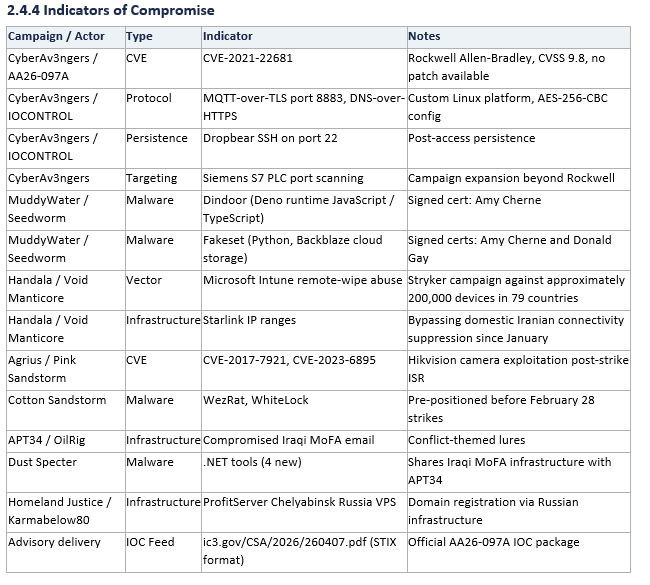
2.4.5 Assessment and Outlook — Ceasefire Expiration Scenarios
The five-day window to ceasefire expiration (April 17 through April 22) is the highest-risk interval in the reporting period for destructive Iranian cyber operations against U.S. or U.S.-aligned targets. The following scenario matrix synthesizes the most probable operational pathways and their associated cyber implications. Probabilities reflect analyst judgment based on public reporting and historical precedent; confidence is MODERATE given the structural unpredictability of the ceasefire negotiating environment.
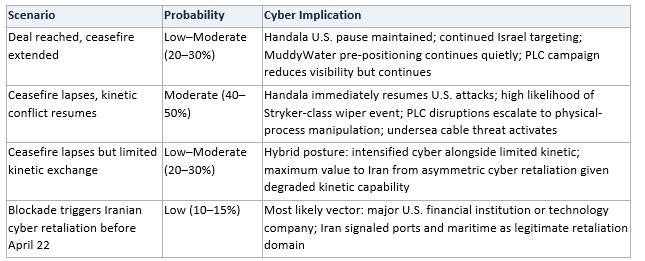
Historical precedent strongly reinforces the escalation framing. The 2015 Joint Comprehensive Plan of Action nuclear deal was followed by continued Iranian APT activity. The 2020 Nagorno-Karabakh ceasefire produced a 300-plus percent increase in state-linked cyber incidents in the following period per Mandiant. The current ceasefire is structurally weaker than either precedent — no cyber provisions, no enforcement mechanism, two-week duration, and documented in-principle-only extension status.
Defender priorities specific to the April 17–22 window include: (1) OT / ICS IOC queries against CISA AA26-097A indicators covering the full January 2025-through-present period; (2) Rockwell Allen-Bradley CompactLogix and Micro850 PLC audit with physical mode switches set to run position and PLCs disconnected from the public internet; (3) MFA enforcement on all remote access to OT environments with network proxy or firewall in front of PLCs; (4) MuddyWater Dindoor and Fakeset threat hunting on networks of U.S. financial institutions, airports, defense supply-chain firms, and non-profits using the Amy Cherne and Donald Gay certificate identifiers; (5) Cotton Sandstorm WezRat and WhiteLock scanning particularly in Israeli-adjacent supply chains and U.S. companies with Israeli operations; (6) Microsoft Intune permission audit and MDM remote-wipe access-control verification; (7) IOCONTROL detection via alerts on MQTT-over-TLS port 8883 and DNS-over-HTTPS originating from OT network segments; (8) NetBlocks and Cloudflare Radar Iran connectivity alerts at greater than 5 percent of pre-war levels triggering immediate threat-hunt campaigns; and (9) 72-hour continuity planning for power, water, and energy-grid outage scenarios affecting critical dependencies.
Part 3 — Cross-Domain Analysis
Part 3 synthesizes the four nation-state assessments into cross-cutting analysis structured around the ceasefire countdown, the convergence among adversaries, the calendar of geopolitical triggers with cyber implications, the structural degradation of U.S. cyber-defense capacity at CISA, and the 30- to 90-day strategic outlook.
3.1 Ceasefire Countdown Assessment
The April 22 ceasefire expiration dominates the five-day forward-looking horizon. As of April 17, the factual baseline is: no formal extension deal exists; White House Press Secretary Levitt confirmed April 16 that “no deal in place to extend it”; Islamabad talks collapsed April 11–12; the U.S. naval blockade has been fully implemented since April 14–15 costing Iran an estimated $400–435 million per day; Defense Secretary Hegseth stated that failure to negotiate would result in “a blockade and bombs dropping on infrastructure, power, and energy”; Trump publicly rated the prospects of a permanent ceasefire as “looking very good” on April 17 but gave no clear commitment on a ceasefire extension, saying he was “not sure it needs to be extended”; Pakistani mediators are urging ceasefire maintenance; some European and Gulf Arab leaders privately expect six months for a full peace deal. An in-principle two-week extension is in de facto negotiation.
The convergence of three dynamics — the April 22 expiration, the blockade-induced Iranian economic pressure, and Nozomi Networks’ and SISA’s assessment of the April 8–22 window as highest-risk for a Stryker-class wiper — places the next five days in an unusually compressed escalation decision cycle. The documented Handala declaration that the cyber war will not end with any military truce, the Wiper-as-a-Service ecosystem documented in April 1 Code Blue research, and the 60-plus group Electronic Operations Room proxy coalition’s operational tempo together mean that even if the ceasefire is extended, cyber operations will almost certainly continue and in some groups will likely escalate.
Three independent signals require monitoring through April 22. First, the status of Islamabad talks reported by Trump on April 17 as possible “this weekend”; any substantive progress would reduce the scenario-two probability and shift outcomes toward scenario one. Second, the “Internet Pro” selective restoration trajectory; broader restoration ahead of April 22 would be a strong operational signal that Iranian APT tempo restoration is imminent. Third, any Handala or Electronic Operations Room coalition announcement reframing the tactical U.S. pause — Handala’s reservation that the pause is temporary and time-limited means an end-of-pause declaration is a direct escalation indicator.
3.2 Cross-Nation Convergence
Convergence among Russia, China, Iran, and the DPRK reached a new evidentiary tier during the reporting period. The pattern is no longer bilateral coordination between pairs of actors but multi-lateral structural integration in which each actor provides what the others cannot obtain elsewhere. Russia provides intelligence, battlefield experience, and GLONASS-based navigation assurance. China provides BeiDou precision, the TEE-01B satellite and Emposat ground stations, missile-fuel precursors, and the imminent MANPADS / HQ-9B shipment pipeline. DPRK provides mass-production capacity (33,000-plus ammunition containers to Russia since August 2023) and financial-theft revenue (with Lazarus-Medusa and Moonstone-Qilin coordination with Russian ransomware operators). Iran serves as the active kinetic laboratory validating capabilities for all three — the JNS framing terms it the “Axis of Evasion,” where the coordination framework operates through “knowledge, software improvements, technical consultation, and limited high-value equipment rather than large-scale weapons deliveries.”
The April 17 JNS / Tsukerman analysis confirmed the satellite tier of coordination: Russian and Chinese satellites are conducting dozens of detailed Middle East imagery surveys weekly to support Iranian targeting of U.S. forces and Israeli energy sites. Russian satellite feeds provide space-based surveillance, missile-launch detection, and regional force tracking via early-warning satellites and SIGINT networks in the Caspian region and Syria. GLONASS access is confirmed for Iranian missile guidance — distinct from and complementary to BeiDou integration. Russian expertise in Shahed production line methods, fiber-optic guidance, jamming-resistant navigation, and battlefield repair cycles has been shared with Iranian engineers. Russian specialists are helping Iran coordinate Bavar-373, Russian-supplied S-300 components, and shorter-range point-defense systems. The Wikipedia / ISW synthesis confirms Russia’s support has “focused on intelligence sharing and logistical aid, avoiding direct combat” and that Russia’s support has “diminished over time” as Ukraine war resource constraints tighten — but the satellite-tier intelligence relationship remains intact.
The China dimension is anchored in the April 16 Asia Times TEE-01B confirmation and the April 11 CNN MANPADS / HQ-9B preparation report. Small Wars Journal’s March 20 analysis confirmed BeiDou provides Iran with sub-1-meter ballistic-missile accuracy, resistance to Western GPS jamming, and post-launch redirection up to 2,000 kilometers — with the Fateh-110, Fath-360, Emad, and Ghadr series assessed to use hybrid GNSS-inertial guidance incorporating BeiDou. The April 11 Global Defense Corp allegation of BeiDou-3 and Huawei deliberate backdoors remains unverified but warrants monitoring. JNS (April 17) confirmed additional Chinese contributions: sodium perchlorate shipments (main oxidizer for solid rocket fuel), radio-frequency connectors, turbine blades for missile production, Baidu AI and satellite-data access, and a now-departed stream of Chinese engineers who worked in Iran through 2025 and early 2026. Trump’s April 15 statement that Xi “assured the president that they are not supplying Iran with weapons” is directly contradicted by the April 11 CNN report — the gap between public assurances and covert action defines Beijing’s dual-track posture.
The Russia-DPRK dimension is operationalized through the TASS-KCNA information-war agreement signed March 28, 2026 and fully analyzed April 16 by the Moscow Times. The pact covers joint counteraction to “disinformation” at bilateral and multilateral levels, exchanges of news articles and content coordination, use of Russia’s global language reach to amplify DPRK-favorable narratives internationally, and use of KCNA narrative tactics to improve Russian public perception of North Korea amid DPRK troop deployments to Ukraine. The PISM April 8 report confirmed coordinated cyber activities between North Korean groups (Lazarus, Moonstone Sleet) and Russian groups (Qilin, Medusa, Gamaredon) using shared infrastructure and tools. Operations include attacks on foreign institutions, information theft, and financial acquisition. The PISM report flagged an escalating risk of coordinated hybrid operations against European targets.
The Ukrainian intelligence assessment of April 7 documented Russia-Iran operational coordination: Russian groups Z-Pentest Alliance, NoName057(16), and DDoSia Project collaborating with Iran’s Handala Hack via Telegram; simultaneous publication of Israeli ICS credentials by Russian groups and Israeli energy company attack warnings by Handala; shared ProfitServer Chelyabinsk infrastructure used by Iranian Homeland Justice (UAC-0074) and Karmabelow80 for domain registration; and Iranian adoption of techniques “indicating they had obtained them from Russian military intelligence hackers.” Approximately 60 hacktivist groups are active on the Iran front per Unit 42 estimates.
ODNI’s Annual Threat Assessment 2026 (March 23) provides the foundational strategic framing: China is “most active and persistent cyber threat to U.S. government, private-sector, and critical infrastructure networks”; Russia “poses a persistent, advanced cyber attack and foreign intelligence threat”; Iran “maintains a persistent intent to target the U.S. and its allies... despite challenges on display during the 12-Day War in 2025”; and North Korea combines espionage, cybercrime, and financial theft stealing at minimum $1 billion annually to fund weapons programs. The Atlantic Council’s “Axis of Evasion” framework and ODNI’s standing assessments together frame this as structural convergence rather than episodic alignment.
3.3 Geopolitical Triggers Calendar
The following events with cyber implications are scheduled or expected within the 30- to 60-day forward horizon. The calendar is organized chronologically and annotated with the principal cyber dimension for each event.
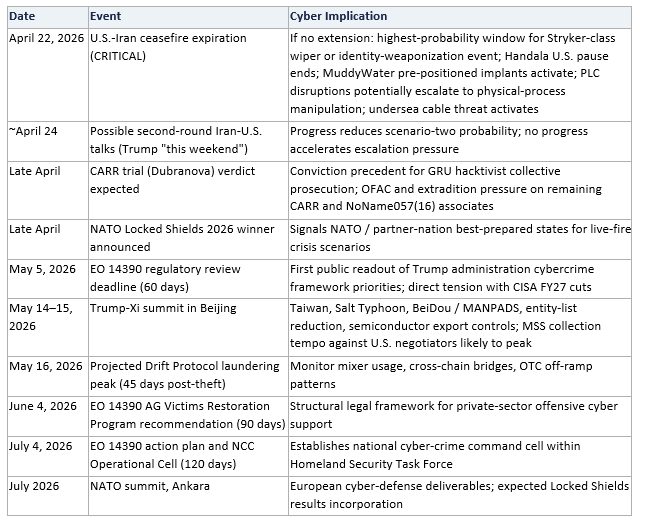
3.4 CISA Structural Degradation
U.S. cyber-defense capacity at the federal civilian level is degrading at the moment convergence among adversaries is reaching a new evidentiary tier. The trajectory has six elements.
First, workforce reduction. Nearly 1,000 staff — approximately one third of the workforce — departed by early 2026 due to DOGE-related budget and policy changes. Effective staffing has dropped from approximately 3,700 to 2,700, a 27 percent reduction over roughly twelve months. Second, senior-leader attrition in 2026 alone. Bob Costello (CIO), David Stern (Pre-Ransomware Notification Initiative lead), and Shelly Hartsook (Acting Cybersecurity Associate Director) have departed in 2026 to date. Third, the director vacuum. The director position has been vacant since Jen Easterly departed; Sean Plankey was nominated by Trump in March 2025 but remains unconfirmed due to a conflict-of-interest investigation; Madhu Gottumukkala (Acting Director through early 2026) departed amid a polygraph scandal; Nick Andersen is currently the acting director, in place since late February 2026.
Fourth, the FY2027 budget proposal released April 3–7 codifies a $707 million program reduction (roughly 30 percent of the FY2025 budget of $2.9 billion, dropping to approximately $2.4 billion), translating to a net roughly $360 million reduction after internal transfers, with 867 positions eliminated. Programs cut entirely include Election Security (with EI-ISAC defunding), Chemical Security (200-plus positions), Stakeholder Engagement Division, International Coordination, and Regional Operations ($42 million). Fifth, the structural-incompatibility point: Executive Order 14390, signed March 6, 2026, explicitly directs CISA through the Secretary of Homeland Security to “partner with the NCC Operational Cell to support state, local, tribal and territorial partners with training, technical assistance, and resilience building” — a mandate structurally incompatible with the simultaneous FY27 proposal to eliminate CISA’s Regional Operations and Stakeholder Engagement Division, the very operational arms that would execute EO-mandated state and local support. Rep. Bennie Thompson (ranking member, House Homeland Security) stated: “There is nothing that justifies a reckless $700 million cut to CISA, particularly at a time of heightened tensions with Iran and an increasingly aggressive China.” Matthew Hartman (Merlin Group): “Strategic mistake at exactly the wrong moment. CISA is the connective tissue for federal civilian cyber defense.” Seemant Sehgal (BreachLock): “Cutting its budget by $707M, on top of what’s already been cut, is a gift to every nation-state actor that’s been quietly targeting U.S. critical infrastructure.”
Sixth, the operational-timing impact. The cuts most affecting international coordination and stakeholder engagement come precisely as the Iran conflict, the Locked Shields exercise, and EO 14390 implementation all demand increased interagency and international cyber coordination. The May 5, 2026 EO 14390 first-milestone deadline is 18 days from the runtime and falls on a date when CISA’s effective staffing, leadership continuity, and program coverage are all at post-2018-creation lows.
3.5 Strategic Outlook (30–90 Days)
The strategic outlook across the 30- to 90-day horizon is dominated by three potentially compounding escalation tracks. The Iran track runs through the April 22 ceasefire expiration, the plausible extension or collapse, the internet-restoration trigger for APT tempo restoration, and the Stryker-class wiper probability window. The China track runs through the May 14–15 Trump-Xi summit with intensifying pre-summit collection, continued Salt Typhoon persistence, sustained Volt Typhoon infrastructure pre-positioning, the dual-track weapons pipeline to Iran, and the entity-list reduction negotiation. The North Korean track runs through the May 16 Drift Protocol laundering peak, anticipated downstream Axios exploitation, and projected continuation of IT-worker sentencing and bounty actions. The Russia track runs through the expected CARR trial verdict, continued NATO-scale intelligence collection, additional European attribution announcements from the Northern European bloc (Finland, Denmark, Baltics), Sandworm destructive-operation readiness, and cross-front hacktivist amplification around Iranian kinetic events.
The cross-track correlation risk is significant. A Stryker-class Iranian wiper against a U.S. financial institution between April 17 and April 22 would almost certainly amplify pro-Russian hacktivist activity through the Electronic Operations Room framework and through the documented Russia-Iran coordination on Telegram. A Chinese sanctions action on MANPADS / HQ-9B shipments would complicate summit preparations and could accelerate Salt Typhoon counter-leverage collection. A DPRK Sapphire Sleet or Contagious Interview campaign against U.S. finance companies during the same window would compound the Iranian financial-sector risk. The 30-day outlook therefore cannot be analyzed by nation in isolation — the structural convergence documented above means that escalation in one theatre will propagate.
The defender posture implications are direct. Organizations should: (1) assume integrated multi-actor pressure during any kinetic escalation window; (2) prioritize OT and PLC hardening given the confirmed Iranian campaign and the Volt Typhoon and Sandworm destructive-readiness dimensions; (3) maintain elevated monitoring of identity and access-management systems through April 22 consistent with Nozomi’s identity-weaponization assessment; (4) audit supply-chain dependencies on NPM, Go, Rust, Packagist, and Python packages given the 1,700-plus malicious DPRK packages and Axios downstream-exploitation horizon; (5) prepare for 72-hour critical-infrastructure-outage scenarios consistent with the AA26-097A impact documentation; and (6) accelerate EO 14390 compliance preparation independent of CISA’s capacity constraints, as the May 5 milestone will not extend.
Part 4 — Recommended Actions
Recommended actions are prioritized across three time horizons: immediate (24–72 hours, focused on the April 22 ceasefire expiration), near-term (1–4 weeks, focused on cross-track consolidation), and ongoing or strategic (90-plus days, focused on structural resilience).
4.1 Immediate (24–72 Hours) — Ceasefire Expiration Preparation
• Execute CISA AA26-097A IOC queries against all OT and ICS environments covering the full January 2025-through-present period. Prioritize Rockwell Allen-Bradley CompactLogix and Micro850 PLCs; set physical mode switches to run position; disconnect PLCs from public internet; enforce MFA on all remote access; implement network proxy or firewall in front of PLCs; disable unused authentication features. Alert on MQTT-over-TLS port 8883 and DNS-over-HTTPS traffic originating from OT network segments, and add Siemens S7 port scanning detection given documented campaign expansion.
• Threat hunt for Sapphire Sleet icloudz backdoor and Zoom SDK Update.scpt indicators across macOS fleets; ensure Apple XProtect updates are current; implement policy blocking downloaded .scpt files from email, chat, or web sources; monitor Telegram Bot API outbound traffic from finance-professional endpoints.
• Threat hunt for MuddyWater Dindoor (Deno runtime JavaScript/TypeScript) and Fakeset (Python, Backblaze-hosted) implants on networks of financial institutions, airports, defense supply-chain firms, and non-profits. Use the “Amy Cherne” and “Donald Gay” certificate identifiers as hunting pivots.
• Audit Microsoft Intune permissions and MDM remote-wipe access controls; review Intune device-management audit logs for unauthorized wipe commands or anomalous remote-wipe policy changes; review supply-chain access for IT and service-provider footholds.
• Configure alerts on NetBlocks and Cloudflare Radar for Iran connectivity rising above 5 percent of pre-war levels. Any restoration event should trigger immediate threat-hunt campaigns for MuddyWater, APT33, APT34, and APT35 indicators.
• Model and rehearse 72-hour power, water, and energy-grid outage scenarios for critical dependencies. Identify alternate vendor relationships and communication protocols that do not depend on internet connectivity in affected geographies.
4.2 Near-Term (1–4 Weeks)
• Patch all CISA KEV April 14 batch entries — CVE-2023-21529 (Exchange, Storm-1175 tie-in) has highest urgency given the 24-hour access-to-encryption timeline. Federal deadlines range from April 16 through April 27; private-sector organizations should meet or accelerate federal deadlines.
• Threat hunt for BPFdoor variant F in telecom and edge-device environments. Focus on SCTP traffic anomalies and HTTPS traffic with packet patterns consistent with trigger embedding. Extend hunt to UAT-7290 implant indicators (SilentRaid, DriveSwitch, RushDrop, Bulbature) to break Operational Relay Box infrastructure sharing.
• Audit supply-chain dependencies across npm, Go, Rust, PHP / Packagist, and Python. Block or quarantine the 164 UNC1069-linked domains documented by SEAL; review maintainer accounts for anomalies consistent with the Axios compromise pattern; apply JFrog-equivalent package-signing verification where possible.
• Review chain-of-custody and evidence-authentication procedures for any litigation relying on DCS-3000 or DCSNet-collected data. Engage outside counsel to assess Federal Rule of Evidence 901(a) exposure.
• Implement ITAR-export-control review of all remote-worker pipelines. Prioritize camera-off interviews, shell-company payment trails, and KVM-switch indicators consistent with the Hopana Tech, Tony WKJ, and Independent Lab shell-company pattern.
• Accelerate EO 14390 compliance preparation independent of CISA capacity constraints. Map current cybercrime-reporting, victim-restoration, and private-sector-partnership capabilities against the May 5, June 4, and July 4 milestones. Document gaps for interagency coordination.
• Initiate Russia-Iran-China convergence monitoring for organizations operating in sectors explicitly targeted in the reporting period (energy, water, financial services, defense, and healthcare). Consolidate threat intelligence subscriptions to ensure multi-vendor coverage of the four-actor stack.
4.3 Ongoing / Strategic
• Establish board-level and C-suite briefing cadence on nation-state cyber convergence, explicitly framing Russia, China, Iran, and DPRK as a structurally linked adversary bloc rather than four independent threats. Use the ODNI Annual Threat Assessment 2026 and the Atlantic Council Axis of Evasion framework as reference materials.
• Build resilience investment plans that do not assume CISA federal-civilian support capacity will remain at current levels. Model the FY2027 cuts as the baseline rather than the worst case and build independent capability where organization mission depends on federal coordination.
• Develop and exercise destructive-attack response playbooks explicitly modeled on the Stryker Corporation March 11 incident (Microsoft Intune remote-wipe abuse, SEC 8-K filing timeline, 50 TB data-loss scenario, cross-border workforce impact). Include board-level communication flows and legal and regulatory notification procedures.
• Maintain sustained engagement with sector-specific ISACs, Cyber Threat Intelligence providers, and peer organizations to sustain early-warning capacity through the ceasefire window and beyond. ISAC participation is particularly critical for the water/wastewater, electricity, healthcare, and financial-services sectors given confirmed targeting in the reporting period.
• Invest in OT and ICS observability consistent with the CISA AA26-097A advisory recommendations and the Dragos and Nozomi baselines. The Siemens S7 expansion signal means baseline PLC coverage needs to extend beyond Rockwell into the broader industrial-automation stack.
• Establish supply-chain software-bill-of-materials (SBOM) practices with specific focus on open-source package consumption. The Contagious Interview five-ecosystem expansion demonstrates that no single ecosystem is safe without SBOM and dependency-monitoring coverage.
• Track the CARR trial verdict, the May 14–15 Trump-Xi summit outcomes, EO 14390 milestone readouts, and the NATO Ankara summit in July as strategic signposts with direct near-term cyber implications.
Part 5 — Appendix
5.1 Methodology
This briefing is compiled from open-source intelligence across 25 research inputs — five baseline reports covering the February 3 through March 20, 2026 window and twenty delta updates covering the four weekly increments ending March 27, April 3, April 10, and April 17, 2026. Each research input addresses one of five analytical domains: Russia, China, North Korea, Iran, and cross-nation convergence. Research inputs were synthesized iteratively across the reporting period with each delta incrementing rather than replacing baseline material.
Source selection followed a tiered approach. Tier-one sources are primary-agency advisories and legal instruments: CISA Known Exploited Vulnerabilities catalog additions and joint advisories, FBI Internet Crime Complaint Center Public-Sector Advisories, DOJ press releases and indictments, EPA and DOE public statements, Treasury OFAC designations and press releases, State Department Rewards for Justice announcements, ODNI Annual Threat Assessment products, White House Executive Orders and fact sheets, congressional testimony, and CERT-UA advisories. Tier-two sources are vendor threat-intelligence research: Microsoft Threat Intelligence, Mandiant / Google Threat Intelligence Group, Trend Micro, Check Point, Rapid7, Trellix, Unit 42 / Palo Alto Networks, Tenable, Recorded Future, Chainalysis, TRM Labs, Elliptic, Proofpoint, ESET, Kaspersky, Dragos, Nozomi Networks, Genians, Zscaler, SentinelOne, Symantec / Carbon Black, Huntress, Fortinet FortiGuard Labs, Bitdefender, Socket, Security Alliance (SEAL), and Ctrl-Alt-Intel. Tier-three sources are authoritative journalism: Reuters, Bloomberg, CNN, CNBC, CBS, ABC, The New York Times, Al Jazeera, Kyiv Independent, United24 Media, TechCrunch, The Register, The Hacker News, Cybersecurity Dive, The Record, BleepingComputer, CyberScoop, SC World, Krebs on Security. Tier-four sources are policy and think-tank analysis: Atlantic Council, Brookings Institution, Carnegie Endowment, CSIS, Chatham House, Defense News, FDD, Flashpoint, ISW and Critical Threats Project, IISS, JNS, PISM, RSIS, Shieldworkz, Steptoe, and ComplexDiscovery.
Confidence levels follow the U.S. intelligence-community standard. HIGH confidence reflects multi-source corroboration including at least one tier-one or tier-two disclosure. MODERATE confidence reflects tier-two or tier-three sourcing without primary-agency formal statement. LOW confidence reflects single-source or uncorroborated claims. Unverified or contested claims are flagged explicitly in the text, including the Global Defense Corp BeiDou-3 and Huawei backdoor allegation, the APT Iran 375 TB Lockheed Martin claim, and the contested Fancy Bear attribution for the 284-account email compromise. All analytical conclusions are derived exclusively from open-source material; no classified information was used in the preparation of this briefing.
5.2 Consolidated Indicators of Compromise
The following consolidated indicators are organized by nation and reflect the highest-priority indicators derived from the reporting period. This list complements but does not replace the IOC sections in Part 2 and is intended to support single-reference integration into defender tooling. Sources for each indicator appear in the Source Log (Section 5.3).
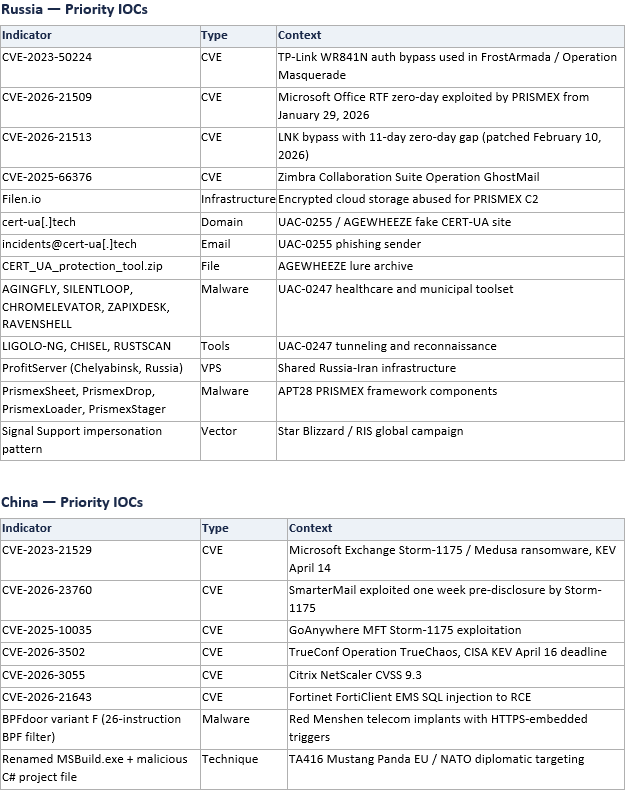
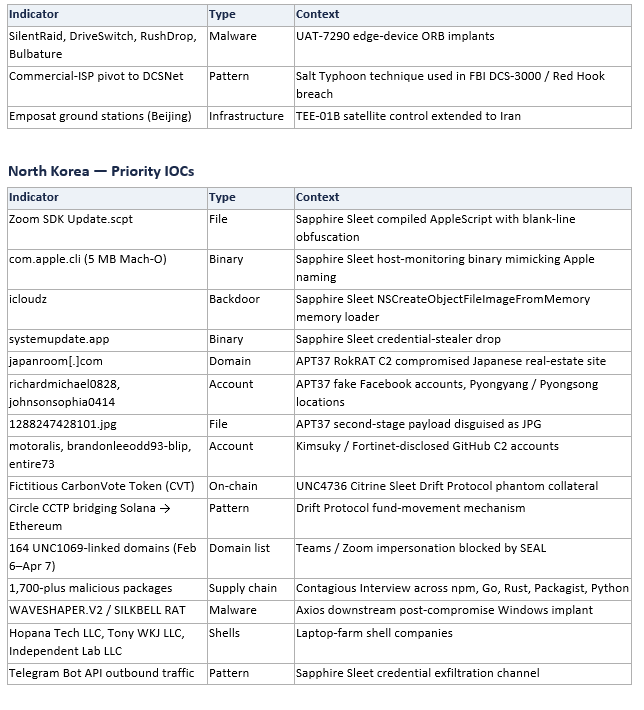
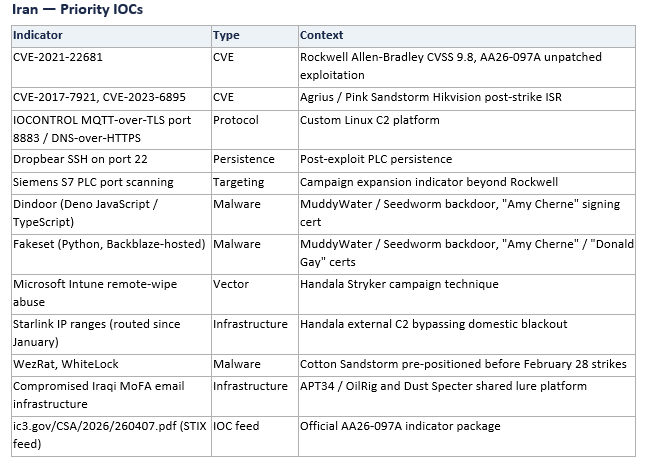
5.5 Distribution and Handling
This briefing is classified UNCLASSIFIED // OSINT and is prepared for strategic decision-makers and cybersecurity leadership. All content is derived from open-source intelligence. Sharing within your organization is permitted consistent with your internal information-handling policies.