
Executive Summary
BOTTOM LINE UP FRONT
On the night of 11–12 October 2026, an unidentified actor remotely forced Danfoss refrigeration system managers in hundreds of French supermarkets into a continuous defrost state, driving display cases and freezers to roughly 50 °C for about six hours. Fresh and frozen stock was destroyed, several stores caught fire, and losses are measured in the tens of millions of euros. A Sekoia analyst reports the same activity reached Spain, Portugal, Poland, Germany and Belgium; that spread is not yet confirmed by any government.
The attack required no malware and, as far as public evidence shows, no zero-day. It turned a routine maintenance function into a heating weapon on internet-exposed controllers that were either end-of-life (AK-SM800, AK-SC355) or running AK-SM 800A firmware more than a year behind its security fix. A detailed exploitation recipe and an exposure census were published 63 days before the attack.
No actor has claimed it and no government has attributed it. The destruction-only effect, one-night multi-country synchronisation and total silence fit a state-aligned sabotage operation better than a criminal one. Our leading hypothesis is the GRU-linked pro-Russia hacktivist OT ecosystem (CARR / Z-Pentest / Sector16), assessed at low-to-moderate confidence. Defenders should act on capability and exposure now, not wait for attribution.
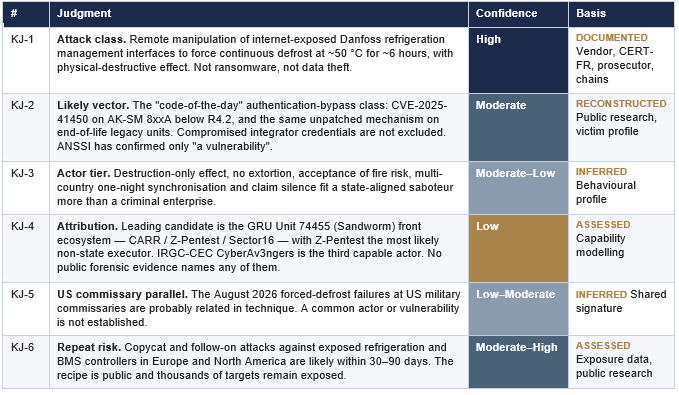
Key Judgments
Confidence levels follow ICD 203 conventions (see Appendix A). Evidence labels distinguish what is documented from what is reconstructed or inferred.
1. Scope, Cutoff and Methodology
▪ Scope. The 11–12 October 2026 attack on French supermarket refrigeration, its technical reconstruction, and candidate actor assessment. The August 2026 US military commissary incident is included as context because it shares the forced-defrost signature and the published-research timeline.
▪ Cutoff. 12 October 2026, 19:41 UTC. The investigation is hours old and ANSSI/OFAC forensics are not public. This is a day-one baseline, not a final reconstruction.
▪ Methodology. Source-chain tracing from press to wire services, vendor research and government advisories; capability-based actor modelling against CISA advisories AA25-343A and AA26-097A; and a claim sweep of public monitoring channels only (claim trackers, press, government sources). No direct underground forum access was performed.
▪ Known bias. French broadcaster BFMTV originated the disclosure, and its store figures run higher than chain statements. Discrepancies are preserved, not averaged.
2. Incident Overview
2.1 What happened
Overnight on Sunday 11 to Monday 12 October 2026, refrigeration systems in French supermarkets were remotely forced into a continuous defrost cycle. Defrost is a legitimate protection function that normally runs for about two hours a day, using heaters or reversed refrigerant flow to clear ice from evaporator coils. Held on with heaters active and setpoints driven to about 50 °C, it turns display cases and cold rooms into warming ovens.
Refrigeration contractors received remote temperature alarms during the night. By Monday morning, Danfoss displays in some stores still showed temperatures above 26 °C. Stores discarded all affected fresh and frozen product, and the Paris prosecutor confirmed several fires. Les Mousquetaires (owner of Intermarché) said affected fridges were heated to 50 °C for six hours.
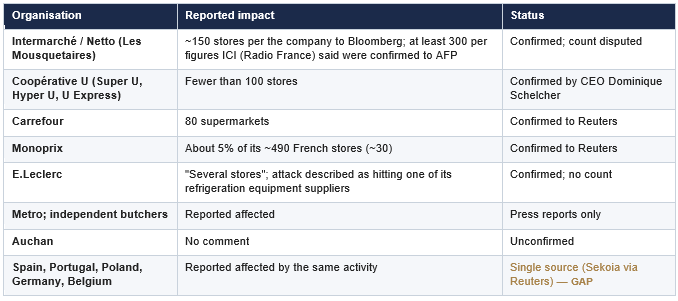
2.2 Affected organisations
2.3 Reconciling the scale
Estimates range from about 150 to 500 stores. BleepingComputer reported 250–350; BFMTV about 400 across Intermarché, Netto and Coopérative U; Cooling Post suggested around 500. Combining the chain-level figures confirmed to wire services gives a defensible floor of roughly 300 or more French stores, with ~500 a plausible upper bound pending official tallies.
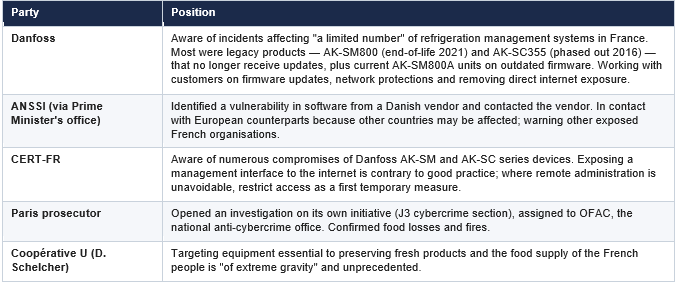
2.4 Official and stakeholder statements

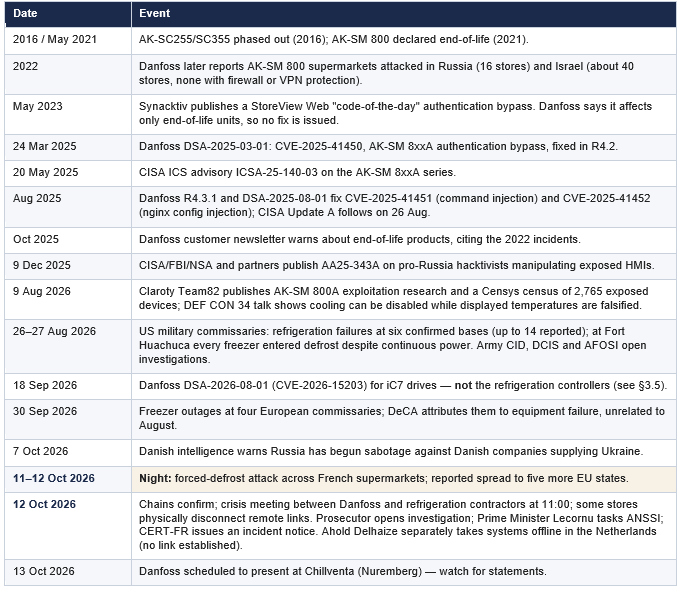
2.5 Timeline
3. Technical Analysis
3.1 The target platform
A supermarket runs all of its display cases, compressor packs and cold rooms from one supervisory controller. In the affected stores this was the Danfoss ADAP-KOOL AK-SM 800A system manager, or its predecessors the AK-SM 800 and AK-SC 355. The controller schedules temperatures and defrost cycles for every case in the store and exposes a browser-based management console titled StoreView.
The console exists so refrigeration contractors can monitor and adjust hundreds of sites from one desk. That convenience is the exposure: whoever holds administrator access to this interface effectively controls every thermostat in the store. Versions before 4.x, which Danfoss calls legacy, no longer receive software or security updates.
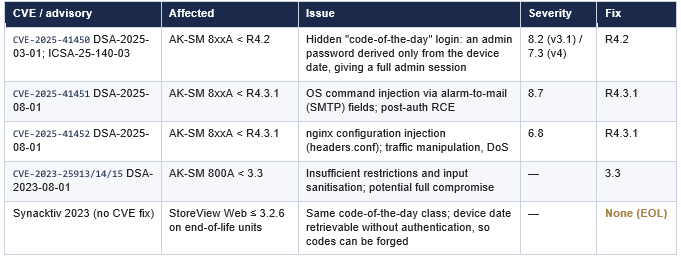
3.2 Known vulnerabilities
WHY THIS MATTERS
Danfoss says most victims ran end-of-life AK-SM800 and AK-SC355 units that will never be patched, and a no-credential authentication bypass for that hardware family has been public since 2023. Together with CVE-2025-41450 on unpatched AK-SM 800A units, this makes an internet-scale takeover entirely plausible without any zero-day.
Analyst note: a stolen integrator password would work on any firmware version. The reported pre-v4 victim profile therefore points toward scan-driven exploitation rather than credential theft INFERRED. No official source has confirmed the specific flaw used.
3.3 Internet exposure

France’s outsized share of global exposure matches where the victims are. That supports opportunistic targeting at scale driven by exposure, not bespoke intrusion.
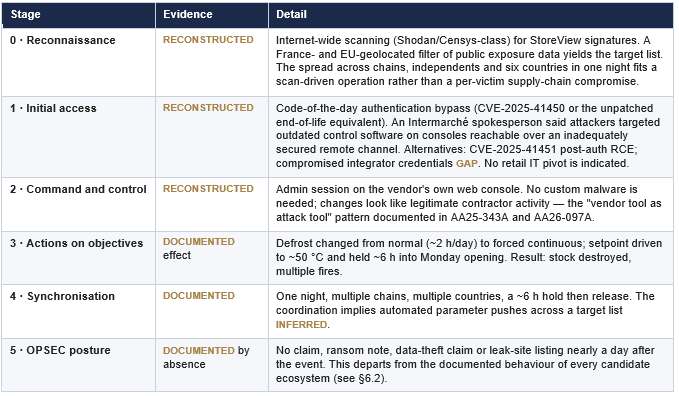
3.4 Attack chain reconstruction
Stages 0–2 are reconstructed with no public forensic confirmation. Stages 3–4 are documented by victim and vendor statements. Stage 5 is documented by the negative result of the claim sweep.
CAPABILITY DEMONSTRATED, NOT OBSERVED
Team82 showed at DEF CON 34 that a compromised AK-SM 800A can shut off cooling while falsifying displayed temperatures. The French attack was loud — staff met a wave of heat — so there is no evidence this was used. A quieter future attack could spoil product silently, including pharmaceuticals, and put unsafe food on sale.
3.5 Correcting a circulating error
Several outlets, citing AFP, linked the attack to a Danfoss flaw disclosed on 18 September 2026 that allows read/write access to internal values and execution of unsigned programs. That advisory is DSA-2026-08-01 / CVE-2026-15203 (CVSS 9.3). It concerns debug interfaces in Danfoss iC7 Automation, iC7-Marine and iC7-Hybrid drive software, not the AK-SM/AK-SC refrigeration managers. We assess with high confidence that it is not the vector. Patching iC7 drives does nothing for refrigeration exposure.
4. Why It Worked: Root Causes
1. Firmware a year past its fix, and hardware past its life. R4.3.1 shipped in August 2025; affected units ran pre-4 legacy firmware in October 2026. Danfoss says it had long advised supermarkets to move off the affected models.
2. Remote management by design. Management consoles were reachable from the public internet so contractors could work remotely — a convenience-versus-exposure trade-off made across the whole sector.
3. A published exploit recipe. Team82 documented the hidden authentication path and the exposure census 63 days before the attack, and extended the story to falsified temperature readings at DEF CON 34. Any competent actor had the how-to.
4. A monoculture single point of failure. One vendor platform, shared contractors and centralised remote supervision linked competing retail chains into one attack surface.
5. A governance gap. NIS2 Annex II covers food businesses engaged in wholesale distribution and industrial production, not retail, so the stores holding these controllers had no binding security duty over them. The EU Cyber Resilience Act’s 24-hour reporting duty for actively exploited vulnerabilities, in force since 11 September 2026, now applies to Danfoss as the vendor.
6. An insurance void. Intermarché has warned its policies may not cover this class of damage, so losses land on the chains and liability will be contested.
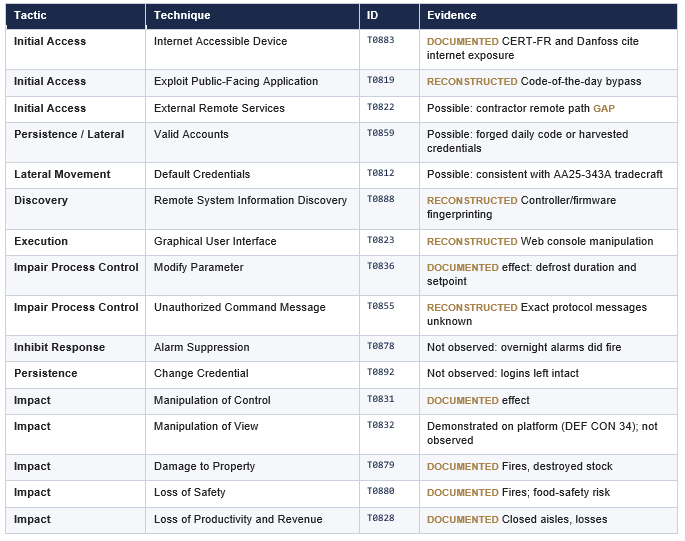
5. MITRE ATT&CK for ICS Mapping
The mapping below is analyst work for this incident, not an official CISA mapping
6. Attribution Assessment
6.1 Status
Unattributed. As of cutoff, no group has credibly claimed responsibility, no government has attributed the attack, and no indicators of compromise have been published. We found no claim from Z-Pentest, CARR, NoName057(16), Sector16, TwoNet or affiliated Telegram channels. Any later claim should be treated with scepticism until corroborated with screenshots of actual Danfoss interfaces matched to store-level evidence; CISA notes these groups regularly make false or exaggerated claims.
Our ranking is capability-based: which actors have publicly demonstrated every component of this attack — scanning for exposed controllers, weak-authentication bypass, setpoint manipulation, physical-destructive effect and multi-site synchronisation? Three ecosystems qualify. Everything below is assessment, not established fact.
6.2 The key discriminator: silence
OPEN QUESTION
Every documented pro-Russia hacktivist OT operation (CARR, Z-Pentest, Sector16) is claimed on Telegram, usually with video. Iran’s CyberAv3ngers also claim loudly. The total silence after this attack departs from both ecosystems’ documented behaviour. It is consistent with a state-tier operation, a front group acting under direction, an actor that wants no attention, or a claim being staged for later. A delayed claim would re-weight everything in this section.
6.3 Candidate #1 — GRU Unit 74455 (Sandworm) front ecosystem
CARR / Z-Pentest / Sector16. Assessed leading candidate, low-to-moderate confidence. AA25-343A states that actors suspected to be from GRU Unit 74455 likely funded the tools CARR used through at least September 2024, and Mandiant assesses Sandworm sits behind the CARR, XakNet and Solntsepyok personas.
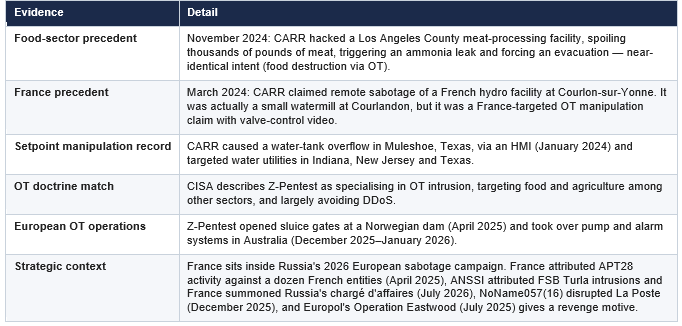
Tension. Every known front-tier food or water OT attack was claimed with video, and CISA grades this tier as less sophisticated than APT groups. One-night multi-country automation slightly exceeds their demonstrated level unless they had state support.
6.4 Candidate #2 — Z-Pentest Alliance acting independently
Assessed most likely non-state executor, possibly under direction. Formed in September 2024 by former CARR and NoName057(16) members, Z-Pentest is the ecosystem’s dedicated OT arm. It has demonstrated multi-site, multi-country setpoint manipulation with physical effect, targets food and agriculture, and avoids DDoS. A maximal-visual signature (50 °C aisles at Monday opening) with no financial demand fits an attention motive.
Tension. For this group, the claim is the product; silence is off-pattern. The simplest resolution is Z-Pentest as executor under direction from Candidate #1’s state tier INFERRED.
6.5 Candidate #3 — CyberAv3ngers / IRGC-CEC
Low confidence for France; leading hypothesis for the August 2026 US commissary case. This is the only other actor set with a proven, current, publicly documented campaign of exposed-controller setpoint manipulation: the Aliquippa, Pennsylvania, Unitronics compromise (November 2023, default credentials, 75+ devices) and the 2026 campaign against US water systems documented in AA26-097A, updated in July with safety-system subversion. The attack class is identical.
Tension. Operational geography: their OT campaign is US- and Israel-centric and France is not in their adversary set. They also claim loudly, so silence contradicts their pattern. The US commissary case — US military food supply, 18 days after the public recipe, during an active US–Iran conflict — is a much better fit.
6.6 Access-vector hypothesis: a shared provider
Separately from actor identity, a compromise of a shared refrigeration maintenance or monitoring provider remains plausible as a contributing vector. Mousquetaires said its systems were under Danfoss management, competing chains share contractors and the same platform, and one employee said every store supervised through the Danfoss platform was affected. Against this, Danfoss and CERT-FR frame the incident as exposed legacy devices. Whether the entry was scan-driven or credential-driven is the single discriminator that separates opportunistic from targeted.
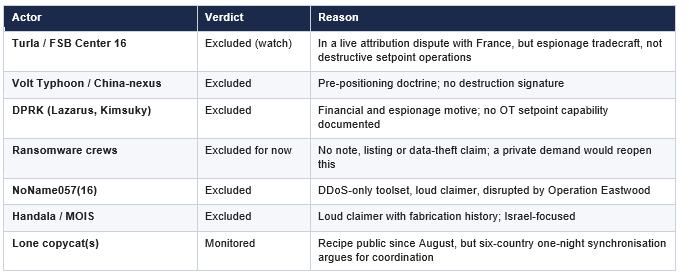
6.7 Excluded and monitored actors
6.8 Alternative explanations kept live
▪ Criminal demonstration before private extortion. Weakly consistent with the absent ransom note; a single private demand would make this the leading hypothesis.
▪ Misconfiguration or bad update. Effectively disconfirmed for France, where the chains and prosecutor describe a cyberattack with documented remote manipulation, but still open for the US commissary case.
▪ A state actor outside the top three, or an unknown crew using the public recipe.
Strategic Outlook
▪ Follow-on activity (moderate–high). The technique is proven, public and cheap, and thousands of targets remain exposed. Expect opportunistic copycats against Danfoss, Copeland and other refrigeration/BMS platforms in Europe and North America, especially in the run-up to Christmas, along with false or inflated hacktivist claims riding the publicity.
▪ Target expansion (moderate). Cold-storage warehouses, food distribution centres, pharmacies and pharmaceutical cold chains run similar controllers. With falsified telemetry, a stealthier attack could cause public-health harm rather than visible waste.
▪ Policy response (high). Expect ANSSI/CERT-FR guidance, EU-level coordination, debate over bringing food retail into NIS2 scope, and pressure on vendors over end-of-life support and secure-by-default remote access.
▪ Geopolitics. If attribution to a Russia-aligned actor emerges, this marks a step change in the hybrid campaign against France and its allies: from DDoS and espionage to deliberate food-supply sabotage.
Key Assumptions and Analytic Limitations
Key assumptions
▪ Danfoss’s characterisation of the affected fleet (mostly end-of-life units plus outdated AK-SM 800A firmware) is accurate.
▪ The attack was a single coordinated operation rather than several actors converging on the same night.
▪ Public exposure data reasonably reflects the population the actor scanned.
Analytic limitations
▪ This assessment draws on public reporting within roughly 24 hours of the incident. Store counts, loss estimates and the multi-country spread come from companies, media and one vendor analyst and will change.
▪ Single-source and aggregator claims are flagged throughout and should not be treated as established.
▪ Attribution judgments are deliberately low-confidence and capability-based. No forensic evidence links any named actor to this incident.
Overall assessment confidence
Moderate. High for event facts and attack class; moderate for the access vector; low for attribution.